Psalm 69:1-5, 30-36 – The Praise of Suffering

Psalm 69 by Japanese painter Makoto Fujimura

Save me, God,
    because the waters have reached my neck!
I have sunk into deep mud.
    My feet cannot touch the bottom!
I have entered deep water;
    the flood has swept me up.
I am tired of crying.
    My throat is hoarse.
    My eyes are exhausted with waiting for my God.

More numerous than the hairs on my head
    are those who hate me for no reason.
My treacherous enemies,
    those who would destroy me, are countless.
    Must I now give back
    what I did not steal in the first place?
God, you know my foolishness;
    my wrongdoings are not hidden from you….

I will praise God’s name with song;
    I will magnify him with thanks
    because that is more pleasing to the Lord than an ox,
    more pleasing than a young bull with full horns and hooves.
Let the afflicted see it and be glad!
    You who seek God—
    let your hearts beat strong again
    because the Lord listens to the needy
        and does not despise his captives.

Let heaven and earth praise God,
    the oceans too, and all that moves within them!
God will most certainly save Zion
    and will rebuild Judah’s cities
    so that God’s servants can live there and possess it.
The offspring of God’s servants will inherit Zion,
    and those who love God’s name will dwell there. (CEB)

As the Church’s and the Christian’s prayer book, the psalms offer a way to come to God when our feelings and emotions have us not knowing how to pray, at all.  If you are depressed because of people who would like to see you fail or are out to get you, then this is the psalm for you to pray!

When you are voiceless, the psalter can voice it for you. When you are unable to put your thoughts into words, the Scripture can word it for you. Two of the great attributes of God are divine power and love, which means that the Lord is more than able to do something about your situation, and it will always be done in a loving way.  Know today that God hears you and is working on a response to your lament – even if it is not in your own words but the words of Holy Scripture.
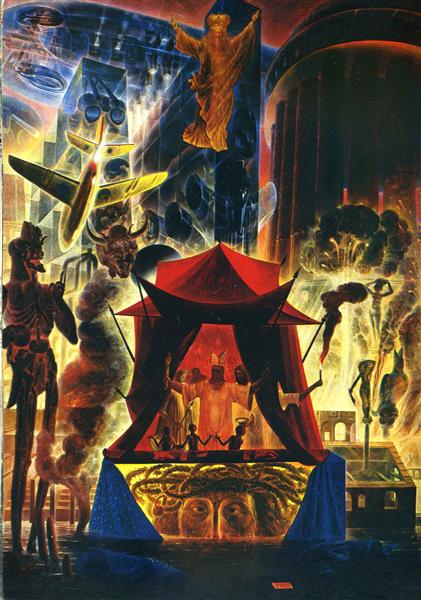
Psalm 69 by Austrian artist Ernst Fuchs, 1960

God will come through in God’s own good time. However, you can still praise the Lord right now, smack in the middle of your dilemma. David, the author of today’s psalm, chose to praise God, even though he did not get an immediate answer to his prayers. Perhaps God is more concerned to change us before changing our circumstances.

We need a solid theology of suffering. And that biblical psalms give it to us. I know of no one who wakes in the morning, sits on the edge of their bed, and says, “Gee, I want to suffer today and feel lots of emotional and spiritual pain.” No, we want happiness and joy, not agony and hardship. Yet suffering has much to teach us and the Lord is rarely quick to snatch us from its lessons. The hardship of personal suffering teaches us faith and dependence upon God, as well as leading us to ask for help from others so that we are lovingly supported.

“The way you look at things is the most powerful force in shaping your life.”

john o’donohue

Tribulations in life are common to all people without exception. The issue is whether we will submit to its hard-knock education, or not – whether we will become better people, or bitter. The Irish teacher and poet, John O’Donohue, penned a poem entitled, “For Suffering,” concerning the blessing of hard things:

May you be blessed in the holy names of those

Who, without knowing it,

Help to carry and lighten your pain.

May you know serenity

When you are called

To enter the house of suffering.

May a window of light always surprise you.

May you be granted the wisdom

To avoid false resistance;

When suffering knocks on the door of your life,

May you glimpse its eventual gifts.

May you be able to receive the fruits of suffering.

May memory bless and protect you

With the hard-earned light of past travail;

To remind you that you have survived before

And though the darkness is now deep,

You will soon see approaching light.

May the grace of time heal your wounds.

May you know that though the storm may rage,

Not a hair of your head will be harmed.

To Bless the Space Between Us: A Book of Blesings (Doubleday, 2008)

We have all likely at times felt the anguish of the psalmist – being so overwhelmed that it feels like we are drowning. The feeling is compounded exponentially when behind the sense of trying to keep our heads above water there are people who do not like us – maybe even hate us, to the point of undermining our work every chance they get.  It is in such circumstances we might experience sleepless nights hoping that somehow and someway God will show up.

The typical modus operandi for some within adverse situations is the age-old route of complaining and wishing things were different. Yet neither griping about our problems nor dishing out slander and gossip toward others is a healthy way of dealing with adversity. Just the opposite response is the proper path to the bone-crushing feeling of opposition: to praise God’s name with a song and magnify the Lord with thanksgiving. 

The reason the believer can engage in adoring God during trouble is not some Jedi-type mind trick to make us think more positively. Instead, the basis for praise is in knowing God. It is God who ultimately will deal with the wicked; it is the Lord who will bend to listen to our lament when times are hard. 

Thanking God for answers to prayer in advance of them being answered is a biblical thing to do. Having a faith robust enough to see ahead toward hope can bring love to a loveless situation, and usher in praise before the divine deed of deliverance is even accomplished.

Saving God, thank you for your deliverance!  I give you praise for loving me through sending your Son, the Lord Jesus, to this earthly realm so that I might experience salvation from sin, death, and hell. By Christ’s authority, in the power of the Holy Spirit given to me, I resist the enemy’s attempts to seize control of my life.  I belong to you, holy God. Amen.

Luke 5:1-11 – Generous

Miraculous Draught of Fishes by John Reilly

One day as Jesus was standing by the Lake of Gennesaret, the people were crowding around him and listening to the word of God. He saw at the water’s edge two boats, left there by the fishermen, who were washing their nets. He got into one of the boats, the one belonging to Simon, and asked him to put out a little from shore. Then he sat down and taught the people from the boat.

When he had finished speaking, he said to Simon, “Put out into deep water, and let down the nets for a catch.”

Simon answered, “Master, we’ve worked hard all night and haven’t caught anything. But because you say so, I will let down the nets.”

When they did, they caught so many fish that their nets began to break. So, they signaled their partners in the other boat to come and help them, and they came and filled both boats so full that they began to sink.

When Simon Peter saw this, he fell at Jesus’ knees and said, “Go away from me, Lord; I am a sinful man!” For he and all his companions were astonished at the catch of fish they had taken, and so were James and John, the sons of Zebedee, Simon’s partners.

Then Jesus said to Simon, “Don’t be afraid; from now on you will fish for people.” So, they pulled their boats up on shore, left everything, and followed him. (NIV)

One of the most fundamental characteristics of God is generosity. God’s benevolent nature defines the divine stance toward humanity. This may not seem overly remarkable with only cursory thoughts about God. Yet, when the infinite holiness of God intersects with the prideful arrogance of sinful people, gracious generosity is the unpredictable and amazing result.

Many people on planet earth have been raised with a god who is aloof and curmudgeonly. Such a god gets easily angry and zaps people with lightning or some natural disaster. It is no wonder so many persons have fled from belief in God. Can we, however, entertain the notion that the Creator God of the universe is quite the opposite? In Jesus, we have on display the basic disposition of the Divine.

The Miraculous Catch of Fish by Belgian artist Erik Tanghe

On one occasion, Peter (a guy who could raise the ire of most gods) was going about his business fishing in the Sea of Galilee. Having not yet encountered Jesus but stopping to listen to his words, Peter ended up having this stranger literally get in the boat with him, uninvited. There was something remarkably different and compelling about Jesus since Peter did not immediately toss him out. Such a calm, confident, and gracious nature – nothing like Peter had expected. So, here is this plan fisherman face-to-face with the Christ of God. 

Jesus told Peter to put the boat out and cast the nets. Peter, an experienced fisherman and knowledgeable about the water, knew for certain that he would not catch anything. But, out of deference to Jesus, he did so, anyway. The result was such a large catch of fish that the nets nearly broke from the weight.

Peter’s response is instructive. He fell at the feet of Jesus and said, “Depart from me, for I am a sinful man, O Lord.”  Peter came up against his own small faith. He rightly discerned that he did not deserve such generosity from Jesus, an overflowing abundance given to him despite his unbelief. In the face of such grace, in the vortex of an incredible mercy, having seen the generosity of God directed squarely at him, Peter left it all behind to follow Jesus.

So, here we have the nature and character of God before us. No cranky deity. No exasperated God ready to raise a storm and toss the boat over with Peter in it. No, Jesus, the Son of God, does not operate that way. There is no strong-arming people into faith. God’s tactics steer clear of manipulation through guilt, or mind-twisting others through shaming them. 

Instead, God is beautifully and simply present with people – showing grace and generosity in places where one would least expect to find it. When confronted with such love, what would you do?

Early in my life, I viewed God as some eternally bored deity who would occasionally get out his divine BB gun and shoot people in the rear, just for something to do. God, in my understanding, cared nothing for the real lived experiences of people on earth. But much like Peter of old, Jesus showed up unannounced in my life. And what I found was like Peter – a kind, benevolent Being who showered such generous love on me that my heart was immediately captured. I have never looked back since.

We intuitively know down in our gut, in our bones, when genuine Love is among us because it immediately connects with the deepest needs of our lives. No evangelist must convince us with offering free gold crosses or promised blessings. None of that matters when love incarnate is present, when the great God of all is among us. Peace, hope, and faith are the results of divine presence. They cannot be conjured or ginned up through excessive asceticism or extreme discipline. Love is a gift. Love is a person. And it is given generously and graciously from the One whose very nature is charitable and hospitable.

Gracious God, you sent your Son to me even though I was neither looking for him nor expecting anything from him. Thank you for breaking-in to my life so that I could break-out for you with glory, honor, and praise.  Amen

Praise the Lord!

Praise the Lord!

Praise the Lord from heaven!
    Praise God on the heights!
Praise God, all of you who are his messengers!
    Praise God, all of you who comprise his heavenly forces!
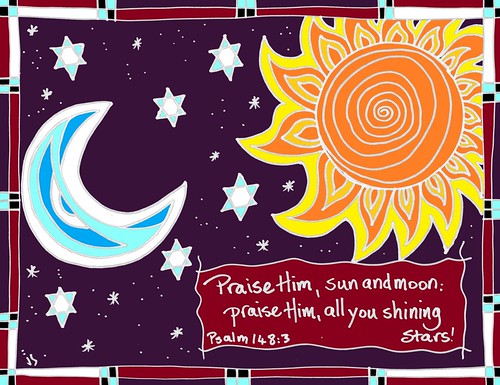
Sun and moon, praise God!
    All of you bright stars, praise God!
You highest heaven, praise God!
    Do the same, you waters that are above the sky!
Let all of these praise the Lord’s name
    because God gave the command and they were created!
God set them in place always and forever.
    God made a law that will not be broken.

Praise the Lord from the earth,
    you sea monsters and all you ocean depths!
Do the same, fire and hail, snow and smoke,
    stormy wind that does what God says!
Do the same, you mountains, every single hill,
    fruit trees, and every single cedar!
Do the same, you animals—wild or tame—
    you creatures that creep along and you birds that fly!
Do the same, you kings of the earth and every single person,
    you princes and every single ruler on earth!
Do the same, you young men—young women too!—
    you who are old together with you who are young!

Let all of these praise the Lord’s name
    because only God’s name is high over all.
    Only God’s majesty is over earth and heaven.
God raised the strength of his people,
    the praise of all his faithful ones—
        that’s the Israelites,
        the people who are close to him.

Praise the Lord! (Psalm 148, CEB)

This is the Christmas season.  We are in the third day of the twelve days of Christmas.  This time in the Church Calendar gives focus to declare along with the angels and all of God’s creation:  Glory to God in the highest; praise the Lord!  Everything in all creation points to a creator who cares for us. 

These days between December 25 and January 5 are to be a great celebration because King Jesus has come and is the rightful Sovereign over all creation.  We are to grasp the meaning of Christ’s incarnation; and affirm the identity of Jesus as both full human and fully divine.  Beginning with Christ’s birth, we enter a reflection on the meaning of Christ’s life and prepare for the journey toward the cross and the empty tomb.

Today, however, we simply praise the Lord along with all creation.  This is what the psalmist calls us all to do.  The entire universe is called to praise the Lord.  Everything outside our earth is to give God glory.  Everything in the universe points to a God who is worthy to be praised.

Let us assume the distance between the earth and the sun (ninety-two million miles) was reduced to the thickness of a sheet of paper. If that is the case, then the distance between the earth and the nearest star would be a stack of papers seventy feet high. And the diameter of the galaxy would be a stack of papers three-hundred-ten miles high. Our galaxy is just a speck of dust in the universe, yet Jesus holds the universe together by the word of his power.

We serve a big God who is worthy to be praised, not only out there in the universe but here on earth.  The psalmist calls on all the earth to echo the adoration of God.  That means everything and everyone on earth – fish, animals, birds, even trees as well as people. 

Research in the field of bioacoustics has revealed that every day we are surrounded by millions of ultrasonic songs. For example, the electron shell of the carbon atom produces the same harmonic scale as a Gregorian chant.  Whale songs can travel thousands of miles underwater.  Meadowlarks have a range of three hundred notes. Supersensitive sound instruments have discovered that even earthworms make faint staccato sounds!

Arnold Summerfield, a German physicist, and pianist observed that a single hydrogen atom, which emits one hundred frequencies, is more musical than a grand piano, which only emits eighty-eight frequencies.  Science writer Lewis Thomas summed it up it this way: “If we had better hearing, and could discern the singing of sea birds, the rhythmic drumming of schools of mollusks, or even the distant harmonics of flies hanging over meadows in the sun, the combined sound might lift us off our feet.”

Praise the Lord.  We have a vision in this psalm of all creation praising God as one great big choir. Praise is to occur with both words and actions.  With words, praise is an expression of gratitude to God for who she is and what he has done.  With actions, praise is a posture of submission and an acknowledgement of dependence.

Therefore, through testimony we declare what God has done in our lives and how he is worthy to be praised and obeyed.  With the emphasis on praise in a season dedicated to joy, we must also recognize that for many people Christmas is difficult.  Loneliness, thin finances, unemployment, illness, strained relationships, and bittersweet memories can all be a discouraging contrast to the celebration going on around them.

Praise, however, is not just for the joyful; it can happen no matter the circumstances because the Christian’s happiness is not dependent upon positive situations but rather upon the person and work of Jesus.  It may not be easy to find our voice of praise along with everyone else, but we are not alone.  We can choose to join with all creation to praise the name of the Lord. 

A dear parishioner of mine shared this a few years ago after experiencing multiple surgeries in the year:

“I am thankful for a chance to get out of the house. Of course, my walker was with me.  I am amazed how quickly folks move over, slow down, and give me space when I am out with that thing….  At church it feels like I am parting the Red Sea! The reason I hate the walker is because it says to the whole world, ‘Hey, I’m broken!’  I realize we all have areas that we are broken, most of them we can hide or cover up. Why are we so ashamed to confess the truth? Who really has it all together? I know we love our privacy and shun pity. However, I have been shown so much grace, kindness, and compassion as I push this piece of aluminum around that I hope this experience continues to change me for the better. I hope in the future I will be sensitive to those who are broken on the inside as well as the outside. May the love of Christ give me eyes to see people as he does, precious and accepted, just as they are.”

That, my friends, is the reasonable and logical end of praising the Lord – to connect what God has done and is doing with what he can do through us as we glorify his name. By simply being who we are created to be, we praise the Lord along with all creation.  When we as people in God’s image, reflect that image in how we talk and how we live, we participate with the universe in declaring God is good. 

Praise is to be the glue that binds us all together. Let us praise the name of the Lord. To be more specific, let the church praise the Lord!  Let leaders everywhere praise the Lord!  Let healthcare workers praise the Lord!  Let salespersons and factory workers praise the Lord!  Let police and lawyers praise the Lord! Let the trees, mountains, and all living things praise the Lord!  Let engineers and educators praise the Lord!  Let the little children praise the Lord!  Let clerks and cashiers, waiters and waitresses, janitors and housekeepers praise the Lord!  Let the lost and the lonely praise the Lord along with the happy and satisfied. Let everything that has breath praise the Lord!  Praise the Lord!

Whether you are bursting to proclaim it, or struggle to say it and live it, praise the Lord along with everything in the universe because we serve a God who keeps us close to heart.  Praise the Lord!

What do you have to praise the Lord for today?

How do you express your praise, both personally and publicly?

Where is your favorite place to praise the Lord?

When does praise to God come easily for you, and when it is difficult?

Who do you like praising the Lord with?

May your life become a paeon of praise to the God who is worthy to receive all glory, honor, and praise. Amen

John 1:1-14 – Christmas Day

The Word was first,
the Word present to God,
    God present to the Word.
The Word was God,
    in readiness for God from day one.

Everything was created through him;
    nothing—not one thing!—
    came into being without him.
What came into existence was Life,
    and the Life was Light to live by.
The Life-Light blazed out of the darkness;
    the darkness couldn’t put it out.

There once was a man, his name John, sent by God to point out the way to the Life-Light. He came to show everyone where to look, who to believe in. John was not himself the Light; he was there to show the way to the Light.

The Life-Light was the real thing:
    Every person entering Life
    he brings into Light.
He was in the world,
    the world was there through him,
    and yet the world didn’t even notice.
He came to his own people,
    but they didn’t want him.
But whoever did want him,
    who believed he was who he claimed
    and would do what he said,
He made to be their true selves,
    their child-of-God selves.
These are the God-begotten,
    not blood-begotten,
    not flesh-begotten,
    not sex-begotten.

The Word became flesh and blood,
    and moved into the neighborhood.
We saw the glory with our own eyes,
    the one-of-a-kind glory,
    like Father, like Son,
Generous inside and out,
    true from start to finish. (MSG)

Merry Christmas! Glory to God in the highest, and on earth peace, goodwill toward humanity! Today we celebrate the mystery of the incarnation – the unfathomable miracle of God becoming human – all for us and for our salvation.

The beginning of the Apostle John’s Gospel is an astounding passage of Scripture. These are verses to slowly and worshipfully read through because it is a theologically rich, lovingly beautiful, and missionally sensitive piece of Holy Scripture. 

The high and holy God has chosen to come and reveal true divinity to us in the person of Jesus. We know God through Christ. We learn what God is like through Jesus. God graciously condescended to us, bent down to communicate in ways we can understand and discern, through the Lord Jesus. 

The God which Christians worship and serve is an over-the-top gracious and generous God. This is a God who has gone to incredible lengths in restoring lost humanity. Since God has bridged the great chasm between heaven and earth, we have hope, joy, peace, and faith. With God in the neighborhood, divine love becomes our motivation to reach out in compassionate service. People matter to God. We matter so much that God cared enough to be born.

This Tiny Baby by Madeleine L’Engle

Whoever is the baby?

Nothing but a little lamb

who says God is and that I am.

Who is this tiny baby?

Just an infant, meek and mild,

just a feeble, mortal child.

Who is this tiny baby?

The Lord strong and mighty

even the Lord mighty in battle.

The king of glory is coming,

who is the Lord of Hosts.

This is the tiny baby!