Psalm 111 – Theology 101

Total Praise by Barbara Hayes

Praise the Lord!

I will thank the Lord with all my heart
    in the meeting of his good people.
The Lord does great things;
    those who enjoy them seek them.
What he does is glorious and splendid,
    and his goodness continues forever.
His miracles are unforgettable.
    The Lord is kind and merciful.
He gives food to those who fear him.
    He remembers his agreement forever.
He has shown his people his power
    when he gave them the lands of other nations.

Everything he does is good and fair;
    all his orders can be trusted.
They will continue forever.
    They were made true and right.
He sets his people free.
    He made his agreement everlasting.
    He is holy and wonderful.

Wisdom begins with respect for the Lord;
    those who obey his orders have good understanding.
    He should be praised forever. (NCV)

First and foremost, the psalms are about God. So then, the psalter is a rich description and repository of sound theology. As such, each psalm enlightens us about the Lord of the universe. Keep in mind that Christians are presently in the season of Epiphany. Although Lent is fast approaching with its own seasonal focus, we are still inhabiting the light shown for us – beginning with the star of Bethlehem and bringing all kinds of people to the Christ.

The Psalms are a wonderful source of light, leading us to discover, know, love, and serve the God who has shown grace to us by divine revelation. To read and pray the psalter is to have a crash course in Theology 101…

  • We pray because we believe we will be heard. 
  • We believe we will be heard because we believe there is a God who listens. 
  • We believe there is a God who listens because we believe the One who listens is always merciful, kind, and good. 

The basis of all prayer is our view of God.  Nobody sustains a prayer life to a fickle distant God who is only attentive whenever it strikes his fancy. But if God is really God – fair, just, committed, and full of good deeds – then, prayer is an effortless interaction, and we are eager to do it.

Notice the descriptions of God in today’s psalm. God’s attributes and character translate perfectly into just and loving action in the world:

God is full of glory, therefore everything the Lord does is splendid.

God is good all the time, therefore goodness never runs out of steam.

God does miracles so that we will not forget the accessibility of divine power.

God is kind and merciful as demonstrated by providing for human need and keeping divine promises.

God is honest and fair; therefore, humanity can trust in divine judgments.

God is free, and so, can set people free from their worst spiritual bondage and self-imposed prisons.

The way to access such incredible divine resources is through honoring and respecting the Lord. Because God is the very definition of merciful grace and steadfast love, human overtures of respect and obedience become willing and joyful. In other words, we obey God because we want to – not because we must.

Entrusting oneself to a benevolent God who makes and keeps promises to people is easy. No coercion or persuasion is necessary. All that need be done is to declare the good things God has done.

Loyal and gracious God, you always keep your promises, and there is never a time when you renege on them.  Thank you for promising deliverance from sin, death, and hell through your Son, our Savior, Jesus Christ who with you and the Holy Spirit benevolently reign forever and ever.  Amen.

Jeremiah 20:14-18 – Overwhelmed with Grief

By Unknown artist

Cursed be the day I was born!
    May the day my mother bore me not be blessed!
Cursed be the man who brought my father the news,
    who made him very glad, saying,
    “A child is born to you—a son!”
May that man be like the towns
    the Lord overthrew without pity.
May he hear wailing in the morning,
    a battle cry at noon.
For he did not kill me in the womb,
    with my mother as my grave,
    her womb enlarged forever.
Why did I ever come out of the womb
    to see trouble and sorrow
    and to end my days in shame? (NIV)

Perhaps you feel as though you must put on a good face, a decent front for others to see. You don’t like other people seeing you upset or cry because it can be embarrassing. Maybe you believe others don’t need to be burdened with your sadness. The last thing you want is to be a killjoy.

Sometimes you might even put up a front with God.  Maybe you think God wants everyone to be perpetually happy and always sing with the birds in blissful joy and gladness, or whistle while you work. However, that would not be an accurate view of God.

One of the most faithful people in Holy Scripture, Jeremiah, freely and unabashedly lamented before God – to the point of wishing he were dead. Jeremiah, the incredible prophet of God, closer to the Lord than anyone of his generation, was so despondent and ashamed that he wished he were never even born. The suffering and the shame were just too overwhelming.

To say that Jeremiah had a difficult ministry is a gross understatement. He literally had the ministry from hell, prophesying to people who neither liked him, nor his message to them. In the middle of it all, Jeremiah threw up his hands and let out his complaint to God. Jeremiah was in such ministerial misery that he wished he had been a stillborn baby.

Lest you think Jeremiah was sinfully depressed or just cuckoo, he is far from alone in the Bible. King David had no scruples about letting God know how he felt about his dire circumstances. Job, likely the most famous sufferer of all, spent time doing nothing but lamenting his terrible losses for months. What all three of them have in common is that they openly grieved with great tears, yet neither cursed God nor forsook the Lord.

Lamentation is the sacred space between intense grieving to God without blaming the Lord for our significant changes and losses in life. I would even argue that lamenting and grieving before God is a necessary spiritual practice which needs full recognition in the Body of Christ. Please sit with that last statement for a bit and consider how it might become a reality in your own life and context.

Grief can and does attach itself to any change or loss. It is the normal emotional, spiritual, physical, and relational reaction to that injury of the heart. There is only one way through grief. We must tell our story to another. It is both biblical and quite necessary.

Share each other’s burdens, and in this way obey the law of Christ.”

galatians 6:2, NLT

We need our spirituality to support us in such times – not drive us away through a misguided theology of believing you must keep a stiff upper lip. It is critical to have safe and supportive people in our lives when going through overwhelming circumstances.

“Spirituality is recognizing and celebrating that we are all inextricably connected to each other by a power greater than all of us, and that our connection to that power and to one another is grounded in love and compassion.”

Brené Brown

Our tears are holy. They are not the mark of weakness, but of power. The prophet Jeremiah was doing a very godly thing in expressing his grief. And Jeremiah’s lament is what helped steel him for the several attempts on his life that he faced.

Let the tears do their intended work in your life.

God of all, you feel deeply about a great many things.  As your people, we also feel a great depth of emotion when our lives go horribly awry from our dreams and expectations.  Hear our lament as we pour out our grief before you, through Jesus, our Savior, with the presence of the Holy Spirit.  Amen.

Psalm 86 – Theology Proper

Psalm 86 by Ann Williams

Incline your ear, O Lord, and answer me,
    for I am poor and needy.
Preserve my life, for I am devoted to you;
    save your servant who trusts in you.
You are my God; be gracious to me, O Lord,
    for to you do I cry all day long.
Gladden the soul of your servant,
    for to you, O Lord, I lift up my soul.
For you, O Lord, are good and forgiving,
    abounding in steadfast love to all who call on you.
Give ear, O Lord, to my prayer;
    listen to my cry of supplication.
In the day of my trouble I call on you,
    for you will answer me.

There is none like you among the gods, O Lord,
    nor are there any works like yours.
All the nations you have made shall come
    and bow down before you, O Lord,
    and shall glorify your name.
For you are great and do wondrous things;
    you alone are God.
Teach me your way, O Lord,
    that I may walk in your truth;
    give me an undivided heart to revere your name.
I give thanks to you, O Lord my God, with my whole heart,
    and I will glorify your name forever.
For great is your steadfast love toward me;
    you have delivered my soul from the depths of Sheol.

O God, the insolent rise up against me;
    a band of ruffians seeks my life,
    and they do not set you before them.
But you, O Lord, are a God merciful and gracious,
    slow to anger and abounding in steadfast love and faithfulness.
Turn to me and be gracious to me;
    give your strength to your servant;
    save the child of your serving girl.
Show me a sign of your favor,
    so that those who hate me may see it and be put to shame,
    because you, Lord, have helped me and comforted me. (NRSV)

Today’s psalm is a prayer of David, asking God for help against enemies. David was a guy who knew what it was like to have evil men hate him and pursue taking his life through no fault of his own. I am not sure about your experiences with such people. Although I have never faced adversity to such a degree as David, I do know something about people who, to put it bluntly, just flat-out hate my guts. It feels awful, and it can be terribly draining emotionally and spiritually. Having disrespectful and rude people talk behind your back (and sometimes even to your face) is in direct contrast to who God is.

God is described by David as merciful and gracious, slow to anger, abounding in steadfast love, and faithful. Whereas insolent people objectify others and seek their own selfish agendas, God always acts in accord with a basic character of love and grace. Based upon the nature of God, we can choose to cry out, just like David did, to show us a sign of God’s favor. We can pray for God to provide us with some tangible communication of divine love in ways we can understand so that we can be helped and receive the kind of comfort we need through our adversity.

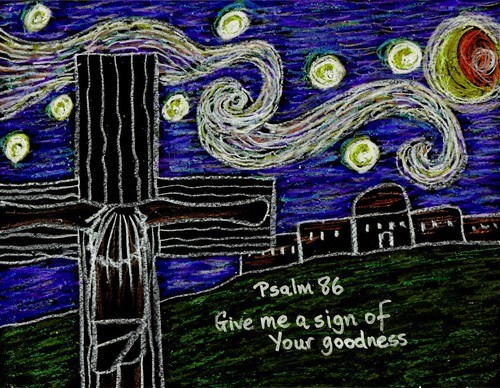
Psalm 86, chalk art by Scottish pastor and artist John Stuart, 2009

Be assured that with such a God, our pleas, cries, and tears will be noticed, affirmed, and answered. We can trust the sovereign Lord of all creation to address the insolence and injustice that exists around us and toward us.

All of this gets down to our view of God, our theological understanding of the basic Divine nature and purpose.  For some people, God is up there, somewhere, like some white-bearded old guy who is aloof to what is going on down here – there is neither anything personal nor personable about him, at all. For others, God is a force which binds all things together. In this theology, God exists, but you are never quite sure how to connect – it is like a crapshoot trying to get in touch with him.  For yet others, God is perpetually perturbed about something; he has a bee in his bonnet, and it is apparently our job to figure out what he is so sullen and upset about all the time so that we can appease him in some way.

However, the psalmist, David, sees God in wholly other ways than this. For David, God is personal, knowable, and reachable. David thought about God in ways which transcend either gendered or personality-type categories. Note the descriptions David provided: a willingness to forgive; an abiding, consistent, and steadfast presence of divine love; always having the time and desire to listen; possessing the power and ability to provide help and protection; being kind and merciful; not being easily angered; and extending needed comfort and consolation.

Now this is a God you can sink your teeth into – attentive, engaged, and anything but upset all the time. This is the reason why David has confidence to ask for deliverance, direction, and delight. Such a God is like a caring grandmother who seeks to always love and serve, and not a crotchety old curmudgeon who always seems bothered by everyone and everything.

If your theology, your view of God, cannot support and bear the weight of life’s hardest circumstances, then you need a different view of God! I invite you to see the God of David. Theology proper discerns the being, attributes, and works of God as fundamentally faithful and loving. This God has both the ability and the will to meet and satisfy your life’s greatest needs.

Great God of David, you are above all things and beside all things and with all things. You are uniquely positioned and powerful to walk with me through all the situations of my life. Thank you for sending the Son of David to make real your promises to me.  Amen.

Isaiah 41:14-20 – For Such a Worm as I

Do not fear, you worm Jacob,
    you insect Israel!
I will help you, says the Lord;
    your Redeemer is the Holy One of Israel.
Now, I will make of you a threshing sledge,
    sharp, new, and having teeth;
you shall thresh the mountains and crush them,
    and you shall make the hills like chaff.
You shall winnow them and the wind shall carry them away,
    and the tempest shall scatter them.
Then you shall rejoice in the Lord;
    in the Holy One of Israel you shall glory.

When the poor and needy seek water,
    and there is none,
    and their tongue is parched with thirst,
I the Lord will answer them,
    I the God of Israel will not forsake them.
I will open rivers on the bare heights,
    and fountains in the midst of the valleys;
I will make the wilderness a pool of water,
    and the dry land springs of water.
I will put in the wilderness the cedar,
    the acacia, the myrtle, and the olive;
I will set in the desert the cypress,
    the plane and the pine together,
so that all may see and know,
    all may consider and understand,
that the hand of the Lord has done this,
    the Holy One of Israel has created it. (NRSV)

Each morning I rise and read God’s Holy Word. It is a discipline I have been doing for over forty years. In the past few years, I have begun reading more slowly and with greater contemplation – because the goal is not to check off having read some verses on a Bible reading plan. The aim is to connect meaningfully with God. The desired result is to hear the voice of the Lord, and to let the Scriptures do their incredible work in our hearts.

One of the ways I connect with Scripture, after having read the verses for the day several times, is to write it in my own words…

“My dear servant, there is no need whatsoever to worry yourself,

though others say about you,

            ‘That guy is nothing, only a wormy maggot!’

I am your holy God,

            who saves and protects you.

I’ll let you be like a big ol’ log

            covered with sharp spikes.

You will grind and crush

every mountain and hill in front of you

            until they turn to dust.

A strong wind will scatter the dust of unholy jerks

            in all directions.

Then you will celebrate

and praise me, your Lord,

            the holy God who watches your life.

When your financial budget no longer budges

and your bank accounts lie empty

            and you have no idea where to turn,

I, your Lord, and your God

will come to your rescue.

            I will not forget you.

I will make rivers of abundance flow

            on the desolate mountain peaks of your life.

I will send streams of life

to fill your empty valley of life’s tribulations.

Dry and barren places in your life

will flow with springs

            and become a lake of grace and goodness.

I will fill the parched desert areas of your needy life

            with all kinds of fruitful trees –

apple trees, olive trees, fig trees,

oak and walnut, elm and maple, fir, and pine,

like in the original garden,

all your needs will be met in and through me, your God.

Everyone will see this

            and know that I,

the holy Yahweh God whom you love and serve,

            created every bit of it.”

Whichever way we choose to view ourselves, as worm and insect, or as majestic person in the image of God, the spiritual reality continually before us is that the Lord will provide, bless, and care for us. We are the recipients of God’s gracious salvation. Although many modern hymnals do not include Isaac Watt’s, At the Cross, and if they do, the original words have been changed – it matters little. Because the action of deliverance belongs to God, and neither to you nor me. And even though we seem but lowly worms next to God, the Lord chooses to treat us with deference, accommodation, and care. Any low view of self is quickly eradicated in the face of such divine love.

Stanza 1:

Alas! and did my Savior bleed?

And did my Sov’reign die?

Would He devote that sacred head

For such a worm as I? 

Chorus:

At the cross, at the cross,

Where I first saw the light,

And the burden of my heart rolled away –

It was there by faith I received my sight,

And now I am happy all the day. 

By Isaac Watts (1674-1748) and published in 1707.