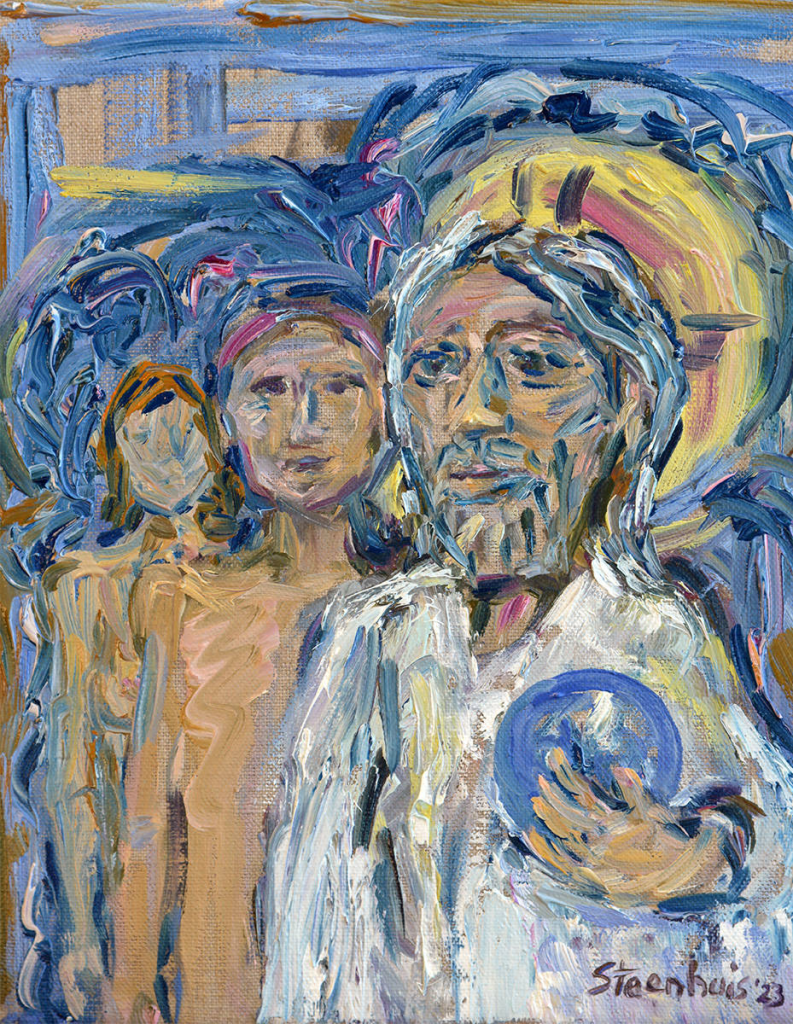
Everything Belongs to God (Psalm 24)

By Stushie Art

The earth is the Lord’s and all that is in it,
    the world, and those who live in it,
for he has founded it on the seas
    and established it on the rivers.

Who shall ascend the hill of the Lord?
    And who shall stand in his holy place?
Those who have clean hands and pure hearts,
    who do not lift up their souls to what is false
    and do not swear deceitfully.
They will receive blessing from the Lord
    and vindication from the God of their salvation.
Such is the company of those who seek him,
    who seek the face of the God of Jacob.

Lift up your heads, O gate
    and be lifted up, O ancient doors,
    that the King of glory may come in!
Who is the King of glory?
    The Lord, strong and mighty,
    the Lord, mighty in battle.
Lift up your heads, O gates!
    and be lifted up, O ancient doors,
    that the King of glory may come in!
Who is this King of glory?
    The Lord of hosts,
    he is the King of glory. (New Revised Standard Version)

The world belongs to God; and so do we. People have a simple, yet profound, task in this life: To confess the Lord’s great and sovereign ownership of everything, including themselves; and to therefore live a good and holy life because of that theological understanding.

“There is not a square inch in the whole domain of our human existence over which Christ, who is Sovereign over all, does not cry, Mine!”

Abraham Kuyper

Abraham Kuyper (1837-1920) was born in the Netherlands. He was a church minister, university professor, and politician – having established a Christian university, as well as served in the Dutch parliament and as Prime Minister of the Netherlands.

Kuyper labored throughout his life to flesh-out the theological implications of a sovereign God. He consistently insisted that all we do as humans is to be integrated and brought under the lordship of Jesus Christ.

He firmly believed that all things belong to God in Christ; thus, all the fragments of our lives are to be oriented and integrated around our Creator’s great claim upon us as creatures. Whether a pastor, teacher, or politician – every vocation, each activity, and all thoughts and intents rightly belong to God.

By Stushie Art

This means that religion and spirituality cannot be kept within superimposed limits. There is no separation of any one domain of human thought from the rest, no isolation of any one domain of human life from another or from Christ.

The spiritual life is not limited to merely the ethereal. It is both celestial and terrestrial – heavenly and earthly – concerned for the immaterial and the material. God cares about it all, because it all belongs to God.

God owns the world. So, the implications of this for us is huge. It means we don’t really own anything. We are simply stewarding all that God has given us – including our very lives.

The chaos of this world, from a biblical perspective, comes from creatures attempting to assert their own sovereignty and to control things. Since we were not created to be little gods roaming about doing our own thing, the inevitable result is a topsy-turvy messed-up world.

God’s divine claim and ownership of the world means that absolute authority does not rest with nations, states, or leaders. Everything we see, as well as what we don’t see, belongs to the Lord.

A significant task of believers is to confess and bear witness to God’s rightful and benevolent rule in this world. In fact, Christians everywhere pray toward this end every week:

“Your kingdom come, your will be done, on earth, as it is in heaven.” (Matthew 6:10)

The circle of life, within Holy Scripture, is the Creator God bestowing life and relationship to created humans, who then respond by practicing just and righteous living – thereby receiving renewal from the Lord and life anew. Theoretically, this movement can go unbroken. It can be a regular celebration in consistent rhythms of worship and adoration of God.

When we are able to get into the intended divine groove of faith, life, and worship, we will discover our meaning and purpose in the world.

By rightly ordering our lives, centering and grounding them in the gracious and loving relationship of Creator and creature, then we find true blessing – because it enjoys an intuited stamp of approval by the God who makes life possible.

In the Christian tradition, Jesus is the Victor, the King of Glory. All the promises and hopes of people are found and focused, in Christ. We enter through Jesus, the door of life, into deliverance from death and everything which separates us from God, others, and self.

Jesus comes to bring blessing, justice, righteousness, mercy, purity, and peace. For this is how the world was meant to operate from the beginning. We are to open the ancient door of faith, especially when the Lord comes knocking:

Listen! I am standing and knocking at your door. If you hear my voice and open the door, I will come in and we will eat together. Everyone who wins the victory will sit with me on my throne, just as I won the victory and sat with my Father on his throne. If you have ears, listen to what the Spirit says to the churches. (Revelation 3:20-22, CEV)

Old Abraham Kuyper is long dead, and yet he got it right, if we are able to hear him:

“Whatever people may do, to whatever they may apply their hands – in agriculture, in commerce, and in industry, or in mind, in the world of art, and science – they are, in whatsoever it may be, constantly standing before the face of God. They are employed in the service of God. They have strictly to obey God. And above all, they must aim at the glory of God.”

Blessed Lord, Creator of heaven and earth, though I am quite capable of fretting, complaining, and lamenting about how out of control things seem, the truth is that nothing is outside your grip. I may not always see your hand, discern your heart, or like your ways, but you are God and there is no other. 

So, continue to renew my thinking, gentle my heart, and deepen my worship. I humbly and gladly affirm that you are God, and I am not, through Jesus Christ, my Lord, who with you and the Holy Spirit reign sovereign as one God, now and forever. Amen.

How To Handle the One Who Grieves (Job 37:1-13)

The Wrath of Elihu, by William Blake, 1805

“At this my heart pounds
    and leaps from its place.
Listen! Listen to the roar of his voice,
    to the rumbling that comes from his mouth.
He unleashes his lightning beneath the whole heaven
    and sends it to the ends of the earth.
After that comes the sound of his roar;
    he thunders with his majestic voice.
When his voice resounds,
    he holds nothing back.
God’s voice thunders in marvelous ways;
    he does great things beyond our understanding.
He says to the snow, ‘Fall on the earth,’
    and to the rain shower, ‘Be a mighty downpour.’
So that everyone he has made may know his work,
    he stops all people from their labor.
The animals take cover;
    they remain in their dens.
The tempest comes out from its chamber,
    the cold from the driving winds.
The breath of God produces ice,
    and the broad waters become frozen.
He loads the clouds with moisture;
    he scatters his lightning through them.
At his direction they swirl around
    over the face of the whole earth
    to do whatever he commands them.
He brings the clouds to punish people,
    or to water his earth and show his love.” (New International Version)

Job’s Despair, by William Blake, 1821

On the one hand, the biblical book of Job needs little introduction. Many people know it has to do with a man’s innocent suffering and tenacious faith. Most folks are familiar with how it feels to suffer for no apparent reason. And everyone understands the struggle when life is broken by pain and loss.

Yet, on the other hand, the book of Job defies simple anecdotes about suffering. And the relationship between Job and God has a lot of complexity to it. Add in Job’s friends with their wordy offerings into his situation, and there becomes a fuller picture of the true wrestling of faith and patience that occurs.

Elihu was a young person who was with the three friends of Job. After listening to everyone speak, he himself went on a long speech, stretching six chapters from Job 32-37. He was angry with Job, and with Job’s three friends.

The young Elihu had picked up that Job thought of himself more righteous than God. And he was also upset that the “friends” offered nothing helpful, and could provide no convincing answers to Job – thus making it appear that God was guilty of Job’s intense suffering and grief.

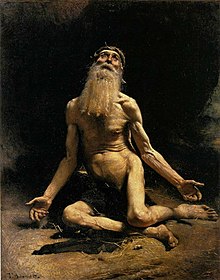
Job, by French painter Léon Bonnat, 1880

In today’s Old Testament lesson, we are getting an end part of Elihu’s speech in which he sought to defend God’s justice through observing the majesty and order of creation.

The testimony of God’s sovereign governance of the world is found in the rain, the thunder, and the lightning; through the winter storms and the frost. The Lord uses the created order to both judge and sustain people. And through the ecological systems we can see that God is at work, regulating it all, and using it for divine purposes, Elihu points out.

What strikes me about Elihu’s words is that he is not wrong, he’s just not very helpful. As a believer, I look at his speech as more of a Captain Obvious moment; yes, he is stating theological reality, but no, he’s not really breaking any new ground or giving any great insight here.

Both Job and Job’s friends had already expressed a theological perspective in kind. Which makes me curious as to why Elihu felt so compelled to even talk at all. I think he would have been better remembered, and maybe even hailed as spiritual beyond his years, if he would have just kept silent.

I realize not everyone is going to go with me on that observation, and that’s fine. Yet it seems to me that a good many people lob too many words toward the suffering among us, when what is actually needed is a compassionate presence that has learned to be comfortable with the uncomfortable.

There are times when words are not needed, when the situation is so incredibly unique and/or difficult that to offer a speech is like yelling in the woods with no one around; it might make the one yelling feel better but that’s about it.

If anyone needed to feel better it wasn’t Elihu. What’s more, a perceived need of defending God’s reputation or honor perhaps betrays a shortsighted theology to begin with. The Lord is quite big enough to handle any rebuffs or misunderstandings from mouthy humans. God isn’t in Junior High School, requiring a mouthpiece to help him out in a scuffle.

I would personally rather give comfort to a hurting person, instead of theological exhortations and speeches about how we ought to talk to, and about, God. That’s because I observe Jesus bringing genuine comfort and help. And I would much rather take my cues for dealing with grieving people from Christ than from Elihu, or anybody else for that matter.

“God blesses those people who grieve. They will find comfort!” (Matthew 5:4, CEV) Jesus said this in his Sermon on the Mount, as a beatitude of all who desire God’s kingdom. Christ understood well the psalmist’s understanding of God’s role and stance concerning people’s grief: “The Lord is close to the brokenhearted; he saves those whose spirits are crushed.” (Psalm 34:18, CEB)

The Apostle Paul, taking a lesson from both his Jewish learning and his encounter with Christ said, “mourn with those who mourn.” (Romans 12:15, NIV) Comfort because of grief and suffering will be built into the end of time. Methinks, then, that this is important…

“Look! God’s dwelling place is now among the people, and he will dwell with them. They will be his people, and God himself will be with them and be their God. ‘He will wipe every tear from their eyes. There will be no more death’ or mourning or crying or pain, for the old order of things has passed away.” (Revelation 21:3-4, NIV)

In whatever way you choose to look at the book of Job, please don’t miss what is to be our response to another’s pain. There is a time for theological education, and there is a time to put a robust theology into practice through a very real comforting presence of another who is in terrible suffering.

God, the strength of the weak and the comfort of those who suffer: Hear my prayers and grant those who suffer in body, mind, or spirit the power of your grace, that affliction may be turned into health, and sorrow into joy. Amen.

Life (Genesis 1:20-2:4a)

The Creation of Heaven and Earth, by Unknown artist, c.18th century

God said, “Let the waters swarm with living things, and let birds fly above the earth up in the dome of the sky.” God created the great sea animals and all the tiny living things that swarm in the waters, each according to its kind, and all the winged birds, each according to its kind. God saw how good it was. Then God blessed them: “Be fertile and multiply and fill the waters in the seas, and let the birds multiply on the earth.”

There was evening and there was morning: the fifth day.

God said, “Let the earth produce every kind of living thing: livestock, crawling things, and wildlife.” And that’s what happened. God made every kind of wildlife, every kind of livestock, and every kind of creature that crawls on the ground. God saw how good it was. Then God said, “Let us make humanity in our image to resemble us so that they may take charge of the fish of the sea, the birds in the sky, the livestock, all the earth, and all the crawling things on earth.”

God created humanity in God’s own image,
        in the divine image God created them,
            male and female God created them.

God blessed them and said to them, “Be fertile and multiply; fill the earth and master it. Take charge of the fish of the sea, the birds in the sky, and everything crawling on the ground.” Then God said, “I now give to you all the plants on the earth that yield seeds and all the trees whose fruit produces its seeds within it. These will be your food. To all wildlife, to all the birds in the sky, and to everything crawling on the ground—to everything that breathes—I give all the green grasses for food.” And that’s what happened. God saw everything he had made; it was supremely good.

There was evening and there was morning: the sixth day.

The heavens and the earth and all who live in them were completed. On the sixth day God completed all the work that he had done, and on the seventh day God rested from all the work that he had done. God blessed the seventh day and made it holy, because on it God rested from all the work of creation. This is the account of the heavens and the earth when they were created. (Common English Bible)

God Created Man in His Image – Male and Female, by Jill Steenhuis

In this Christian season of Eastertide, believers remember and celebrate new life in Jesus Christ. In today’s Old Testament lesson, the lectionary reminds us of original life – when God created the heavens and the earth.

The Beginning of Life

This was the beginning, before there were any words like sin, disobedience, guilt, and shame. This was the time when the original people, Adam and Eve, knew nothing about trying to chase after unconditional love. They had no concept of estrangement or heartache. Everything was fresh and alive and shiny. Disappointment, hurt, and sadness were unknown to them. Everywhere, the earth was teeming with abundant life.

God made it all; and all that was created was very good, supremely reflecting the goodness of the Creator. Life existed everywhere. The predictable and consistent rhythms of the universe were in place. Day and night, work and rest, creation and care, were all woven into the fabric of the world’s sights and seasons. The possibilities for growth were incredible. Life was indeed good.

“New” was simply part of all there was. Without any want or need, every day was an adventure of discovering all the newness which existed.

The Complicated Life

We all, however, know that it did not remain this way. People are now all too familiar with the myriad ways of injustice, and with the film of sin that covers the entire world like a noxious pollutant. And it is this situation, of course, which created the need for a “new” life, because the present life had become a moldy old leftover in the refrigerator of a life that doesn’t keep anything cold nor fresh.

People were created as good human beings. Even though sin has profoundly touched everything in creation, goodness is still within us as God’s image-bearers. The later introduction of human sin into the world in no way whatsoever removes the inherent stamp of the divine image upon us.

Humanity is the only creature who bears this likeness to God. We are related to the animal world, having been created on the same day, and sharing the same blessings of life. Yet, people are distinctive, set above all other creatures.

The Responsible Life

This is why people are given dominion over all other creatures. This is not a claim to privilege; it is, however, very much a claim to responsibility. People have been tasked with being faithful stewards of creation, entrusted with caring for other creatures and the created order.

And humanity was created as both male and female, together expressing the will and character of God in creation as they tend to it and care for it. Together with God, we are relational beings, and not just a race of individuals inhabiting the same earth.

God is a social being, existing as a community within the Godhead. Therefore, to exist as an image-bearer of God means that people are social creatures who need community – with both God and other people.

After God did all the work of creating the world with all its plants and animals and birds and fishes and people, God “rested.” This is why the seventh day is set aside as sacred; its different than the other days, sort of like how people are similar but different from the other creation.

God is clearly separated from the work and the creation itself, that is, God is transcendent and above all things as the Creator. The world is good, but the world is not divine. In the same way, by observing a day of rest, humanity recognizes and affirms and remembers that the work they have done is not divine.

Our human works, good as they may be, are not a thing to be worshiped or equated with God. Therefore, the Sabbath both celebrates the creation and the created order of things, as well as separates us from the idol worship of our hands.

To live into our inherent image of God means that we will work hard and tend to the gardens that are around us. Yet, at the same time, we will understand that in doing our responsible tasks, people are to live in community and love one another, without idolizing any other part of creation or what we creatively build with our own two hands. That is for God alone, who is distinct from all that God has created.

God our Father, you created the world and sent your own Son to live among us, made of the same stuff, breathing the same air, marveling at sunrise and sunset just as we do. Help us to participate in the life around and within us as your life, as you living in us and we living in you and in each other.

God of love and life, restore us to your peace, renew us through your power and teach us to love all that you have created and to care for the earth as your gift and our home. Amen.

Face Reality (Numbers 20:22-29)

Aaron’s Death, by David Roberts, 1842

The whole community of Israel left Kadesh and arrived at Mount Hor. There, on the border of the land of Edom, the Lord said to Moses and Aaron, “The time has come for Aaron to join his ancestors in death. He will not enter the land I am giving the people of Israel, because the two of you rebelled against my instructions concerning the water at Meribah. Now take Aaron and his son Eleazar up Mount Hor. There you will remove Aaron’s priestly garments and put them on Eleazar, his son. Aaron will die there and join his ancestors.”

So Moses did as the Lord commanded. The three of them went up Mount Hor together as the whole community watched. At the summit, Moses removed the priestly garments from Aaron and put them on Eleazar, Aaron’s son. Then Aaron died there on top of the mountain, and Moses and Eleazar went back down. When the people realized that Aaron had died, all Israel mourned for him thirty days. (New Living Translation)

There is a tendency for us “enlightened” humans to believe that we are far more advanced than our ancestors – who did not know all that we very smart people today know.

Such a mental stance only demonstrates that perhaps we are getting more stupid as the centuries and the millennia wear on.

Despite all of our accumulated knowledge and research, and incredible technical advances, we have (in my humble opinion) strayed rather far from a wise understanding of anthropology and theology. In other words, many people in this contemporary world have little to no idea about who they are, why they are here, and what to do when life and death happens.

The death of Aaron the priest happened over 3,500 years ago. Yet, here I am, referencing it. Why? Because there is meaning to it. The ancients have a great deal to teach us, that is, if we have the spiritual and emotional ears to hear, and eyes to see. Notice just some of the lessons they continue to teach us…

The Need to Accept Death

Just as we have all been born into this world, we shall all die someday. If we are such an enlightened people, it would seem to me that we all might have highly developed coping skills, strategies, and ways of honoring and accepting the inevitable death of another – not to mention having adequately prepared for our own demise.

And yet, we go on, day after day, as if we will live forever. Then, when someone we care about dies, it’s as if we cannot believe it has happened. But there is only one sure event in this life, and that is death. It is inexorably coming, whether we like it, or not.

It also seems to me that a great deal of contemporary religious piety is shallow, and does not plumb the depths of real spiritual substance. The irony of it, for many, is that they long for heaven, but ignore death. This is nothing but the denial of reality. Our very real lives here and now must be contended with, including the inevitable death to come.

Reality is the one substantial door that must be acknowledged, experienced with all of our senses and emotions, and passed through – not denied. Only through complete acceptance of this world can the greater reality of the world to come be truly known.

Fantasy and endless gospel songs about heaven can only lead us astray. We picture a future of our own imaginations, which deludes and dulls us of how to actually pass from one dimension to another.

Death was a daily reality amongst the Israelites in their forty years of desert wandering. They understood that each individual passing was inextricably connected to the whole of the community.

John Donne was an Anglican priest and poet in seventeenth century England. He was insistent that all humanity is connected, that whatever happens to one of us, happens to all of us. I take some liberties in contemporizing his Old English language written in 1627:

“No one is an island, entirely independent. Every person is a piece of the continent, a part of the main body of land. If a clod of dirt happens to be washed away by the sea, the whole land mass is the less, just as if an entire peninsula fell off into the water. Whether a friend dies, or anyone in the world dies, it diminishes me because I am involved in the whole of humanity. Therefore, never question to know for whom the bell of death tolls; it tolls for you.”

John Donne (1572-1631)

The Need for Bereavement

A story is told of an old Sufi mystic who visited a sheikh in Baghdad. He found the sheikh gazing into a bowl filled with water. So, he inquired about this odd practice. The sheikh replied that he was watching the moon in the basin. To which the Sufi mystic cried out:

“Unless you have a boil on the back of your neck, lift up your head and look at the sky! There you will see the moon as it is, and not in this basin. Why are you leaning over basins, when all you are really doing is depriving yourself of what you are really looking for?”

Sufi Master, 13th century

As a Pastor and Chaplain who engages in a lot of grief support for those who have lost loved ones to death, and who has dealt with hundreds of people with significant emotional issues, I can say that a lot of people’s grief goes unattended. A good many people go looking for comfort, all by themselves, in staring into a bowl of water.

Death is real. And when someone close to us dies, it hurts like hell. It’s as if somebody came along and pulled the rug out from underneath us. We are flat on our backs and unable to get up.

The only way we can get back up is with the help of others. When Aaron died, the entire community mourned for a full month. Perhaps nothing speaks more to the modern delusion of death and grief than of taking a day or two off work, then expecting to return as if nothing ever happened. No wonder so many people end up in significant depression and anxiety.

The Need for God

Ignoring God is what got the Israelites in their predicament of desert wandering in the first place. And it is also what got both Aaron and Moses a refusal by the Lord to enter the Promised Land.

God isn’t some genie in a bottle that we can control, or a divine Santa to receive presents from. Like death, God is a reality that must be contended with. To go your own way, and decide which commands and instructions you’d like to keep, and which one’s you’ll discard, will not end well – not to mention simply stating that there is no God at all.

Humans are creatures, formed by their Creator. Obedience to God is vital, not optional, because the Lord’s presence is much like the unseen and constant force of gravity. You ignore it at your own peril.

Although we have a lot of freedom in how we can live our lives, and the choices we can make, there yet remains a basic way of existence for everyone. And that way is meant for good, not evil; it has its foundation in the character of God. The Lord is pure love, justice, righteousness, and goodness.

Therefore, as people in God’s image and likeness, we too, are to live in a way that is just, right, good, and loving. To not live in this way would be like walking off the roof of your house because you don’t believe in gravity – then blaming God for your broken body (and soul).

The Need for Ritual in Transition

Israel was transitioning from desert wandering to entering the Promised Land. They were also transitioning leadership from Aaron to Eleazar. And it was all acknowledged with rituals to help people make those transitions.

The community did not simply get an email from Moses informing them of a new priest and welcoming Eleazar to the company. There was an extended time of mourning the loss of Aaron, and a meaningful ritual that demonstrated the change of leaders.

Transitions can be hard. But with every change there is a transition time that must be faced and walked through. Rituals can help us with that. If we ignore this reality, we will find ourselves unable to navigate changes that we personally never asked for. 

The following are some things that I have found helpful in handling change and dealing with the transition from one reality to another:

  1. Maintain personal spiritual rituals. If the change is one that I did not choose, then having regular times of silence and solitude, prayer and bible reading, fasting and journaling help me make sense of what is happening and put it in proper perspective.
  2. Maintain personal health rituals. Freaking out by burning the candles at both ends, forgetting to eat sensibly, and ignoring exercise only exacerbates the change and makes the transition time unbearable.  Instead, take the time necessary to remain healthy through proper sleep, nutrition, and activity.
  3. Grieve and ritualize your losses. Lament, I would argue, is a spiritual practice – a necessary one. It is also biblical.  To focus on next steps without acknowledging transition is to set oneself up for later emotional difficulty and/or trauma. Unpack the heart and allow yourself to feel the loss.
  4. Be patient. Rituals cannot be hurried. The Lord cares more about our spiritual growth and character development than avoiding painful transitions. Let God teach you all that you need to learn.

Institutions and faith communities are sometimes notorious for being inflexible and allergic to change. But, after all, they are made up of real flesh and blood people. To struggle with change is to be human.

Let’s first help ourselves to know how to cope with needed transitions so that we can do the important work of transitioning others from one spiritual place to another. 

It’s high time for us to face the reality that the ancients have much to teach us – including ancient literature such as the Bible.