You Can’t Leverage a Leviathan (Job 41:1-11)

“Can you draw out Leviathan with a fishhook
    or press down its tongue with a cord?
Can you put a rope in its nose
    or pierce its jaw with a hook?
Will it make many supplications to you?
    Will it speak soft words to you?
Will it make a covenant with you
    to be taken as your servant forever?
Will you play with it as with a bird
    or put it on a leash for your young women?
Will traders bargain over it?
    Will they divide it up among the merchants?
Can you fill its skin with harpoons
    or its head with fishing spears?
Lay hands on it;
    think of the battle; you will not do it again!
Any hope of capturing it will be disappointed;
    one is overwhelmed even at the sight of it.
No one is so fierce as to dare to stir it up.
    Who can stand before it?
Who can confront it and be safe?
    —under the whole heaven, who?” (New Revised Standard Version)

Just as “Behemoth” is an English transliteration of the Hebrew word (Job 40:15), so is the word “Leviathan” (לִוְיָתָן). The reason for merely transliterating the words is that we don’t really know what sort of creatures they are with any certainty.

Yet, what we do know, is that both of them are strong and ferocious creatures, described by God as beyond the control of humans. They cannot be domesticated, or serve as pets. That’s because no human could ever hunt or capture one of them. Just to look at a Leviathan would cause a person to flee in fear.

The biblical character of Job had been through a lot. Back in the beginning of the Book of Job, he is described as a man who is upright and blameless. Because of this, Satan entered the picture, going to God and accusing Job of only being faithful because he was blessed. So, God allowed Satan to afflict Job, but not kill him.

Yet, Job knew nothing about this celestial conversation. All he knew was that he lost everything and everyone he cared about. On top of it all, Job experienced painful sores which left his health ravaged and his body unable to do much of anything.

Job’s three “friends” came to comfort him. But they did just the opposite by arguing with him and accusing him of secret sinning. All Job wanted was some vindication, some answers to his questions, and some sort of sense to all the senseless suffering.

After long speeches of both Job and his companions, God’s agonizing silence was finally broken. For several chapters (Job 38-41) God gives no answers, but instead, asks his own questions. The gist of God’s confrontational response comes down to this:

You are wondering about things that are way above your ability to know and understand. But what you need to know is that life consists in relationships, in dialogue and interaction with me, and especially with honesty and vulnerability which goes along with those relations.

Life cannot be boiled down to a nice, neat system of good people getting good stuff, and bad people getting bad stuff. Yell at me, and rage at me, if you must. Then you will be honest, real, and relating to me. But I have no tolerance for anyone who tries to be Me, and thinks they know how things actually are, and how they work.

There is no “The Universe For Dummies” by God on the way things operate in the universe. That’s because it cannot be dumbed-down enough for any human to grasp. All we have is relational interaction and connection.

We can’t even figure out what in the world creatures like Behemoth and Leviathan are, let alone understand how to deal with them. Methinks that despair has a much more prominent place for us humans than we realize. But that is a bigger discussion than Behemoth, and so, is for another time.

It could be that God talking of Leviathan – this big uncontrollable and unpredictable creature – is one way of helping us come to grips with our divine/human relationship.

You and I have absolutely no control over God. It’s not remotely possible, at all. And if nobody can domesticate, let alone capture, a Leviathan, then there is no possibility of ever using God as a personal pet for our own purposes.

Far too many of us humans, demand God to show up and explain himself; or we do all sorts of genuflections and pray volumes of words to try and leverage God into answering us and giving us what we want. But there is no leveraging a Leviathan.

Precious few persons on this earth simply let God be God; and choose to focus on being a real, vulnerable human who needs and wants God. Such persons do not try and capture God, because they have already been captured by God.

We are all at the mercy of God, and in no way can manipulate or cajole God toward our agenda for how we think things ought to go. We might as well try and catch a Leviathan.

Humanity does not hold onto God; God holds onto us. God is not obliged to serve us and do our bidding; but we are very much obliged to God in service and fidelity.

God, I believe, rightly seems perturbed by all of longwinded speeches, only because he was being treated as some sort of divine vending machine who dispenses the proper candy bar with an obligatory monetary oblation.

Do we actually believe that we can do a sort of spiritual credit card slide, and get a belly full of goodies? If you want good from God, then do good and be a good person, right?…

Um, no. Frankly, that kind of spirituality irks God. Good people sometimes get bad stuff. And that reality bothers some of us humans to no end.

There is a reason for all that occurs, but it’s way above our human pay grade to know and understand what it’s really all about. So, treat God as God, as the Sovereign of the universe, as the Holy One whom we must relate to in truth, honesty, realness, and vulnerability.

This is another day, O Lord. I don’t really know what it will bring forth. Regardless, make me ready for whatever this day may be. If I am to stand up, help me to stand bravely. If I am to sit still, help me to sit quietly. If I am to lie low, help me to do it patiently. And if I am to do nothing, let me do it gallantly. Make these words more than words, and please give me the Spirit of Jesus. Amen.

Fight, Flight, Freeze, or Faith (Psalm 11)

I have taken refuge in the Lord.
    So how can you say to me,
    “Flee to the hills like a bird
        because the wicked
        have already bent their bows;
        they’ve already strung their arrows;
        they are ready to secretly shoot
        those whose heart is right”?
When the very bottom of things falls out,
    what can a righteous person possibly accomplish?

But the Lord is in his holy temple.
    The Lord! His throne is in heaven.
His eyes see—
    his vision examines all of humanity.
The Lord examines
    both the righteous and the wicked;
    his very being hates anyone who loves violence.
God will rain fiery coals and sulfur on the wicked;
    their cups will be filled
    with nothing but a scorching hot wind
    because the Lord is righteous!
    He loves righteous deeds.
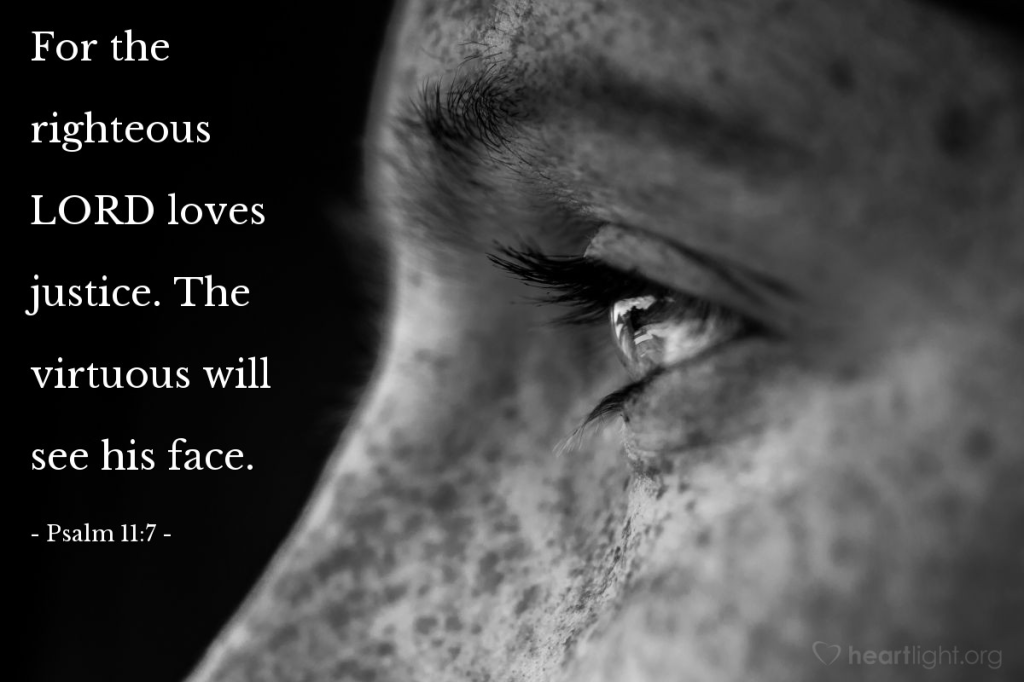
    Those whose heart is right will see God’s face. (Common English Bible)

We all know what it feels like to take the brunt of someone’s poison verbal darts. It’s scary and stressful. What do you do? In a state of fear, shock, or panic, we will likely either fight, flight, freeze, or faith.

Fight

If you have ever received a nasty email based on half-truths and accusations; stood dumbfounded as someone hurled misinformation and criticism at you; and/or experienced the victimization that comes from slanderous and gossiping tongues, then the psalmist knows exactly how you feel. 

Cobbling together a hasty email response, full of anger and vitriol, only sucks us into the person’s evil ways. Metaphorically punching someone in the face for their slap to your face is how the demonic realm handles offenses. Fighting back with an equal or greater force is diametrically opposed to the way of Jesus in loving our enemies and praying for those who persecute us.

Flight

Then, there is the response of taking flight from the nastiness. Indeed, it sometimes seems as if good people are always getting swallowed whole by unjust words and behaviors directed squarely at them. 

And it doesn’t help when the downers among us stroll along and give us their unhelpful fatalism about how there is nothing we can do and how nothing will ever change.

Freeze

Some folks are just plain dumbfounded that another person can be so mean or controlling, so they freeze, unable to speak or do anything. They end up suffering in silence, without their victimization having a voice.

Faith

To be the target of evil speech or malevolent actions is, at the least, unsettling, and, at worst, can bring years of struggle, depression, and inability to serve. Yet, there is someone who sees it all, and that someone will address the wrong. 

We have an option beyond fighting back in anger, fleeing altogether in fear, or freezing in our tracks. We can trust God. We can have faith.

God Sees

The Lord sits aloft, overseeing all, and knows everything humanity does and says. God always does right and wants justice done. Everyone who shares a divine sense of what is right and just will see God’s face. God will act because the Lord abhors and despises those who are cruel and enjoy violence.

It’s not a good idea to get on God’s bad side. The way to flare God’s anger is by possessing an acerbic tongue; relishing in verbal violence; and, having no remorse about any of it. Because God loves people, God hates evil. 

The righteous can take solace in the truth that God really does see the harm done and is in a position to do something about it. Like the psalmist, we seek the Lord. The Lord fights our battles.

Not Okay

Whenever we are harassed and the ungodly give us a hard time, the psalmist isn’t offering some nice religious platitudes such as, “Just let go and let God,” “Everything works for the good of those who love God,” or “It’s okay, you’ll be in heaven someday.”

In another context, maybe those statements are helpful. But being in the teeth of the wicked, all is not okay. As much as some folks try to sanitize an evil situation with rainbows and butterflies, the evil is real, and it’s there.

The truth is that everything is not okay. And it’s okay to not feel okay. The earth is filled with violence, malevolence, oppression, injustice, and systemic evil. The psalmist knows this, all too well.

Humble yourselves under God’s power so that he may raise you up in the last day. Throw all your anxiety onto him because he cares about you.

1 Peter 5:6-7, CEB

God Acts

Today’s psalm is reminding and reassuring us that the Lord is aware of what’s going on and will most certainly do something about it. God will act to punish the wicked and deliver the Lord’s people.

There may not be peace this present moment, yet it will not always be this way. We shall behold the face of the Lord.

The Lord is a righteous judge. Justice is the foundation of God’s throne. God sees the entire spectrum of humanity and can make a right assessment of people’s thoughts, intents, words, and actions.

We, however, cannot. Therefore, it is most necessary for us to put our trust in a Divine Being who cares about right and wrong and has the power to act with justice.

Whenever we are hemmed-in through the schemes of diabolical persons and are powerless, there is always the choice to trust in the Lord. The outcome of every life on earth rests in the hands of God. And it will be a just and right rendering.

Trust in the Lord and do good. Seek peace and pursue it. We might struggle mightily on both the inside and outside – our hard circumstance might not change immediately – yet God is the One who will vindicate the just person when the time is right.

You are not alone. The Lord is with you always.

God of justice, look at the state of your servant and act on my behalf. Do not let evil prevail. Thwart the ungodly so that they can no longer do any harm. Amen.

Abundant Life (1 Kings 8:1-21)

Solomon dedicates the Temple at Jerusalem, by James Tissot (1836-1902)

Solomon then summoned to Jerusalem the elders of Israel and all the heads of the tribes—the leaders of the ancestral families of the Israelites. They were to bring the Ark of the Lord’s Covenant to the Temple from its location in the City of David, also known as Zion. So all the men of Israel assembled before King Solomon at the annual Festival of Shelters, which is held in early autumn in the month of Ethanim.

When all the elders of Israel arrived, the priests picked up the Ark. The priests and Levites brought up the Ark of the Lord along with the special tent and all the sacred items that had been in it. There, before the Ark, King Solomon and the entire community of Israel sacrificed so many sheep, goats, and cattle that no one could keep count!

Then the priests carried the Ark of the Lord’s Covenant into the inner sanctuary of the Temple—the Most Holy Place—and placed it beneath the wings of the cherubim. The cherubim spread their wings over the Ark, forming a canopy over the Ark and its carrying poles. These poles were so long that their ends could be seen from the Holy Place, which is in front of the Most Holy Place, but not from the outside. They are still there to this day. Nothing was in the Ark except the two stone tablets that Moses had placed in it at Mount Sinai, where the Lord made a covenant with the people of Israel when they left the land of Egypt.

When the priests came out of the Holy Place, a thick cloud filled the Temple of the Lord. The priests could not continue their service because of the cloud, for the glorious presence of the Lord filled the Temple of the Lord.

Then Solomon prayed, “O Lord, you have said that you would live in a thick cloud of darkness. Now I have built a glorious Temple for you, a place where you can live forever!”

Then the king turned around to the entire community of Israel standing before him and gave this blessing: “Praise the Lord, the God of Israel, who has kept the promise he made to my father, David. For he told my father, ‘From the day I brought my people Israel out of Egypt, I have never chosen a city among any of the tribes of Israel as the place where a Temple should be built to honor my name. But I have chosen David to be king over my people Israel.’”

Then Solomon said, “My father, David, wanted to build this Temple to honor the name of the Lord, the God of Israel. But the Lord told him, ‘You wanted to build the Temple to honor my name. Your intention is good, but you are not the one to do it. One of your own sons will build the Temple to honor me.’

“And now the Lord has fulfilled the promise he made, for I have become king in my father’s place, and now I sit on the throne of Israel, just as the Lord promised. I have built this Temple to honor the name of the Lord, the God of Israel. And I have prepared a place there for the Ark, which contains the covenant that the Lord made with our ancestors when he brought them out of Egypt.” (New Living Translation)

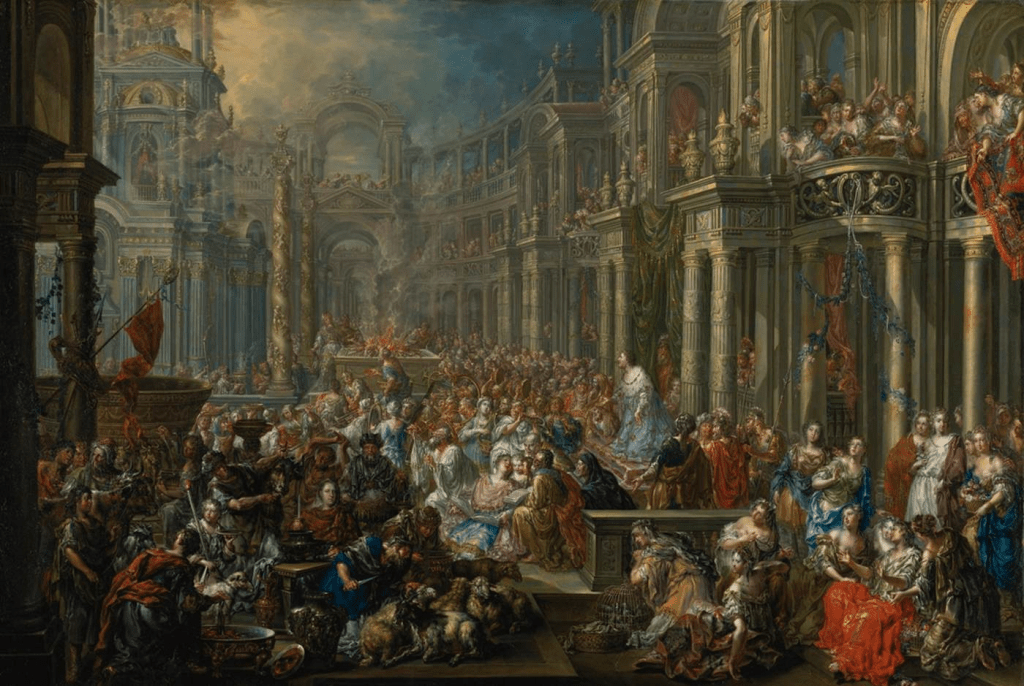
Dedication of Solomon’s Temple in Jerusalem, by Johann Georg Platzer (1704-1761)

I admit, at many times, that I am prone to melancholy. I tend to be quick at accepting blame, and rather slow at owning my good work. Another way of putting this is that it is easier to give than to receive.

Those who have endured a lot of hard circumstances, and persevered through many adversities, can sometimes be reticent to accept the good, the abundant, and the beautiful, whenever it comes to us in this life.

Waiting for the other shoe to drop, far too many people hold back themselves from receiving and enjoying the really good things in life. They worry that the goodness will disappear, or be taken away; and so, they withhold gratitude and blessing, whenever they are in the presence of great abundance.

Just so you know, in case there are those of you who need to hear it spelled out plainly: That’s messed up.

People are meant to be abundantly generous, as well as wildly receptive. It’s likely why there are so many spiritually unhealthy persons in the world.

Bless their hearts, they give a lot, without receiving much, and then their spiritual diarrhea makes it so they can’t give anymore. And they oftentimes give to those who are in such a habit of receiving (and not giving) that the receiver’s spiritual constipation becomes a terrible problem.

Let’s avoid both extremes by letting ourselves both give and receive with equal abandon. No one can be spiritually growing, healthy, and mature without the dynamic of giving and receiving.

Solomon knew how to do both. King Solomon was the king of abundance. He accepted and received big; and he gave and blessed big. Nobody before him or after him received and gave more.

The Temple, in all of its glory and grandeur, with the Ark of the Covenant encrusted with gold as the central object in the building, was all for a God who doesn’t live in houses, a God who is invisible.

In Solomon’s dedication of the Temple, he made it clear that the God of Israel is not, and cannot, be restricted to, or located within, a single place. Thus, the Lord is limitless, and not subject to any human manipulation.

God is free to give with great abandon. And God is also free to take away. Blessed be the name of the Lord God. If we continually try and anticipate or predict what God will do, we will likely be a nervous ball of anxiety all of the time, wondering when the unexpected and/or unwanted will visit us.

It is much better to receive the good things the Lord gives us, and enjoy them while we have them.

“I came that they may have life and have it abundantly.”

Jesus (John 10:10)

Nothing is permanent, with the exception of relationships and love. So, if we can connect the temporal material things of this life in service to the immaterial realities of this universe, then we are in a position to experience peace, joy, and satisfaction.

If and when the material disappears, or is taken away, then it shall neither defeat us, nor destroy us. For our relational connections with God and others exist, and are free flowing, with the energy of gracious receiving and giving as the conduit of abundant life.

Melancholy is important and has its place for us in this present life; yet, so do things like celebration, dedication, joy, exuberance, emotional commitment, and open love. Indeed, to have these in abundance is a reflection of the God of abundance, in whose name we are bold to pray:

God of abundance, you have fed us with the bread of life and cup of salvation; you have united us with Christ and one another; and you have made us one with all your people in heaven and on earth. Now send us forth in the power of your Spirit, that we may proclaim your redeeming love to the world and continue forever in the risen life of Christ our Savior. Amen.

A Thunderous Beauty (Psalm 68:24-35)

Your solemn processions are seen, O God,
    the processions of my God, my King, into the sanctuary—
the singers in front, the musicians last,
    between them young women playing tambourines:
“Bless God in the great congregation,
    the Lord, O you who are of Israel’s fountain!”
There is Benjamin, the least of them, in the lead,
    the princes of Judah in a body,
    the princes of Zebulun, the princes of Naphtali.

Summon your might, O God;
    show your strength, O God, as you have done for us before.
Because of your temple at Jerusalem,
    kings bear gifts to you.
Rebuke the wild animals that live among the reeds,
    the herd of bulls with the calves of the peoples.
Trample under foot those who lust after tribute;
    scatter the peoples who delight in war.
Let bronze be brought from Egypt;
    let Cush hasten to stretch out its hands to God.

Sing to God, O kingdoms of the earth;
    sing praises to the Lord,
O rider in the heavens, the ancient heavens;
    listen, he sends out his voice, his mighty voice.
Ascribe power to God,
    whose majesty is over Israel
    and whose power is in the skies.
Awesome is God in his sanctuary,
    the God of Israel;
    he gives power and strength to his people.

Blessed be God! (New Revised Standard Version)

From psalm to psalm, the entire biblical psalter is consistent in praising God. Foremost among the praise is celebrating God’s inherent character, and for how that divine character acts with power and grace in the world.

Since God is an infinitely immense Being, our human language cannot begin to adequately contain or describe such incredible divinity. Yet, words are what the psalms have for trying to communicate the attributes of such an awesome God.

That’s why the use of metaphors is significant. Whenever we can picture something we are familiar with, then imaginatively place God alongside it, it helps give us at least a rudimentary idea and feeling of who God is, what God is all about.

To gain a glimpse of God’s majesty and sovereignty over the universe, the psalmist invites us to see with our spiritual eyes that God riding the sky; and to hear with our spiritual ears the thunderous shout that roars and reverberates throughout the cosmos.

Along with our eyes and ears, we are invited to respond by using our power of words and speech to proclaim God’s power. And, I must say, that power is well beyond our ability to describe.

With all of the powerful forces in this world, they are but a mere puff of breath to the God who reigns supreme over all powers, both in heaven and on earth. God’s power is a thunderous beauty. God’s splendor and strength rise larger than thunderheads.

Having grown up in Midwest America, I’ve seen my share of large thunderheads (massive cumulus clouds which form just before a storm), thunderstorms replete with bright lightning and noise so awesome it shakes the farmhouse, and tornados with such force that they rip the roof off a barn as if it were a Lego building.

The appropriate response to such a great God is to make music for the One who strides the ancient skies in a heavenly chariot; and yet stoops to listen and care about puny humans.

The reasonable response to such a breathtaking God is to listen to the divine voice thundering in the world, and submit to the sound which seems like it might split the heavens open.

To gain a mere glimpse of God’s strength and power will inevitably result in a response of giving up our all to the Lord of the universe – everything we have, and all that we are.

To know, even a tiny smidgeon, of such a God will bring our own loud shouts of proclaiming God’s goodness, grace, and generosity to anyone who will listen to us.

To glimpse what the psalmist sees will consume us with awe, as we intuitively connect with the glory which is constantly streaming from heaven.

What’s more, God shares divine strength with people. God doesn’t have to do that. The Lord has no obligation to do so. Yet, it happens, despite our fickle praise and inconsistent devotion.

So, let’s give our highest praise to the God of the psalms. Let’s imbibe of God’s thunderous presence among us.

I guarantee that it will make us happier than a gopher in soft dirt; or a butcher’s dog; or a unicorn eating cake on a rainbow.

Eternal Trinity – blessed Father, Son, and Spirit – the awesome God whom I serve: The more I enter you, the more I discover, and the more I discover, the more I seek you. A massive thunderhead is but a small cloud next to you, the Godhead, the incredible Three-in-One.

Through you, almighty Lord, I shall come to know myself and my world. And that knowledge is a mighty love for humanity which spans longer and higher than the universe itself. May the love, unity, harmony, community, goodness, and power which is always present within yourself, mighty God, be present with me, your servant.

For just a molecule of You is enough to power me for eternity. Praise the Lord! Amen.