What Is It You Are Trying To Do? (Mark 10:2-16)

Jesus blesses the children

Some, testing him, asked, “Is it lawful for a man to divorce his wife?” He answered them, “What did Moses command you?” They said, “Moses allowed a man to write a certificate of dismissal and to divorce her.” But Jesus said to them, “Because of your hardness of heart he wrote this commandment for you. But from the beginning of creation, ‘God made them male and female.’ ‘For this reason a man shall leave his father and mother and be joined to his wife, and the two shall become one flesh.’ So they are no longer two but one flesh. Therefore what God has joined together, let no one separate.”

Then in the house the disciples asked him again about this matter. He said to them, “Whoever divorces his wife and marries another commits adultery against her, and if she divorces her husband and marries another, she commits adultery.”

People were bringing children to him in order that he might touch them, and the disciples spoke sternly to them. But when Jesus saw this, he was indignant and said to them, “Let the children come to me; do not stop them, for it is to such as these that the kingdom of God belongs. Truly I tell you, whoever does not receive the kingdom of God as a little child will never enter it.” And he took them up in his arms, laid his hands on them, and blessed them. (New Revised Standard Version)

Trying To Parse the Law?

The topic of divorce has always been a hot button issue throughout human history. And there have continually been diverse views and opinions about it. This is also true of Holy Scripture. A variety of interpretations are offered by many about the Bible’s view of divorce, and Christ’s words concerning it.

Much like today, divorce in the first century was accepted as part of what happens in society, even among Jews, although it was more proliferate in other cultures. Most of the discussions about divorce centered in legal details, with some speaking against it as bad for society.

Among the Jewish religious leaders and experts in the law, it was generally recognized that divorce occurs, with Mosaic legislation proscribing how to carry out divorce (Deuteronomy 24:1-4). Yet, other scripture texts frame the existence of divorce as questionable for God’s people. (e.g. Genesis 2:24; Malachi 2:13-16)

Trying to Test Jesus?

Anyone who doesn’t like another, will often confront them on a hot button issue that has plenty of diverse opinion to it. This is why the Pharisees sought to get Christ’s take on the topic of divorce.

Essentially, Jesus reframed divorce so that it was no longer simply a legal topic, but involves real people. Christ talked about divorce in a way that upheld the dignity of persons, especially women; and lifted up the true sanctity of marriage.

In turning the discussion from a legalities to God’s design for humanity and marriage, Jesus cut to the heart of the matter, to God’s intent, and to human frailty. He focused on relationships, because they were inherent from the beginning.

Yes, divorce is a reality, and it is has its place in society. But no, it’s not supposed to be this way. The very word “divorce” means there is a separation, a breech, a disconnection of relationship. This is why Christ went to another topic: adultery.

Trying To Divorce Women?

Jesus said that a person initiating a divorce in order to marry another person commits adultery. In saying this, he was not offering a legal conversation of details. Rather, Christ was focusing on people; he was concerned for wives and women.

The conversation between Jesus and the Pharisees was a discussion between men, and presupposed a man’s point of view on divorce. Women did not have the ability to initiate divorce in the ancient society.

And Christ seems to have had no stomach for being drawn into abstract legal debates between a bunch of men. Instead, he cared about the people involved in an actual divorce, especially the women.

For all intents and purposes, women (and their sexuality) were the property of men – the father, and then later, the husband. In this social milieu, whenever a husband initiated a break in the relationship, it was important for a woman to have a certified document of divorce. Without that certification, a woman divorcee would be landlocked, unable to do much of anything, as well as be the brunt of societal gossip, slander, or worse.

Since Jesus was talking to the men, the Pharisees, he pointedly looked at them and let them know that, although they might initiate a divorce, it in no way justified their sneaking and creeping around. It didn’t cover their adulterous relationship(s) nor their adulterous hearts.

All this is to say that Christ very much opposed divorce on the grounds of putting a wife away out of a desire for a different spouse. He intended on empowering women. In a divorce situation, because a man was in control of the process, it was then the man who commits adultery against the woman.

Both logically and legally, a woman could never commit adultery because of divorce – only the man. What’s more, adultery is not primarily a violation of the law, but of the woman. Jesus believed it was high time for some accountability with the men.

Even though contemporary Western society is much different than the ancient social structure, Christ’s teaching is still relevant. The need to uphold not just the law, but the rights of women is a must for today, as well.

Unless we can observe Christ’s concern for women’s justice and rights, there will be men who continue to leverage their own gender over and against females and wives. And there will continue to be both husbands and wives who initiate divorce for their own adulterous motives, thus putting their spouse in moral, legal, emotional, and spiritual jeopardy.

Trying To Keep Children Away?

The overarching ethics of Jesus, and the law of God, is to provide justice and righteousness for the most vulnerable among us. And this is why the teaching about divorce is coupled with instruction about children.

In our contemporary society, children have rights and are accorded significant status. That was not true in the ancient world. Children were mostly viewed as potential adults. Until then, kids were to stay quiet unless spoken to, and to obey their parents with absolutely no talk-back.

Christ’s disciples did what any student following their teacher would do; they kept the kids at bay so that Jesus could do his important ministry work. But what the disciples discovered is that the kids were actually part of that important ministry work. As children, they were vulnerable, at the low end of the social scale, and had no personal rights other than being part of a family.

To become like a little child in order to enter the kingdom of God did not mean becoming innocent; it meant becoming humble and dependent, and embracing meekness, gentleness, and lowliness. It meant to become the last and the least among us. Because the last will be first, and the least will become great.

Trying To Get It Right?

It’s important for us to uphold the sanctity of human life, and the spirit of the law. The law is intended to preserve and protect life – and is not to be used to find loopholes or ways to get what you want.

Meeting the needs of all people – whether they be men, women, children, and whether they be rich or poor – is to be everyone’s concern. Why? Because justice and righteousness are at the heart of God’s concern for humanity.

Merciful God, who discerns each heart: We confess our family is most often like strangers to us. So, give to all parents and children the grace to see one another as they truly are, and as you have called them to be. In the name of Jesus Christ, our mediator and advocate, we pray. Amen.

The Evil Within (Mark 7:1-8, 14-15, 21-23)

Now when the Pharisees and some of the scribes who had come from Jerusalem gathered around him, they noticed that some of his disciples were eating with defiled hands, that is, without washing them. (For the Pharisees, and all the Jews, do not eat unless they wash their hands, thus observing the tradition of the elders, and they do not eat anything from the market unless they wash, and there are also many other traditions that they observe: the washing of cups and pots and bronze kettles and beds.)So the Pharisees and the scribes asked him, “Why do your disciples not walk according to the tradition of the elders but eat with defiled hands?” He said to them, “Isaiah prophesied rightly about you hypocrites, as it is written,

‘This people honors me with their lips,
    but their hearts are far from me;
in vain do they worship me,
    teaching human precepts as doctrines.’

“You abandon the commandment of God and hold to human tradition…”

Then he called the crowd again and said to them, “Listen to me, all of you, and understand: there is nothing outside a person that by going in can defile, but the things that come out are what defile…”

For it is from within, from the human heart, that evil intentions come: sexual immorality, theft, murder, adultery, avarice, wickedness, deceit, debauchery, envy, slander, pride, folly. All these evil things come from within, and they defile a person.” (New Revised Standard Version)

There are many people who believe that evil resides out there, but not in here.

“Out there” is usually in places where people don’t live like me, think like me, and act like me. Rarely does anyone, when asked where evil is, points to their own heart.

The religious establishment of Christ’s day saw evil as something which existed “out there” where the sinners are; but not “in here” where I am.

Jesus had something to say on that subject. The exchange between the religious leaders and Christ began with a query toward Jesus about Jewish traditions and interpretations of the Mosaic law.

The leaders observed that Christ’s disciples were not holding to traditional purity practices. They were not washing their hands in a certain way prior to eating. This was less of a criticism on the followers of Jesus, and much more an indictment on Jesus as their rabbi.

It was believed that there are customs which properly trained disciples ought to know and follow. And Christ’s followers were not, it was assumed, trained well.

The religious establishment understood the words and ways of Jesus as an affront to the teaching of the elders, and of proper scriptural and legal interpretation.

Jesus, however, made a distinction between traditions of the elders and God’s commands. The former are human precepts, whereas the latter are to be obeyed. In no way did Christ demean Mosaic law, or any commandments of God.

Instead, Jesus rejected how particular interpretations – along with practices which arose from those interpretations – end up obscuring the spirit and intent of the law. In other words, purity does not come from hand washing, because neither purity nor impurity originates from the hands.

Christ reached back into the prophecy of Isaiah to show that there is a contrast between what the mouth utters and what is within the heart. The incongruence between the words spoken and the heart’s true state puts the issue of where impurity and evil really come from: The heart, not the mouth.

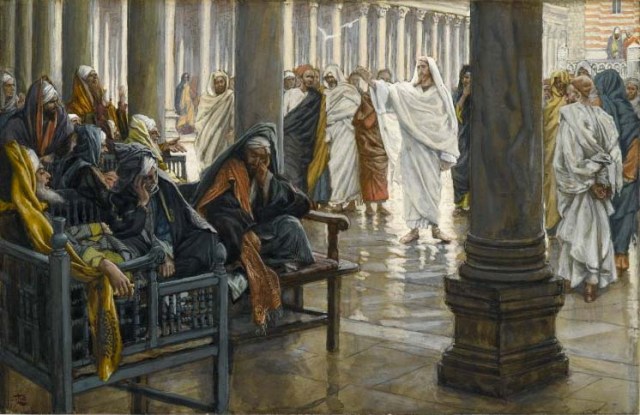
Jesus and the Pharisees, by French painter James Tissot (1836-1902)

Evil intentions originate within. Evil actions are animated by the heart. Evil attitudes are born in the heart. The human heart is the place which needs attention because, for ancient people, this is where a person’s rational will is located. It is where moral pollution dwells, deep within.

Let’s keep in mind that, in the verbal kerfuffle between Christ and the religious leaders, there is no evidence that Jesus disregarded Jewish dietary laws. He instead took the religious establishment to task on elevating outward human traditions, while simultaneously ignoring the inward human heart.

Food and hand-washing are not the chief concern, when it comes to purity and impurity. At issue is the source of defilement, that is, where the pollution is sourced. Jesus insisted that it’s more about who you are, and what is in your heart, than it is about the food you eat or avoid.

In truth, the problem of defilement is important. And keeping the Mosaic law is significant. Yet, Jesus was looking at these issues from a different angle. He affirmed the law’s purpose in restraining evil and avoiding impurity, along with the religious leaders. However, Christ disagreed with them on how the law is practically observed and obeyed.

Jesus did not come up with something new or strange in talking about evil emanating from the heart. Judaism is a religion of the heart, just as much as Christianity or any other religion.

The heart is devious above all else;
    it is perverse—
    who can understand it?
I the Lord test the mind
    and search the heart,
to give to all according to their ways,
    according to the fruit of their doings. (Jeremiah 17:9-10, NRSV)

So, what’s up with the conflict between Jesus and the religious leaders? Over time, many located evil outside, out there, with evildoers and law-breakers, with those disobedient to the law. Christ came along and reaffirmed where the problem originates, scripturally.

One isn’t defiled by improper handling of ritual; one is defiled because being unaware of, or not acknowledging, the dark shadows which reside within every human heart.

Therefore, the discussion of evil and impurity is useless, if we only talk about influences from outside. Deal, instead, with the influences from within.

The heart is not all bad; there’s a lot of good there. But there are spaces within the heart which are camouflaged in darkness. Those places need attention, before we launch into evil which exists elsewhere.

Everyone must come to the point of understanding that they are capable of both great good and great evil. A Pharisee is not all good. And a lawbreaker is not all bad. Until we can see the commonality between ourselves and those we separate ourselves from, we will continually miss the heart of true religion.

Whether a Jew, Christian, Muslim, or any other religious tradition, we must deal with our own collective house, and our own personal heart. Hate speech toward another group has no warrant from Jesus. Injustice has no place in Christianity or anywhere else.

Furthermore, not a one of us can rationalize any unjust words and/or inactions. If that happens, a terrible blindness has occurred in which someone or some group of people refuse to see their own culpability in evil, and project it outward onto another person or group.

If we keep the light of the gospel in our own hearts, then it is much less likely that we will demean or attack others, either verbally, physically, or both.

Using a self-constructed and janky flashlight to shine on another’s heart does nothing but keep the attention off of our own heart. That sort of dubious searching of splinters helps no one, especially ourselves, who already have nasty logs in our own eyes.

Evil is deeper than mere selfishness, bigger than a personal error in judgment, and greater than some individual bad decisions. That’s because there is also a collective heart in every organization, institution, corporation, and faith community. Injustice and unrighteousness resides in those hearts, as well. This makes all of us – personally and communally – both victims of evil, as well as perpetrators of wickedness.

This is why grace and mercy are the real answers to the evil in this world’s systems, and in the human heart. Jesus is trying to pave the way toward a solution of the problem of evil.

Let’s give him an honest look and hearing.

Most merciful God, we confess that we have sinned against you in thought, word, and deed, by what we have done, and by what we have left undone. We have not loved you with our whole heart; we have not loved our neighbors as ourselves. We are truly sorry and we humbly repent. For the sake of your Son Jesus Christ, have mercy on us and forgive us; that we may delight in your will, and walk in your ways, to the glory of your Name. Amen.

What Will You Do with Jesus? (John 5:1-18)

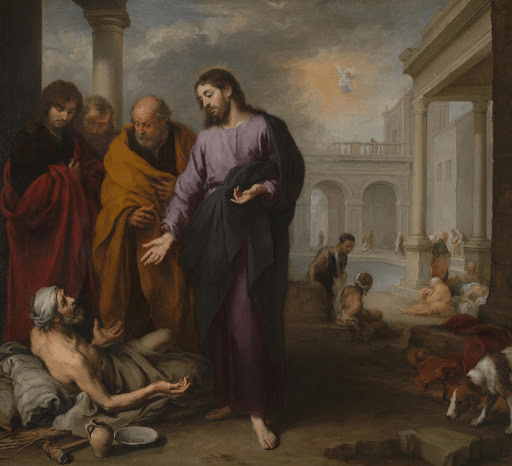
Healing the Paralytic, by Bartolomé Esteban Murillo, 1670

Sometime later, Jesus went up to Jerusalem for one of the Jewish festivals. Now there is in Jerusalem near the Sheep Gate a pool, which in Aramaic is called Bethesda and which is surrounded by five covered colonnades. Here a great number of disabled people used to lie—the blind, the lame, the paralyzed. One who was there had been an invalid for thirty-eight years. When Jesus saw him lying there and learned that he had been in this condition for a long time, he asked him, “Do you want to get well?”

“Sir,” the invalid replied, “I have no one to help me into the pool when the water is stirred. While I am trying to get in, someone else goes down ahead of me.”

Then Jesus said to him, “Get up! Pick up your mat and walk.” At once the man was cured; he picked up his mat and walked.

The day on which this took place was a Sabbath, and so the Jewish leaders said to the man who had been healed, “It is the Sabbath; the law forbids you to carry your mat.”

But he replied, “The man who made me well said to me, ‘Pick up your mat and walk.’ ”

So they asked him, “Who is this fellow who told you to pick it up and walk?”

The man who was healed had no idea who it was, for Jesus had slipped away into the crowd that was there.

Later Jesus found him at the temple and said to him, “See, you are well again. Stop sinning or something worse may happen to you.” The man went away and told the Jewish leaders that it was Jesus who had made him well.

So, because Jesus was doing these things on the Sabbath, the Jewish leaders began to persecute him. In his defense Jesus said to them, “My Father is always at his work to this very day, and I too am working.” For this reason they tried all the more to kill him; not only was he breaking the Sabbath, but he was even calling God his own Father, making himself equal with God. (New International Version)

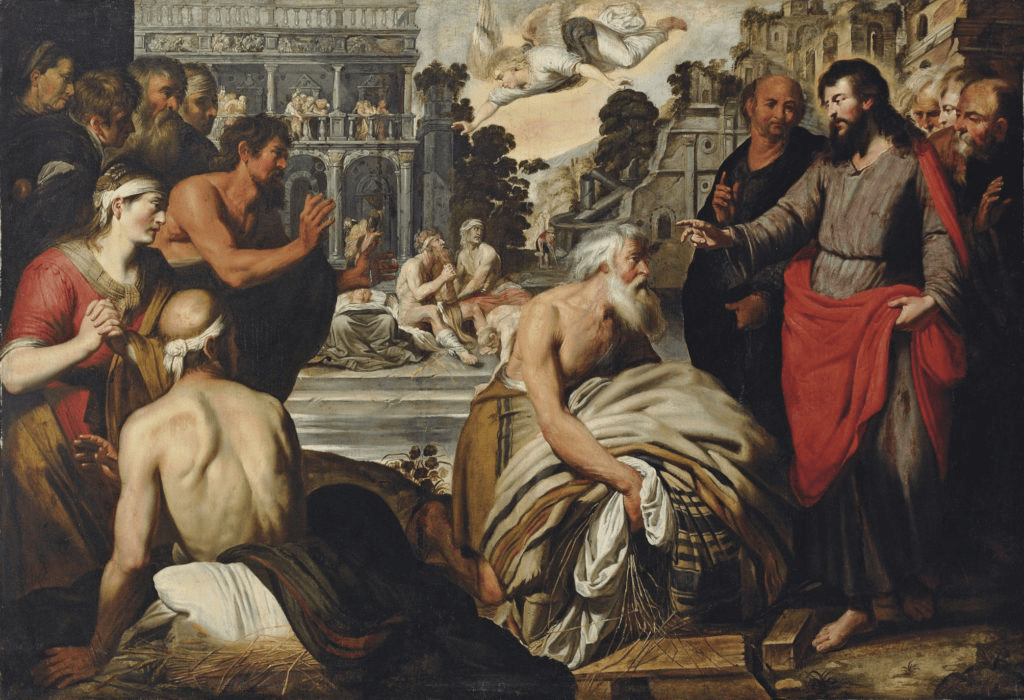
Christ at the Pool of Bethesda, by Artus Wolffort, c. 1625

During one of the yearly Jewish festivals, on a Sabbath day, a miracle happened. Miracles of healing are typically accompanied by celebration and joy. But not so much with this one.

It’s one of those things about living in a messed up world of broken systems, that an invalid can start walking and there are people who have frowns and furrowed brows about it.

Granted, the man who was healed by Jesus may seem a bit hard to like in some ways. We don’t really know what he was into, but when Christ bestows healing on you, then says to stop sinning, it’s probably a significant sin to warrant the Lord’s exhortation.

Regardless of any sort of sin, the man appears to be paraplegic. Especially in the ancient world, this meant all sorts of problems had to be navigated – such as needing others to literally carry you around (no wheelchair or handicapped accessible anything), long periods of social isolation, lack of bodily control over your bowels and bladder, and the continual needs for cleanliness.

This made the man hard to like by many people just because he likely had strong body odors and had to crawl to get around if no one would help. He would not have been pleasant to look at. But he would have to make sure you did because, in the absence of any charity, the guy’s only option was to beg.

I’m glad there are greater forces in the world than indifference and dislike. There is grace – which is an act of bestowing honor and/or forgiveness to another person. It is not dependent upon whether one deserves it. Grace chooses not to hold something over or against another. It is a deep concern for others that comes from within and not from without.

“I do not understand at all the mystery of grace – only that it meets us where we are but does not leave us where it found us.”

Anne Lamott

Another gracious act that Jesus did was to honor the man’s dignity by respecting him with a question. By asking a question, we don’t assume we know what’s best for another. Sincere questions acknowledge another’s basic humanity. “Do you want to get well?” Jesus asked.

In the life of being an invalid and having little control over much of anything, including one’s own body, being asked a question is to receive the gift of autonomy.

There are many times in my work as a hospital chaplain that I speak with patients who don’t have a lot of control in their lives. I go out of my way to ask questions such as, “May I come in?” “Is it alright with you if I pull up a chair and sit down?” “Would you be okay telling me about what is going on?” “May I pray with you?”

This is important, because there are too many other people in this world who would just barge into a room, act like they own the place, and talk at them, and not with them – hence reinforcing to the person that they’re nothing compared to others, that they don’t have any real say.

The man’s response to Jesus was to essentially say that he is alone. He has no one to help him. Even though the man is in a city, surrounded by hundreds and thousands of others, he is lonely.

Not anymore. Jesus saw him, even inquired about him and learned about the man. Jesus Christ, the Lord of all, cared about a non-descript invalid and was sincerely curious about him. In a world of everyone for himself, Jesus championed the lonely and the lost.

A simple command to obey was all. Christ told the man to pick up his mat and walk. That’s it. Just as words created the world, so a few words created a whole new life for the man. So, he got up, and he walked.

It’s interesting that the religious leaders never seemed to notice the man when he was lame, but now that he’s up and walking around, they pay attention to his apparent work on a Sabbath.

The invalid was validated by Jesus, but Jesus, the one validated by the Father, was invalidated by the religious leaders, who are the spiritual invalids.

It was against the (their) rules to carry something around. Apparently, it was okay for people to be lonely, not contribute to society in meaningful and dignifying ways, and to suffer; but it’s not okay to walk and carry a mat.

Even worse, is anyone who would heal on the Sabbath and tell the healed person to walk and carry a mat. It was so bad, apparently, that it warranted persecuting such a person. But that’s what happens when people are forced to serve rules, instead of the rules serving people.

On top of it all, Jesus was working; and he justified it by stating that his Father keeps working. This was dangerously close to blasphemy by likening himself to God. For the religious leaders, not only was Jesus unethical in breaking the law, but he was also theologically immoral; he claimed a special relation with God.

The more that laypeople get to know Jesus, the more compelling he becomes; they want to follow him. But the more that clergy discover Jesus, the more angry they become and want to do away with him.

Ultimately, it is Jesus we must contend with, and not the law and our interpretations of scripture. We need to decide what we are going to do with Jesus… what will you do?…

Remember Passover (Deuteronomy 16:1-8)

Exodus, by Yoram Raanan

Observe the month of Aviv and celebrate the Passover of the Lord your God, because in the month of Aviv he brought you out of Egypt by night. Sacrifice as the Passover to the Lord your God an animal from your flock or herd at the place the Lord will choose as a dwelling for his Name. Do not eat it with bread made with yeast, but for seven days eat unleavened bread, the bread of affliction, because you left Egypt in haste—so that all the days of your life you may remember the time of your departure from Egypt. Let no yeast be found in your possession in all your land for seven days. Do not let any of the meat you sacrifice on the evening of the first day remain until morning.

You must not sacrifice the Passover in any town the Lord your God gives you except in the place he will choose as a dwelling for his Name. There you must sacrifice the Passover in the evening, when the sun goes down, on the anniversary of your departure from Egypt. Roast it and eat it at the place the Lord your God will choose. Then in the morning return to your tents. For six days eat unleavened bread and on the seventh day hold an assembly to the Lord your God and do no work. (New International Version)

The first five books of the Old Testament are known by Christians as the Pentateuch. These same books are the Torah in Judaism. Deuteronomy is the fifth and final book; it is a restatement of God’s Law for the Israelites about to enter the Promised Land.

Several prominent theological themes are highlighted in the book of Deuteronomy. It vigorously advocates for exclusive loyalty to the monotheistic God, Yahweh. Yahweh is characterized as a transcendent Being, full of steadfast love and transformative justice.

Deuteronomy places significant emphasis upon the covenant relationship between God and Israel. The covenant was established with the patriarchs – Abraham, Isaac, and Jacob – and affirmed at Mount Sinai after the exodus from Egypt, at the giving of the Law. This Law was graciously provided by God for the people; it is encapsulated in the Ten Commandments, and is to be reaffirmed as soon as Israel enters the land.

Moses receiving the Tablets of Law, by Marc Chagall, 1963

Therefore, the entire book of Deuteronomy looks forward toward a new existence in the Promised Land. This new society is to pursue justice and be devoted to righteousness. All Israel is to live in harmony with God and one another, enjoying the land and the covenant relationship.

The welfare of Israel depends upon upholding and maintaining the social and religious laws given by Yahweh. God’s commands are a divine gift, and if closely followed, will be the best humanitarian way of caring for the poor and disadvantaged, as well as bringing the people close to Yahweh.

The sacrificial system will revolve around a singular sanctuary in the religious capital. By locating sacrifices in a particular place, this has the effect of Jewish faith not becoming dependent on offerings, but instead on mercy, love, learning the law, and rituals that uphold reverence for God.

Perhaps the greatest of all the rituals is Passover. Israel’s experience of deliverance at the Red Sea and the centralization of worship in Jerusalem is remembered and celebrated at the festival of Passover every year.

In the original Passover, at the time of the exodus, the blood of a sacrificed lamb was smeared on the doorposts of each Jewish home. In doing this, it let the angel of death know to “pass over” that house, thereby only entering Egyptian homes that did not revere nor recognize God. This act was also the final miraculous act of ten plagues leveled on Egypt.

And There Was a Great Cry in Egypt, by Arthur Hacker, 1897

As the households of Egypt were grieving their dead, Israel was urged by the Egyptians to get out. Egypt feared what would happen if the Israelites remained. Therefore, Israel left post haste. They didn’t have any time for their bread to rise. The people ate unleavened bread so they could immediately leave Egypt.

So, from then on, every year in early Spring, Israel commemorates and remembers God’s deliverance of the people from slavery. God, through Moses, instructed the Israelites to mark Aviv as the first month; it is then that the Passover festival is to occur.

I believe that what we can takeaway from this Scripture, is that perhaps, we ought to stop trying to always have takeaways for everything – as if the Bible can be boiled down to some neat personal application for my life.

Aside from admitting I’ve had a bit of a cynical streak lately, we really must contend with seasons like Passover and Lent, and matters such as social justice and religious worship. These religious seasons are important enough to warrant what the late Eugene Peterson called “a long obedience in the same direction.”

By that phrase, Peterson meant that there are some spiritual practices that we must commit ourselves to year after year, even day after day, for the rest of our lives. Generations before did, and generations after us will need to, as well.

Spiritual growth and maturity take time; and we must patiently and consistently cultivate a sense of justice and a practice of righteousness over and over again.

Passover Seder, by Melita Kraus

One must fight for what they believe, each and every day. Spiritual growth takes a lot of time, grit, tenacity, and resilience. It requires patience and grace, perseverance and a good nature. And it is very much a skill which demands daily practice.

Contemporary society is obsessed with quick fixes and easy solutions. But the time-tested practices of Lent, rooted in the remembrances of Passover, are a Christian discipleship that is long on obedience in the same well-worn ancient directions.

We need to keep moving in the directions of deepening a life of prayer, learning the joy of service, growing in the worship of God, and discovering the virtues of humility and a concern for the welfare of everyone in the community.

In other words, to truly observe something, we need to do it, over and over, year after year. In observing the significant events and dates and seasons of the Christian Year, we can find the sort of spiritual support that will fortify our soul, and bless others.

Almighty and everlasting God, you hate nothing you have made and forgive the sins of all who are penitent: Create and make within us new and contrite hearts, so that we may acknowledge our guilt and lament our shame. Let us obtain from you, O merciful God, reconciliation through the Cross, and empowerment through the Spirit, to do justice, love mercy, and walk humbly with you. Amen.