Luke 4:14-30 – Why Is Our Ministry Important?

Jesus Unrolls the Scroll in the Synagogue, by French artist James Tissot (1836-1902)

Jesus returned to Galilee in the power of the Spirit, and news about him spread through the whole countryside. He was teaching in their synagogues, and everyone praised him.

 He went to Nazareth, where he had been brought up, and on the Sabbath day he went into the synagogue, as was his custom. He stood up to read, and the scroll of the prophet Isaiah was handed to him. Unrolling it, he found the place where it is written:

 “The Spirit of the Lord is on me,
    because he has anointed me
    to proclaim good news to the poor.
He has sent me to proclaim freedom for the prisoners
    and recovery of sight for the blind,
to set the oppressed free,
     to proclaim the year of the Lord’s favor.”

Then he rolled up the scroll, gave it back to the attendant and sat down. The eyes of everyone in the synagogue were fastened on him. He began by saying to them, “Today this scripture is fulfilled in your hearing.”

All spoke well of him and were amazed at the gracious words that came from his lips. “Isn’t this Joseph’s son?” they asked.

Jesus said to them, “Surely you will quote this proverb to me: ‘Physician, heal yourself!’ And you will tell me, ‘Do here in your hometown what we have heard that you did in Capernaum.’”

“Truly I tell you,” he continued, “no prophet is accepted in his hometown. I assure you that there were many widows in Israel in Elijah’s time, when the sky was shut for three and a half years and there was a severe famine throughout the land. Yet Elijah was not sent to any of them, but to a widow in Zarephath in the region of Sidon. And there were many in Israel with leprosy in the time of Elisha the prophet, yet not one of them was cleansed—only Naaman the Syrian.”

All the people in the synagogue were furious when they heard this. They got up, drove him out of the town, and took him to the brow of the hill on which the town was built, in order to throw him off the cliff. But he walked right through the crowd and went on his way. (New International Version)
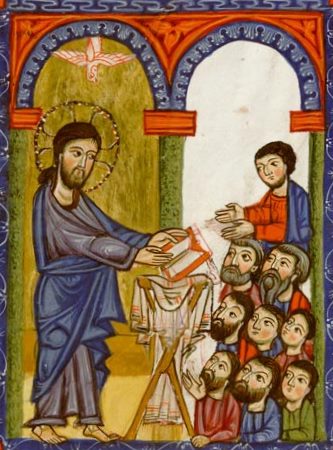
Jesus was the hometown boy of Nazareth, the rising star who was putting the small village on the map. He walked into the synagogue on the Sabbath with the people all watching with pride, their chests puffed with delight over one of their own making it to the big time. 

It just so happened that on that day the Old Testament reading was from the prophet Isaiah – a prophecy of grace and healing that fit the budding ministry of Jesus. Here was the hope of Israel. It was all bunnies and butterflies, until Jesus decided to say a few words to them all….

Jesus took the prophecy of Isaiah about proclaiming liberty to captives and the oppressed and then applied it, not to his fellow Jews who were present, but to, of all people, Gentiles! 

Jesus just had to open his mouth and point out that in the days of Elijah, the prophet was sent to a Gentile woman. In addition, Jesus let everyone know the prophet Elisha cleansed a Gentile. The gathered synagogue worshipers understood exactly what Jesus was doing – claiming to be the ultimate prophet, sent for those people. 

It was too much for the people gathered for worship. All hell broke loose as the “worshipers” became so angry and insolent that they drove Jesus out of town and tried to kill him. Jesus had that kind of effect throughout his earthly ministry by saying and doing the unexpected. 

The people of Nazareth seemed to have always interpreted the message of Isaiah and the prophets as being for themselves, not others. Whenever any believer or church loses sight of a biblical message and re-interprets it as being for only us, then we end up like the Nazarenes of old who did not recognize Jesus for who he really is and what he really came to do. 

Some believers and churches need a question asked of them: Are you ready to throw Jesus off a cliff?

Our faith is not merely individual; it is meant to impact the world. In the beginning the earth was created by God and it was good. Yet, it didn’t take long for things to go sideways. The fall of humanity into sin and disobedience brought death and decay to the world. Ever since, the human condition has been dominated by guilt, shame, indifference, violence, taking advantage of others, pride, and selfishness.

However, God did not leave the world to its own demise. The Lord began the process of reconciliation, culminating in the person and work of Jesus Christ. And now, Christians are a new society, the community of the redeemed, the church. As the people of God, we are called to do justice, love mercy, and walk humbly.

Jesus came to save us from our predicament, and to proclaim good news to the poor, freedom for prisoners, recovery of sight for the blind, and freedom for those oppressed by others. The kingdom of God is to extend over every square inch of this earth, every nation, every race and ethnicity, every institution and organization, and every individual. It all belongs to God’s rule and reign in Christ.

Jesus has made us, his disciples, ambassadors of reconciliation. Ever since the fall of humanity, God is reclaiming and redeeming, even now, all of creation back to himself. The Lord is seeking to bring people back into the harmony that existed in the Garden of Eden. Although this will only be fully realized when Christ returns, we presently now have the responsibility to be gracious agents of God’s kingdom, restoring all areas of this world and all people to their rightful place, at peace with God.

There is every reason to hope because a new world began emerging at the resurrection of Jesus Christ from death. As Christians, we accept struggle and hardship in this life and endure all things because, even though disease, destruction, and death claim so many lives, the love of God in Christ will never change nor die.

Because of the risen and ascended Christ, who is the light for all people everywhere, Christ’s disciples are able to respond to the great mass of human suffering with compassion.

This is important since compassion might not be our initial reaction to human suffering. Like the villagers in Christ’s hometown of Nazareth, we can chafe at the thought of compassionately reaching out to the poor, the prisoner, the blind, and the oppressed. We might either resist ministry to the “other” because we believe they caused their own poverty and adverse situation, or because we simply don’t believe we are wired for ministry to them.

If you knew me before I was a Christian, you might not recognize me. I didn’t love anybody. I had no compassion for anyone. It wasn’t until I experienced the love and compassion of Jesus Christ that my life turned upside-down. I began responding to human need with a deep concern. I sought to connect with all kinds of people. I wanted to make a difference in the world.

Back then I was (and to some degree still am) something of an agitator. Maybe that’s one reason I am so drawn to the compassion of Christ. For compassion is actually a radical form of criticism, declaring that our pains and our hurts are to be taken seriously, that they are not to be accepted as natural but abnormal and unacceptable for the human condition. It’s not supposed to be this way!

The compassion of Jesus needs to be understood as a totally subversive action against the kingdom of darkness, a bold and daring affront against all that keeps people locked into systems of oppression and poverty.

The world needs to experience the Church everywhere as a place and a people of good news – expressed in both word and deed – in which they are hospitably invited into the very life of God and experience the fullness of peace and joy in the Holy Spirit. In other words, we are not only in the personal transformation business, but we are also in the business of transforming society so that the common good of all persons is upheld.

As the church proclaims and seeks to establish the kingdom of God, it comes to see that all human need is important – whether it is spiritual, physical, mental, or emotional. We “do justice” by helping others experience the reality of God’s love in Christ and compassionately meet their holistic needs. We “love mercy” by showing hospitality and inviting folks very different from ourselves into our lives. We “walk humbly” with our God by emulating the compassionate ministry of Jesus to all people.

What is your “compassion quotient?” That is, how much compassion do you have in your life right now?

What are some tangible ways we can work on raising our level of compassion and demonstrating compassionate action to those around us and in our city?

It is questions like these that enable us to sync our lives with the heart of Jesus, who still desires to bring good news to the world.

Almighty God, you sent your Son Jesus Christ to reconcile the world to yourself: We praise and bless you for sending your people in the power of the Spirit to preach the Gospel to all nations. We thank you that in all parts of the earth a community of love has been gathered together by many prayers and labors, and that your people share in your mission of restoring all people to unity with yourself and one another in Christ; for the kingdom and the power and the glory are yours forever. Amen.

The Effects of Humanity’s Fall


            The entire world is profoundly broken.  Everywhere people are ‘messed-up’.  Anywhere one goes, whether it is school, work, home and even church, there is institutional brokenness expressed in systems or organizing structures that contain elements of bondage instead of freedom.  It does not take a Christian to observe and know that things just do not seem right.
 
            The Bible’s description of this reality goes back to the fall of humanity.  Satan, the devil, led the original persons, Adam and Eve, into disobedience of God.  Satan tempted Eve to doubt whether God really had her best interests at mind; to question the truthfulness of God’s Word; and, to wonder about the wisdom of listening to God (Genesis 3:1-5).  Adam just flat out chose to disobey God, and, so, the entire world changed (Genesis 3:16-17). 
 
            Immediately, everything was different in the world and with people.  The choice to disobey God brought feelings of fear and shame; a loss of fellowship with God; hiding from God; a bent to pervert the truth; the propensity for the genders to try and dominate each other; expulsion from the garden; and, physical death (Genesis 3:7-24).  That is quite a list of downright icky stuff.  No wonder the world is messed up.
 
            The fall of humanity still affects us all.  It has brought not only physical death, but spiritual death.  That means we are alienated from God, in rebellion against him, and enslaved to our own passions and desires (Isaiah 1:2-6; Romans 2:14-15; Ephesians 2:1-3).  We are alienated from one another as persons by having continual bents toward discord, suspicion, and jealousy instead of love and trust (Romans 1:29-31; James 3:14-16).  We are even alienated and totally out of touch with ourselves by either loving ourselves as gods or hating ourselves with inordinate emotional masochism (Philippians 2:21; 2 Timothy 3:2-4).  In short, we are selfish people who experience separation from God, others, and self.
 
            If this is the true reality of humanity, then it is depressing, discouraging, and damaging.  Who, then, will rescue us from this death?  Thanks to God who has given us victory through the Lord Jesus Christ (Romans 7:24-25; 1 Corinthians 15:57).  The good news is that through the death and resurrection of Jesus the curse has been reversed.  He has brought us restoration to our original place of fellowship with God.  Jesus is the way, the truth, and the life.  Only through him is there hope for humanity (John 14:6).  Freedom, therefore, involves knowledge, honesty, and sincere decisions of faith and love whereby truth is applied to life.
 
            Jesus offered himself for us so that we might live and no longer be separated from God, others, and self.  He has brought us reconciliation.  In him we have been blessed with every spiritual blessing (2 Corinthians 5:16-19; Ephesians 1:3; 2 Peter 1:3).  Jesus is the rightful ruler of the universe, and is able to make all things work together for good in the life of his people (Philippians 2:9-11; Romans 8:28-29).
 
            The essence, spirit, and purpose of church ministry, therefore, is to come alongside people trapped in their cycles of  brokenness and tell them of the good news of Jesus to deliver from all the crud.  Anything short of this is not really Christian ministry; it is just doing stuff.  The church is, then, to call out sin where it resides in sinful structures and not only within individuals.  But we are to do this with all the graciousness that behooves children of God, and always with the remedy of the cross of Christ.


            Yes, the world is terribly askew.  But God demonstrated his love for us in that, while we were still sinners, Christ died for us (Romans 5:8).  We need a Savior.  God provided One.  Jesus is the answer.  Are you in touch with the ways you are separated from God, others, and self?  Are you aware of the ways in which your church has an unhealthy separation from the world?  In what ways can you and your church apply the love of God to broken people and systems in your community?  What will it take to reach the un-churched and de-churched in your families and neighborhoods?  
 
            Having the church ask the right questions is the first step toward bringing true Christian ministry to bear upon the great need of the world.  Don’t express your fallen nature by wasting your time debating personal preferences in the church; spend your energies and prayers in reaching people for Jesus.  The fall does not have to define us; we can get back up again because of Jesus Christ.

Hiding from God


Our human nature tends to look at the one thing we cannot do, instead of seeing all the range of possibilities that we can do.  The serpent, the devil, was successful in getting Adam and Eve to focus on that one tree they needed to avoid (Genesis 3:1-7).  Instead of seeing all the prospects of life with God, in our fallen condition just tell us what we cannot do and we will probably be sure to do it.  More than that, the devil subtly planted a terrible and untruthful idea in the heads of Adam and Eve – that God was somehow holding out on them and was not providing everything they really needed and wanted in life.  Sin looks really good, and even initially tastes really good.  Yet, sin has an awful aftertaste and reeks inside us.  Sin always over-promises and under-delivers.
 
            We all face temptation, sin, and the effects of sin.  Perhaps the greatest impact of sin is sewing fig leaves for ourselves and hiding – hiding from God, hiding from one another, and even hiding from ourselves.  All this hiding causes us to be spiritually blind, and to sleepwalk through hell unaware of our true spiritual condition.  Because of this reality, we all need a Savior to deliver us.  Apart from God we are only dust.  We need God’s Spirit to breathe life into us.  We need God’s Spirit to breathe life into the church.  We need God’s Spirit to grace us with conviction of sin, and breathe new life into us so that we may again enjoy him in Paradise.  Just as we did not give ourselves life and cause ourselves to be born, so we cannot give ourselves new life but must be born again by God’s Spirit.
 
            Hiding with fig leaves is the symbolic way of demonstrating that Adam and Eve were acting independently, and were now going to operate on their own apart from God.  Our fallen spiritual condition does not want to acknowledge our need for the sheer grace of God.  Instead, we hide our true motives and desires.  Through The Fall we are inclined to look for ways to deal with problems in our lives apart from God.
 
            We want to return to Paradise, and we devise all kinds of thoughts and ways of doing that.  Paradise always seems to be “out there” somewhere.  In our fallen condition, we buy into the “if only” syndrome instead of dealing with the sin in our own hearts.  If only we had that one thing, then we would be happy and be in Paradise.  Single people may look for that special someone, believing that Paradise will come if they meet Mr. Right or Miss All That.  Married persons may think that if only their spouse would be more like _____, then Paradise will come.  Kids might believe that when they grow up, then there will be independence and they can do whatever they want and there will be Paradise.  “If only” we had more money.  “If only” we had a bigger house, another car, or more power and influence.  “If only” other people would stop being jerks, care more, serve more, love more.  “If only” I had my way then, we think, there would surely be a restoration to Paradise.
 
We often expect way too much of relationships with others.  A woman will never find a man who completes her because no man can fix what is broken within her heart.  Even If every woman had a man who thought of nothing but her, how to romance her, how to love and encourage her, she would still be empty.  No man is enough.  Every woman needs a Savior.  And a man will never find a woman that takes care of everything in his life.  Even if every man came home each evening to a woman who was all dolled-up with a freshly grilled steak on the table for him, he would still be empty because no woman can fix what is broken within his heart.  Neither red meat nor any woman can provide for a man what he really needs.  Men need a Savior.  We all need a Savior.  We all need deliverance from our disordered loves and misguided attempts to find Paradise in this life apart from God.  The temptation after The Fall is to try and find Paradise outside of God through perfect relationships and ideal circumstances.  Yet, what we really need is to repent of the sin of our own hearts, and deal with the brokenness of our own lives.  And that is what the season of Lent is all about.
 
In this season of Lent, we must repent of our hiding and wishing for everything and everyone else to be different without any cost to ourselves.  What do you need to repent of in this season?  Who are the people that you look to do for you what only God can do?  Have you forsaken your first love of Jesus Christ?  Has your relationship with God been non-existent?  Has it been stale, dull, and lacking passion, desire, and energy?  Has distance replaced intimacy between you and God?  Do you avoid the spiritual disciplines of bible reading and prayer because you believe something else will satisfy the real needs of your heart?  Are you keeping up appearances and hiding, while on the inside you have doubt, depression, and despair that things will never change? 


May you have the courage to face the empty places of your heart and allow the unconditional grace of Jesus to cleanse and fill your soul.  Soli Deo Gloria.