Acts 5:33-42 – Worthy to Suffer Disgrace

The Apostles by Russian artist Peter Gorban (1923-1995)

When the council members heard this [God raised Jesus from the dead—whom you killed by hanging him on a tree] they became furious and wanted to kill the apostles. One council member, a Pharisee and teacher of the Law named Gamaliel, well-respected by all the people, stood up and ordered that the men be taken outside for a few moments. He said, “Fellow Israelites, consider carefully what you intend to do to these people. Some time ago, Theudas appeared, claiming to be somebody, and some four hundred men joined him. After he was killed, all his followers scattered, and nothing came of that. Afterward, at the time of the census, Judas the Galilean appeared and got some people to follow him in a revolt. He was killed too, and all his followers scattered far and wide. Here is my recommendation in this case: Distance yourselves from these men. Let them go! If their plan or activity is of human origin, it will end in ruin. If it originates with God, you will not be able to stop them. Instead, you would actually find yourselves fighting God!” The council was convinced by his reasoning. After calling the apostles back, they had them beaten. They ordered them not to speak in the name of Jesus, then let them go. The apostles left the council rejoicing because they had been regarded as worthy to suffer disgrace for the sake of the name. Every day they continued to teach and proclaim the good news that Jesus is the Christ, both in the temple and in houses. (CEB)

People talk about things which are important to them. Even quiet and introverted individuals will speak at length, barely taking a breath, if you get them on a topic for which they are passionate about. 

Today’s New Testament lesson has the Apostles speaking incessantly about someone they love to talk about.  In fact, the original disciples of Jesus chattered so much about who they loved, Jesus, that the Jewish ruling council (the Sanhedrin) wanted to shut them up by killing them. But a wise member of the council saw the foolishness of this approach and persuaded the Sanhedrin against it. Instead, the council gave the Apostles a thorough whipping, warned them to stop talking all the time about Jesus, and let them go.

There is a time to listen, and there is a time to speak.  The Apostles could not keep silent.  They considered their beating an act of solidarity with their Lord Jesus and went right on talking. Every day they spent time in the temple and in one home after another. They never stopped teaching and telling the good news that Jesus is the Messiah.

The joy of knowing Jesus – crucified, risen, ascended, and coming again – is such a rich experience that one cannot help but be a chatterbox with joy about him. Even in the face of persecution, the ecstasy of knowing Christ transcends physical pain and suffering.

Today, there are places throughout the world where the scenario of continual discourse about Jesus is taking place with joy, despite the presence of persecution.  There are also places, mainly in America, where talking about Jesus does not even take place in the church building where believers gather to worship, let alone out in the public square.

One of the great tragedies of the contemporary Western church is that one can talk freely and openly about the weather, the latest sports, political happenings, and get away with never speaking or dialoging about Jesus.

The Apostle Peter, having learned the hard way, exhorted believers in his epistle that suffering is inevitable. So, the real issue is whether one suffers because of Christ or because of their own wrongheaded decisions. If others reject us, let it be for holiness, love, and hospitality – and not for babbling a bunch of unbiblical nonsense. Peter said:

Since Christ suffered in his body, arm yourselves also with the same attitude… Dear friends, do not be surprised at the fiery ordeal that has come on you to test you, as though something strange were happening to you. But rejoice because you participate in the sufferings of Christ, so that you may be overjoyed when his glory is revealed. If you are insulted because of the name of Christ, you are blessed, for the Spirit of glory and of God rests on you. If you suffer, it should not be as a murderer or thief or any other kind of criminal, or even as a meddler. However, if you suffer as a Christian, do not be ashamed, but praise God that you bear that name. (1 Peter 5:1, 12-16, NIV)

Today, allow two different emotions to arise and sway your prayers and speech.  First, allow the joy of the Lord Jesus to fill you and give you freedom to speak his Name and the grace he gives.  Second, allow a sorrowful lament to come forth from your heart, and speak it out loud before God concerning the great silence of the church in the West.

Loving Lord Jesus, you save completely those who come to you by faith.  Thank you for the work of forgiveness and healing that takes place in your Name everyday in the world.  Yet, I also lament the many confessing believers in your Name who never speak of the good news in their everyday conversations, even within the church.  Lord, have mercy. Christ, have mercy. Lord, have mercy and grant us peace.  Amen.

Psalm 69:1-5, 30-36 – The Praise of Suffering

Psalm 69 by Japanese painter Makoto Fujimura

Save me, God,
    because the waters have reached my neck!
I have sunk into deep mud.
    My feet cannot touch the bottom!
I have entered deep water;
    the flood has swept me up.
I am tired of crying.
    My throat is hoarse.
    My eyes are exhausted with waiting for my God.

More numerous than the hairs on my head
    are those who hate me for no reason.
My treacherous enemies,
    those who would destroy me, are countless.
    Must I now give back
    what I did not steal in the first place?
God, you know my foolishness;
    my wrongdoings are not hidden from you….

I will praise God’s name with song;
    I will magnify him with thanks
    because that is more pleasing to the Lord than an ox,
    more pleasing than a young bull with full horns and hooves.
Let the afflicted see it and be glad!
    You who seek God—
    let your hearts beat strong again
    because the Lord listens to the needy
        and does not despise his captives.

Let heaven and earth praise God,
    the oceans too, and all that moves within them!
God will most certainly save Zion
    and will rebuild Judah’s cities
    so that God’s servants can live there and possess it.
The offspring of God’s servants will inherit Zion,
    and those who love God’s name will dwell there. (CEB)

As the Church’s and the Christian’s prayer book, the psalms offer a way to come to God when our feelings and emotions have us not knowing how to pray, at all.  If you are depressed because of people who would like to see you fail or are out to get you, then this is the psalm for you to pray!

When you are voiceless, the psalter can voice it for you. When you are unable to put your thoughts into words, the Scripture can word it for you. Two of the great attributes of God are divine power and love, which means that the Lord is more than able to do something about your situation, and it will always be done in a loving way.  Know today that God hears you and is working on a response to your lament – even if it is not in your own words but the words of Holy Scripture.

Psalm 69 by Austrian artist Ernst Fuchs, 1960

God will come through in God’s own good time. However, you can still praise the Lord right now, smack in the middle of your dilemma. David, the author of today’s psalm, chose to praise God, even though he did not get an immediate answer to his prayers. Perhaps God is more concerned to change us before changing our circumstances.

We need a solid theology of suffering. And that biblical psalms give it to us. I know of no one who wakes in the morning, sits on the edge of their bed, and says, “Gee, I want to suffer today and feel lots of emotional and spiritual pain.” No, we want happiness and joy, not agony and hardship. Yet suffering has much to teach us and the Lord is rarely quick to snatch us from its lessons. The hardship of personal suffering teaches us faith and dependence upon God, as well as leading us to ask for help from others so that we are lovingly supported.

“The way you look at things is the most powerful force in shaping your life.”

john o’donohue

Tribulations in life are common to all people without exception. The issue is whether we will submit to its hard-knock education, or not – whether we will become better people, or bitter. The Irish teacher and poet, John O’Donohue, penned a poem entitled, “For Suffering,” concerning the blessing of hard things:

May you be blessed in the holy names of those

Who, without knowing it,

Help to carry and lighten your pain.

May you know serenity

When you are called

To enter the house of suffering.

May a window of light always surprise you.

May you be granted the wisdom

To avoid false resistance;

When suffering knocks on the door of your life,

May you glimpse its eventual gifts.

May you be able to receive the fruits of suffering.

May memory bless and protect you

With the hard-earned light of past travail;

To remind you that you have survived before

And though the darkness is now deep,

You will soon see approaching light.

May the grace of time heal your wounds.

May you know that though the storm may rage,

Not a hair of your head will be harmed.

To Bless the Space Between Us: A Book of Blesings (Doubleday, 2008)

We have all likely at times felt the anguish of the psalmist – being so overwhelmed that it feels like we are drowning. The feeling is compounded exponentially when behind the sense of trying to keep our heads above water there are people who do not like us – maybe even hate us, to the point of undermining our work every chance they get.  It is in such circumstances we might experience sleepless nights hoping that somehow and someway God will show up.

The typical modus operandi for some within adverse situations is the age-old route of complaining and wishing things were different. Yet neither griping about our problems nor dishing out slander and gossip toward others is a healthy way of dealing with adversity. Just the opposite response is the proper path to the bone-crushing feeling of opposition: to praise God’s name with a song and magnify the Lord with thanksgiving. 

The reason the believer can engage in adoring God during trouble is not some Jedi-type mind trick to make us think more positively. Instead, the basis for praise is in knowing God. It is God who ultimately will deal with the wicked; it is the Lord who will bend to listen to our lament when times are hard. 

Thanking God for answers to prayer in advance of them being answered is a biblical thing to do. Having a faith robust enough to see ahead toward hope can bring love to a loveless situation, and usher in praise before the divine deed of deliverance is even accomplished.

Saving God, thank you for your deliverance!  I give you praise for loving me through sending your Son, the Lord Jesus, to this earthly realm so that I might experience salvation from sin, death, and hell. By Christ’s authority, in the power of the Holy Spirit given to me, I resist the enemy’s attempts to seize control of my life.  I belong to you, holy God. Amen.

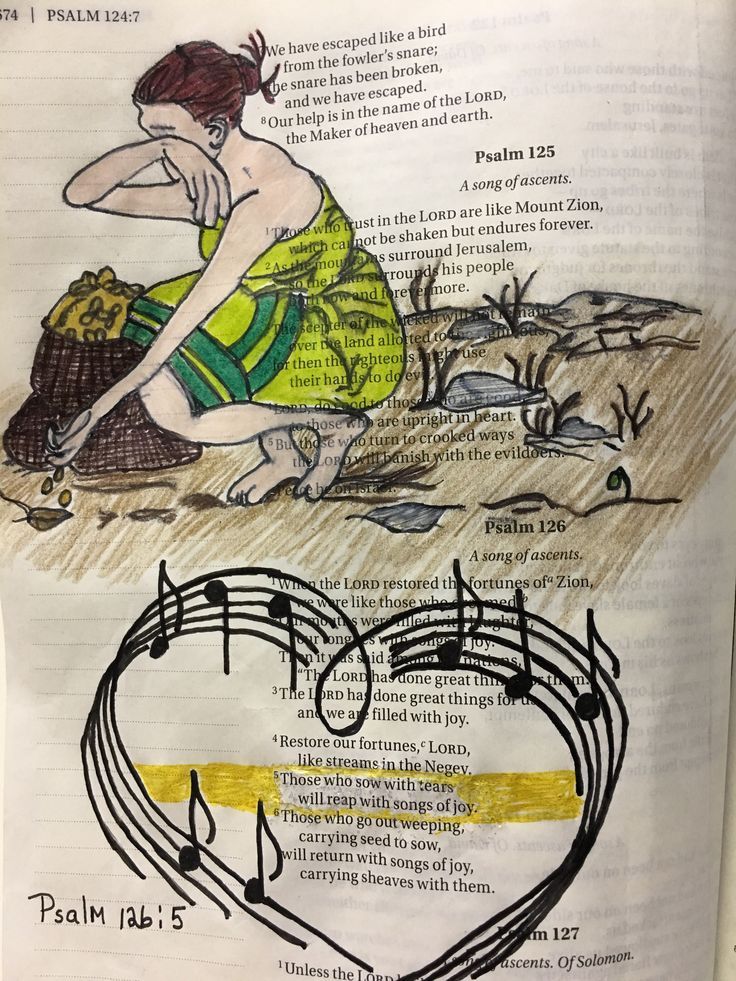
Psalm 126 – Sorrow and Joy

When the Lord restored the fortunes of Zion,
    we were like those who dreamed.
Our mouths were filled with laughter,
    our tongues with songs of joy.
Then it was said among the nations,
    “The Lord has done great things for them.”
The Lord has done great things for us,
    and we are filled with joy.

Restore our fortunes, Lord,
    like streams in the Negev.
Those who sow with tears
    will reap with songs of joy.
Those who go out weeping,
    carrying seed to sow,
will return with songs of joy,
    carrying sheaves with them. (NIV)

Likely none of us awake in the morning, sit up on the edge of the bed and say to ourselves, “Well, let’s see, I think I’ll cry and be sorrowful today.” We might do that with joy, not with sadness. It can be easier to gravitate toward the fulfillment of dreams, laughter, and happiness than tears and weeping.

If we want to experience authentic joy, the path is through crying because it is our tears which find a better way.

Whether it comes from a certain denominational tradition, ethnic background, or family of origin dynamics, there are many Christians who love to emphasize Jesus as Victor and camp in resurrection power – while eschewing Christ as the man of sorrows, acquainted with grief and sadness.

It is from this place of continually viewing only one dimension of Christ’s redemptive work that pastoral care often falls far short of true help. Trying to engineer cheerfulness and create solutions to a person’s genuine grief is, at best, not helpful, and at worst, damaging to their soul. Such attempts will only lead to cheap joy.

Coming to the place of sincerely singing spontaneous songs of joy with a sense of abundant satisfaction comes through suffering and sorrow.

There must be a crucifixion before there is a resurrection. In the agrarian culture of ancient Israel, the metaphor of sowing a reaping connected well to the importance of planting tears and allowing them to flower later into an abundant harvest of joy.

Perhaps in American culture, a more apt metaphor would be financial investing and cashing out. The investment we put into attending to our grief with expressions of lament through tears, will eventually get a return, and we shall be able to cash out with a rich bounty of joy.

All good things in life are realized through a lot of blood, sweat, and tears. “Blessed are those who mourn,” said Jesus, “for they shall be comforted” (Matthew 5:4, NIV). Just as it takes both field crops and economic investments time to grow and mature, so the believer’s life is a process of spiritual development which is watered through tears and experiences the up-and-down sorrows of a market economy.

There is coming a day when our joy will be realized in full measure. The season of Advent reminds us that we must wait, and that we must suffer many things before we enter the kingdom of God and enjoy unending fellowship with our beloved Savior and King.

Great God almighty, with expectant hearts we await the coming of Christ. As once he came in humility, so now may he come in glory so that he may make all things perfect in your everlasting kingdom. For Christ is Lord forever and ever. Amen.

Philippians 3:7-11 – The Ultimate Value

A mosaic of the Apostle Paul in St Isaac’s Cathedral, St. Petersburg, Russia

Christ has shown me that what I once thought was valuable is worthless. Nothing is as wonderful as knowing Christ Jesus my Lord. I have given up everything else and count it all as garbage. All I want is Christ and to know that I belong to him. I could not make myself acceptable to God by obeying the Law of Moses. God accepted me simply because of my faith in Christ. All I want is to know Christ and the power that raised him to life. I want to suffer and die as he did, so that somehow, I also may be raised to life. (CEV)

As I looked at today’s date, I realized that it was on this day thirty-six years ago that my now dear wife told me, “I love you.” Two months previous, I had told her, “I love you.” She did not reciprocate. Instead, this lovely girl whom I had come to love (it was not love at first sight for either of us, which is a much longer story for another time) flat out retorted back to me, “Well, I don’t love you. Listen, Mr., I’ve heard every line in the book. What’s your angle? What do you want from me?”

For me, I knew I what I had was genuine love and not infatuation because I found myself responding matter-of-factly, “There’s no angle. I love you. If you choose not to love me back, I’ll just keep loving you.” This threw her into a two-month long sort of existential angst in which she explored the depths of her own spirit to see if her best friend was her love, as well.

So, when the love of my life said to me on that day, “I love you,” I knew it came from a place of soul-searching, prayer, trepidation, deliberate resolve, and genuine sincerity. For my wife, to say those words meant she was committed to me. They were not said lightly. It took a lot for those words to be formed.

On that day thirty-six years ago, the both of us had amazing clarity about the direction of our lives. We were going to be together, and no other person would ever have the primary place we each now enjoyed with one another. To me, every other girl seemed like nothing compared to my beloved. And, I will still admit, my feelings have not changed one iota.

I picture the Apostle Paul going through a similar struggle and process of coming to Christ. And once he did commit, no one was ever going to usurp the place of Jesus in his life.

I honestly believe that the primary reason my dear wife and I have been together all this time and still love each other as if it were December 10, 1984 is because of our shared commitment and ultimate value of knowing Christ. For each of us, Jesus is everything. Our lives center around him. The grace of God in Christ shapes all our worldview and animates every action we take.

Together with the Apostle Paul, we want to know Christ and we will take whatever situation is necessary to realize a continual growth in grace with Jesus at our side. Just as the adversity, hardship, and difficulties we have faced together over the decades has caused to bring us even closer together, so facing all of it with Christ in the middle of it has brought us closer to God.

Although it may seem counter-intuitive, power and suffering go together. For example, weightlifting causes fibers of the muscles to sustain injury. So, the body repairs those damaged fibers by fusing them, which then increases the mass and size of the muscles. It is through suffering, even trauma, that muscles grow bigger and stronger.

Spiritual power results from undergoing suffering. Through hard circumstances, our spirits experience hurt. Yet, through the process of healing we become stronger, more resilient, and our faith grows. A deeper experience of Christ and a greater intimacy with Jesus results from identifying with him in his suffering. Show me a person with vigorous faith and I will show you a person who has been strengthened through suffering.

When Jesus Christ is our surpassing value, everything else is viewed differently – the past, present, and future take on new meaning. We tell ourselves an alternate story, based in the person and work of Christ. In this Christian season of Advent, we look back to the first advent of Christ’s incarnation; look forward to the second advent of Christ coming again; and, this shapes how we live in the present between the two advents accepting suffering as a gift and embracing fresh power as a means to serve others.

Yes, this is a special day for me. Yet, everyday is a special day when I can enjoy fellowship with my Lord together with my wife.

Almighty and eternal God, so draw my heart to Christ, so guide my mind, so fill my imagination, so control my will, that I may be wholly yours, utterly dedicated to you; and then use me, I pray you, as you will, and always to your glory and the welfare of your people; through the sufferings of my Lord and Savior Jesus Christ and in the his great resurrection power I pray. Amen.