2 Kings 22:11-20 – Humble Yourself

The Scribe Shaphan Reading The Book Of Law To King Josiah by Leonaert Bramer (1596-1674)

When Josiah heard what was in The Book of God’s Law, he tore his clothes in sorrow. At once he called together Hilkiah, Shaphan, Ahikam son of Shaphan, Achbor son of Micaiah, and his own servant Asaiah. He said, “The Lord must be furious with me and everyone else in Judah, because our ancestors did not obey the laws written in this book. Go find out what the Lord wants us to do.”

The five men left right away and went to talk with Huldah the prophet. Her husband was Shallum, who was in charge of the king’s clothes. Huldah lived in the northern part of Jerusalem, and when they met in her home, she said:

You were sent here by King Josiah, and this is what the Lord God of Israel says to him: “Josiah, I am the Lord! And I will see to it that this country and everyone living in it will be destroyed. It will happen just as this book says. The people of Judah have rejected me. They have offered sacrifices to foreign gods and have worshiped their own idols. I cannot stand it any longer. I am furious.

“Josiah, listen to what I am going to do. I noticed how sad you were when you read that this country and its people would be completely wiped out. You even tore your clothes in sorrow, and I heard you cry. So, I will let you die in peace before I destroy this place.”

The men left and took Huldah’s answer back to Josiah. (Contemporary English Version)

It is hard to fathom that things spiritually degenerated so much in the kingdom of Judah that the Book of Law, God’s Word to Israel, was completely lost. The Law was tucked so far back in the temple, and had gathered so much dust, that everyone simply forgot it existed. 

Maybe we in the Western world can relate to this more than we think. When a plethora of Bibles and translations exist, yet they gather dust on the shelf, and we have not cracked it open since….?

We are approaching the end of the Christian Year which annually culminates in Christ the King Sunday. As we journey with Jesus and ascend his holy hill, we anticipate corporately acknowledging Christ’s lordship. A good and biblical way to do so is through penitent humility. 

King Josiah’s officials found the Book of the Law and brought it to him. After they read the words, which had not been uttered for a very long time, the king was completely undone with humble repentance. He realized the life of the nation did not revolve around the majesty and kingship of God, and it cut him to the core of his being.  

An appropriate response to the realization of God’s sovereignty and Christ’s lordship is humility. Without humility, there is no going forward; there is only the ghastly state of remaining stuck in one place with ancient dust accumulating on our static hearts. However, with humility there is repentance; and with repentance there opens up the grand vistas of hope, new life, and fresh beginnings.

“It was pride that changed angels into devils; it is humility that makes men as angels.”

St. Augustine

I (humbly) ask that you try something quite different from your regular experience today. Put on some old clothes then carefully read the words of today’s Old Testament Scripture lesson. Take the time to acknowledge a sin of omission in your life. Then, tear your clothes; yes, rip your shirt. 

Allow yourself to feel, like Josiah, the realization of missing the mark. Yet do not remain in this condition. Drink in the grace of God in Christ and receive the forgiveness that is yours in Christ. The trajectory of our Christian lives is determined by the depth of humility we experience and filling the hole with mercy.

It’s difficult to be submissive. To acknowledge, without denial, that we are in a bad place and will reorient our lives takes a lot of courage and humility. If pride and arrogance are the original sin, then the remedy to that malady is a meek and obedient spirit. 

No matter who we are, people are meant and designed by their Creator to live a humble life of submission to the moral and ethical will of God.

Humility is the cornerstone to every good thing in this life.  Jesus said:

“Blessed are the poor in spirit, for theirs is the kingdom of heaven… Blessed are the meek, for they will inherit the earth.” (Matthew 5:3, 5 NIV)

The door of God’s kingdom swings-open on the hinges of humility. The Apostle Paul, seeking to follow his Master Jesus in his teaching and humility said:

“Since God chose you to be the holy people he loves, you must clothe yourselves with tenderhearted mercy, kindness, humility, gentleness, and patience.” (Colossians 3:12, NLT)

Basic human relations are to be firmly grounded in humility. The old prophet made his expectations clear:

“He has told you, O mortal, what is good; and what does the Lord require of you but to do justice, and to love kindness, and to walk humbly with your God?” (Micah 6:8, NRSV)

Life is truly life when it is based in humility. We live with the confidence of the psalmist:

“God leads humble people to do what is right, and he teaches them his way.” (Psalm 25:9, GW)

In the end, we are to bow to the God of the Word, for the Word is life.

Awesome God, although I might not always perceive your majesty and sovereignty, you stand above all creation as the Lord whom I am to submit to in all things.  I come to you in great humility of heart and vow to obey everything I read in your Holy Word through Jesus Christ, my King. Amen.

Ephesians 5:21–6:9 – Submit to One Another

Submit to one another out of reverence for Christ.

Wives, submit yourselves to your own husbands as you do to the Lord. For the husband is the head of the wife as Christ is the head of the church, his body, of which he is the Savior. Now as the church submits to Christ, so also wives should submit to their husbands in everything.

Husbands, love your wives, just as Christ loved the church and gave himself up for herto make her holy, cleansing her by the washing with water through the word, and to present her to himself as a radiant church, without stain or wrinkle or any other blemish, but holy and blameless. In this same way, husbands ought to love their wives as their own bodies. He who loves his wife loves himself. After all, no one ever hated their own body, but they feed and care for their body, just as Christ does the church— for we are members of his body. “For this reason, a man will leave his father and mother and be united to his wife, and the two will become one flesh.” This is a profound mystery—but I am talking about Christ and the church. However, each one of you also must love his wife as he loves himself, and the wife must respect her husband.

Children, obey your parents in the Lord, for this is right. “Honor your father and mother”—which is the first commandment with a promise— “so that it may go well with you and that you may enjoy long life on the earth.”

Fathers do not exasperate your children; instead, bring them up in the training and instruction of the Lord.

Slaves, obey your earthly masters with respect and fear, and with sincerity of heart, just as you would obey Christ. Obey them not only to win their favor when their eye is on you, but as slaves of Christ, doing the will of God from your heart. Serve wholeheartedly, as if you were serving the Lord, not people, because you know that the Lord will reward each one for whatever good they do, whether they are slave or free.

And masters, treat your slaves in the same way. Do not threaten them, since you know that he who is both their Master and yours is in heaven, and there is no favoritism with him. (New International Version)

Submission – the word itself may stir a less than positive reaction within us.

For many people, submission implies someone else is going to have authority over me – and they might not like that. To submit to another person smacks of being forced into something we don’t want, like some mixed-martial-arts submission hold where the other person taps out.

It doesn’t help when many people have past experiences in which individuals in authority neither liked them nor treated them with respect. Their visceral reaction to the word “submit” is very raw and real.

Biblically, within the first pages of Genesis, the disobedience of Adam and Eve resulted not only in a separation between God and people, but also between man and woman. The Fall had terrible consequences for them. The entire world now lives under a curse. Relations between the sexes, because of the Fall and the curse, are twisted.

To the woman, God said,

“I will make your pains in childbearing very severe;
    with painful labor you will give birth to children.
Your desire will be for your husband,
    and he will rule over you.” (Genesis 3:16, NIV)

The phrase “your desire will be for your husband” is a Hebrew idiom (a metaphorical phrase with a special meaning). This refers to women’s urge for independence from men. 

“He will rule over you” is also a Hebrew idiom, referring to man putting woman “under his thumb” (an American idiom). 

Women, in their fallen state, work to be independent from men. They diligently try and function without them. 

Men, in their fallen state, bring a “heavy hand” (another American idiom) to women by insisting on always “calling the shots” (yet another idiom) and dismissing females as if what she has to say or think doesn’t matter, or at least doesn’t “carry much weight” (idiom again!) as a man’s words do.

The way gender relations, in the Christian tradition, are supposed to happen is based in who God is:

  • The Son (Jesus) submits to the Father by placing himself under authority. The Father, in turn, lifts up the Son to share in reigning with him in the kingdom of God.
  • The Church submits to Christ, and Christ, in turn, lifts up the Church so that she reigns with him in the kingdom of God.
  • The wife submits to husband, and he, in turn, lifts her up so that she reigns with him in the kingdom of God.

This is mutual submission – and not a matter of the boss and the bossed.

To submit simply means we willingly place ourselves under authority – the choice is with us. Forced submission is slavery and oppression – not true submission.  

To function without submitting to one another brings disorder and chaos, keeping the curse going into generation after generation. Christians, however, are to reverse the curse.

“God has bound us together in such a way that none of us should reject submission. Where love reigns, this spirit of service is mutual….  Since there is nothing more opposed to the human spirit than the desire to submit to others, Paul calls us to it by reminding us of the reverence we owe to Christ. He is the only one who can tame our rebellious spirit and subdue our pride, so that we are willing to serve our neighbors.”

John Calvin

It is important to understand how the grammar of today’s New Testament lesson is set up, because if we don’t get this, we will not practice submission well.

The main verb of the section is “be filled” with the Spirit (Ephesians 5:18). There are five participles which explain how the action of the main verb is to be done. Submitting is one of those participles. Submitting to one another is everyone’s responsibility.

Submission is a spiritual practice. The following people and relationships are mentioned (Note: these were intended by the Apostle Paul to be a representative list, not an exhaustive list):

  • Wives to husbands (respect)
  • Husbands to wives (sacrificial love) The head and body metaphor is meant to convey intimacy, union, and relationship, not any kind of silliness in husbands doing all the brain work and making all the decisions. Spouses are two people in one, just as the Father and Son are two in one. You cannot have two independent persons doing their own thing, any more than a head and body can operate independently.
  • Children to parents (obedience)
  • Parents to children (compassionate and empathic spiritual support)
  • Slaves to masters (obedience)
  • Masters to slaves (fair and equitable treatment)

Scripturally, we do a disservice if we only focus on how husbands, children, and slaves must submit, because we are all to submit to one another, including husbands, parents, and masters. 

Christians bring order out of chaos when there is submission to one another out of reverence for Christ.

Misunderstandings and misinterpretations of today’s text typically result in one group of people trying to force authority on another group. Proper understandings will always result in practicing humble and compassionate service to each other.

Submitting to one another means we must cooperate with one another instead of competing against each other. For example, women are to respect men by not acting as autonomous persons who have no need of those stupid men. And men are to not abuse women by ignoring and dismissing them as inferior emotional beings. Instead, both sexes will volitionally choose to submit to each other and act in accord, comity, and harmony.

All believers are to function together as God’s co-heirs and God’s co-rulers in and over God’s creation. This is the good order to which God has called us, and it is a high calling for which we need the filling of God’s Spirit to help us.

Lord Jesus, we bow down and humbly bring to you our gift of submission. Thank you for submitting to the Father until the end, achieving salvation for us. Teach us the meaning of meekness, and may our wills submit to your will. Graciously remove our disobedience and pride and shape us to your will. Guide us on the road of resigning our wills to yours. Mold our souls into total divine submission. Help us to walk in the path of righteous submission to each other, hand in hand. May we be filled with the Holy Spirit so that we will completely embody a submissive and teachable spirit. Amen.

Colossians 1:15-23 – Worship That Is Fit for a King

The Son is the image of the invisible God, the firstborn over all creation. For in him all things were created: things in heaven and on earth, visible and invisible, whether thrones or powers or rulers or authorities; all things have been created through him and for him. He is before all things, and in him all things hold together. And he is the head of the body, the church; he is the beginning and the firstborn from among the dead, so that in everything he might have the supremacy. For God was pleased to have all his fullness dwell in him, and through him to reconcile to himself all things, whether things on earth or things in heaven, by making peace through his blood, shed on the cross.

Once you were alienated from God and were enemies in your minds because of your evil behavior. But now he has reconciled you by Christ’s physical body through death to present you holy in his sight, without blemish and free from accusation— if you continue in your faith, established and firm, and do not move from the hope held out in the gospel. This is the gospel that you heard and that has been proclaimed to every creature under heaven, and of which I, Paul, have become a servant. (New International Version)

Jesus is King. Neither you, nor I, are. 

A simple statement; yet, not easily engrafted into daily life. 

The original sin of Adam and Even was rebellion – to break the bonds of loving authority God provided for them. We (especially us Americans) have this nasty anti-authoritarian strain which runs rather deep in us. 

As a child, when my middle daughter was grappling with the implications of faith in Christ, she once blurted out an honest cry that we can likely resonate with: “I just don’t want another person in my life telling me what to do!” 

Indeed, Jesus is King; we are not.

The New Testament lesson for today is rich with the pre-eminence and lordship of Jesus Christ: 

  • All things were created through Jesus and for him. 
  • Everything in all creation is held together by Jesus. 
  • Christ is the head of the church. 
  • In Jesus Christ, complete divinity exists and reigns. 
  • Jesus made peace through the cross because he had the authority and the qualifications to do so. 
  • Broken relationships and proper lines of authority are now restored and redeemed in Christ.

We can also likely relate to, at times, indulging an illusion of being in control and independently dictating the course of our lives. Yet, mercifully, Jesus is the great Sovereign, and this is a good thing – because in Christ we find reconciliation and purity of life. 

“The supreme thing is worship. The attitude of worship is the attitude of a subject bent before the King… The fundamental thought is that of prostration, of bowing down.”

G. Campbell Morgan

Because Christ is King, we really ought to submit to him. In fact, we need to pay some attention to how our bodies are to submit to his lordship.

When the body moves to animating physical actions of submission, this helps the heart to follow. Whole person worship involves engaging the mind, spirit, emotions, and, yes, the body. To neglect the body in worship is to truncate the ability to connect with God in Christ.

A typical metaphor for the Church is the “Body of Christ.” We can live into that phrase through an embodied spirituality of submission. Our individual bodies are temples of the Holy Spirit, important for expressing worship. (1 Corinthians 3:16)

God created us with literal physical bodies. And Jesus has a literal physical body. Bodies are important for whole person worship. This means the physical postures we take in worshiping King Jesus are significant. We need to pay attention to them.  

A healthy practice for Christians is to kneel in the presence of the Lord. I realize some Christian traditions do it as a part of their worship, and some do not. Some like it, some don’t. Yet, bowing, even prostrating oneself (if you are physically able!) can be a powerful symbol of the heart’s desire and disposition to submit to the lordship and authority of Jesus Christ. 

Crawling out of bed in the morning onto one’s knees and beginning the day aiming to live into the will of God, and ending the day in the same manner, are a practical means of remembering who Jesus is and who we are.

I believe all believers need to feel free in adopting a physical posture of worship which helps them connect with God in Christ. For some, that will be sitting in a comfortable position in contemplation. Others will want to stand, raise their hands, even dance in praise.

It also behooves us to let our bodies respond to whatever is happening with us spiritually. Exuberant praise needs the expression of hand clapping and toe tapping. Confession of sin needs a bit of bowing, kneeling, even prostrating. For prayer, hands open and palms facing up to receive blessing from God is a good bodily position of worship.

You get the idea. Just remember we need to strive for congruence in our worship, that is, what is happening with our outward bodily movements needs to match what is occurring inward with our spirits. And when the two are in sync, meaningful worship can happen – worship of submission fit for a king.

Sovereign God, in your mercy you have sent your Son, the Lord Jesus, who has brought reconciliation to a once broken relationship.  I bow before you in obedience, submission, and worship.  Let me live a cross-shaped life through enjoying the peace you have given me in Christ in both body and soul. Amen.

2 Samuel 6:1-11 – Unacceptable Worship

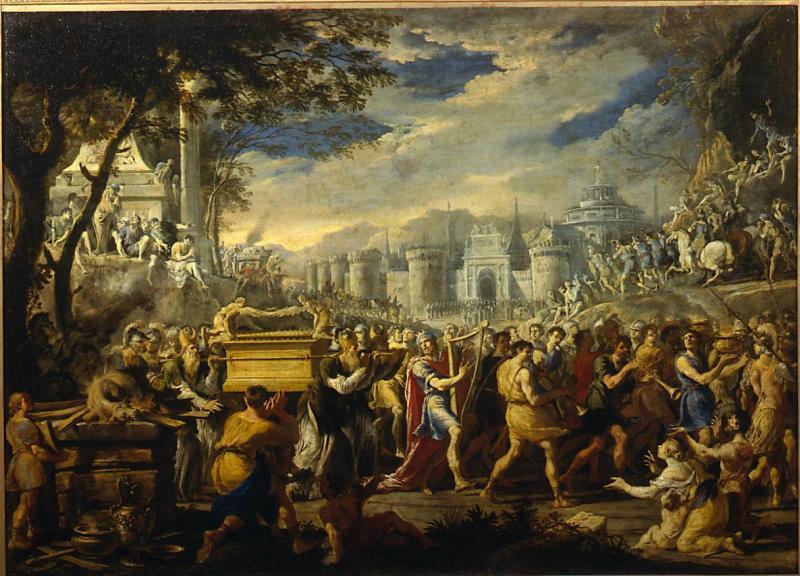
Transferring the ark of the Lord to Jerusalem by Domenico Gorgiolo (1609-1675)

David again brought together all the able young men of Israel—thirty thousand. He and all his men went to Baalah in Judah to bring up from there the ark of God, which is called by the Name, the name of the Lord Almighty, who is enthroned between the cherubim on the ark. They set the ark of God on a new cart and brought it from the house of Abinadab, which was on the hill. Uzzah and Ahio, sons of Abinadab, were guiding the new cart with the ark of God on it, and Ahio was walking in front of it. David and all Israel were celebrating with all their might before the Lord, with castanets, harps, lyres, timbrels, sistrums and cymbals.

When they came to the threshing floor of Nakon, Uzzah reached out and took hold of the ark of God, because the oxen stumbled. The Lord’s anger burned against Uzzah because of his irreverent act; therefore, God struck him down, and he died there beside the ark of God.

Then David was angry because the Lord’s wrath had broken out against Uzzah, and to this day that place is called Perez Uzzah.

David was afraid of the Lord that day and said, “How can the ark of the Lord ever come to me?” He was not willing to take the ark of the Lord to be with him in the City of David. Instead, he took it to the house of Obed-Edom the Gittite. The ark of the Lord remained in the house of Obed-Edom the Gittite for three months, and the Lord blessed him and his entire household. (NIV)

The narrator who originally compiled, told, and wrote this story wanted to communicate something significant about God and how to relate to the Lord.  God put the big kibosh on David’s hoedown. At that time in the history of Israel, the ark was the foremost symbol God was present with the people. Within the ark contained the tablets of the Ten Commandments (the symbol of God’s Word); the staff of the first priest, Aaron, (the symbol of God’s choice); and, a pot of manna (the symbol of God’s provision). 

The ark was a holy object, pointing to a holy God.

The ark of the Lord was built during the time of Moses, when the ritual laws were established concerning offerings and how to approach God in worship. There were detailed prescriptions for how to construct all the sacred articles for worship. (Exodus 35:30-40:33) 

The ark was at the center of worship, representing the presence of God among the people. For nearly five-hundred years before David, the ark had become a familiar object in the life of Israel, always there, continually being the symbol of God to the people.

We have all likely had the experience of something becoming so familiar to us that we begin to lose sight of how important and valuable it really is. Not until we lose it, or something traumatic happens, do we wake up and take stock of its true significance. 

The Israelites had become lethargic and apathetic toward the worship of God, and it led to some disheartening and tragic circumstances. The people of God throughout the ages have always needed to be vigilant against the opiate of familiarity, dulling the senses to the importance of worship.

Moving the ark of the Lord to Jerusalem was one of the first acts David did as the king of Israel and Judah.  God was with David and brought him success against his enemies. David enjoyed a close relationship with God.  Yet even though David’s heart was in the right place, he made a huge miscalculation which ended up offending God. 

David had the best of intentions in bringing the ark to Jerusalem and giving it a prominent place in the center of Jewish life. This was an exceptionally good plan. The problem, however, came in the manner the ark was carried from one place to another. 

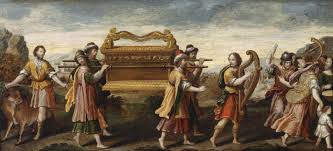
King David bringing the ark to Jerusalem by Unknown Italian artist, c.1500

God’s law laid out in careful detail how the ark was to be transported. Uzzah and Ahio were Levites charged with the ark’s care. Only the Levites could handle the ark and the holy objects of worship that went along with it. Since it was the job of the Levites for hundreds of years, they knew better than to carry the ark of the Lord on a cart. God clearly told Moses that the ark was to have two long poles of acacia wood overlaid with gold inserted into four gold rings of the ark.

The ark was to always be carried on the shoulders of the Levites with the two poles.

We are not told why Uzzah and Ahio were pulling the ark on a cart with oxen instead of carrying it in the prescribed way. Perhaps it was because the ark was incredibly heavy and no easy task to carry.  Maybe they decided it would be easier and more expedient to have the much stronger oxen pull the ark on a nice new cart; it would save a lot of energy transporting it over a long distance. 

As pragmatic people, Uzzah and Ahio’s approach makes a lot of sense. However, God was not okay with this arrangement.  When the oxen stumbled and the ark was in danger of falling off the cart, Uzzah reflexively reached out to steady it.  That was the last act Uzzah ever did on this earth. God immediately put him down for his “irreverent act.”

So, here is the not so good idea: Evaluating the worship of God by common sense pragmatism, what we think will work best, and how we feel it ought to be done.  Everything about worship is to pay attention to the holiness of God through our obedience.  Whenever we avoid the prescriptions of Holy Scripture, however best the intentions might be, is not a good thing and people will get hurt.  One can never justify an action that goes against God’s Word because people are praising God. 

Just because the heart is in the right place does not mean what is being done is okay.

David’s first response was anger, then fear.  He gave his best effort, and it resulted in God’s disfavor. Perhaps David realized that maybe he took for granted that the ark could be moved any old way he wanted to move it. 

Trouble with God happens whenever we value efficiency and expediency over obedience and submission.

The great error of Uzzah which resulted in his death was trying to manage God. We do not take care of God; God takes care of us. God does not bow to us and allow himself to be managed by creatures. The Lord wants pure unadulterated obedient worship from people in the way God wants it to be done, period. It is not up for negotiation.

So, David took some time to re-evaluate the whole approach to worship he was doing and left the ark with a Philistine. Then, he went back and did it right….

Holy God, we confess that we have too often forgotten we are yours. Sometimes we carry on our lives as if there was no God and we fall short of being a credible witness to you. For these things we ask your forgiveness and for your strength. Give us clear minds and open hearts so we may bear witness to you in our world. Remind us to be who you would have us to be regardless of what we are doing or who we are with. Hold us close and build our relationship with you and with those you have given us on earth, through Jesus Christ our Lord. Amen.