Learn by Example (1 Corinthians 10:6-13)

Now these things occurred as examples to keep us from setting our hearts on evil things as they did. Do not be idolaters, as some of them were; as it is written: “The people sat down to eat and drink and got up to indulge in revelry.” We should not commit sexual immorality, as some of them did—and in one day 23,000 of them died. We should not test Christ, as some of them did—and were killed by snakes. And do not grumble, as some of them did—and were killed by the destroying angel.

These things happened to them as examples and were written down as warnings for us, on whom the culmination of the ages has come. So, if you think you are standing firm, be careful that you don’t fall! No temptation has overtaken you except what is common to mankind. And God is faithful; he will not let you be tempted beyond what you can bear. But when you are tempted, he will also provide a way out so that you can endure it. (New International Version)

To learn by example is a whole lot better than having to learn something the hard way. One of the lessons of Holy Scripture is that it contains many stories of what not to do, and the consequences of disobedience and experiencing hard things because of anger and stubbornness.

The ancient Israelites in the desert were a group of people who ended up having to learn most things the hard way – simply because they were too stubborn and independent to listen to Moses and obey God’s commands.

Dealing with upset and recalcitrant people is a drag. But there is such a simple solution to it that you might not even believe it. If you learn to practice the one simple solution to dealing with angry, stubborn, and insecure people, your time will open much wider; your own emotions will calm down a great deal; and, you may find the kind of peace and settled conviction that you long for.

You know the type. We have all dealt with them. That chronically upset relative or in-law who demands your time and attention; the insecure co-worker who is constantly chirping about something he does not like in the company; or, the cranky neighbor who only talks to you when something infringes on his person or property.  These scenarios, and many more, you and I either have or will face.

Perhaps the religiously and perpetually upset person or group is the worst – because they hide their fears, anxieties, and insecurities behind a façade of piety and performance.

Let angry people endure the backlash of their own anger; if you try to make it better, you’ll only make it worse. (Proverbs 19:19, MSG)

I once was in a wedding in which a bridesmaid was constantly upset about something all throughout the rehearsal and into the wedding day. It got so bad that, just as we were about to walk down the aisle, she became agitated about something she did not like, and angrily stormed away. 

What would you do in such a situation? What did I do? I did absolutely nothing. I ignored her, told the rest of the wedding party to not follow her, and went about the ceremony. When she saw no one was going to rescue her, she was in line at the last minute to participate. 

If there is a person in your life, or you are in a group, who has frequent emotional meltdowns about most anything, learn the example of Holy Scripture, and hear this wisdom principle that can change your life: 

Angry, stubborn, and insecure people get upset because it works – they get their way. Someone will come to their rescue and fix their anger. But if you will practice the simple solution of letting them just be upset and stew in their own juices without coming to their aid to make it all better, they will eventually stop sucking your time and energy into their angry upset vortex.

The disobedient and upset person is typically one with some sort of entitlement mentality. The bridesmaid didn’t like the way things were being done, and she felt “entitled” to have things go her way. She wasn’t used to accepting “no” like most other people have to do. She believed everyone else ought to adjust for her behavior.

The important point to note here is that it is not your job to fix their emotions; it isn’t your responsibility to smooth everything out so that everyone feels just fine and are calmed down. Instead, it is my job and your job to practice self-control and be responsible for our own emotional well-being. 

If you keep trying to calm an angry person and assuage their emotions to an even keel, you will have to do it again, and again, and again…. Until they figure out their anger doesn’t work, it just does not pay to be upset.

This means that, deep within your soul, you must move from the fear of negative emotions in others to positive possibilities in the right direction. Not everyone is going to like you, no matter how hard you try.

“Follow my example, as I follow the example of Christ.”

The Apostle Paul (1 Corinthians 11:1, NIV)

Please understand that this does not mean we avoid helping others. It just means we don’t enable their bad behavior by solving their problems for them. We can walk beside them, encourage them, and teach them, but all without doing it for them.

Whenever we think we can handle things on our own, without anyone else’s input through consultation and collaboration, then we are setting up ourselves to have to learn the hard way. So, how will you choose to learn?

O God, by your Spirit, fashion our lives according to the example of your Son, and grant that we may show the power of your love to all among whom we live; through Jesus Christ our Lord. Amen.

Accept Your Shadow Side (Acts 7:30-40)

“Forty years later, in the desert near Mount Sinai, an angel appeared to Moses in the flame of a burning bush. When Moses saw it, he was amazed at the sight. As he went to take a closer look, the voice of the Lord called out to him, ‘I am the God of your ancestors—the God of Abraham, Isaac, and Jacob.’ Moses shook with terror and did not dare to look.

“Then the Lord said to him, ‘Take off your sandals, for you are standing on holy ground. I have certainly seen the oppression of my people in Egypt. I have heard their groans and have come down to rescue them. Now go, for I am sending you back to Egypt.’

“So God sent back the same man his people had previously rejected when they demanded, ‘Who made you a ruler and judge over us?’ Through the angel who appeared to him in the burning bush, God sent Moses to be their ruler and savior. And by means of many wonders and miraculous signs, he led them out of Egypt, through the Red Sea, and through the wilderness for forty years.

“Moses himself told the people of Israel, ‘God will raise up for you a Prophet like me from among your own people.’Moses was with our ancestors, the assembly of God’s people in the wilderness, when the angel spoke to him at Mount Sinai. And there Moses received life-giving words to pass on to us.

“But our ancestors refused to listen to Moses. They rejected him and wanted to return to Egypt. They told Aaron, ‘Make us some gods who can lead us, for we don’t know what has become of this Moses, who brought us out of Egypt.’ (New Living Translation)

We humans are a confusing paradox of sinner and saint. We are majestic people, created in the image and likeness of a good God. We are also profoundly fallen, touched by sin in every area of our lives. Our hearts exist with both light and darkness, having the capacity for both incredible altruism as well as inexplicable evil.

So then, it will do no good to retreat into binary definitions of people as being either good or bad. No, we shine and shadow at the same time. What really gets us into a terrible mess is when we ignore or deny our shadow selves. We then demonize the other while claiming purity for ourselves.

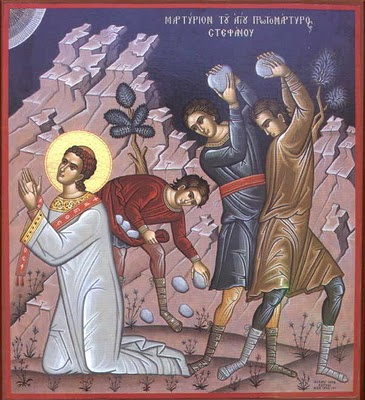
This is precisely what occurred when Stephen stood and spoke to a group of his fellow Jews. They stubbornly refused to acknowledge their shadow side. And it resulted in Stephen’s stoning and death. Whereas Stephen lifted and brought to light the unseemly aspects of their collective heritage, the people wanted nothing to do with it.

The Martyrdom of Stephen

In our present day, responses that do not want to acknowledge the shadow side include statements such as, “Quit being so negative. We focus on the positive. Expel this recalcitrant troublemaker once and for all!”

Oy. Acceptance cuts two ways. We must accept both our blessings and our curses. The acceptance of reality will not occur apart from a solid self-acceptance of who we are and how we are feeling in any given situation. On the practical level, it works something like the following story…

Several years ago, I went on a leadership retreat in the Canadian wilderness. We were so far out in the sticks that we needed special first aid training before leaving because if someone got severely injured it would be hours before any medical attention could be received. There was no cell phone service, no towns, no anything except mile after square mile of wilderness. 

One day, I was canoeing with a group of leaders, far out into the Canadian wilderness where there were no towns or people anywhere near us. It was very windy on this day in late May – which meant the water was still ice cold in Canada. One of the canoes capsized. We had to act quickly and deliberately – which was no small feat in a stiff wind. More than fifteen minutes would result in hypothermia for the two people in the water.

I did not like being in that situation. In fact, I didn’t much like the Canadian wilderness. Too many black flies and giant mosquitoes for me. My shadow side was coming out. But here I was, and I had to accept the reality I was in. One of the lessons I learned in that moment was that acceptance can sit alongside other reactions and emotions.

For example, a person can be outraged by an injustice, as Stephen was, and accept that it is a reality. Acceptance does not mean complacency or giving up. We can accept something while at the same time trying to make it better.

I also needed to accept what was happening inside of me. I was cold and worried. Trying to push those feelings away would have only added to the stress of the situation. If I failed to accept what was true about myself, I would be less able to deal with the situation, and so, would compromise my ability to help two people at risk.

I needed to accept the entire circumstance, including myself. Accepting what is inside gave me more influence over the situation, not less. Self-acceptance became the key to acceptance of unwanted conditions, and more importantly, acceptance of one another as human beings.

In that moment of rescuing two people (which ultimately proved successful) I became aware of a part of myself – the part that gets afraid and irritated – and chose not to stuff it or deny its existence.

I became the guy who talked to the panicked people in the water and kept them as calm as possible so that the others could get them out. I was able to do my part to help fearful people because I acknowledged and accepted my own fear.

Unlike my situation, however, Stephen’s experience ended in martyrdom. Just because we respond rightly, is no guarantee that everything will work out for our benefit. Rather, we say and do the things we must say and do, while leaving the results to a sovereign Lord.

It is our responsibility to work on ourselves, not others. And acceptance is the path to get there, all of it – including the shadow side – and not just part of it.

Jesus, let your mighty calmness lift me above my fears and frustrations. By your deep patience, give me tranquility and stillness of soul in you. Make me in this, and in all things, more and more like you. Amen.

Don’t Be a Fool (Proverbs 1:20-33)

Wisdom shouts in the street;
    in the public square she raises her voice.
Above the noisy crowd, she calls out.
    At the entrances of the city gates, she has her say:
“How long will you clueless people love your naïveté,
    mockers hold their mocking dear,
    and fools hate knowledge?
You should respond when I correct you.
    Look, I’ll pour out my spirit on you.
    I’ll reveal my words to you.
I invited you, but you rejected me;
    I stretched out my hand to you,
    but you paid no attention.
You ignored all my advice,
    and you didn’t want me to correct you.
So I’ll laugh at your disaster;
    I’ll make fun of you when dread comes over you,
        when terror hits you like a hurricane,
        and your disaster comes in like a tornado,
        when distress and oppression overcome you.
Then they will call me, but I won’t answer;
    they will seek me, but won’t find me
        because they hated knowledge
        and didn’t choose the fear of the Lord.
They didn’t want my advice;
    they rejected all my corrections.
They will eat from the fruit of their way,
    and they’ll be full of their own schemes.
The immature will die because they turn away;
    smugness will destroy fools.
Those who obey me will dwell securely,
    untroubled by the dread of harm.” (Common English Bible)

I don’t know about you, but I find that the older I get, the more I realize I don’t know.

What I’m trying to say is that, as I move along in this life, I am discovering more and more how much I need wisdom.

Wisdom is more than being smart, intelligent, or even having some common sense; it is to gain a basic foundation of sound knowledge and instruction, and then having the ability to put that knowledge into practice, applying it to the specific concrete situations we face daily.

In other words, to be wise is to make decisions, engage in actions, and speak words that are appropriate to a given circumstance.

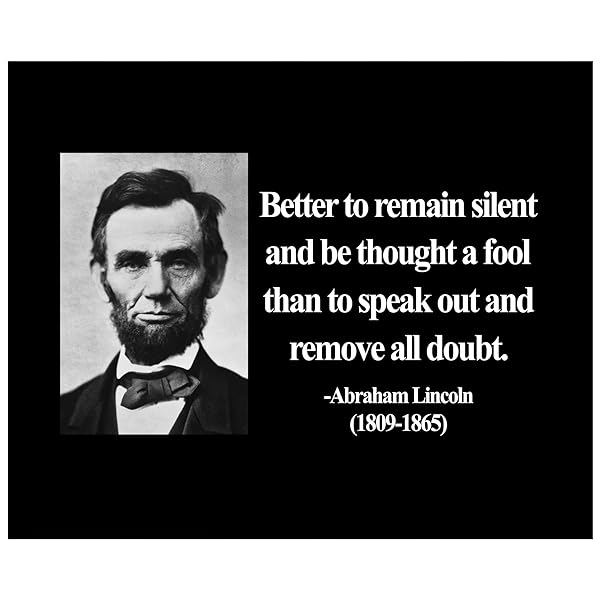
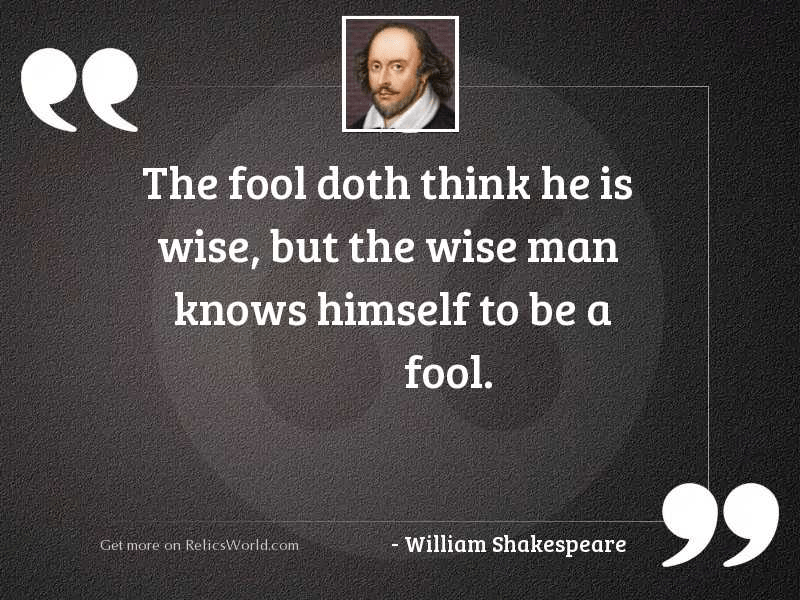
Conversely, stupidity has less to do with one’s intelligence quotient (IQ), lack of education (degrees), or ability to speak well (erudition). To be stupid means that a person is too stubborn to accept help, take advice, or learn from their mistakes.

The Foolish Person

Instead, a stupid fool relies on their own short-sighted opinions, looks for easy ways out of trouble, and generally expects others to think and act the way they do. And that approach to life can literally get you killed. I can testify to that as a hospital chaplain who has been around a lot of death.

The telltale signs of a foolish person are:

  • Refusing to change, even if it means having a better life, or even to keep living
  • Ignoring the advice, correction, or rebuke of another person
  • Being cynical and sarcastic most of the time
  • Mocking and talking down to others
  • Disliking books and reading; or just generally not wanting to learn or consider new ideas
  • Freaking-out when any little thing doesn’t go their way

A person characterized by those things will face disaster, likely sooner than later. That will happen, not so much because they tend to get into trouble, but because they do not have a solid spiritual, emotional, and mental foundation of internal support to draw from. So, when disaster hits them, they fall over and crumble, like a house with its foundation built on sand.

Fools won’t find God in the mix of their hardship since they did not look to the Lord to begin with. And even in the midst of their adversity, the fool would rather blame God than seek God’s help. Indeed, stupidity is the deliberate cultivation of ignorance.

The Wise Person

The wise person, however, is careful to set aside time so that they can learn about God and God’s Word. They seek to know God’s commands in order to live honestly, ethically, responsibly, and justly.

Wisdom has taught them humility, obedience, and acceptance. When the storms of life hit the wise, they are safe and secure in a house built on the rock; the wind and waves shall not blow them over.

People who have sought wisdom can remain calm in the midst of trouble; rely on their acquired experiential knowledge in hard situations; and have faith that doing what is right and just is its own reward.

Wisdom is still calling out, just as she did all those centuries ago to the ancients. Amidst all the noise, bustle, and confusion of our contemporary society, you can hear the clarion voice of Lady Wisdom above the fray – that is, if you are bending your ear to listen…

Almighty God, the Creator and Author of my life, help me learn to read what you have written on my heart. Give me discerning eyes, a steadfast spirit, and courage of heart to look within me in order to understand how to reach outside of me. And once I have begun to read you aright, give me the generosity to help others to read you, to sound you out one letter, and one word of radical giving at a time. Amen.

God Will Give a New Heart (Ezekiel 36:24-28)

I will take you from every nation and country and bring you back to your own land. I will sprinkle clean water on you and make you clean from all your idols and everything else that has defiled you. I will give you a new heart and a new mind. I will take away your stubborn heart of stone and give you an obedient heart. I will put my spirit in you and will see to it that you follow my laws and keep all the commands I have given you. Then you will live in the land I gave your ancestors. You will be my people, and I will be your God. (Good News Translation)

As a hospital chaplain who has spent a great deal of time on cardiac care units, I have had several occasions to follow patients through the process of a heart transplant. I sat with them as they wondered if they would ever get a new one, because their own heart could no longer sustain the rest of their life. Would they die before receiving one? What would happen to their families?

Then, finally the day came for many (unfortunately, not all); there is a heart for them! After the incredible transplant surgery, joy abounds, knowing there is a new lease on life, a fresh experience. Through weeks or months of waiting and flirting with the Grim Reaper of death, hope is realized. Their old useless heart now replaced with a vibrant one, full of life!

However, the process is not yet over. Typically, about two or three days into possessing this new heart, a new realization comes along with it: Someone else had to die so that I could live….

He personally carried our sins
    in his body on the cross
so that we can be dead to sin
    and live for what is right.
By his wounds
    you are healed. (1 Peter 2:24, NLT)

God will…

Life comes from death. Resurrection can only happen when there is a crucifixion. Gaining a new spiritual heart has been achieved at the greatest of costs. “I will” is uttered nine times by God in five verses of Ezekiel’s prophecy. In gracious acts of determination to restore fallen people, God makes promises and has the authority and power to back them up.

Our new heart is waiting to be animated by God’s Spirit so that our observance of God’s law is infused with divine might. Our consent to surgery is all that is needed. Consider just a few of the great “I will” statements of Holy Scripture:

I will instruct you and teach you in the way you should go; I will counsel you with my loving eye on you.” (Psalm 32:8, NIV)

“If someone trusts me, I will save them.
    I will protect my followers who call to me for help.
When my followers call to me, I will answer them.
    I will be with them when they are in trouble.
    I will rescue them and honor them.
I will give my followers a long life
    and show them my power to save.” (Psalm 91:14-16, ERV)

I will strengthen you; I will help you; I will uphold you with my victorious right hand.” (Isaiah 41:10, NRSV)

“Call to me and I will answer you and tell you great and unsearchable things you do not know.” (Jeremiah 33:3, NIV)

I will never leave you nor forsake you.” (Hebrews 13:5, NKJV)

The emphasis in today’s Old Testament lesson is on God’s role, not ours. The prophet Ezekiel’s hope is not in the faithfulness of the people in following some new set of rules. Instead, God is their hope. God will save them by gathering, cleansing, and giving Israel a new heart, mind, and spirit to obey God’s words.

God will gather

Those in diaspora, scattered far and abroad in exile, will be gathered back from the nations and into their own land. God will reverse the experience of dispersion by reassembling the people.

He will raise a banner for the nations
    and gather the exiles of Israel;
he will assemble the scattered people of Judah
    from the four quarters of the earth. (Isaiah 11:12, NIV)

God will cleanse

God will purify the people, cleansing them from their rebellion and defilement. Since the people’s exile was a punishment for their corruption, they were therefore in need of purification.

I will cleanse them from all the sin they have committed against me and will forgive all their sins of rebellion against me. (Jeremiah 33:8, NIV)

God will give

Specifically, God does the seemingly impossible: gives a new heart. The people’s old sinful stubbornness is replaced wholesale with fresh desires for justice and righteousness. They will think and act differently because of this gracious newness.

Much like the real physical heart that can barely function any longer, the people’s collective heart was nearly dead, and as unresponsive as a stone. They needed a transplant, so that they could come alive again to God’s moral law and benevolent rule in the world.

“This is the covenant I will make with the people of Israel
    after that time,” declares the Lord.
“I will put my law in their minds
    and write it on their hearts.
I will be their God,
    and they will be my people.” (Jeremiah 31:33, NIV)

Despite all the threats of judgment throughout the long prophecy of Ezekiel, and all the distressing experiences of the people’s exile, God still desired to be their God. The Lord wants a relationship with people, and will do what it takes to restore it when it becomes broken and damaged. Indeed the Lord is a God of restoration.  

May Christ make his home in your heart as you trust in him.

May your spiritual roots grow down deep into God’s love and keep you strong.

May you have the power to grasp, along with all God’s people, how wide, how long, how high, and how deep is the love of God.

May you experience the love of Christ, though it is too great to understand fully.

May you be made complete with all the fullness of life and power that comes from God.

May your new heart pump with the grace of Jesus Christ, the love of God, and the encouragement of the Spirit. Amen.