Spiritually and Emotionally Overwhelmed

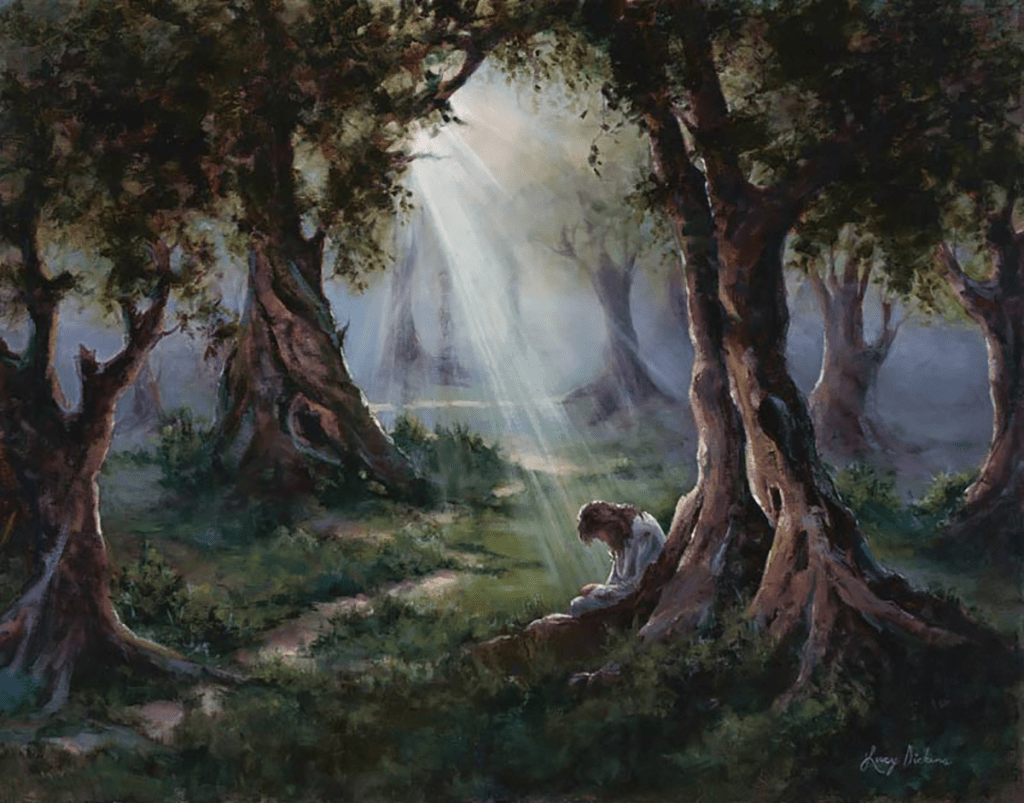
Gethsemane – His Will, by Lucy Dickens

I lift up my eyes to the hills—
    from where will my help come?
My help comes from the Lord,
    who made heaven and earth. (Psalm 121:1-2, NRSV)

“You can’t calm the storm, so stop trying. What you can do is calm yourself. The storm will pass.” – Timber Hawkeye

Even Jesus got overwhelmed.

He took Peter and the two sons of Zebedee along with him, and he began to be sorrowful and troubled. Then he said to them, “My soul is overwhelmed with sorrow to the point of death. Stay here and keep watch with me.”

Going a little farther, he fell with his face to the ground and prayed, “My Father, if it is possible, may this cup be taken from me. Yet not as I will, but as you will.” (Matthew 26:37-39, New International Version)

Jesus was so spiritually and emotionally overwhelmed, he felt so bad, that depression and grief were a powerful part of his experience in the garden as he anticipated facing his horrendous death.

Yes, Jesus became grieved and depressed. Not only did he express such emotions in prayer, but he also told his feelings to his disciples. I personally don’t know of any leader – either in the world or in the church – that would ever admit such a thing to his/her parishioners, employees, or constituents.

Christ confessed that his very soul was encircled with grief-stricken depression. The weight of the emotion was so heavy that Jesus felt as though he was being crushed to death.

“It is one thing for Jesus to feel this way; but should a leader tell his followers he feels this way? Isn’t a part of effective leadership keeping fears from followers? But if Jesus having depression has already taught us it is acceptable, at times, to be depressed, then Jesus talking about his depression teaches that it is acceptable, at times, for leaders to tell followers the bad state of their souls.” – Frederick Dale Bruner, The Church Book: Matthew 13-28

If Jesus needed human companionship and the ability to bear his soul, then how much more do his followers need to do so? And especially the clerics who are ordained to his ministry?

Becoming overwhelmed is a universal human experience:

May my prayer come before you;
    turn your ear to my cry.

I am overwhelmed with troubles
    and my life draws near to death.
I am counted among those who go down to the pit;
    I am like one without strength. (Psalm 88:2-4, New International Version)

We may become overwhelmed by being devastated or feeling overpowered by a confluence of circumstances all at once. To be overwhelmed is to experience several big emotions all at once – including an awful feeling of estrangement from God and/or others.

Whenever complicated grief, relational distance, traumatic experiences, and too many responsibilities come together, they create a perfect storm which can leave us stuck, lonely, and chronically tired.

There are times when it seems as if every time we turn around, there’s another big shoe that drops. We might end up dealing with so many large circumstances and important situations happening at the same time, that we become spiritually and emotionally overwhelmed with it all.

Although it’s easy to become overwhelmed, it’s hard to get over those big, troubled feelings. Yet, we can do it. We can initially calm ourselves enough to function.

Yet, we also need to understand that the emotional array surrounding our difficult circumstances will take more than a few minutes and a few breathing exercises to overcome; it could take weeks, months, even longer.

What’s more, going forward, there will always be a need to listen to our bodies, be attentive to our feelings, and remain in touch with our gut instincts.

We could use some helpful habits to serve us well, whenever we sense the tug toward that sinking feeling of becoming spiritually and emotionally overwhelmed:

  • Sit with your emotions, especially the grief. That is, acknowledge your feelings, and actually let yourself feel them, and express them in positive ways that don’t damage others or their property.
  • Identify and list your current stressors. Then, prioritize them as to which you will work on first. Avoid multi-tasking. Breaking down your life into manageable pieces, done over time with patience, is a healthy way of approaching the behemoth in front of you.
  • Write out your experiences. Keep a daily journal. Focus on expressing both your emotions and your gratitude. The act of writing in and of itself is a powerful means of bringing health, wholeness, and some sort of sense to your situations.
  • Create art. Learn a musical instrument, write your own poetry, sculpt, or paint. Let any anger and frustration come out through your art, rather than coming out sideways onto others through verbal violence.
  • Discover new or alternative spiritual practices, i.e. mindfulness, meditation, Reiki, aromatherapy, breath prayers, etc. Crazy new circumstances you’ve never experienced before may require some seemingly new or strange practices you’ve never tried before.
  • Change the story you are telling yourself. Look for parts of your experience within your control. Learn from the past. Consider what you might do differently in the future in similar situations. In other words, let your story not be one big nasty carbuncle on your soul; allow it to be a companion that teaches you.
  • Consider having a comfort animal. Caring for a pet fosters emotional healing. This one addition to your life could change it immeasurably for good.
  • Engage your inner critic. Face the judgment you may be giving yourself and replace it with grace. Work on dropping the ego and becoming your true self. And there is perhaps no better way of this happening than facing your inner critic.
  • Exercise. Pay attention to where you carry stress in your body. Find an enjoyable way of moving your body.
  • Connect with others. Join a group of like-minded people, such as a faith community or a volunteer organization. Tell your story to another trusted person, such as a friend, therapist, or pastor.
  • Find your identity. Most spiritual traditions take a high view of humanity as having intrinsic worth. As for me, I know to whom I belong: God. Having my identity firmly in Christ – and not in my abilities, or the lack of them – makes all the difference.

Our limitations, screw-ups, diseases, disorders, and disasters need not define our lives. There is no shame in admitting when we are full of sorrow, in the throes of grief, experiencing depression, or living in an awful situation.

Taking Jesus as an example, we have the courage to face stressful adversity and become the people we were always meant to become.

May the places of darkness within you be turned towards the light. And may you know divine shelter and healing blessing when you are called to stand in the place of pain. Amen.

Approach Everything with Humility and Wisdom (Esther 5:1-14)

Esther, by Marc Chagall, 1960

On the third day Esther put on her royal robes and stood in the inner court of the palace, in front of the king’s hall. The king was sitting on his royal throne in the hall, facing the entrance. When he saw Queen Esther standing in the court, he was pleased with her and held out to her the gold scepter that was in his hand. So Esther approached and touched the tip of the scepter.

Then the king asked, “What is it, Queen Esther? What is your request? Even up to half the kingdom, it will be given you.”

“If it pleases the king,” replied Esther, “let the king, together with Haman, come today to a banquet I have prepared for him.”

“Bring Haman at once,” the king said, “so that we may do what Esther asks.”

So the king and Haman went to the banquet Esther had prepared. As they were drinking wine, the king again asked Esther, “Now what is your petition? It will be given you. And what is your request? Even up to half the kingdom, it will be granted.”

Esther replied, “My petition and my request is this: If the king regards me with favor and if it pleases the king to grant my petition and fulfill my request, let the king and Haman come tomorrow to the banquet I will prepare for them. Then I will answer the king’s question.”

Haman went out that day happy and in high spirits. But when he saw Mordecai at the king’s gate and observed that he neither rose nor showed fear in his presence, he was filled with rage against Mordecai. Nevertheless, Haman restrained himself and went home.

Calling together his friends and Zeresh, his wife, Haman boasted to them about his vast wealth, his many sons, and all the ways the king had honored him and how he had elevated him above the other nobles and officials. “And that’s not all,” Haman added. “I’m the only person Queen Esther invited to accompany the king to the banquet she gave. And she has invited me along with the king tomorrow. But all this gives me no satisfaction as long as I see that Jew Mordecai sitting at the king’s gate.”

His wife Zeresh and all his friends said to him, “Have a pole set up, reaching to a height of fifty cubits, and ask the king in the morning to have Mordecai impaled on it. Then go with the king to the banquet and enjoy yourself.” This suggestion delighted Haman, and he had the pole set up. (New International Version)

Esther Comes Before the King, by Johann Boeckhorst (1604-1668)

Three days of fasting by Esther and her attendants, along with all of the Jewish people in the Persian capital city, came to the point of approach and confrontation. But it was not confrontation in the sense of in-your-face; that would get you killed in the emperor’s court.

One did not approach the king without being asked to do so. Yet, Queen Esther was the only person in a position to try and speak to the king on behalf of the Jewish people. A royal edict had been pronounced; a day was coming when they would be slaughtered and plundered. Something had to be done. And that something became a someone: Esther.

Although Esther was a queen, it was not by her own choice. She was brought into the royal court through a long process of finding a queen for the king. Esther was taken from her home; she had to participate.

It seemed as if she had no agency of her own. But there came a time when Esther had to find that personal agency and speak her own voice – even though it was at great risk to her own life, as well as the life of her people.

Perhaps because Esther had no ability to seek status, she seems to have come to the conclusion that she could be used where she was – that somehow she came to the Persian court for just such a time as this, the saving of many lives.

Queen Esther evidenced a spirit of collaboration and wisdom. She knew she could not directly confront the king concerning Haman’s evil scheme to rid the earth of Jews. She needed to approach by coming in the side door of humility and gentleness.

Thus, Esther requested the presence of King Xerxes and his right hand man Haman to a banquet. There was no arrogant demanding of justice or rights. There was only a genuine spirit of trying to do right.

All of us have others who hold positions of power over us. They make decisions which impact us significantly, whether for good or for ill. The way in which we deal with people in authority can make all the difference, not only for ourselves, but also for many other folks as well.

Power dynamics exist everywhere, in every organization, institution, family, workplace, neighborhood, and faith community. We are not in control of those structures. Yet, you and I have control of ourselves. We can choose how to respond to any given situation.

We have the opportunity to decide whether to be respectful or disrespectful, patient or impatient, wise or foolish, encouraging or discouraging, helpful or obnoxious.

Esther chose wisely. Haman chose foolishly. He was self-centered, power hungry, status conscious, angry, and downright arrogant.

Haman was obsessed with everyone giving him honor. So, when Mordecai didn’t bow to him, Haman made it his personal mission to do away with him. But that wasn’t enough. He also created a devious plan to kill all Jews.

The misuse of power is one of the most devastating sins a person can do, namely because it affects so many people and makes their lives miserable, if not dead. Abusers are typically, at their core, insecure persons who overcompensate for feeling better by pushing others down.

Abusive persons in authoritative positions is a very bad combination. The only human life they value is themselves. And they don’t care who they destroy to get what they want to feel secure and important.

Unfortunately, those in high positions sometimes (maybe oftentimes) have no idea how to properly assess the character and competence of those who want authority. Xerxes was a terrible judge of character, choosing Haman for high office and listening to him.

There are far too many persons in this world, in our own societies and institutions, who are not fit to hold any sort of public office or responsible position of power. They may talk a good line on the outside, but inside they have a hollow spot where there soul should be.

Yet, we elect them, or are okay with them in office. There’s no pushback. We can even stump for some of those morally stunted individuals. It should not be that way. We can most certainly do better, in this day and age. King Xerxes isn’t around, and there isn’t any supreme sovereign emperor calling all the shots.

We need to take responsibility, first and foremost, by developing a just and wise character within ourselves.

One’s own spiritual growth and emotional maturity will help to make wise decisions and right judgments. It is imperative that we have enough discernment to judge between the genuine article and a charlatan; and between one who has authentic potential, and one who has none.

Haman was no good for anybody but himself. And that, he even screwed up. But Esther was the right person for the right time. She evidenced a solid character, a listening spirit, and moral sensitivity.

May her tribe increase.

O Spirit of God, we ask you to help orient all our actions by your good and wise inspiration, and carry them on by your gracious assistance, so that every prayer and work of ours may always begin from you; and through you be happily ended. Amen.

For Such a Time as This (Esther 4:1-17)

When Mordecai learned of all that had been done, he tore his clothes, put on sackcloth and ashes, and went out into the city, wailing loudly and bitterly. But he went only as far as the king’s gate, because no one clothed in sackcloth was allowed to enter it. In every province to which the edict and order of the king came, there was great mourning among the Jews, with fasting, weeping and wailing. Many lay in sackcloth and ashes.

When Esther’s eunuchs and female attendants came and told her about Mordecai, she was in great distress. She sent clothes for him to put on instead of his sackcloth, but he would not accept them. Then Esther summoned Hathak, one of the king’s eunuchs assigned to attend her, and ordered him to find out what was troubling Mordecai and why.

So Hathak went out to Mordecai in the open square of the city in front of the king’s gate. Mordecai told him everything that had happened to him, including the exact amount of money Haman had promised to pay into the royal treasury for the destruction of the Jews. He also gave him a copy of the text of the edict for their annihilation, which had been published in Susa, to show to Esther and explain it to her, and he told him to instruct her to go into the king’s presence to beg for mercy and plead with him for her people.

Hathak went back and reported to Esther what Mordecai had said. Then she instructed him to say to Mordecai,“All the king’s officials and the people of the royal provinces know that for any man or woman who approaches the king in the inner court without being summoned the king has but one law: that they be put to death unless the king extends the gold scepter to them and spares their lives. But thirty days have passed since I was called to go to the king.”

When Esther’s words were reported to Mordecai, he sent back this answer: “Do not think that because you are in the king’s house you alone of all the Jews will escape. For if you remain silent at this time, relief and deliverance for the Jews will arise from another place, but you and your father’s family will perish. And who knows but that you have come to your royal position for such a time as this?”

Then Esther sent this reply to Mordecai: “Go, gather together all the Jews who are in Susa, and fast for me. Do not eat or drink for three days, night or day. I and my attendants will fast as you do. When this is done, I will go to the king, even though it is against the law. And if I perish, I perish.”

So Mordecai went away and carried out all of Esther’s instructions. (New International Version)

Mordecai and Esther (Bible Project)

King Xerxes was the royal sovereign over the greatest empire up to that time in history. Haman was the king’s right hand man who arranged a sinister plot to destroy the Jewish people. Queen Esther was a Jew, for which neither Haman nor Xerxes knew; she rose from obscurity to become the queen. And Mordecai was Esther’s cousin, having taken her in and raised her.

The Jewish people were exiles, due to the Babylonians capturing Jerusalem and taking the people into captivity. Although the Persians, who overthrew the Babylonians, began allowing some of the Jews to return to Judah, there were still many diaspora Jews who made a life for themselves in Persia.

Esther was an unlikely candidate as both a queen and a heroine. She was an orphan and not well-known, even within her own community. Yet, Esther was taken from her foster home with Mordecai, and was thrown into all the perturbations of Persian life in the empire’s court and the nation’s culture.

She was the ultimate outsider, thrust into insider status. Esther was a minority in a majority culture; a resident alien; and a foreigner to Persian society and royalty. It was a lot for her.

Try and put yourself in her shoes. Do you hide your Jewishness, or make it known, and how much? How do you navigate being raised in a culture very different than the one you are being immersed and assimilated in? Who am I? What am I really supposed to be about? Why am I here?

Expressing one’s spiritual identity requires some significant consideration and careful application. And it will be dynamic, with ongoing considerations of how to grow and sustain a healthy sense of self so that it will be impactful and lasting.

We may reflexively think that since Esther was queen, she could freely exercise power and leverage her position to achieve anything she wanted. However, Esther was in a totally new reality. She didn’t enter it with political savvy or understanding about how things work or get done. Esther was very much subject to the whims and plans of King Xerxes.

Queen Esther must have thought she was in an impossible position. Haman had hatched a strategy to rid the empire of her own people, the Jews. And they were beside themselves. Mordecai entreated Esther to do something. But Esther was green and scared and way out of her element.

And yet, the heroine was inside her all along; it just needed the proper experience to bring her out.

We might understand if Esther saw herself as a mere orphan Jew who was just trying to fake-it-till-you-make-it in a world and a situation that was way over her head. We could understand if she saw herself without any real agency to effect anything in a large overwhelming empire.

Yet, here we are, all these millennia later, talking about Queen Esther and her bravery. There is even a Jewish holiday, Purim, celebrated because of her extraordinary courage… But I am getting ahead of myself. Today’s piece of the story begins in tension, and ends with even more.

Mordecai arose and gave a coach’s speech to Esther. He told her that she must step up and step into this particular historical moment in time. Providence had led her to be in her unique position; and the Jewish people were in an awful position.

It was precisely the right time for Esther to dig deep and release the heroine within. Esther could save her own people. Nobody else could. Only her.

Like it or not for Esther, her Jewishness was part of the whole gnarly situation. She could deny it and hide it – which would mean suppressing and stuffing the heroine. Or she could put herself out there, speak truth to power in love, and let the consequences come what may.

What impresses me about Esther is that not only did she listen to Mordecai, but she took the further step of calling upon the support of her own Jewish community. Esther was straightforward in telling them exactly what she needed from them, and what she would do herself.

Esther staked out her identity and faith, and risked her life for an entire nation of people… but we are not to the end of the story yet.

For now, we need to sit with this painful and awkward tension between life and death. Three days of sorrowful and heartfelt prayer. Three days of darkness. Three days of seeming as if one is in a grave with a huge stone boulder in front of it.

Like Esther, it is important for us to struggle with our own identity, and to take risks in soliciting the help of the believing community. We all must grapple with the nature of faith, the challenges of living in this present culture, and the politics of it all.

We need to take a good hard look at ourselves and discern who we truly are – people created in the image and likeness of God, who have majesty stamped on our very souls; and who truly have it within ourselves to make a difference in this big world of ours.

If we are to truly become aware of our majesty as people, we shall be willing to take the risk of helping those who are vulnerable, powerless, and threatened. That’s because our identity shapes our choices and actions. We live into who we believe we are.

By realizing that we belong to God, we avoid becoming complicit in evil. Instead, we leverage our place and position in life to do what is right, just, and good. There is confidence, even if afraid, of doing what is right.

I am wondering if you can think the thought, and embrace the reality, that you were sovereignly placed here on this earth by God “for such a time as this.”

Just and right God, you sent your servant Esther into a life of privilege, so that those without would be taken care of. In our privilege, show us how to advocate for those who have less, so that your world might be peaceful and good. Amen.

The Wounded Healer (Psalm 18:1-6, 43-50)

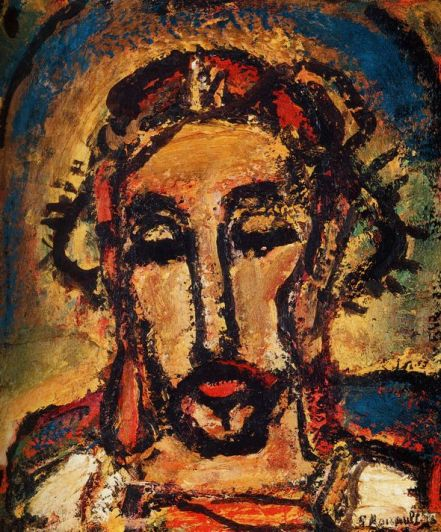
By French painter Georges Rouault (1871-1958)

I love you, Lord;
    you are my strength.
The Lord is my rock, my fortress, and my savior;
    my God is my rock, in whom I find protection.
He is my shield, the power that saves me,
    and my place of safety.
I called on the Lord, who is worthy of praise,
    and he saved me from my enemies.

The ropes of death entangled me;
    floods of destruction swept over me.
The grave wrapped its ropes around me;
    death laid a trap in my path.
But in my distress I cried out to the Lord;
    yes, I prayed to my God for help.
He heard me from his sanctuary;
    my cry to him reached his ears…

You gave me victory over my accusers.
    You appointed me ruler over nations;
    people I don’t even know now serve me.
As soon as they hear of me, they submit;
    foreign nations cringe before me.
They all lose their courage
    and come trembling from their strongholds.

The Lord lives! Praise to my Rock!
    May the God of my salvation be exalted!
He is the God who pays back those who harm me;
    he subdues the nations under me
    and rescues me from my enemies.
You hold me safe beyond the reach of my enemies;
    you save me from violent opponents.
For this, O Lord, I will praise you among the nations;
    I will sing praises to your name.
You give great victories to your king;
    you show unfailing love to your anointed,
    to David and all his descendants forever. (New Living Translation)

King David, the psalmist, had no problem with publicly expressing his great feeling of love for God. His desire was to be thoroughly devoted to the Lord; and he confidently discerned God as the source of his strength.

What’s more, David freely recognized God as the One who brought him deliverance. David cried out in distress. In his despair and desperation, he looked to the Lord, and God responded.

This is in contrast to those who complain about God and consider the Lord as distant and uncaring – if existing at all. David’s experience was that of being heard by God. And he wanted everyone to know, so that the faithful may be encouraged.

David didn’t want people becoming discouraged because of the bitterness of others who accuse God of being unconcerned.

The psalmist was not just talking about some mundane request, like asking for parking spot close to the building. David was in a life-and-death situation, stressful beyond imagination. Things were not looking good for him.

It seemed that the insolent, who think God isn’t watching, believed they could act unjustly and do whatever they wanted. Sadly, their lust for power and control blinds them to the larger reality of an invisible God who sees, and who responds at just the right time.

David wanted people to remember and not to forget about the saving actions of God. Because by keeping in mind who God truly is, then we can have confident trust, and will live in a way that is right, just, and good.

“Our service will not be perceived as authentic unless it comes from a heart wounded by the suffering about which we speak.”

Henri Nouwen

A good, right, and just life is always the appropriate response to divine mercy and deliverance. We are saved from evil, so that we might live in the spiritual freedom of purity and peace. And David gave God some due praise, adoration, and thanksgiving for rescuing him from his enemies.

Since David went through all of the adversity, hardship, stress, and suffering of dealing with unjust people, he was in a position to be a wounded healer for us.

A wounded healer is not someone who endorses a victim mentality. Rather, this is a person who has been profoundly hurt – physically, mentally, emotionally, or spiritually – and comes through the experience with an ability to be present with others and help facilitate healing in those who suffer.

Surely he took up our pain
    and bore our suffering,
yet we considered him punished by God,
    stricken by him, and afflicted.
But he was pierced for our transgressions,
    he was crushed for our iniquities;
the punishment that brought us peace was on him,
    and by his wounds we are healed. (Isaiah 53:4-5, NIV)

We all suffer and face various hard circumstances. And we are all changed by the hurtful encounters. But we don’t all respond the same way to that adversity. The difficult experiences of pain lead us to become either bitter or better.

If we have a wounded healer in our life, there is a good chance that we will be able to move through the hardship and come to a place of gratitude for what the Lord has done for us and how God brought us deliverance.

“As followers of Jesus we can also allow our wounds to bring healing to others.”

Henri Nouwen

Deliverance may not end up looking like anything we anticipate. If we are stuck on particular outcomes and have a singular expectation, then we may very well miss the Rescuer when the ship of salvation shows up.

Yet, if we can remain open to and aware of God – as well as of what’s going on inside us – then we shall likely experience healing for our deep wounds of pain. And we will embrace the scars it leaves as a reminder of the Lord’s deliverance.

It could be that things don’t change, at least like we want. In such times, perhaps the greatest healing that can take place is to be healed from the need for healing.

The Lord shows unfailing commitment and steadfast love to the faithful, to those who seek God. We shall find the divine in all circumstances, that is, if we seek God with all our heart.

“You will seek me and find me when you seek me with all your heart.” (Jeremiah 29:13, NIV)

Pain cannot be taken away unless we enter into it. So, it only makes sense to me, that we have a guide like the psalmist to lead us, and a Savior like Jesus to rescue us.

“Wholeness is not achieved by cutting off a portion of one’s being, but by integration of the contraries.”

Carl Jung

May you be patient in suffering, as Christ was in his earthly pain.

May the Lord be near you in your time of weakness and wondering.

May God sustain you by divine grace, and grant you courage not to have a failure of faith.

May you know healing of both body and soul.

And may you always believe that what happens to you in this present life is of little account if you hold Christ in eternal life. Amen.