Welcome, friends! The body is important. Our physical bodies are the vehicle to accomplishing the will of God in the church and the world. Click the videos below and let us discover the connection between the spirit and the body…
1 Corinthians 6:12-20
This Body Is Your Temple by Matt and Joanna Black
Go forth into the world in peace; be of good courage; hold fast that which is good; render to no one evil for evil; strengthen the fainthearted; support the weak; help the afflicted; honor everyone; love and serve the Lord in body, mind, and spirit, rejoicing in the power of the Holy Spirit; and the blessing of God almighty, the Father, the Son, and the Holy Spirit, be among you and remain with you always. Amen.
It is normal to feel guilty at this time of year about our bodies. Some of the more common goals for a new year are to lose weight, stop smoking, get in shape, have better sleep hygiene, and generally learn better self-care. I am not going to add to the burden of guilt but emphasize something important: Our bodies are the vehicle given to us to glorify God. Our spirituality is quite embodied. (1 Corinthians 6:19-20)
One of the reasons we fail our bodies is that we do not always make the biblical connection of seeing our material selves with the same importance as the immaterial. The Apostle Paul brought up a discussion about the body to the Corinthian Church because Corinth was a Greek city thoroughly imbibed with a Platonic philosophy of life. At the core of Plato’s view of humanity was that the immaterial and the spiritual were of higher value than the body. For Plato, the body is a necessary evil. He referred to our souls as being imprisoned within the flesh. When we die the soul is released and is freed from its bodily prison.
Western civilization has been significantly influenced, even today, by Plato’s view of humanity. Yet, that is not a biblical view of the body. Instead of being a prison, the body is a temple, a sacred place which is no better and no worse than the soul. When we die, we will not be disembodied souls, but will experience a bodily resurrection at the end of the age. Eternity will be spent existing in a real glorified body free from sin. (1 Corinthians 15)
Since the body is sacred, and we glorify God with our bodies, then we must steward them just like we would steward any other physical material possession we own. We have bought into Platonic philosophy when we treat our cars better than we treat our bodies. If a warning light comes on in our cars, we get it checked by the mechanic. He fixes the issue and tells us what we need to do to prevent it from happening again, and we listen to him.
Far too often, when warning lights go off in our bodies, we ignore them until our bodies literally break down and we must go to the doctor. And even then, the doctor tells us to do something, and we do not do it. We never avoid the advice of our mechanic, and yet we do it with our doctor. We need to adopt the biblical wisdom of glorifying God on this earth through our bodies.
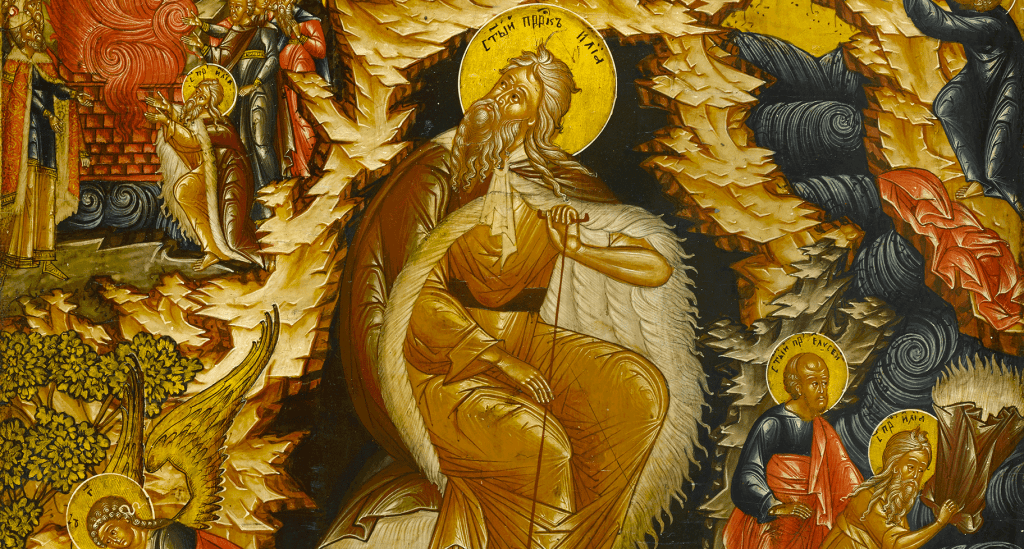
God’s care for our bodies can be found, for example, in the Old Testament prophet, Elijah. After Elijah experienced a great spiritual victory, he became the target of evil Queen Jezebel. Elijah ran for his life and was severely burned-out from intense spiritual struggles with the queen’s prophets of Baal (1 Kings 19:1-3). At that point, God did not come to Elijah and give him a sermon or exhortations about getting over it. No, God restored Elijah’s body. And the Lord wants to restore our bodies, as well.
19th century Russian Orthodox icon of the prophet Elijah in the wilderness
First, Elijah needed sleep (1 Kings 19:5-6). Millions of Americans are sleep deprived and live with a significant sleep debt (thus being continually cranky and out of sorts). Insurance companies know this is a major issue because improper sleep habits have caused various auto accidents and fatalities. I once kept a crazy schedule with not many hours for sleep. One day, during rush hour, I drove through a downtown expressway in bumper-to-bumper traffic and fell asleep. I woke up about two minutes later and was still alive driving down the highway. I sincerely believe God graciously drove the car for me. That was my “wake up” call to change the way I was treating my body.
Second, Elijah needed to eat well (1 Kings 19:6-8). For us, that means eating healthy. One source of being overweight is failing to make the connection that eating is a spiritual activity. Food is important to the kingdom of God. It was eating that got us into trouble to start with and resulted in the fall of humanity. Eventually, we will come full circle with eating being the activity we engage in at the end of the age – a redeemed view of food and eating together with Jesus at the marriage supper of the Lamb (Revelation 19:1-10). God cares about food – what we eat and how much of it we consume. He cares because we do not own our bodies – we steward them for God.
Third, Elijah needed some vigorous exercise (1 Kings 19:8-9). He walked all the way to Mount Horeb, which was over a month’s travel. But that exercise was essential to his well-being, both physically and spiritually. It was only after he slept, ate well, and walked that Elijah was ready to meet with God in a powerful experience.
Our physical fitness is a spiritual issue, and so, needs prioritization. I am under no illusions or delusions about the difficulty of this. I prefer brownies to broccoli and rather like sleeping instead of exercise. Yet, I work at being physically fit and caring for my body. I am personally motivated toward health because I love God and want to please the Lord with my body. After all, my body was important enough to be redeemed through the Cross of Christ.
This is not about willpower – it is about Christian stewardship. I look at my body the same way I look at borrowing something from another person: I return it in the best condition I can. When the Lord takes me someday, I do not want it to be because I hastened my own death through disregard of my God-given body.
If I were God, donuts would be health food, sitting back in the recliner would build muscle, and two hours of sleep at night would be sufficient. But I am not God, so I submit to doing what it takes to have an embodied spirituality. We are to enjoy life through making the connection between the spiritual and the physical because that is the way God created us.
It is never too late to be a proper steward of the body. Our physical anatomy is an amazing work of God and incredibly receptive to healthy choices. Here are a few of the choices we can make…
Remember the positives
Remember that care of the body is worth it. Being fit feels great and equips us for the will of God. Keep the long view in mind. Sacrificing a temporary pleasure is worth the eventual gain.
Start small
I will not be doing any triathlons anytime soon, or ever. We need to be realistic and set appropriate goals without comparison to others. Start small and build up over time with slow incremental change. The place to begin is by rearranging our schedules so that our bodies become a priority. Maybe it is time to make that doctor’s appointment you have been putting off.
Join others
Accountability and fun can and ought to go together. For example, preparing meals together is a chance to connect with a friend or family member. Discover and maintain a consistent rhythm of health that works for you and is enjoyable.
Reframe it
People often give up their best laid plans because they are disconnected from the rest of their lives. Reframing our view of the body as a spiritual activity helps connect and align our mind, body, and spirit in the wholeness God designed for us.
Start today
It takes time for something to become a habit. All good things are a process of realization. Consider and plan today, asking for God’s direction. Get the Lord in on it from the beginning and let it be an offering to him.
May you find the joy, contentment, and satisfaction of living with a body properly cared for and ready for use to the glory of God.
On the eighth day, when it was time to circumcise the child, he was named Jesus, the name the angel had given him before he was conceived.
When the time came for the purification rites required by the Law of Moses, Joseph and Mary took him to Jerusalem to present him to the Lord (as it is written in the Law of the Lord, “Every firstborn male is to be consecrated to the Lord”), and to offer a sacrifice in keeping with what is said in the Law of the Lord: “a pair of doves or two young pigeons.”
Now there was a man in Jerusalem called Simeon, who was righteous and devout. He was waiting for the consolation of Israel, and the Holy Spirit was on him. It had been revealed to him by the Holy Spirit that he would not die before he had seen the Lord’s Messiah. Moved by the Spirit, he went into the temple courts. When the parents brought in the child Jesus to do for him what the custom of the Law required, Simeon took him in his arms and praised God, saying:
“Sovereign Lord, as you have promised, you may now dismiss your servant in peace. For my eyes have seen your salvation, which you have prepared in the sight of all nations: a light for revelation to the Gentiles, and the glory of your people Israel.”
The child’s father and mother marveled at what was said about him. Then Simeon blessed them and said to Mary, his mother: “This child is destined to cause the falling and rising of many in Israel, and to be a sign that will be spoken against, so that the thoughts of many hearts will be revealed. And a sword will pierce your own soul too.”
There was also a prophet, Anna, the daughter of Penuel, of the tribe of Asher. She was incredibly old; she had lived with her husband seven years after her marriage, and then was a widow until she was eighty-four. She never left the temple but worshiped night and day, fasting and praying. Coming up to them at that very moment, she gave thanks to God and spoke about the child to all who were looking forward to the redemption of Jerusalem.
When Joseph and Mary had done everything required by the Law of the Lord, they returned to Galilee to their own town of Nazareth. And the child grew and became strong; he was filled with wisdom, and the grace of God was on him. (Luke 2:21-40, NIV)
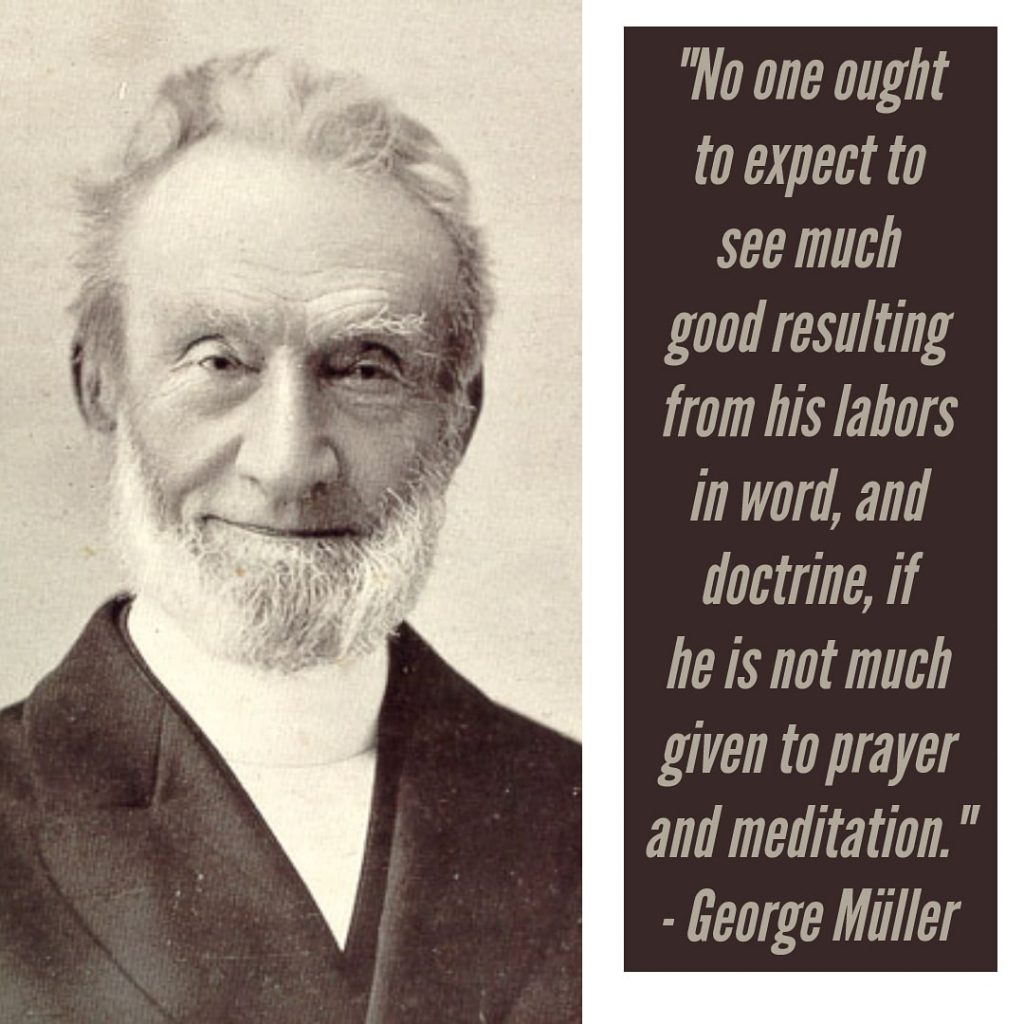
George Mueller (1805-1898) was a man full of hope in God. For sixty-six years he preached in a small chapel in Bristol, England, yet what he is best known for is his orphanage.
After being in ministry for a few years, Mueller became deeply concerned for the street children of the city and decided to start an orphanage. The problem was he had no money. So, with nothing but his hope in Christ he prayed God would provide. For the next sixty-four years, that was how George Mueller operated.
In that course of time, he built an orphanage, where he cared for and educated over eighteen-thousand children; educated over one-hundred-thousand more children in other schools at the Orphanage’s expense; distributed hundreds of thousands of Bibles and tens of millions of religious tracts; supported one-hundred-fifty missionaries; travelled over two-hundred-thousand miles as a missionary himself; and proclaimed the Gospel to over three million people around the world.
In all that time, Mueller never asked for one penny from anyone, his children never missed a meal, and he never had a debt.
We are not all called to be like George Mueller, or even like Simeon and Anna in our Gospel story. However, all of us are called to grab hold of God’s promises with such faith and hope that, even though we may not yet see it realized, we live as though it has already happened. This is what it means to participate with God.
When George Mueller had a need, he pleaded to God and banked on the promise of God. Mueller prayed for more than money; he prayed for individuals, as well. Sometimes he prayed for someone for as long as fifty years. He never stopped praying for anyone or anything until he got his request. That is how convinced George Mueller was that God would answer his prayers.
All the promises of Holy Scripture revolve around Jesus Christ. Jesus is the fulfillment of hope for persons of every nation and ethnicity. Christ is our Redeemer, and his salvation is limitless and includes all kinds of people. Simeon and Anna, despite their age, despite the fact they lived their entire lives without seeing the Deliverer, never lost hope in the promise of God and never gave up praying and looking for the Savior.
Hope in the Bible is not wishful thinking but confident expectation which is grounded in the promises of God. Since all those promises have not yet been fully realized, we must have a quiet confidence and a patient spirit to anticipate the light at the end of the tunnel. Listen to what the Roman church needed to hear about this:
We groan inside as we wait to be adopted and for our bodies to be set free. We were saved in hope. If we see what we hope for, that is not hope. Who hopes for what they already see? But if we hope for what we do not see, we wait for it with patience. (Romans 8:23-25, CEB)
Simeon and Anna gave testimony about the hope of all the earth. We have a moving scene of the old man, Simeon, being led by the Spirit of God to enter the temple and take hold of the baby Jesus and cradle him in his arms. Simeon’s hope is being realized as he declared that this little baby will be the means of salvation for all people.
This salvation comes at a great cost – and all of history hinges on this little child in Simeon’s arms. Will people move toward or away from God? Anna came along and, as the George Mueller of the ancient world, devoted herself constantly to prayer and anticipated the coming of the Messiah. Anna confirmed the testimony of Simeon that this baby is the hope of Israel, the Redeemer of both Jew and Gentile.
Presentation in the Temple by British artist Sylvia Lauder
Today you decided to be here and join me; yet it was more than your own consideration. The Holy Spirit of God, like Simeon of old, led you and I to this place of virtual meeting, perhaps because we long to see our hope realized – to find in the Christ child all we have longed for and have been waiting to see happen in our lives.
God wants us to see Jesus. So, close your eyes, because the hope of all life cannot be seen with human eyes…
See him as a little baby…
See him as he grows with wisdom and favor with both God and others…
See him as he teaches, ministers, and heals the outcast and loves the common person…
See him as he is arrested, beaten, and taken outside of the city…
See them take the hammer and nail his hands and feet to a cross…
See him as you kneel before a terrible cross and watch him die, not for himself, not because he deserved it, but because of the world’s great sin and because humanity has lost their way…
See him as he is placed in the grave…
See him rise from death…
See him ascend to heaven…
See the Lord Jesus Christ in all his glory…
See that he has done all of this for you! Do not lose hope! Do not give up! Search the Scriptures for the promises of God. Grab hold of them and rely on them as if your life depended on it – and it does!
Why did Simeon and Anna not lose hope? How could they remain so devout? Why, over the years and the decades when all seemed dark and despondent, did they not give up searching for the Christ of God?
Because we become just like who we worship.
If we spend all our time, thoughts, and energy on money, we will live and die with whatever the markets are doing…
If we spend all our time, thoughts, energy on our job and our work, we will live and die with our ability to produce and get things done…
If we spend all our time, thoughts, and energy on watching out for ourselves because we believe no one cares, then we will live and die lonely and dejected…
But if we spend our time, use our thoughts, and expend our energy in the hope of all the earth, Jesus, the Savior of the world, then we will experience the deepest needs of our lives being met – we will become like Jesus, showing love, giving grace, and enjoying unhindered relationship with God.
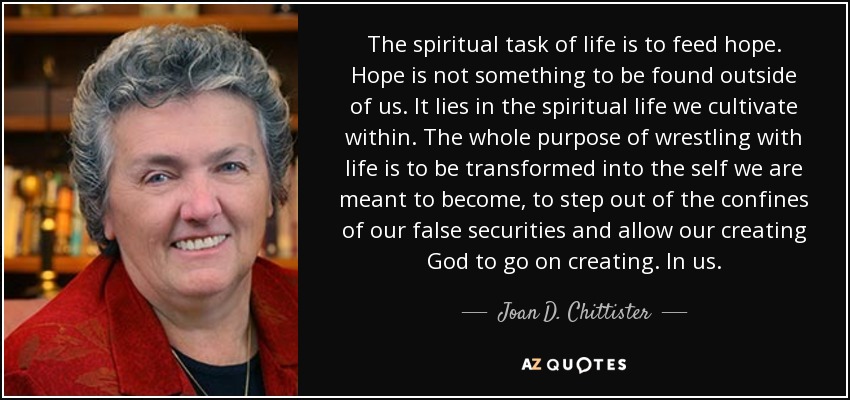
No tragedy can dim the hope that comes from knowing God will walk with you through the valley. Hope is neither cheap, nor easy. Genuine hope typically arises from the ash heap of unfulfilled dreams, messed-up plans, and broken hearts. We often need to experience hopelessness before we can realize hope itself. It is the absence of hope that holds the invitation to forsake old ways and strike out on a new path to find our heart’s truest desire. Author Joan Chittester has wisely said:
“The challenge of hopelessness is the challenge to re-enter humanity, to take our part in it knowing that the lack of hope has much within it to shape our life. Losing hope leads us to understand that misfortune is not failure. It is at most simply a digression through life intended to make us reassess our course, our goals, and our aspirations.”
Indeed, hopelessness need not lead to despair. The profound lack of hope is ironically what reawakens and rekindles hope within us. It is the process of reassessment that is the opportunity to hope again with a sharper and a greater assurance of hope – to create space in becoming fully alive to the hope that has always been there – maybe just underneath all of life’s accumulated stuff.
For me, hope rekindles when I withdraw to a quiet place, either sitting down in my favorite chair or walking along a secluded wooded path. I allow and encourage the sixth sense of faith and imagination to inform my other five senses. This helps my heart to enlarge, the empty places of my soul to be filled with the hope of Christ. It is in this inner place, where our hearts join the heart of God, that we find an alternative way to the true hope for which we have been striving for so long to realize.
For the grace of God has appeared that offers salvation to all people. It teaches us to say “No” to ungodliness and worldly passions, and to live self-controlled, upright and godly lives in this present age, while we wait for the blessed hope—the appearing of the glory of our great God and Savior, Jesus Christ, who gave himself for us to redeem us from all wickedness and to purify for himself a people that are his very own, eager to do what is good. (Titus 2:11-14, NIV)
We have a sure and certain hope which presently now shapes our lives as we wait patiently. Just as we await a coming vaccine and deliverance from COVID-19 which presently now forms our living with masking, social distancing, and sheltering in place – so we look forward to the coming of our glorious Savior and the realization of our salvation in its fullness. Meanwhile, much like Simeon and Anna, we presently now devote our lives to prayer and wait….
“Be yourself, everyone else is taken.” – Oscar Wilde.
People are complicated. They cannot be reduced to simple categories, as if an individual person can be neatly labeled as good or bad, nice or naughty, magnificent or mean, altruistic or selfish. No, people are wondrously intricate beings with a vast inner world of values and motivations. The reality of humanity is that we are a befuddling mix of virtue and vice with capabilities of much greater good than we realize along with an unfortunate capacity for heinous words and actions in the world. We are both blessed with the enduring mark of God’s image and cursed with not acknowledging our inherent worth through using cheap parlor tricks to prove we matter to others. As a result of these two often competing realities, we all tend to inhabit a sort of spiritual schizophrenia which vacillates between the true self and a false self.
What is the true self?
The true self is a person’s pursuit of realizing their own potential of gifts and abilities to be used for the common good of all. The true self embraces authenticity, vulnerability, and courage in their desire for growth and development of the inner person. The true self is open, being curious about self and others. Wanting to realize the full implications of God’s image within them, the true self is free to explore the vast potential of good which resides inside. The true self loves others from a place of invitation and patience. The true self is a master of one’s own inner wisdom and, so, has ability to rest and have peace.
What is the false self?
The false self is a person’s compulsion to achieve an idealized form of themselves. Such a self seeks the adulation of others since they lack awareness of their true self. The false self holds on to secrets, avoids emotions, and seeks perfection. The false self is closed, being afraid that others might reject them, if they knew the true self. Thus, the tragedy of the false self is that – in seeking self-protection – they do not find the self-realization and love they long for. Obsessively attempting to present an image to the world of having it all put together, the false self does not risk being brave. Instead, it fears others might see the bad within them, and so, judge and reject them. The false self uses love to manipulate others to love them back. The false self has no mastery of self because it attempts to become a master of a small world over others. The false self is never at rest and obsessively moves from one project to another.
Why does a person have a false self?
When someone has a great deal of inner stress, they might become estranged or alienated from their true self. For example, if someone has experienced trauma, they might direct their energy toward molding themselves into an idealized self. The hope of such a misadventure is to become impervious to any further trauma and pain. In short, the false self seeks power over others through doing everything the right way all the time so that they can feel a sense of security, superiority, and/or control in every situation.
How do I realize the true self?
The following is by no means an exhaustive list of connecting with our true selves. Indeed, you will likely come up with many more ways. After all, you have potentialities within you which I do not possess!
Pay attention to your spiritual self. Just as our physical spine supports us and we need to take good care of it, so we have a spiritual spine which supports us when we need it – that is, if we pay attention to it and maintain good habits of self-care.
Believein the inherent good you possess – that it will eventually win and have the day. The image of God permanently resides within us; the curse of the fallen world does not. Have faith that goodness will prevail in your life.
Focusprimarily on exploring your true self through a positive plan; and, only secondarily focus on combating the false self. Compulsively trying to suppress the false self is, ironically, giving it power to call the shots in your life.
Develop new habits and routines which are life-giving for you. Avoid implementing long lists of do’s and don’ts which are cumbersome and burden your soul with an unnecessary heavy load. A good rule of thumb here is that if your plan and routines are serving you well, then you are probably on a healthy path. If you find yourself constantly a slave to your routines, then you are serving the plan and are likely on an unhealthy road.
Create a safe space for yourself in which your true self can arise. This means developing healthy rhythms of giving and receiving love; and, sharing your story and listening to others share their stories. And these occur when we have a safe space to inhabit. Safe spaces typically don’t fall into our laps. We need to take some initiative to find them.
Take your emotions seriously. Many people have learned from their family of origin and/or their church or faith community that thoughts are more important than feelings; and, to not show emotions or even really acknowledge them. This, perhaps more than any other reason, pushes a person toward pursuing an idealized false self. In truth we are emotional creatures and our feelings are significant, valid, and vital. As we take those feelings seriously through talking about them and sharing them with trusted individuals, our true self begins to emerge.
Seek support through finding groups who share your desire for self-realization and discovering persons who model what you are looking for. For example, for me, Jesus Christ is the ultimate model. When tempted with a devil’s pact for achieving salvation through self-idealization, Jesus did not take it. Instead, he chose the hard road of self-realization and was satisfied doing the will of God.
Some quotes on realizing the true self:
“If you don’t get lost, there’s a chance you may never be found.” – Anonymous
“Owning our story and loving ourselves through that process is the bravest thing we’ll ever do.” — Brené Brown
“There are three things extremely hard: steel, a diamond, and to know one’s self.” – Benjamin Franklin
“Always be a first-rate version of yourself and not a second-rate version of someone else.” – Judy Garland
“The path to great confidence is not in becoming invincible, flawless, and seemingly perfect. But rather, it is in embracing your humanity, in all its messy glory and tender vulnerability.” – Aziz Gazipura
“Embrace the glorious mess that you are.” – Elizabeth Gilbert
“Knowing your own darkness is the best method for dealing with the darkness of other people.” – Carl Jung
“Live life as though nobody is watching and express yourself as though everyone is listening.” – Nelson Mandela
“Be who you are and say what you feel, because those who mind don’t matter and those who matter don’t mind.”– Dr. Seuss
“The freedom to be yourself is a gift only you can give yourself. But once you do, no one can take it away.” – Doe Zantamata









 Rev. Tim Ehrhardt