You Can’t Leverage a Leviathan (Job 41:1-11)

“Can you draw out Leviathan with a fishhook
    or press down its tongue with a cord?
Can you put a rope in its nose
    or pierce its jaw with a hook?
Will it make many supplications to you?
    Will it speak soft words to you?
Will it make a covenant with you
    to be taken as your servant forever?
Will you play with it as with a bird
    or put it on a leash for your young women?
Will traders bargain over it?
    Will they divide it up among the merchants?
Can you fill its skin with harpoons
    or its head with fishing spears?
Lay hands on it;
    think of the battle; you will not do it again!
Any hope of capturing it will be disappointed;
    one is overwhelmed even at the sight of it.
No one is so fierce as to dare to stir it up.
    Who can stand before it?
Who can confront it and be safe?
    —under the whole heaven, who?” (New Revised Standard Version)

Just as “Behemoth” is an English transliteration of the Hebrew word (Job 40:15), so is the word “Leviathan” (לִוְיָתָן). The reason for merely transliterating the words is that we don’t really know what sort of creatures they are with any certainty.

Yet, what we do know, is that both of them are strong and ferocious creatures, described by God as beyond the control of humans. They cannot be domesticated, or serve as pets. That’s because no human could ever hunt or capture one of them. Just to look at a Leviathan would cause a person to flee in fear.

The biblical character of Job had been through a lot. Back in the beginning of the Book of Job, he is described as a man who is upright and blameless. Because of this, Satan entered the picture, going to God and accusing Job of only being faithful because he was blessed. So, God allowed Satan to afflict Job, but not kill him.

Yet, Job knew nothing about this celestial conversation. All he knew was that he lost everything and everyone he cared about. On top of it all, Job experienced painful sores which left his health ravaged and his body unable to do much of anything.

Job’s three “friends” came to comfort him. But they did just the opposite by arguing with him and accusing him of secret sinning. All Job wanted was some vindication, some answers to his questions, and some sort of sense to all the senseless suffering.

After long speeches of both Job and his companions, God’s agonizing silence was finally broken. For several chapters (Job 38-41) God gives no answers, but instead, asks his own questions. The gist of God’s confrontational response comes down to this:

You are wondering about things that are way above your ability to know and understand. But what you need to know is that life consists in relationships, in dialogue and interaction with me, and especially with honesty and vulnerability which goes along with those relations.

Life cannot be boiled down to a nice, neat system of good people getting good stuff, and bad people getting bad stuff. Yell at me, and rage at me, if you must. Then you will be honest, real, and relating to me. But I have no tolerance for anyone who tries to be Me, and thinks they know how things actually are, and how they work.

There is no “The Universe For Dummies” by God on the way things operate in the universe. That’s because it cannot be dumbed-down enough for any human to grasp. All we have is relational interaction and connection.

We can’t even figure out what in the world creatures like Behemoth and Leviathan are, let alone understand how to deal with them. Methinks that despair has a much more prominent place for us humans than we realize. But that is a bigger discussion than Behemoth, and so, is for another time.

It could be that God talking of Leviathan – this big uncontrollable and unpredictable creature – is one way of helping us come to grips with our divine/human relationship.

You and I have absolutely no control over God. It’s not remotely possible, at all. And if nobody can domesticate, let alone capture, a Leviathan, then there is no possibility of ever using God as a personal pet for our own purposes.

Far too many of us humans, demand God to show up and explain himself; or we do all sorts of genuflections and pray volumes of words to try and leverage God into answering us and giving us what we want. But there is no leveraging a Leviathan.

Precious few persons on this earth simply let God be God; and choose to focus on being a real, vulnerable human who needs and wants God. Such persons do not try and capture God, because they have already been captured by God.

We are all at the mercy of God, and in no way can manipulate or cajole God toward our agenda for how we think things ought to go. We might as well try and catch a Leviathan.

Humanity does not hold onto God; God holds onto us. God is not obliged to serve us and do our bidding; but we are very much obliged to God in service and fidelity.

God, I believe, rightly seems perturbed by all of longwinded speeches, only because he was being treated as some sort of divine vending machine who dispenses the proper candy bar with an obligatory monetary oblation.

Do we actually believe that we can do a sort of spiritual credit card slide, and get a belly full of goodies? If you want good from God, then do good and be a good person, right?…

Um, no. Frankly, that kind of spirituality irks God. Good people sometimes get bad stuff. And that reality bothers some of us humans to no end.

There is a reason for all that occurs, but it’s way above our human pay grade to know and understand what it’s really all about. So, treat God as God, as the Sovereign of the universe, as the Holy One whom we must relate to in truth, honesty, realness, and vulnerability.

This is another day, O Lord. I don’t really know what it will bring forth. Regardless, make me ready for whatever this day may be. If I am to stand up, help me to stand bravely. If I am to sit still, help me to sit quietly. If I am to lie low, help me to do it patiently. And if I am to do nothing, let me do it gallantly. Make these words more than words, and please give me the Spirit of Jesus. Amen.

Why? (Job 18:1-21)

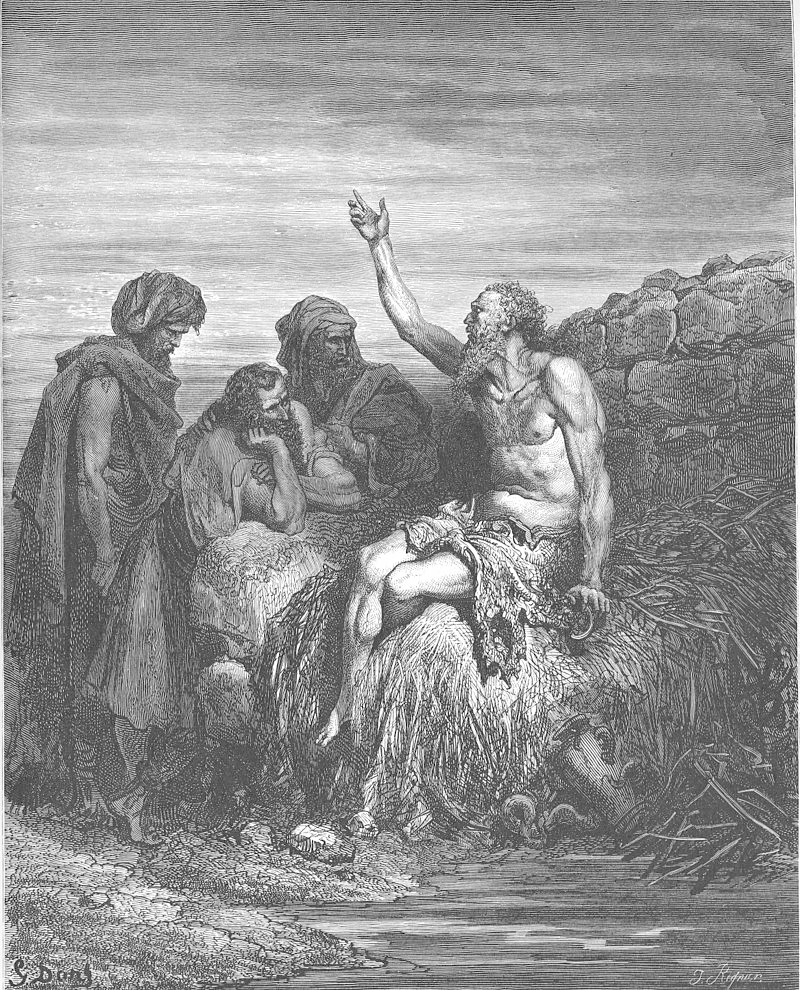
Job speaks with his friends, by Gustave Doré, 1866

Then Bildad the Shuhite replied:

“When will you end these speeches?
    Be sensible, and then we can talk.
Why are we regarded as cattle
    and considered stupid in your sight?
You who tear yourself to pieces in your anger,
    is the earth to be abandoned for your sake?
    Or must the rocks be moved from their place?

“The lamp of a wicked man is snuffed out;
    the flame of his fire stops burning.
The light in his tent becomes dark;
    the lamp beside him goes out.
The vigor of his step is weakened;
    his own schemes throw him down.
His feet thrust him into a net;
    he wanders into its mesh.
A trap seizes him by the heel;
    a snare holds him fast.
A noose is hidden for him on the ground;
    a trap lies in his path.
Terrors startle him on every side
    and dog his every step.
Calamity is hungry for him;
    disaster is ready for him when he falls.
It eats away parts of his skin;
    death’s firstborn devours his limbs.
He is torn from the security of his tent
    and marched off to the king of terrors.
Fire resides in his tent;
    burning sulfur is scattered over his dwelling.
His roots dry up below
    and his branches wither above.
The memory of him perishes from the earth;
    he has no name in the land.
He is driven from light into the realm of darkness
    and is banished from the world.
He has no offspring or descendants among his people,
    no survivor where once he lived.
People of the west are appalled at his fate;
    those of the east are seized with horror.
Surely such is the dwelling of an evil man;
    such is the place of one who does not know God.” (New International Version)

It only makes sense that Bildad was expecting a sensible discussion with Job.

But it was not going to happen.

Why?

Because grief doesn’t make sense; it’s nonsensical, whimsical, and fractal.

If you’ve ever been in a discussion with someone in which the person speaks illogically, it’s likely that you tried to talk sensibly and logically, pointing out the thought process.

And if you have ever done that, it’s also likely that the person did not change one iota of what they said.

Why?

Because people are not primarily thinking creatures who happen to have emotions. Instead, people are emotional creatures who happen to think.

Why do people ask, “Why?”

Because they’re angry. It’s not a cerebral question; it’s an emotional question.

Bildad, a “friend” of Job, was exasperated with his carrying on about being innocent, contending with God, and expressing anger – which is rather funny, because Bildad himself was angry.

Why?

Because supposedly logical and controlled people have illogical and emotional issues, too.

Welcome to the human race, all of you who pride yourselves on your flawless logic and neatly formed theology.

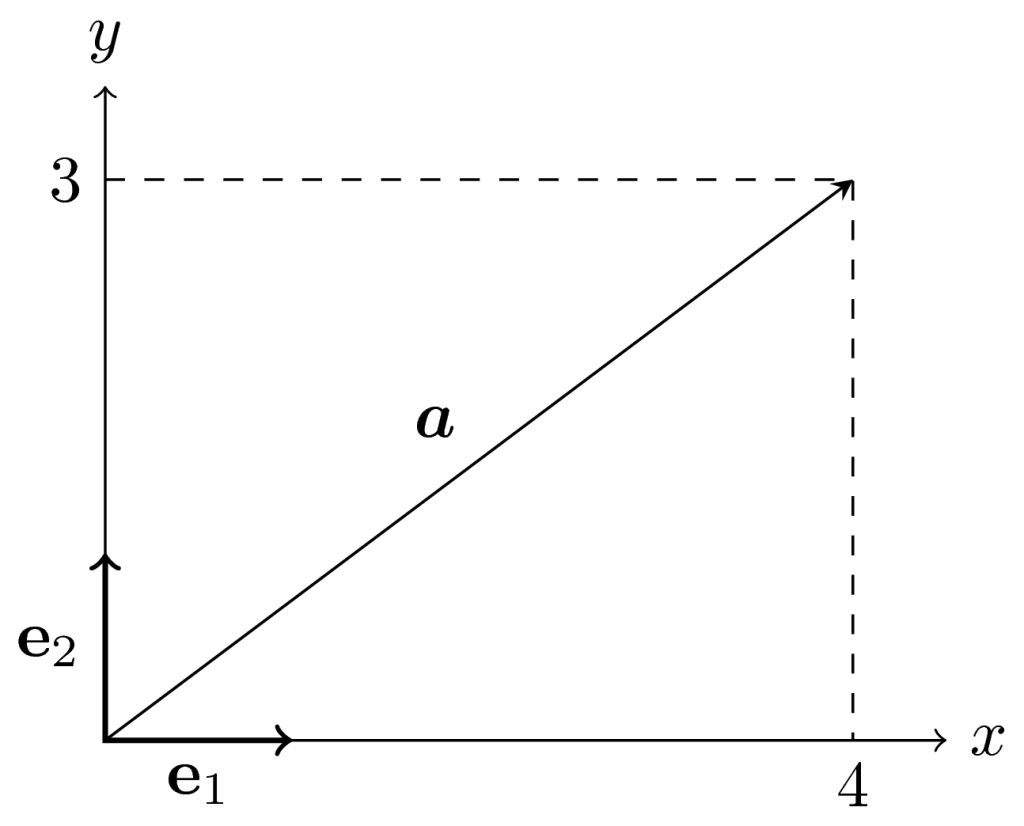
There is a chunk of people in this world who think that everything either works, or ought to work, according to Cartesian coordinates.

A Cartesian coordinate system describes the position of points in space using perpendicular axis lines that meet at a point called the origin. Any given point’s position can be described based on its distance from the origin along each axis. In other words, Cartesian coordinates allow one to specify the location of a point.

So, why am I talking about Cartesian coordinates?

Because that is what Bildad the Shuhite was trying to do with Job, to fix him on a plane that he could understand.

Because in Bildad’s theological world, the wicked are punished by God with bad circumstances and suffering. In the Cartesian world, as the wickedness increases, so does the pain and suffering.

Hence, one is being punished by God… But does the world really operate according to Bildad’s conception of it?

Hell no! (apparently wicked people say that sort of thing when not in the Cartesian world; they should probably get right with God; and, by the way, sarcastic people are wicked, too)

Bildad went so far as to suggest that perhaps Job doesn’t know God at all.

After all, that’s where one goes in a conversation with someone who doesn’t conform to clear and tidy Cartesian-style theology.

They can preach hellfire and damnation to others, yet when another even uses the word “hell” in a phrase, that is where they’re going to go.

It seems that Bildad isn’t really making sense.

Why?

Because he’s stuck. He cannot imagine life outside of his theological bubble.

The difference between Bildad and Job is that Job will admit that he is stuck, confused, messed-up, angry, and has no decent answer to what is going on in his life.

Whereas Bildad would never admit such a thing, even though he is so far stuck in the mud that it would take a divine miracle to get him out.

In fact, it appears we all need a divine miracle.

But God is silent.

Why?

I don’t know. But I do know that it won’t be for long.

Everyone might want to brace themselves for what’s coming.

Why?

Because we will receive precisely what we’re looking for: A word from God. But it’s probably not going to be what we expect.

After all, we aren’t living in a world of Cartesian coordinates.

O Lord God almighty, Creator of heaven and earth: I admit that these people you created drive me nuts! And I’m one of them! I can barely live with myself, let alone others.

In my wondering and confusion and pain, it’s hard to focus on anything. I don’t know why everything is upside-down and topsy-turvy. Yet, somehow I know, and am convinced, that you are present with me, and that you love me.

How in the world could I accept good from you, and not bad? If you love me, and are present with me, then I believe that whatever happens from this point forward, I shall not be forsaken by you.

Contend with those who contend against me. Help me with today, for tomorrow has enough worries of its own. Amen.

Wear the Right Clothes (1 Samuel 2:18-21)

Hannah fits Samuel with a priestly robe, by Unknown artist

But Samuel was ministering before the Lord—a boy wearing a linen ephod. Each year his mother made him a little robe and took it to him when she went up with her husband to offer the annual sacrifice. Eli would bless Elkanah and his wife, saying, “May the Lord give you children by this woman to take the place of the one she prayed for and gave to the Lord.” Then they would go home. And the Lord was gracious to Hannah; she gave birth to three sons and two daughters. Meanwhile, the boy Samuel grew up in the presence of the Lord. (New International Version)

Hannah had to deal with infertility, a rival who taunted her mercilessly, and the societal shame of it all. But the God who is rich in mercy heard Hannah’s prayer at the Tabernacle in Shiloh. She was given a son, Samuel.

And when he was old enough – about 3 or 4 years of age – Hannah and her husband Elkanah presented Samuel to Eli the priest at the Tabernacle. She had vowed to do so if the Lord granted her a son. Hannah made good on that promise.

It turns out that the small boy Samuel was head-and-shoulders above the adult priests. Eli and his two sons, Hophni and Phineas, were no good, too small for the office of priest they occupied. Their service to God was anything but that. They served themselves, especially the two sons.

Eli’s adult children blatantly engaged in sacrilege, aggressively grabbing whatever they wanted from the sacred space of the Tabernacle. They made a mockery of the Lord’s instructions regarding sacrifices and worship in that holy place. The two of them cursed others (which would come back on them soon enough).

In contrast, the boy Samuel was a blessed child. His dear mother Hannah would make him a new priestly robe year after year as he served faithfully. His growing stature, and the need for clothing which suited him, were a light shining in the darkness of two sons who were outfitted in priestly garb that didn’t spiritually fit them at all.

The thing about our clothes is that they can either be an expression of who we truly are; or they can be a covering which hides the true identity. The story makes it plain that Samuel had a beautifully handcrafted robe which suited him perfectly. But Hophni and Phineas inherited priestly threads that seemed like ill-fitting hand-me-downs.

All of us are either revealing who we really are for all to see with unabashed authenticity, or we are concealing ourselves behind a disingenuous false façade, so that our true self is obscured and hidden in the shadows.

We are embodied people living on a physical earth. Our clothes aren’t just mere coverings of the body; they are a material means of communicating important immaterial aspects of ourselves and the world. The elaborate garb of the priest has significance, and ought not to be taken lightly.

In the case of Eli’s sons, they used their clothing to fleece incoming worshipers who were making genuine animal sacrifices to God. The priestly outfits themselves were not the problem; at issue was two people committing sacrilege against the Lord, and injustice toward the Lord’s people.

Material things neither contaminate nor purify a person; the heart does that. We just need to ensure that material objects like clothing are set apart for specific and good purposes. Those clothes ought to be congruent with the person and the task at hand. And clothing ought never to demean or deceive ourselves or others.

Although we aren’t told what sort of clothing Hannah wore, I’m sure that everything she wore spoke to her humility before others, devotion to God, and spirit of doing what is right and just. The Lord gave her clothes fitted for a mother by blessing Hannah with even more children. I can imagine that the biblical writers had women like her in mind when they wrote some of their words:

I want women to enhance their appearance with clothing that is modest and sensible, not with elaborate hairstyles, gold, pearls, or expensive clothes. They should make themselves attractive by doing good, which is appropriate for women who claim to honor God. (1 Timothy 2:9-10, CEB)

It is not fancy hair, gold jewelry, or fine clothes that should make you beautiful. No, your beauty should come from inside you—the beauty of a gentle and quiet spirit. That beauty will never disappear. It is worth very much to God. (1 Peter 3:3-4, ERV)

For all of us, we are encouraged to wear actual and metaphorical clothing that is consistent with what is good:

Right living was my clothing. Fairness was my robe and turban. (Job 29:14, ERV)

Because we belong to the day, we must live decent lives for all to see. Don’t participate in the darkness of wild parties and drunkenness, or in sexual promiscuity and immoral living, or in quarreling and jealousy. Instead, clothe yourself with the presence of the Lord Jesus Christ. And don’t let yourself think about ways to indulge your evil desires. (Romans 13:13-14, NLT)

Therefore, as God’s chosen people, holy and dearly loved, clothe yourselves with compassion, kindness, humility, gentleness and patience. (Galatians 3:12, NIV)

The boy Samuel lived up to the priestly clothes he was wearing; they fit him like a hand in a glove. But the adults who should have known better, Eli and his sons, dressed down their priestly garments and demeaned the office of priest for the people they should have been serving.

It is high time to dress appropriately and clothe ourselves with Christ, so that the very life of Jesus may flow powerfully in us and through us, to the glory of God. Amen.

Remember Passover (Deuteronomy 16:1-8)

Exodus, by Yoram Raanan

Observe the month of Aviv and celebrate the Passover of the Lord your God, because in the month of Aviv he brought you out of Egypt by night. Sacrifice as the Passover to the Lord your God an animal from your flock or herd at the place the Lord will choose as a dwelling for his Name. Do not eat it with bread made with yeast, but for seven days eat unleavened bread, the bread of affliction, because you left Egypt in haste—so that all the days of your life you may remember the time of your departure from Egypt. Let no yeast be found in your possession in all your land for seven days. Do not let any of the meat you sacrifice on the evening of the first day remain until morning.

You must not sacrifice the Passover in any town the Lord your God gives you except in the place he will choose as a dwelling for his Name. There you must sacrifice the Passover in the evening, when the sun goes down, on the anniversary of your departure from Egypt. Roast it and eat it at the place the Lord your God will choose. Then in the morning return to your tents. For six days eat unleavened bread and on the seventh day hold an assembly to the Lord your God and do no work. (New International Version)

The first five books of the Old Testament are known by Christians as the Pentateuch. These same books are the Torah in Judaism. Deuteronomy is the fifth and final book; it is a restatement of God’s Law for the Israelites about to enter the Promised Land.

Several prominent theological themes are highlighted in the book of Deuteronomy. It vigorously advocates for exclusive loyalty to the monotheistic God, Yahweh. Yahweh is characterized as a transcendent Being, full of steadfast love and transformative justice.

Deuteronomy places significant emphasis upon the covenant relationship between God and Israel. The covenant was established with the patriarchs – Abraham, Isaac, and Jacob – and affirmed at Mount Sinai after the exodus from Egypt, at the giving of the Law. This Law was graciously provided by God for the people; it is encapsulated in the Ten Commandments, and is to be reaffirmed as soon as Israel enters the land.

Moses receiving the Tablets of Law, by Marc Chagall, 1963

Therefore, the entire book of Deuteronomy looks forward toward a new existence in the Promised Land. This new society is to pursue justice and be devoted to righteousness. All Israel is to live in harmony with God and one another, enjoying the land and the covenant relationship.

The welfare of Israel depends upon upholding and maintaining the social and religious laws given by Yahweh. God’s commands are a divine gift, and if closely followed, will be the best humanitarian way of caring for the poor and disadvantaged, as well as bringing the people close to Yahweh.

The sacrificial system will revolve around a singular sanctuary in the religious capital. By locating sacrifices in a particular place, this has the effect of Jewish faith not becoming dependent on offerings, but instead on mercy, love, learning the law, and rituals that uphold reverence for God.

Perhaps the greatest of all the rituals is Passover. Israel’s experience of deliverance at the Red Sea and the centralization of worship in Jerusalem is remembered and celebrated at the festival of Passover every year.

In the original Passover, at the time of the exodus, the blood of a sacrificed lamb was smeared on the doorposts of each Jewish home. In doing this, it let the angel of death know to “pass over” that house, thereby only entering Egyptian homes that did not revere nor recognize God. This act was also the final miraculous act of ten plagues leveled on Egypt.

And There Was a Great Cry in Egypt, by Arthur Hacker, 1897

As the households of Egypt were grieving their dead, Israel was urged by the Egyptians to get out. Egypt feared what would happen if the Israelites remained. Therefore, Israel left post haste. They didn’t have any time for their bread to rise. The people ate unleavened bread so they could immediately leave Egypt.

So, from then on, every year in early Spring, Israel commemorates and remembers God’s deliverance of the people from slavery. God, through Moses, instructed the Israelites to mark Aviv as the first month; it is then that the Passover festival is to occur.

I believe that what we can takeaway from this Scripture, is that perhaps, we ought to stop trying to always have takeaways for everything – as if the Bible can be boiled down to some neat personal application for my life.

Aside from admitting I’ve had a bit of a cynical streak lately, we really must contend with seasons like Passover and Lent, and matters such as social justice and religious worship. These religious seasons are important enough to warrant what the late Eugene Peterson called “a long obedience in the same direction.”

By that phrase, Peterson meant that there are some spiritual practices that we must commit ourselves to year after year, even day after day, for the rest of our lives. Generations before did, and generations after us will need to, as well.

Spiritual growth and maturity take time; and we must patiently and consistently cultivate a sense of justice and a practice of righteousness over and over again.

Passover Seder, by Melita Kraus

One must fight for what they believe, each and every day. Spiritual growth takes a lot of time, grit, tenacity, and resilience. It requires patience and grace, perseverance and a good nature. And it is very much a skill which demands daily practice.

Contemporary society is obsessed with quick fixes and easy solutions. But the time-tested practices of Lent, rooted in the remembrances of Passover, are a Christian discipleship that is long on obedience in the same well-worn ancient directions.

We need to keep moving in the directions of deepening a life of prayer, learning the joy of service, growing in the worship of God, and discovering the virtues of humility and a concern for the welfare of everyone in the community.

In other words, to truly observe something, we need to do it, over and over, year after year. In observing the significant events and dates and seasons of the Christian Year, we can find the sort of spiritual support that will fortify our soul, and bless others.

Almighty and everlasting God, you hate nothing you have made and forgive the sins of all who are penitent: Create and make within us new and contrite hearts, so that we may acknowledge our guilt and lament our shame. Let us obtain from you, O merciful God, reconciliation through the Cross, and empowerment through the Spirit, to do justice, love mercy, and walk humbly with you. Amen.