How To Handle the One Who Grieves (Job 37:1-13)

The Wrath of Elihu, by William Blake, 1805

“At this my heart pounds
    and leaps from its place.
Listen! Listen to the roar of his voice,
    to the rumbling that comes from his mouth.
He unleashes his lightning beneath the whole heaven
    and sends it to the ends of the earth.
After that comes the sound of his roar;
    he thunders with his majestic voice.
When his voice resounds,
    he holds nothing back.
God’s voice thunders in marvelous ways;
    he does great things beyond our understanding.
He says to the snow, ‘Fall on the earth,’
    and to the rain shower, ‘Be a mighty downpour.’
So that everyone he has made may know his work,
    he stops all people from their labor.
The animals take cover;
    they remain in their dens.
The tempest comes out from its chamber,
    the cold from the driving winds.
The breath of God produces ice,
    and the broad waters become frozen.
He loads the clouds with moisture;
    he scatters his lightning through them.
At his direction they swirl around
    over the face of the whole earth
    to do whatever he commands them.
He brings the clouds to punish people,
    or to water his earth and show his love.” (New International Version)

Job’s Despair, by William Blake, 1821

On the one hand, the biblical book of Job needs little introduction. Many people know it has to do with a man’s innocent suffering and tenacious faith. Most folks are familiar with how it feels to suffer for no apparent reason. And everyone understands the struggle when life is broken by pain and loss.

Yet, on the other hand, the book of Job defies simple anecdotes about suffering. And the relationship between Job and God has a lot of complexity to it. Add in Job’s friends with their wordy offerings into his situation, and there becomes a fuller picture of the true wrestling of faith and patience that occurs.

Elihu was a young person who was with the three friends of Job. After listening to everyone speak, he himself went on a long speech, stretching six chapters from Job 32-37. He was angry with Job, and with Job’s three friends.

The young Elihu had picked up that Job thought of himself more righteous than God. And he was also upset that the “friends” offered nothing helpful, and could provide no convincing answers to Job – thus making it appear that God was guilty of Job’s intense suffering and grief.

Job, by French painter Léon Bonnat, 1880

In today’s Old Testament lesson, we are getting an end part of Elihu’s speech in which he sought to defend God’s justice through observing the majesty and order of creation.

The testimony of God’s sovereign governance of the world is found in the rain, the thunder, and the lightning; through the winter storms and the frost. The Lord uses the created order to both judge and sustain people. And through the ecological systems we can see that God is at work, regulating it all, and using it for divine purposes, Elihu points out.

What strikes me about Elihu’s words is that he is not wrong, he’s just not very helpful. As a believer, I look at his speech as more of a Captain Obvious moment; yes, he is stating theological reality, but no, he’s not really breaking any new ground or giving any great insight here.

Both Job and Job’s friends had already expressed a theological perspective in kind. Which makes me curious as to why Elihu felt so compelled to even talk at all. I think he would have been better remembered, and maybe even hailed as spiritual beyond his years, if he would have just kept silent.

I realize not everyone is going to go with me on that observation, and that’s fine. Yet it seems to me that a good many people lob too many words toward the suffering among us, when what is actually needed is a compassionate presence that has learned to be comfortable with the uncomfortable.

There are times when words are not needed, when the situation is so incredibly unique and/or difficult that to offer a speech is like yelling in the woods with no one around; it might make the one yelling feel better but that’s about it.

If anyone needed to feel better it wasn’t Elihu. What’s more, a perceived need of defending God’s reputation or honor perhaps betrays a shortsighted theology to begin with. The Lord is quite big enough to handle any rebuffs or misunderstandings from mouthy humans. God isn’t in Junior High School, requiring a mouthpiece to help him out in a scuffle.

I would personally rather give comfort to a hurting person, instead of theological exhortations and speeches about how we ought to talk to, and about, God. That’s because I observe Jesus bringing genuine comfort and help. And I would much rather take my cues for dealing with grieving people from Christ than from Elihu, or anybody else for that matter.

“God blesses those people who grieve. They will find comfort!” (Matthew 5:4, CEV) Jesus said this in his Sermon on the Mount, as a beatitude of all who desire God’s kingdom. Christ understood well the psalmist’s understanding of God’s role and stance concerning people’s grief: “The Lord is close to the brokenhearted; he saves those whose spirits are crushed.” (Psalm 34:18, CEB)

The Apostle Paul, taking a lesson from both his Jewish learning and his encounter with Christ said, “mourn with those who mourn.” (Romans 12:15, NIV) Comfort because of grief and suffering will be built into the end of time. Methinks, then, that this is important…

“Look! God’s dwelling place is now among the people, and he will dwell with them. They will be his people, and God himself will be with them and be their God. ‘He will wipe every tear from their eyes. There will be no more death’ or mourning or crying or pain, for the old order of things has passed away.” (Revelation 21:3-4, NIV)

In whatever way you choose to look at the book of Job, please don’t miss what is to be our response to another’s pain. There is a time for theological education, and there is a time to put a robust theology into practice through a very real comforting presence of another who is in terrible suffering.

God, the strength of the weak and the comfort of those who suffer: Hear my prayers and grant those who suffer in body, mind, or spirit the power of your grace, that affliction may be turned into health, and sorrow into joy. Amen.

Leave a Supportive Spiritual Legacy (Deuteronomy 11:18-21)

 “So commit yourselves wholeheartedly to these words of mine. Tie them to your hands and wear them on your forehead as reminders. Teach them to your children. Talk about them when you are at home and when you are on the road, when you are going to bed and when you are getting up. Write them on the doorposts of your house and on your gates, so that as long as the sky remains above the earth, you and your children may flourish in the land the Lord swore to give your ancestors.” (New Living Translation)

The biblical book of Deuteronomy is a farewell address by Moses to the Israelites.

Moses was about to die. The Israelites were about to enter the Promised Land.

So, Moses restated God’s law and called the people to remember all that God had done. He exhorted the people to communicate the law and their heritage to the next generations.

If God’s words and God’s ways are continually observed, then the people would prosper in God’s Promised Land.

The overarching call and command of Moses to the people is to love God with everything they have and everything they are.

God’s people are to have a dedicated commitment of mind, body, emotions, and spirit to the law of God. Each ability and gift, and all that makes a person a person, is to have its clear direction and orientation toward loving God through obeying God’s commands.

The love of God is meant to become a habit in the normal daily rhythms of life. How do we do that? Impress God’s commands by talking about them in every sort of context: home and family; neighborhood and workplace; morning and evening. People are even to write out God’s commands and have them in front of us all the time. 

Indeed, the entire day is an opportunity to love God by talking about God’s words. Discussing God’s words and commands doesn’t need to be forced or awkward. Yet, it is something which needs some intention and purpose to it.

Most people like talking about things which are important to them. If someone is really into classic cars, he does not have to try and force a conversation about it because it just comes out of him. Because they go to car shows, maybe own a classic car that they are continually tinkering with, and read up on car magazines, a discussion about the subject is quite natural to them.

So, the best way to live into God’s law is to spend time with God through regular Bible reading, focused and earnest prayer, conversing with others, and taking advantage of opportunities to learn and know about God. For the Christian, talking about Jesus is meant to be organic, springing from a heart which loves God and observes God’s law.

When it comes to family, an expert theologian or biblical scholar is not needed; there just needs to be a willingness and a curiosity to ask questions.

Back when raising my girls, most of our conversations at the table centered around one question I would ask. We discussed it, talked about it, and mulled it over. Sometimes it was a deep theological question. At other times, it was a practical question. My wife and I often had others share a meal with us, so I usually asked our guests to tell their God story or participate with us in the question. If they were not Christian, I would ask them what they thought about Jesus and faith, and why.

God loves it when we have conversation in the home around biblical teaching. God also loves it when we have discussions in public. Some Orthodox Jewish persons still to this day wear a “phylactery” on their foreheads – a small box with little Scripture passages inside of it – testifying to their value of the written Word.

I’m not sure that’s what Moses had in mind when he talked about binding God’s commands on the forehead and tying them as symbols on the hands. Much of the Hebrew language is metaphorical, speaking about concrete things as a way of communicating something intangible. So, I wonder if the big idea here is simply to be open about faith and love for God and the law.

Although I don’t believe we have to take today’s verses quite so literally, there is, however, something to be said for keeping Holy Scripture continually in front of us, in order to remember divine commands and promises.

It’s good to write some Bible verses and place them on your bathroom mirror, the dash of your car, in your pants pocket, or anywhere you will see them on a regular basis. It’s a practical way of remembering to observe all that God has commanded.

Physical reminders of significant spiritual events can help us keep the words of God in our lives. When the Israelites experienced God in some significant way, they built an altar. For example, when they approached the Jordan River to enter the land, God caused the water to stop flowing so that they could cross over. Here is what happen next: 

Joshua erected a monument, using the twelve stones that they had taken from the Jordan. And then he told the People of Israel, “In the days to come, when your children ask their fathers, ‘What are these stones doing here?’ tell your children this: ‘Israel crossed over this Jordan on dry ground.’

“Yes, God, your God, dried up the Jordan’s waters for you until you had crossed, just as God, your God, did at the Red Sea, which had dried up before us until we had crossed. This was so that everybody on earth would recognize how strong God’s rescuing hand is and so that you would hold God in solemn reverence always.” (Joshua 4:20-24, MSG)

Passing the spiritual baton and leaving a heritage for future generations is a sacred trust. One of the best ways for that to happen is within the home, talking about God and Scripture as a daily routine, as well as freely conversing about spirituality in public.

There are several ways churches can impress Scripture to younger generations: 

  1. Train them to lead. Adults do not have to do everything in the church. Every generation can be empowered to engage in ministries on a regular basis. Everyone needs a mentor to do anything well – which means taking others with us along the journey of ministry so they can both shadow and participate.
  2. Empathize with young people and young families. That means avoiding criticism. It’s easy for older generations to be critical about another generation’s lack of involvement; or how they live their lives. They don’t need our criticism, but our help. Empathy means that we recognize others are trying to do the best they can in a crazy world. And it’s a world quite different from the one I grew up in. This is a very competitive world, requiring more energy and drive than previous generations. Being a student today is not like being a student when I was a kid.  Being a young parent is not the same today as it once was. Today’s family structure is completely changed; what we think of as a traditional family only makes up 7% of the American population. The stance to take on this is not to criticize, but to encourage and help.
  3. Take the message of Jesus seriously.  Discussion, conversation, questions, and mutual sharing are the ways Jesus developed his followers; and it’s a way we can reach younger generations. Dialogue goes a lot further than simply telling others what they should believe and do.
  4. Adopt a young person, or a young family. If you consider yourself part of an older generation, consider taking a younger person or family under your wing, who is not related to you. Invite them to a meal, read these verses, and discuss them together. Commit to praying for them daily for a set period.
  5. Look for ways to support children, teens, and young families. Prioritizing younger generations means they don’t have to do everything our way. Rather, it means we will listen to what they need in loving God and building into their own families.
  6. Be great neighbors. Discuss, teach, empower, and develop young people – without criticism – into good neighbors who engage their local community by addressing issues with great love and lots of compassion.

There are many more ways to engage. The idea here is that we think about how to embody the teaching we have in Deuteronomy by passing on God’s love and God’s words. So, where will you start?…

Remember Passover (Deuteronomy 16:1-8)

Exodus, by Yoram Raanan

Observe the month of Aviv and celebrate the Passover of the Lord your God, because in the month of Aviv he brought you out of Egypt by night. Sacrifice as the Passover to the Lord your God an animal from your flock or herd at the place the Lord will choose as a dwelling for his Name. Do not eat it with bread made with yeast, but for seven days eat unleavened bread, the bread of affliction, because you left Egypt in haste—so that all the days of your life you may remember the time of your departure from Egypt. Let no yeast be found in your possession in all your land for seven days. Do not let any of the meat you sacrifice on the evening of the first day remain until morning.

You must not sacrifice the Passover in any town the Lord your God gives you except in the place he will choose as a dwelling for his Name. There you must sacrifice the Passover in the evening, when the sun goes down, on the anniversary of your departure from Egypt. Roast it and eat it at the place the Lord your God will choose. Then in the morning return to your tents. For six days eat unleavened bread and on the seventh day hold an assembly to the Lord your God and do no work. (New International Version)

The first five books of the Old Testament are known by Christians as the Pentateuch. These same books are the Torah in Judaism. Deuteronomy is the fifth and final book; it is a restatement of God’s Law for the Israelites about to enter the Promised Land.

Several prominent theological themes are highlighted in the book of Deuteronomy. It vigorously advocates for exclusive loyalty to the monotheistic God, Yahweh. Yahweh is characterized as a transcendent Being, full of steadfast love and transformative justice.

Deuteronomy places significant emphasis upon the covenant relationship between God and Israel. The covenant was established with the patriarchs – Abraham, Isaac, and Jacob – and affirmed at Mount Sinai after the exodus from Egypt, at the giving of the Law. This Law was graciously provided by God for the people; it is encapsulated in the Ten Commandments, and is to be reaffirmed as soon as Israel enters the land.

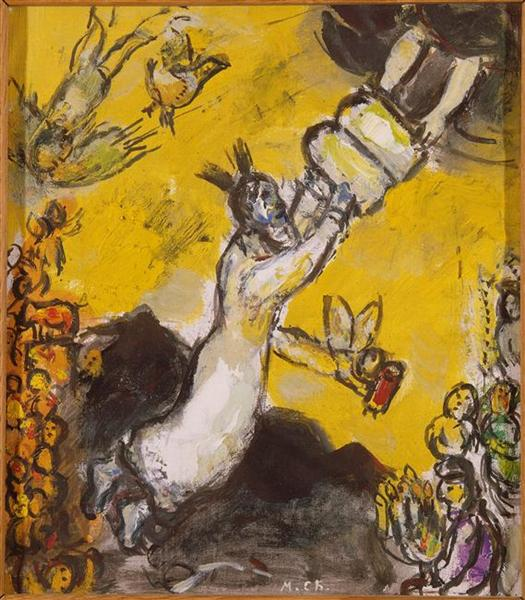
Moses receiving the Tablets of Law, by Marc Chagall, 1963

Therefore, the entire book of Deuteronomy looks forward toward a new existence in the Promised Land. This new society is to pursue justice and be devoted to righteousness. All Israel is to live in harmony with God and one another, enjoying the land and the covenant relationship.

The welfare of Israel depends upon upholding and maintaining the social and religious laws given by Yahweh. God’s commands are a divine gift, and if closely followed, will be the best humanitarian way of caring for the poor and disadvantaged, as well as bringing the people close to Yahweh.

The sacrificial system will revolve around a singular sanctuary in the religious capital. By locating sacrifices in a particular place, this has the effect of Jewish faith not becoming dependent on offerings, but instead on mercy, love, learning the law, and rituals that uphold reverence for God.

Perhaps the greatest of all the rituals is Passover. Israel’s experience of deliverance at the Red Sea and the centralization of worship in Jerusalem is remembered and celebrated at the festival of Passover every year.

In the original Passover, at the time of the exodus, the blood of a sacrificed lamb was smeared on the doorposts of each Jewish home. In doing this, it let the angel of death know to “pass over” that house, thereby only entering Egyptian homes that did not revere nor recognize God. This act was also the final miraculous act of ten plagues leveled on Egypt.

And There Was a Great Cry in Egypt, by Arthur Hacker, 1897

As the households of Egypt were grieving their dead, Israel was urged by the Egyptians to get out. Egypt feared what would happen if the Israelites remained. Therefore, Israel left post haste. They didn’t have any time for their bread to rise. The people ate unleavened bread so they could immediately leave Egypt.

So, from then on, every year in early Spring, Israel commemorates and remembers God’s deliverance of the people from slavery. God, through Moses, instructed the Israelites to mark Aviv as the first month; it is then that the Passover festival is to occur.

I believe that what we can takeaway from this Scripture, is that perhaps, we ought to stop trying to always have takeaways for everything – as if the Bible can be boiled down to some neat personal application for my life.

Aside from admitting I’ve had a bit of a cynical streak lately, we really must contend with seasons like Passover and Lent, and matters such as social justice and religious worship. These religious seasons are important enough to warrant what the late Eugene Peterson called “a long obedience in the same direction.”

By that phrase, Peterson meant that there are some spiritual practices that we must commit ourselves to year after year, even day after day, for the rest of our lives. Generations before did, and generations after us will need to, as well.

Spiritual growth and maturity take time; and we must patiently and consistently cultivate a sense of justice and a practice of righteousness over and over again.

Passover Seder, by Melita Kraus

One must fight for what they believe, each and every day. Spiritual growth takes a lot of time, grit, tenacity, and resilience. It requires patience and grace, perseverance and a good nature. And it is very much a skill which demands daily practice.

Contemporary society is obsessed with quick fixes and easy solutions. But the time-tested practices of Lent, rooted in the remembrances of Passover, are a Christian discipleship that is long on obedience in the same well-worn ancient directions.

We need to keep moving in the directions of deepening a life of prayer, learning the joy of service, growing in the worship of God, and discovering the virtues of humility and a concern for the welfare of everyone in the community.

In other words, to truly observe something, we need to do it, over and over, year after year. In observing the significant events and dates and seasons of the Christian Year, we can find the sort of spiritual support that will fortify our soul, and bless others.

Almighty and everlasting God, you hate nothing you have made and forgive the sins of all who are penitent: Create and make within us new and contrite hearts, so that we may acknowledge our guilt and lament our shame. Let us obtain from you, O merciful God, reconciliation through the Cross, and empowerment through the Spirit, to do justice, love mercy, and walk humbly with you. Amen.

Overwhelmed with Grief (Jeremiah 20:14-18)

Cursed be the day
    on which I was born!
The day when my mother bore me,
    let it not be blessed!
Cursed be the man
    who brought the news to my father, saying,
“A child is born to you, a son,”
    making him very glad.
Let that man be like the cities
    that the Lord overthrew without pity;
let him hear a cry in the morning
    and an alarm at noon,
because he did not kill me in the womb;
    so my mother would have been my grave
    and her womb forever pregnant.
Why did I come forth from the womb
    to see toil and sorrow
    and spend my days in shame? (New Revised Standard Version)

Perhaps you feel as though you must put on a good face, a decent front for others to see. It could be that you don’t like other people seeing you upset or cry because it can be embarrassing. Maybe you believe others don’t need to be burdened with your sadness. The last thing you want is to be a killjoy.

Sometimes you might even put up a front with God. Maybe you think God wants everyone to be perpetually happy and always sing with the birds in blissful joy and gladness, or whistle while you work. However, that would not be an accurate view of God.

One of the most faithful people in Holy Scripture, Jeremiah, freely and unabashedly lamented before God – to the point of wishing he were dead. Jeremiah, the incredible prophet of God, closer to the Lord than anyone of his generation, was so despondent and ashamed that he wished he had never even born. The suffering and the shame were just too overwhelming.

To say that Jeremiah had a difficult ministry is a gross understatement. He literally had the ministry from hell, prophesying to people who neither liked him, nor his message to them. In the middle of it all, Jeremiah threw up his hands and let out his complaint to God. Jeremiah was in such ministerial misery that he wished he had been a stillborn baby.

Lest you think Jeremiah was sinfully depressed or just cuckoo, he is far from alone in the Bible. King David had no scruples about letting God know how he felt about his dire circumstances. Job, likely the most famous sufferer of all, spent time doing nothing but lamenting his terrible losses for months. What all three of them have in common is that they openly grieved with great tears, yet neither cursed God nor forsook the Lord.

Lamentation is the sacred space between intense grieving to God without blaming the Lord for our significant changes and losses in life. I would even argue that lamenting and grieving before God is a necessary spiritual practice which needs full recognition in the Body of Christ. Please sit with that last statement for a bit and consider how it might become a reality in your own life and context.

Grief can and does attach itself to any change or loss. It is the normal emotional, spiritual, physical, and relational reaction to that injury of the heart. There is only one way through grief. We must tell our story to another. It is both biblical and quite necessary.

Bear one another’s burdens, and in this way you will fulfill the law of Christ.

Galatians 6:2, NRSV

We need our own spirituality to support us in such times – not drive us away through a misguided theology of believing you must keep a stiff upper lip. It is critical to have safe and supportive persons in our lives when going through overwhelming circumstances.

“Spirituality is recognizing and celebrating that we are all inextricably connected to each other by a power greater than all of us, and that our connection to that power and to one another is grounded in love and compassion.”

Brené Brown

Our tears are holy. They are not the mark of weakness, but of power. The prophet Jeremiah was doing a very godly thing in expressing his grief. And Jeremiah’s lament is what helped steel him for the several attempts on his life that he faced.

Let the tears do their intended work in your life.

God of all, you feel deeply about a great many things. As your people, we also feel a great depth of emotion when our lives go horribly awry from our dreams and expectations. Hear our lament as we pour out our grief before you, through Jesus, our Savior, with the presence of the Holy Spirit. Amen.