Feeling the Pain (Job 23:1-9, 16-17)

Then Job answered:

“Today also my complaint is bitter;
    his hand is heavy despite my groaning.
Oh, that I knew where I might find him,
    that I might come even to his dwelling!
I would lay my case before him
    and fill my mouth with arguments.
I would learn what he would answer me
    and understand what he would say to me.
Would he contend with me in the greatness of his power?
    No, but he would give heed to me.
There the upright could reason with him,
    and I should be acquitted forever by my judge.

“If I go forward, he is not there;
    or backward, I cannot perceive him;
on the left he hides, and I cannot behold him;
    I turn to the right, but I cannot see him….

God has made my heart faint;
    the Almighty has terrified me.
If only I could vanish in darkness,
    and thick darkness would cover my face. (New Revised Standard Version)

Here is Job, sitting on an ash heap, of all things, and feeling like an ash. His children are gone, all killed by tragic circumstances. His wealth is no more. And now he is lamenting, because he can do nothing else; he has painful nasty sores covering his body that won’t let him do anything.
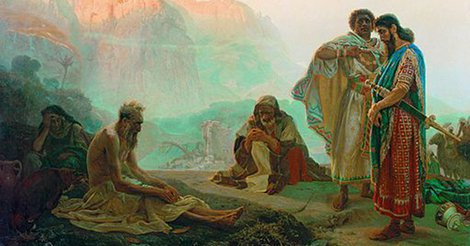
Job and his friends, by Ilya Repin (1844-1930)

And if that isn’t enough, Job’s “friends” come and end up giving him unhelpful speeches about how all this suffering is really his fault. They reasoned (wrongly) that there must be loads of sin in Job’s life for him to be going through such horror. God is punishing him, they insist.

Job’s companions had initially started out well. For seven days they sat with him in silence (Job 2:13). But then, after a week had passed, they just couldn’t take it anymore. They had the compulsion to speak. And when they opened their mouths, it was merely a bunch of ignorant gobbledygook.  

The friends, the companions, were themselves having an existential theological crisis. Their worldview was being challenged and threatened. So, rather than be open-minded and consider that their views may need to be altered, the friends acted like enemies, accusing Job of sin.

At issue was their clear and clean theology of believing that good guys are blessed with wealth, health, and happiness; and bad guys are cursed with poverty, illness, and misery – like Job.

They could not imagine or entertain the thought that God would let a good person suffer like Job was suffering. Therefore, Job must be bad, and they tried to find that hidden sin within him  to which he must repent of.

Yet, in truth, not all suffering – even terrible grinding suffering – is the result of personal sin or bad decision-making. Sometimes, good people suffer horribly, too.

Times may change, but people throughout the ages don’t. Today, we still think along the same lines as the companions of Job. There is far too much blaming of victims for their victimization; and way too many flippant beliefs which say to others in a terrible situation things like, “You reap what you sow.”

Job, through all of the loss, tragedy, and then suffering from his friends, held onto his integrity. Even though Job knew his situation was undeserved, he did not curse God, nor his friends.

Job made the incredible claim that suffering is not always the result of one’s personal sin – something he himself might not have said before his tragic experiences.

But just because Job did not curse, does not mean he was nice and okay with what unfolded in his life. He wished he was never born. He felt like death would be preferable to living. He contended with God, and longed for justice. His ultimate wish was that God would just speak and say something, anything.

Job was hurting so terribly, that he had bitter words of despair for God. He could make absolutely no sense of what was happening. He could not understand why he was the brunt of so much suffering. It felt like God was attacking him, and he said so.

The silence and absence of God were palpable for Job. He longed to speak with God. And his greatest lament – out of all the reasons to lament – was the horrible feeling of being alone without God’s presence and consolation.

It is interesting that we have no mention in the story about Job’s friends speaking directly to God, or praying to God, or addressing God in any way.

They certainly felt free to tell Job who God is, and how God operates in the world. But there was never any intercession for their friend, and no words of crying out to God on behalf of Job. There was only words of rebuke and chastisement, words of hurt that were as painful as the physical sores on his body

The phrase I hear most often from people speaking to the person in grief and pain is, “You just need to be strong.” And a close second is, “Everything happens for a reason.” The latter phrase is simply unhelpful, and the former phrase is actually hurtful.

It is not a sin to be weak. Just in case you read that sentence too quickly, I will say it again: It. Is. Not. A. Sin. To. Be. Weak!

We understand that when someone breaks a bone, they’ll be limited with weakness for a while. And we make helpful accommodations to that effect. But when someone’s heart is broken, and their life emotionally shredded, we expect them to be strong for everyone else around them.

It may be true that everything happens for a reason, yet most of the time, none of us knows the reason why we’re going through what we’re going through. And we probably won’t, this side of heaven.

If we try to have explanations for everything, then we join the company of Job’s companions who had to try and understand what was happening. And their conclusions were very wrong.

However, there is nothing wrong with weeping with those who weep; and expressing pain, grief, and even anger – both for the one who laments, and those who lament with them.

Pain cannot be relieved unless it is acknowledged, affirmed, and addressed by both the one who suffers and the community who surrounds them.

Where there is lament, there are loud words and expressions of grief. When lament is said to God, then God can hold that person, and rock them in the arms of mercy.

But silence is agonizing. We need friends who will listen and grieve with us. It is vital to have companions who voice to God what we cannot voice in our weakness. All of us, together, must hold onto God, and trust that the Lord hears, and will answer.

As Jesus cried out on the cross, I cry out to you in pain, O God my Creator. Do not forsake me. Grant me relief from this suffering and preserve me in peace; through Jesus Christ my Savior, in the power of the Holy Spirit. Amen.

Wisdom for Life (Proverbs 11:1-31)

The Lord detests dishonest scales,
    but delights in an accurate weight.
When pride comes, so does shame,
    but wisdom brings humility.
Integrity guides the virtuous,
    but dishonesty ruins the treacherous.
Riches don’t help in the day of wrath,
    but righteousness rescues from death.
The righteousness of the innocent makes their path straight,
    but the wicked fall in their wickedness.
Those who do right are saved by their righteousness,
    but the untrustworthy are caught by their own desires.
When the wicked die, their hope perishes.
    Yes, any hope based on money perishes.
The righteous are saved from distress,
    and the wicked take their place.
The godless destroy their neighbors by their words,
    but the righteous are saved by their knowledge.
When the righteous succeed, a city rejoices;
    when the wicked perish, there are shouts of joy.
A city is honored by the blessing of the virtuous;
    it is destroyed by the words of the wicked.
Whoever despises their neighbor lacks sense;
    a sensible person keeps quiet.
A slanderer walks around revealing secrets,
    but a trustworthy person keeps a confidence.
Without guidance, a people will fall,
    but there is victory with many counselors.
Guaranteeing the debt of a stranger brings big trouble,
    but the one who refuses to shake hands will be secure.
A gracious woman gains honor;
    violent men gain only wealth.
Kind persons benefit themselves,
    but cruel people harm themselves.
The wicked earn false wages,
    but those who sow righteousness receive a true reward.
The righteous are headed toward life,
    but those who pursue evil, toward death.
The Lord detests a crooked heart,
    but he favors those whose path is innocent.
The evil person will surely not go unpunished,
    but the children of the righteous will escape.
Like a gold ring in a pig’s nose
    is a beautiful woman who lacks discretion.
The desires of the righteous end up well,
    but the expectations of the wicked bring wrath.
Those who give generously receive more,
    but those who are stingy with what is appropriate will grow needy.
Generous persons will prosper;
    those who refresh others will themselves be refreshed.
People curse those who hoard grain,
    but they bless those who sell it.
Those who look for good find favor,
    but those who seek evil—it will come to them.
Those who trust in their wealth will wither,
    but the righteous will thrive like leafy trees.
Those who trouble their family will inherit the wind.
    The fool will be servant to the wise.
The fruit of the righteous is a tree of life,
    and the wise gather lives.
If the righteous receive their due on earth,
    how much more the wicked and sinners? (Common English Bible)

The good and the bad, the wise and the foolish, the righteous and the wicked. When it comes to proverbial wisdom, there are two kinds of people: Those who take a right, just, and good path of life; and those who take the wrong exit, practice injustice, and embrace being bad.

We are all, of course, a strange amalgam of sinner and saint. Everyone has some altruism, along with a devious bent. So, life really comes down to our choices. Will our decision-making be wise, or foolish?

This is where the Book of Proverbs helps us. It lays out a prudent course of action for us, so that we can gain a perspective on the consequences of those actions, whether good or bad.

We have to carefully weigh our decisions and consider the likely outcomes of the choices we make.

As we decide, keep in mind that honesty is the best policy (11:1-4); choices have consequences (11:5-6); certain choices lead to rewards (11:7-10); good brings good, and bad brings bad (11:11-31).

Honesty Is the Best Policy

Making the decision to be honest in all things is what builds our capacity to resist evil. Poor choices often come from simply giving in, because we don’t have our resistance to saying “no” built up yet.

Humility enables us to keep our minds on the task at hand, rather than compromise on our integrity in order to achieve something we believe we need or want. The humble person understands that all things are a gift from God – and that the Lord can give, and the Lord can take away. Humility teaches us to say, “Blessed be the name of the Lord.”

When we are emptied of self-promotion, and filled with honest humility, righteousness results. And the righteous person automatically and reflexively denies all evil and wickedness.

Choices Have Consequences

Just because no one sees it, doesn’t mean there won’t be consequences. And just because there was no lightning strike from God immediately after a transgression, doesn’t mean that God’s judgment isn’t coming later.

I talk to far too many people, in my line of work as a hospital chaplain, who are filled with regret about some decision they made earlier in their life. Because now they are experiencing the physical consequences of that choice (and the emotional and relational consequences, as well).

A set of choices made earlier in life not only have real consequences later that one can see and feel; those decisions also erode the ability to make sound decisions in the present. It is a tough uphill struggle to gain some spiritual and emotional health, whenever any reserve of righteousness was not properly developed and maintained.

Certain Choices Lead to Rewards

Conversely, however, consistently good decisions, made over a stretch of time, provide solid spiritual and emotional dividends from which we can draw from in difficult times.

The chief reward for the righteous is that they have a robust life of faith and goodness because of their relationship to the Lord and a good supportive community of persons.

Foolish living leads to punishment; wise living leads to reward. A good life is really a reward itself. That’s because we are meant to live this way, to be merciful and just in all we do, walking humbly with our God. (Micah 6:8)

When the wicked die, that’s it. But when the righteous die, they leave a profound legacy in the form of others who have been encouraged, helped, and loved by their righteousness. They carry on the legacy of good. It makes a big difference.

I cannot imagine any greater reward than to know that I have been faithful to my God, and good to my fellow humanity. Such persons become like a great cloud of witnesses, testifying to the worth of investing in wisdom and humility.

Good Brings Good, Bad Brings Bad

A just and good life inspires others, invigorates groups of people, and leads to holistic health of individuals. Purity of heart is beneficial to the individual, and is contagious to the community.

A foolish life trusts in their own bad attitudes and personal opinions – and then they will wonder why they don’t get anywhere in life, and nobody wants to be around them.

King Solomon himself, gatherer of the biblical proverbs, knew all too well about both the good and the bad, and their eventual outcomes.

Solomon was quite humble and wise at the beginning of his reign. He did everything his father David asked of him, and more. But his wild success as king gradually brought him to acquire more stuff, more wives, and to fudge on the responsibilities and requirements of being king.

If a guy like King Solomon, who was the wisest person who ever lived, can ignore his own nation’s God and Holy Scripture to get whatever he wanted, then how much more do we, who have less wisdom, need the grace of loving people speaking truth to our hearts?

The people we surround ourselves with, no matter who we are, is vitally important. Everyone needs loving persons around them who will tell them what they need to hear in a spirit of love and grace. 

None of us do well with success unless we have humble and wise persons close to us who have the gumption and the grace to speak into our lives to help us, not hurt us. When we don’t have that, things go sideways.

I encourage you to go back and read Proverbs chapter 11 again, slowly, letting its wisdom seep into you. Also, a good practice is to read a chapter of Proverbs each day for the next month; and to occasionally, in the future, come back to this practice.

May the proverbial biblical wisdom fill your heart and your mind, so that you are able to make sage decisions in all of the various circumstances you encounter in this life. Amen.

Tamar (2 Samuel 13:1-19)

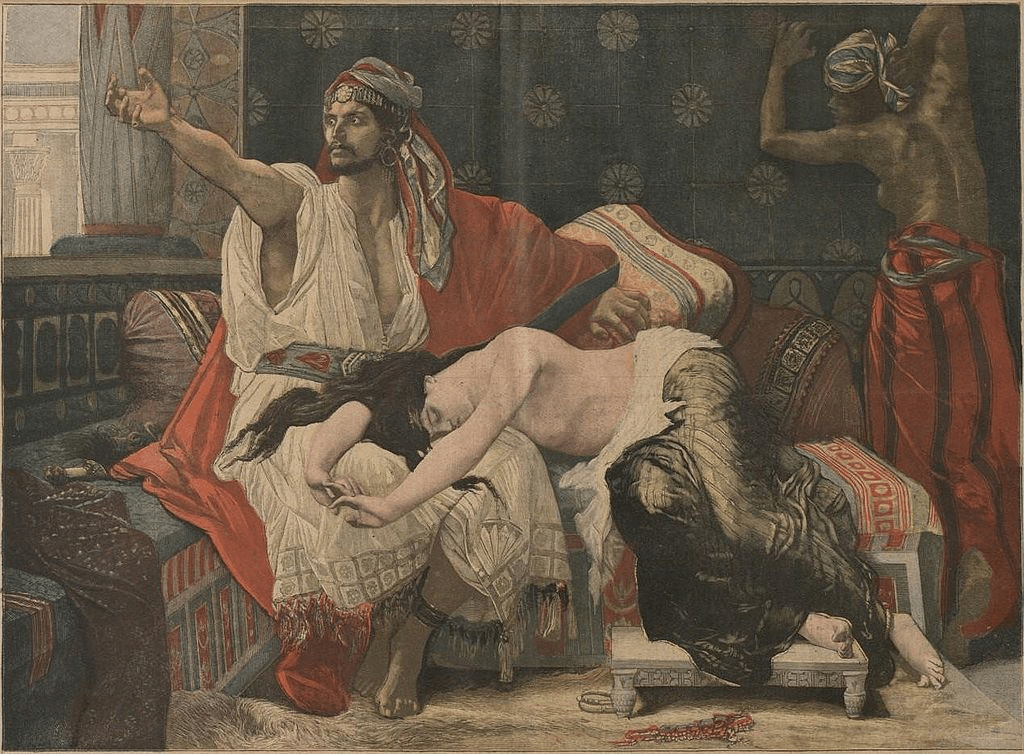
Tamar, by Alexandre Cabanel, 1875

In the course of time, Amnon, son of David fell in love with Tamar, the beautiful sister of Absalom son of David.

Amnon became so obsessed with his sister Tamar that he made himself ill. She was a virgin, and it seemed impossible for him to do anything to her.

Now Amnon had an adviser named Jonadab son of Shimeah, David’s brother. Jonadab was a very shrewd man. He asked Amnon, “Why do you, the king’s son, look so haggard morning after morning? Won’t you tell me?”

Amnon said to him, “I’m in love with Tamar, my brother Absalom’s sister.”

“Go to bed and pretend to be ill,” Jonadab said. “When your father comes to see you, say to him, ‘I would like my sister Tamar to come and give me something to eat. Let her prepare the food in my sight so I may watch her and then eat it from her hand.’”

So Amnon lay down and pretended to be ill. When the king came to see him, Amnon said to him, “I would like my sister Tamar to come and make some special bread in my sight, so I may eat from her hand.”

David sent word to Tamar at the palace: “Go to the house of your brother Amnon and prepare some food for him.” So Tamar went to the house of her brother Amnon, who was lying down. She took some dough, kneaded it, made the bread in his sight and baked it. Then she took the pan and served him the bread, but he refused to eat.

“Send everyone out of here,” Amnon said. So everyone left him. Then Amnon said to Tamar, “Bring the food here into my bedroom so I may eat from your hand.” And Tamar took the bread she had prepared and brought it to her brother Amnon in his bedroom. But when she took it to him to eat, he grabbed her and said, “Come to bed with me, my sister.”

“No, my brother!” she said to him. “Don’t force me! Such a thing should not be done in Israel! Don’t do this wicked thing. What about me? Where could I get rid of my disgrace? And what about you? You would be like one of the wicked fools in Israel. Please speak to the king; he will not keep me from being married to you.” But he refused to listen to her, and since he was stronger than she, he raped her.

Then Amnon hated her with intense hatred. In fact, he hated her more than he had loved her. Amnon said to her, “Get up and get out!”

“No!” she said to him. “Sending me away would be a greater wrong than what you have already done to me.”

But he refused to listen to her. He called his personal servant and said, “Get this woman out of my sight and bolt the door after her.” So his servant put her out and bolted the door after her. She was wearing an ornate robe, for this was the kind of garment the virgin daughters of the king wore. Tamar put ashes on her head and tore the ornate robe she was wearing. She put her hands on her head and went away, weeping aloud as she went. (New International Version)

Tamar, David’s daughter, photo by Dikla Laor

There is a very sad reality that has been pervasive throughout human history. Sexual assault and rape has existed as long as people have been on this earth.

Today’s account of Tamar’s awful experience, of having her life upended and changed forever, and of being dehumanized – treated as an object and not as a person created in the image of likeness of God – is unfortunately a story of far too many women in history, as well as today.

To have this sort of thing happen to just one woman is unacceptable, and ought never to happen again. And yet, countless female lives (not to mention many male lives, as well) have been altered by another (or others) who only viewed them from a place of evil desire.

It isn’t right. It’s not just. It is not good. Downright ungodly is what it truly is. There is nobody who should ever have to go through something like Tamar did.

There are enough of these sorts of stories in history, in literature, and in the news, that it’s hard for past victims not to be re-traumatized all over again – remembering what happened in their own lives, and being triggered yet again with unwanted memories.

That is neither the Bible’s intention, nor mine. Rather, I want to acknowledge Tamar’s experience as having happened, and that it was not her fault in any way, shape, or form. I see Tamar, in the healthy sense of seeing. And I hope, if you in some way relate to Tamar, that you are seen this day by someone who cares, and by a God who understands and grieves along with you.

There’s no need for me, therefore, to rehash the particulars of today’s Old Testament story. This is a scriptural case in which reading it once is sufficient for today. The real question is what we are going to do with it.

For those who are concerned, and wonder how to help someone, a friend or family member, who has been harassed or assaulted, consider the following:

  • Believe them, period. There’s no need to ask a lot of probing questions, as if you’re trying to find the truth. Encourage and support, don’t judge or criticize.
  • Affirm to them that they are not alone. Offer your support and time. Let them know of resources which might help (see below).
  • Let them know this was not their fault. Avoid blaming or trying to find out what they could have done differently.
  • Empower them. It’s their choice to tell their story, or not; or what parts of the story they want to reveal. Do anything you can to let them know they have options, and that they are in control of the conversation.
  • Ask how you can help. “How can I help you?” assumes that the other person knows better than you do about what they need. And keep asking as the days, weeks, and months go on.
  • Tell them your observations. If they look mad or sad, anxious or depressed, or are doing something which seems concerning, offer your observations without judgment. You can always ask them if your own perspective is on, or off.
  • Refer to others who can help. A person in crisis needs more help, not less. Not only might they need a trained therapist, but they may also need other forms of support in order to cope with what happened. Changing a residence, dropping classes, or help with basic daily chores are examples of assistance they may want. They might also need others who can help them with unhealthy ways of coping such as alcohol or risky behaviors.
  • Know your own limits. Steer clear from trying to do the job of people who have the training to do it. Know what you can do and not do. Also, if you do all the problem-solving, they might miss opportunities to learn new ways of coping. For example they might be reluctant to confront important but painful issues in therapy if they have already been discussed with you.

A few resources of help for those affected by sexual assault:

The National Sexual Assault Hotline has confidential 24/7 support either online at online.rainn.org, or by phone at 800-656-4673

End Violence Against Women International (EVAWI) is an organization which is a catalyst for justice and healing, so that every survivor of sexual assault and domestic violence gets the right response, every time. The EVAWI specializes in trauma-informed law enforcement responses. You can find them online at evawintl.org

Rise serves to bring equality to sexual assault survivors across the country and around the world; and seeks to help anyone who has the vision and drive to pen their own rights into existence. They can be found at risenow.us

The National Network to End Domestic Violence (NNEDV), a social change organization, is dedicated to creating a social, political, and economic environment in which violence against women no longer exists. You can find them online at nnedv.org

Gracious heavenly Father: You love and care for all of your children, especially the smallest and most vulnerable. We entrust to you the lives of the many who have been sexually abused, and whose trust and innocence have been destroyed. Help us to hear their cries of pain and to take responsibility for their broken lives.

May they may find understanding and support so that with the help of your grace their wounds may be healed, and they may again know peace. Grant this through our Lord Jesus Christ, your Son, who shared our weakness in all things but sin, and lives and reigns with you in the unity of the Holy Spirit forever and ever. Amen.

The Lord’s Will Be Done (Acts 21:1-16)

The Prophecy of Agabus, by Louis Chéron, 1687

After we had torn ourselves away from them, we put out to sea and sailed straight to Kos. The next day we went to Rhodes and from there to Patara. We found a ship crossing over to Phoenicia, went on board and set sail. After sighting Cyprus and passing to the south of it, we sailed on to Syria. We landed at Tyre, where our ship was to unload its cargo. 

We sought out the disciples there and stayed with them seven days. Through the Spirit they urged Paul not to go on to Jerusalem. When it was time to leave, we left and continued on our way. All of them, including wives and children, accompanied us out of the city, and there on the beach we knelt to pray. After saying goodbye to each other, we went aboard the ship, and they returned home.

We continued our voyage from Tyre and landed at Ptolemais, where we greeted the brothers and sisters and stayed with them for a day. Leaving the next day, we reached Caesarea and stayed at the house of Philip the evangelist, one of the Seven. He had four unmarried daughters who prophesied.

After we had been there a number of days, a prophet named Agabus came down from Judea. Coming over to us, he took Paul’s belt, tied his own hands and feet with it and said, “The Holy Spirit says, ‘In this way the Jewish leaders in Jerusalem will bind the owner of this belt and will hand him over to the Gentiles.’”

When we heard this, we and the people there pleaded with Paul not to go up to Jerusalem. Then Paul answered, “Why are you weeping and breaking my heart? I am ready not only to be bound, but also to die in Jerusalem for the name of the Lord Jesus.” When he would not be dissuaded, we gave up and said, “The Lord’s will be done.”

After this, we started on our way up to Jerusalem. Some of the disciples from Caesarea accompanied us and brought us to the home of Mnason, where we were to stay. He was a man from Cyprus and one of the early disciples. (New International Version)

The Apostle Paul was on his farewell tour, visiting the believers in churches he planted during his missionary journeys.

The visit to Ephesus was especially heart wrenching; everyone knew this was the last time they would see each other. Paul had spent considerable time in Ephesus establishing the church, and went through a lot with the people. They cared for one another deeply, which is seen in their praying meeting on the beach.

Paul was determined to get back to Jerusalem. Everyone knew that Paul would likely be imprisoned or killed or both by returning there. After the tears were shed, Paul and his coterie of people got on a ship and sailed toward Judea.

Once in Judea, Paul and his companions encountered some characters in the city of Caesarea, including four sisters who had the gift of prophecy, and a man named Agabus who was also a prophet.

The Apostle had been warned several times about going back to Jerusalem. Agabus joined the voices by giving a word by means of the Holy Spirit that Paul would meet persecution if he continued on his journey.

Agabus did some rather dramatic Old Testament prophetic type stuff with Paul. Although others interpreted the message of Agabus as a warning to not go into the lion’s den of inevitable persecution, the prophecy itself is only descriptive of what will happen, and not prescriptive of what should be done.

It’s important to distinguish what the Holy Spirit reveals and commands. We ought only to smush the revelation and the commands together when the Spirit does that. In the case of Agabus and Paul, it was only a revelation. And Paul picked up on that immediately. He knew what he was in for, and was okay with it.

The bottom line for the Apostle Paul was that he felt compelled to head for Jerusalem and face whatever he needed to face there. He was determined to personally bring both spiritual encouragement and economic relief for the people in Judea.

It seems that nobody wanted to see Paul get hurt, arrested, killed, or all three; and that’s more than understandable. Yet, the Apostle himself was convinced of what he should do; and no amount of trying to persuade him otherwise was going to work. So, Paul continued his journey.

The believers came around to saying, “The Lord’s will be done.” And that’s really what we all eventually must come to accept – that participation with what God is doing in the world, in a place, and with us personally, is the thing that counts.

Even Jesus needed to get to that point, so maybe we ought to cut others (and ourselves) some slack when it comes to accepting the situation we are called to be in.

 “Father, if you are willing, take this cup from me; yet not my will, but yours be done.”

Jesus (Luke 22:42, NIV)

No one, especially me, is saying that it’s easy to face adversity and hardship for a certain time and place in your life (or the life of someone you love). In fact, much like Jesus in the garden, it is often agonizing. But moving ahead and doing it we shall, if the Lord’s will is plain to us.

One of the reasons why Paul could be so resolute, and do what he did, was because of the support he continually had around him with his traveling companions.

I often ask people if they are part of a church. Some folks take this as a rebuke and instantly feel guilty that they haven’t attended a worship service for a long while. But the reason I ask is that I’m wondering about their sources of support.

Whenever people are going through hard times, its very helpful to have a faith community who they can rely upon and lean into. Since Paul was rarely alone, he had a consistent supportive presence of people who knew him well, and the circumstance he was enduring.

And I’m hoping that same thing for you – to have a good support system in place for help in following through with the will of God, as you understand it. Because if you are convinced of what you must do, and have people to support you in doing it, no matter what happens, then you can endure a lot, as well as learn a lot.

Lord God almighty, help me grow in discernment and making decisions. Jesus, you know the intensity of our struggle when God’s will conflicts with our desires. Equip and enable me to do your revealed will with a glad and sincere heart. May your will be done, in the power of the Holy Spirit. Amen.