O give thanks to the Lord, for he is good; his steadfast love endures forever!
Let Israel say, “His steadfast love endures forever….”
Open to me the gates of righteousness, that I may enter through them and give thanks to the Lord.
This is the gate of the Lord; the righteous shall enter through it.
I thank you that you have answered me and have become my salvation. The stone that the builders rejected has become the chief cornerstone. This is the Lord’s doing; it is marvelous in our eyes. This is the day that the Lord has made; let us rejoice and be glad in it. Save us, we beseech you, O Lord! O Lord, we beseech you, give us success!
Blessed is the one who comes in the name of the Lord. We bless you from the house of the Lord. The Lord is God, and he has given us light. Bind the festal procession with branches, up to the horns of the altar.
You are my God, and I will give thanks to you; you are my God, I will extol you.
O give thanks to the Lord, for he is good, for his steadfast love endures forever. (NRSV)
Show me a spiritual sourpuss, and I’ll show you a person who lives without daily gratitude toward God and others. But show me a gracious person who liberally gives thanks, and I will show you a person profoundly in touch with God’s steadfast love.
The psalmist chose to give thanks for God’s goodness and faithful love. I wonder how much different each day would be if we began it with the psalmist’s great call to worship: “This is the day the Lord has made; let us rejoice and be glad in it.”
There is a misguided notion that only certain people have the attitude of gratitude – that some folks are just naturally ornery, and some are just born happy. But the truth is that gratitude and giving thanks is a practice which needs to be carefully cultivated. As it grows and develops, gratitude bears the fruit of joy.
Thankfulness is a daily decision of faith to have the kind of attitude which pleases God and blesses others.
We now know so much more about the human brain. Research has discovered that the brain is made up of an estimated 100 billion neurons making a total of 100 trillion neural connections. That’s a lot of neural power! Most of those neural pathways are good and healthy. For example, I didn’t have to think about how to tie my shoes this morning because I have a well-developed neural pathway that automatically makes the connection to do it.
However, some of those neural pathways are not good, even unhealthy. There might be connections in our heads which lead to substance abuse when under stress, or to violently lash out when afraid or hurt, or things like plain old procrastination. If you have ever had the experience of telling yourself that you’re not going to respond a particular way, then end up doing it anyway, it is likely you have a well-worn neural pathway which connects certain events to a set of focused actions.
What this all means is that willpower won’t do the trick in changing behavior. That’s because our brains don’t work that way. The good news is that all those neural connections and pathways, like ruts in a gravel road, can fade away and new ones can be developed. Scientists call this “neural plasticity.”
There are practices which can help unhealthy neural connections go away and create new healthy pathways.
One of those practices is gratitude. Giving thanks changes our brain chemistry! Yet, it doesn’t happen overnight. But if we identify three persons or possessions which we are grateful for and say them out loud at least three times a day over the next three months, then we have developed a new neural pathway in our brain.
So, in the future, when we face a stressful event – whereas in the past we might deal with it in an unhealthy way – now our brains reflexively go to a different place and see the situation in a different way than before. And we choose different actions and behaviors.
Readers of this blog know that I continually encourage reading the psalms out loud as prayers to God. If we make this a practice, it will not only change our brains – it will create new spiritual pathways in our souls which fortify us for those times in life when things are tough and hard.
Spiritual practices have a purpose. And when we use those disciplines, we end up developing connections with the Lord which support us and sustain us for a lifetime – not to mention that we become a delight for others to be around instead of being a tedious fart.
Loving God, this is the day you have made; I rejoice in it and am glad that your steadfast love covers all things. Help me to connect every good thing with your gracious hand upon me so that I will not look and act like I was baptized in pickle juice. To the glory of Jesus Christ, I pray. Amen.
O give thanks to the Lord, for he is good; for his steadfast love endures forever. Let the redeemed of the Lord say so, those he redeemed from trouble and gathered in from the lands, from the east and from the west, from the north and from the south….
Some were sick through their sinful ways, and because of their iniquities endured affliction; they loathed any kind of food, and they drew near to the gates of death. Then they cried to the Lord in their trouble, and he saved them from their distress; he sent out his word and healed them, and delivered them from destruction. Let them thank the Lord for his steadfast love, for his wonderful works to humankind. And let them offer thanksgiving sacrifices, and tell of his deeds with songs of joy. (NRSV)
I’ve always found it a bit curious that there are people who continually equate the God of the Old Testament as nothing but a vengeful and wrathful God, continually perturbed and upset, exasperated with us stupid little sinful people. Certainly, there are sections in Scripture dealing with God’s wrath and the divine action spurred from not being okay with injustice running amok on the earth.
Everything God does comes from a place of love.
The Lord has never been okay with sin because it damages and destroys people who are meant for better things. Which is why, when people are in need and cry out to the Lord, God is there for them.
Far more prevalent is the reality that the Old Testament is thickly populated with references to God’s “steadfast love.” This is God’s covenant-keeping love. It is the kind of love that holds on and doesn’t let go. It’s the type of love that is tirelessly gracious, merciful, and kind. It is the love that has compassion on the needy and mercifully does something about their plight.
In today’s psalm, even when there were people sick and in distress because of their own doing, their own sin, and their own fault, God saved them from their mess. That, my friend, is precisely what God does – expertly delivers people with care and precision.
So then, we truly need to get some robust theology to overwhelm and break those old nasty ideas about a fickle God who shakes his finger at us when we screw up and gives a big disappointed *sigh* over our dumb decisions. Just as the psalms steadily and persistently portray to us a God of abiding love, they also equally tell us of a God who is “slow to anger,” not going off the handle quickly. (Psalm 86:15, 103:8, 145:8)
Know deep in your soul that God shows steadfast love.
God doesn’t tell us “I told you so” or “that’s what you get for sinning,” like some obnoxious and overzealous schoolgirl. Nope. God delivers and does it because of steadfast love. It flat out gives God pleasure to save and redeem wayward folk.
That’s why I believe people all over the world have learned to sing the praises of the God of the Bible. It’s why persons from every walk of life and every culture have found God as the great lover of humanity. Their overflowing response to such a loving God is singing, praising, thanking, and offering their lives to the great Lover of their souls.
If you or someone you know struggles with seeing God as capricious, indifferent, or angry, then I strongly urge a steady and daily diet of the psalms over the course of the next month. Call it an intervention of psalms. Reading just five psalms per day gets you through all one-hundred fifty of them in a month. More than that, pray the psalms. Allow them to give you a new perspective on the world, relationships, and self.
“God’s love is like when you sit in front of a fire in winter — you are just there in front of the fire. You don’t have to be smart or anything. The fire warms you.”
Desmond Tutu
This prolific reading of the psalms is not some new or weird thing. It has been around for an awfully long time. The daily recitation of the entire Book of Psalms was an early monastic custom, especially among the Desert Fathers of the 3rd and 4th centuries. By the time Saint Benedict came along with his Rule for monks (c.515 C.E.) many communities had settled on the weekly praying of the entire Psalter. As good old Benedict said, praying less than a full psalter a week betrays “extreme indolence and lack of devotion.”
That might seem over the top to modern readers, yet the big idea is that once the steadfast love of God from the psalms gets into your spiritual bloodstream, the praying and singing of the psalms becomes a delight. I can testify to that. Seems I cannot ever get enough of the psalms. Which really means I love the steadfast love of God!
The Psalms are, I believe, the fulcrum of the Holy Scriptures. They recite and reflect upon the historical acts of God in the Old Testament. They tell of the Lord’s continuing covenantal care for people. The Psalms express the full gamut of human emotion and spiritual devotion of the people of God. Reciting the Psalms aloud frequently puts us in good company with our spiritual ancestors in the faith.
So, what the heck are you waiting for? Go ahead. Read and recite today’s psalm over again and again. Let them do their gracious work in your spirit.
God of all that is good, your steadfast love has been shown to millions who find in you the desire of their hearts. May I see your overflowing goodness, your steadfast love, and your infinite mercy operating in this broken world and in my needy heart; through your Son, my Savior, Jesus Christ, who with you and the Holy Spirit lives and reigns forever. Amen.
Blow the horn in Zion; give a shout on my holy mountain! Let all the people of the land tremble, for the day of the Lord is coming. It is near— a day of darkness and no light, a day of clouds and thick darkness! Like blackness spread out upon the mountains, a great and powerful army comes, unlike any that has ever come before them, or will come after them in centuries ahead…
Yet even now, says the Lord, return to me with all your hearts, with fasting, with weeping, and with sorrow; tear your hearts and not your clothing. Return to the Lord your God, for he is merciful and compassionate, very patient, full of faithful love, and ready to forgive. Who knows whether he will have a change of heart and leave a blessing behind him, a grain offering and a drink offering for the Lord your God? Blow the horn in Zion; demand a fast; request a special assembly. Gather the people; prepare a holy meeting; assemble the elders; gather the children, even nursing infants. Let the groom leave his room and the bride her chamber. Between the porch and the altar let the priests, the Lord’s ministers, weep. Let them say, “Have mercy, Lord, on your people, and don’t make your inheritance a disgrace, an example of failure among the nations. Why should they say among the peoples, ‘Where is their God?’” (CEB)
Imagine you are out for a hike on a beautiful spring day and you come to a creek. You notice that someone has dumped trash into the stream—not a pretty sight. Judging by some of the empty soda cans, the trash has been there awhile. And there is an ugly film on top of the water. You do not want to leave the scene as you found it, because it would bother your conscience.
So, you stoop down and begin gathering the trash. It ends up taking several hours before you can begin to see a difference. It is amazing, you muse, on how much junk is there. You sit back, rest for a moment, and realize you will have to keep coming each day until the site is truly clean. But when you come back the next day, it is as if you did not even do any work at all. In fact, there is more trash than the day before. It seems the garbage bred overnight. You think about the unlikelihood of someone coming to this very spot to dump their garbage just in the one measly day you were away.
Then, you realize that something smells fishy—so to speak. So, you begin to follow the creek upstream. Sure enough, there is a nasty garbage dump that has been there for years. The waste from it is emptying into the passing creek. Your cleaning job was only a small opening to a world of filth. You could try and clean every day. But if you really want your creek to be free of pollution, this means going directly to the source and dealing with the crud that is there.
Our hearts are the source from which our lives flow. Unfortunately, we spend great amounts of time, money, and energy—even in the church—doing trash removal “downstream.” But real transformation begins when we travel upstream to the source. Our real struggles and sins take place where no one sees them down deep in the heart.
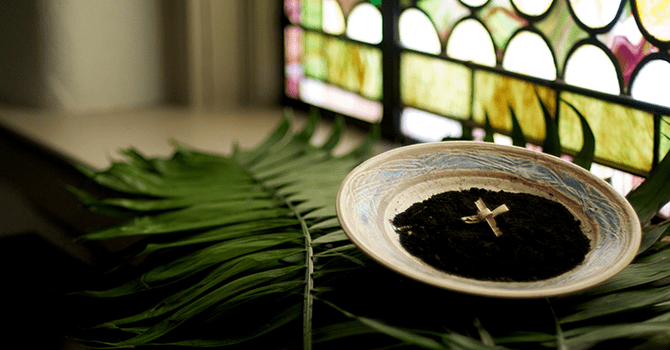
Today is Ash Wednesday, the first day in the season of Lent. Ashes remind us that we live in a polluted world full of garbage. That pollution is fouling up our lives and we must respond to the mess with a humble return to God. Lent is a 40-day cleaning project on the inside of our hearts, instead of trying to keep up dealing with all the scum on the outside of our lives.
Entrance to confronting the dump of garbage requires fasting, self-examination, prayer, and repentance. The Lord said through the ancient prophet Joel that it is not too late to return to God with our whole hearts. To do so requires grieving and lamenting our stinky sin and turning back around to a merciful God who does not like to be angry and punish people.
We find that at the end of the Lenten journey, Jesus is there. He swallows all the massive tonnage of the world’s garbage on the cross. The refuse is so rotten that it kills him, and there is only darkness. Then, three days later, Christ is risen, having shaken off the filthy stench of death. Jesus Christ is the ultimate fulfillment of the prophet’s words, the merciful one who has taken care of the filthy source of garbage once and for all.
May you find on this day and every day that the spiritual practices of prayer, fasting, and repentance put you in a place to receive Jesus. As you lean into the mess throughout the next six weeks of Lent, may you discover the cleansing and healing agent, Jesus Christ, the Savior who scrubs the heart clean of toxic waste.
Holy God, our lives are laid open before you: rescue us from the chaos of sin and through the death of your Son bring us healing and make us whole in Jesus Christ our Lord. Amen.
The Solitude of Christ by French painter Alphonse Osbert, 1897
As soon as they left the synagogue, they went with James and John to the home of Simon and Andrew. Simon’s mother-in-law was in bed with a fever, and they immediately told Jesus about her.So, he went to her, took her hand, and helped her up. The fever left her, and she began to wait on them.
That evening after sunset the people brought to Jesus all the sick and demon possessed. The whole town gathered at the door, and Jesus healed many who had various diseases. He also drove out many demons, but he would not let the demons speak because they knew who he was.
Incredibly early in the morning, while it was still dark, Jesus got up, left the house, and went off to a solitary place, where he prayed. Simon and his companions went to look for him, and when they found him, they exclaimed: “Everyone is looking for you!”
Jesus replied, “Let us go somewhere else—to the nearby villages—so I can preach there also. That is why I have come.” So, he traveled throughout Galilee, preaching in their synagogues, and driving out demons.
A man with leprosy came to him and begged him on his knees, “If you are willing, you can make me clean.”
Jesus was indignant. He reached out his hand and touched the man. “I am willing,” he said. “Be clean!” Immediately the leprosy left him, and he was cleansed.
Jesus sent him away at once with a strong warning: “See that you don’t tell this to anyone. But go, show yourself to the priest and offer the sacrifices that Moses commanded for your cleansing, as a testimony to them.” Instead, he went out and began to talk freely, spreading the news. As a result, Jesus could no longer enter a town openly but stayed outside in lonely places. Yet the people still came to him from everywhere. (Mark 1:29-39, NIV)
Solitude by Russian painter Tatiana Yushmanova
We need rhythm. Everything in life is rhythmic. Each new year moves with the rhythm of the four seasons. Our hearts beat in rhythm. When we walk, our gait is in a distinct rhythm. When talking, we speak with a rhythmic cadence. We sing and make music because of rhythm. We need healthy rhythms of waking and sleeping.
When our rhythm is off, we are off. Busy or unhealthy lifestyles can insidiously drag us away from the spiritual rhythms we need for healthy living. Over time, it may go unnoticed that our rhythm is off. For many folks, normal is getting dressed in clothes bought for work, driving through traffic in a car still being paid for, to go to a job to pay for the clothes, car, house, and other stuff that is left empty of life all day to afford to live in it. Many people are oriented more by the rhythms of work, school, and sports than by a connection to the life, death, and resurrection of Christ.
Our 24/7 world demands more time and resources, convincing us we can never slow down or take a break. Some people know their rhythm is off and out of sync with God’s ways but feel powerless to change it. So, how do we restore the unforced rhythms of God’s grace to the center of our stressed and chaotic lives without being overwhelmed by a new set of time commitments? To have healthy rhythms of life, we must look to Jesus.
Jesus was continually filled with the life of God the Father and therefore was always overflowing with that life to others. Christ had a rhythm of life which was oriented around times of inner solitude with his heavenly Father, and times of outward spiritual care to people. Jesus needed regular, dedicated time for solitude and prayer for the rigors of ministry. So then, how much more do we!
There are two distinct sections in today’s Gospel lesson: Christ’s outward healing ministry; and his inward attention to solitude and prayer. By examining Jesus and following his rhythms of life, we can find the way to living healthy fulfilled spiritual lives as Christians.
The outward healing ministry of Jesus was powerful and effective.
Jesus was committed to helping and healing people with the authority given him. Peter’s mother-in-law was sick. Every sickness in the ancient world was serious and could easily result in either permanent physical damage or death. In a clear demonstration of power, Jesus simply took her by the hand and raised her up to new life. As soon the fever left her, the woman immediately began serving the people in the house. The proper response to being healed by Christ is to become a servant of others.
13th Century Byzantine Church mosaic of Jesus healing Peter’s mother-in-law
Jesus and the disciples were in the little village of Capernaum, and being a small town, the news spread quickly of what happened with Peter’s mother-in-law. As a result, by evening, every sick and demonized person in the village showed up to see Jesus. Christ healed them all and confronted the demonic among them. Jesus wanted to avoid creating a circus and desired to move about freely, so he commanded the demons not to speak, because they knew who he was and what he was up to.
Healing is wonderful. Talking about it, not so much. Discussing healing is difficult because seeing one person healed and restored while another person is not, defies simple answers. So, I offer a few biblical observations about this human conundrum we all have likely experienced.
Healing narratives in the Gospels say much more about Jesus than about us.
Jesus has the power and authority to overthrow demons, cure the incurable, and restore people to health. It is all a sign that the kingdom of God is near, and when the kingdom comes in all its fullness, there will be no more sickness, pain, or demonic influence.
Good health, security, and safety are not necessarily a sign of God’s presence any more than pain and suffering are signs of God’s punishment, or a lack of personal faith.
We have enough stories in the Bible to let us know we are not privy to the big picture of what God is doing. We will not always see what the Lord is up to and very well may never have an answer to our questions, this side of heaven.
Every person who is healed today will eventually get sick again and someday die.
Even Lazarus, whom Jesus raised from the dead, died again. The ultimate meaning of any person’s healing is more than the physical – it affects the entire person – body, mind, emotions, soul, and spirit. For example, forgiveness is many times the needed miracle before any kind of physical healing can occur.
Sometimes the greatest miracle of all is our response to sickness and suffering. A surgeon, Richard Selzer, describes one such miracle: “I stood by the bed where a young woman lies in post-op after surgery, her mouth twisted looking clownish. A tiny twig of the facial nerve, the one to the muscles of her mouth, has been severed to remove a tumor in her cheek. Her young husband is in the room. He stood on the opposite side of the bed as if I were not really in the room, his full attention on her. She asked me, ‘Will my mouth always be like this?’ ‘Yes, it will, because the nerve has been cut,’ I say. She nodded somberly. But the young husband began to smile. He said, ‘I like it; it is kind of cute.’ He bent down to kiss her crooked mouth and I was close enough to see how he twisted his own lips to accommodate hers, to show her that their kiss still works.”
Perhaps the kind of healing we all need is the ability to receive God’s love in the person of Jesus who has accommodated himself to us.
Christ did not spend every waking moment with people, teaching and healing. Jesus knew that working without prayer, rest, and solitude is not realistic and rarely ends well.
The inward prayer and solitude of Jesus caused him to be powerful and effective.
Early the next morning after a day of healing ministry, Jesus got up and went to be alone with the Father. The fact that Peter and the disciples hunted him down when they could not find him, shows they did not quite see the same value of solitude that Jesus did. In Christ’s healthy rhythm of life, he included significant doses of solitude with his Father.
It is important for believers to spend generous portions of time with God. If we fail to do this, God has ways of getting our attention. We must slow down and calm our racing thoughts enough to listen. Human suffering is a great way to meet Jesus! We cannot rush from task to task and expect to live a healthy spiritual life. We need time with Jesus.
“Without great solitude, no serious work is possible.”
Pablo Picasso
Only through a healthy rhythm of life that includes solitude and prayer will we have clear direction for our daily lives, and wisdom for sound decision-making. Jesus came away from his time of solitude having re-connected with his purpose for being on earth. It was his clear conviction that he must travel and not just stay in one place.
Traveling is important to the Christian life. I am not talking about moving from state to state like I have done in my life; I mean that we must keep moving, like walking across the room to engage others we do not know. Our lives become stagnant when we only ever interact in our small circle of friends and family.
So, Jesus traveled throughout Galilee, convinced to do so through his time of solitude and prayer, to spread the good news of God’s benevolent kingdom and drive out demons wherever he went. Even in this we are to imitate our Lord.
Driving out demons is, yes, a literal reference. The demons were driven out so that people could be liberated and experience freedom and connection in community, since most demonized people were always in solitude. They were freed so that they could have healthy rhythms of life of not just solitude but of ministry, service, and community. Hell is a separation from God and others. Jesus came to bring relational health and wholeness through relational connection.
Conclusion
Both continual work and prolonged withdrawal from others is unhealthy. To always be working and serving eventually leads to bitterness, exhaustion, and burn-out. To always be alone (even in a crowd) and not serving leads to spiritual sickness. It may be counter-intuitive for us to break away from work, but solitude and prayer will help us more productive.
If we are constantly on the go, there is healing available through solitude. If we are continually withdrawn from others, then the healing we need will come through engaging with others and moving past passivity.
To attach and detach, to connect and let go, to engage and desist, are spiritual rhythms of life that we must hone and practice so that we will be healthy persons for ourselves and for others.