It’s All About Love (Song of Songs 2:1-7)

I am a rose of Sharon,
a lily growing
in the valleys.

[ GROOM ]

Like a lily among thorns,
so is my true love among the young women.

[ BRIDE ]

Like an apple tree among the trees in the forest,
so is my beloved among the young men.
I want to sit in his shadow.
His fruit tastes sweet to me.
He leads me into a banquet room
and looks at me with love.
Strengthen me with raisins
and refresh me with apples
because I am weak from love.
His left hand is under my head.
His right hand caresses me.

Young women of Jerusalem, swear to me
by the gazelles
or by the does in the field
that you will not awaken love
or arouse love before its proper time. (God’s Word Translation)

Notice how the flowers grow in the field. They never work or spin yarn for clothes. But I say that not even Solomon in all his majesty was dressed like one of these flowers. (Matthew 6:28-29)

Love the Lord your God with all your heart, with all your soul, and with all your strength. (Deuteronomy 6:5)

As long as I have you, I don’t need anyone else in heaven or on earth.

Psalm 73:25

There is nothing quite like a field of flowers. Along the coastal plain of the Mediterranean Sea, south of Mount Carmel, is Sharon. In the ancient world, there was found crocuses, tulips, and hibiscus.

These days, in the Spring of the year, one can see bindweed and pimpernel, sage and iris, as well as orchids and poppies. In addition, lilies bloom throughout the valleys of the Middle East. In the Spring, flowers are commonplace in the valleys and countryside.

In today’s Old Testament lesson, the bride in this poetic ode to love and beauty, is saying there is nothing special about her. There are many women, and she in no way stands amongst them all.

Love says otherwise. Love picks out the individual. In the Song, the groom views the bride as if a flower among thorns. There is a beauty that attracts him to her. She may be a commoner, yet her beautiful qualities stand out and are attractive. All others pale in comparison to her.

Likewise, the bride basks in the security of the groom, finding all others tasteless compared to him. He is like an apple tree that provides shade, and whose fruit is delicious.

There is a mutual attraction that is life-giving and beautiful. It is more than a fleeting infatuation. They see within each other the qualities which will bind and sustain them when there are rough times and hard roads.

Beauty is much more than outward appearance. It is the endearing inner qualities of a good and right spirit, which is outwardly seen in a visage of compassion and caring, gentleness and humility, purity and peace.

Such beauty, in and out, causes one to swoon with love – hence, making one love-sick. Love is powerful. It is not to be corrupted by the lust which only views another as an object to be gained.

We are to let the beauty and power of love develop, grow, and mature. The flowers of the field may seem to spring up overnight. However, the seeds and the bulbs have been awaiting the right time to take root, break the ground, grow up, and flower.

Love is both endearing and enduring. Love is to be nurtured and cultivated. It cannot be hurried. Love is an attention to the whole person, and seeks to endure for the long haul. It maintains a beautiful commitment into the growing coldness of autumn, and holds vigil through the season of winter. Love isn’t going anywhere.

But I am talking about Christ the groom, and Church the bride. Spiritual commitment is not really measured in doctrinal statements and dogmatic theology. It is shown and known by embracing Love with a capital “L.”

God is Love. Yes, God does loving deeds and actions. Yet, we are told that the very nature and character of God is Love. Jesus is Love incarnate, the embodiment of what Love sees and does in this world.

I am, of course, taking a decidedly Christian approach to the Song, and an allegorical view of it. This is why, if we delight in knowing and enjoying the Song, we discover the way to genuine spirituality, and the key which unlocks the whole of Holy Scripture.

Not everyone, of course, will agree with me or choose to go down this allegorical path. Perhaps this is why we have so much religion nowadays which is devoid of love, and chooses to focus on sterile doctrinal checklists to which we must ascribe.

Please don’t hear what I am not saying. Doctrine is important. Theology is a must. But if our doctrine and theology has no beauty, and has no thoughts of love, and is not basically oriented in the direction of love, then I strongly argue that it isn’t doctrine or theology at all!

“And what is proper love? One should love the Lord with an exceeding great and very strong love so that the soul be tied to the love of the Lord, finding itself totally absorbed in it, as if he were suffering of lovesickness, when his mind is never free because of love for that woman, and he is obsessed with her, whether sitting down, or standing up, even when he is eating and drinking. More than this should the love for the Lord be in the heart of those who love him, meditating on it constantly, even as God has commanded us: ‘With all your heart and with all your soul.’” – Maimonides, Jewish Rabbi and philosopher (1138-1204, C.E.)

We were created by God for love. God longs to love us; and we are to love God with our entire self – heart, soul, mind, and strength. What’s more, our own love for one another is shaped by the love we receive from God.

Indeed, the biblical book, Song of Songs, is not only in the literal middle of the Old Testament; it is also in the very heart of it. It is all about Love.

Bless us with Love, O Merciful God;
That we may Love as you Love!
That we may show patience, tolerance,
Kindness, caring and love to all!
O Compassionate One, grant compassion unto us;
That we may help all fellow souls in need!
Bless us with your Love, O God.
Bless us with your Love. Amen.


Developing the Skill of Wisdom (Colossians 1:9-14)

Colossians 1:9-10, by Bible Art

For this reason, since the day we heard about you, we have not stopped praying for you. We continually ask God to fill you with the knowledge of his will through all the wisdom and understanding that the Spirit gives, so that you may live a life worthy of the Lord and please him in every way: bearing fruit in every good work, growing in the knowledge of God, being strengthened with all power according to his glorious might so that you may have great endurance and patience, and giving joyful thanks to the Father, who has qualified you to share in the inheritance of his holy people in the kingdom of light. 

For he has rescued us from the dominion of darkness and brought us into the kingdom of the Son he loves, in whom we have redemption, the forgiveness of sins. (New International Version)

When I was younger, I played a lot of ping-pong. And I got good at it. In fact, during a several months stretch, back-in-the-day, I had a record of 156-2. Not bad.

That kind of record was only possible because of the two reasons that make any skill an accomplishment:

  1. Knowledge. I learned the game of ping-pong and eventually knew it inside and out.
  2. Experience. I practiced for hundreds, if not thousands, of hours in developing my technique.

The sort of knowledge that Paul was talking about was more than information and intellectual understanding; he used a specific word (in the Greek language – ἐπιγινώσκω, pronounced “EPee-gi-NOS-ko) which refers to knowledge gained by experience.

In English, we need to put two words together in order to communicate Paul’s concept: experiential knowledge – an understanding which is gained by continual repetition and practice until there is proficiency.

There are just some things that can only be learned and integrated into life through constant use and development over time. And this is precisely how a person becomes mature in life:

Growth + Time = Maturity.

And with maturity comes the wisdom to live life as it meant to be lived. This means that wisdom doesn’t come overnight or quickly; to be wise requires a great deal of learning, effort, experience, and time.

The wisdom and understanding Paul refers to is not some sort of secret information which has to be accessed through careful initiation into a group of people who have the inside knowledge. No, this is wisdom which can be gained by anyone who embraces a life of faith and spiritual discipline.

The highest form of knowledge for the Apostle Paul is knowing God in Christ.

This sort of knowledge is an understanding of salvation, and experiencing deliverance from guilt, shame, and the false self. Such knowledge is evidenced by the fruit of the Spirit in living a life of love, joy, peace, patience, kindness, goodness, faithfulness, gentleness, and self-control. (Galatians 5:22-23)

Colossians 1:11, by Bible Art

From the outside of Christianity looking in, it may appear that this is all a grand achievement of the human will. But it isn’t. On the inside, the Christian life is thoroughly a work of God’s glorious power, bringing new life, and effecting spiritual growth and maturity into a wise and good way of life.

We did not deliver ourselves. God did. The Lord transferred our membership from the realm of darkness to the empire of light. Christians are simply people who have been redeemed by God in Christ. Our liberation is because of God’s gracious forgiveness of sins.

Forgiveness, however, is not the end game. Forgiveness frees us to pursue the spiritual life without guilt and shame hindering us and weighing us down all the time. Forgiveness opens us to the possibilities of positive and life-giving relational connections with God and other people.

In our relationship with God, prayer becomes the conduit of divine/human conversation. That connection, in the past, had blockage because of our unhealthy lifestyles. But it is now unobstructed because of God’s gracious intervention by Jesus, in the Spirit.

So, when it comes to our interactions in prayer, there’s no need to invent a new game; we just need to learn the one we’ve got, and put in the hours of work necessary to become accomplished at it. 

Today’s New Testament lesson is a prayer from the Apostle Paul to the Colossian Church. His prayer for them was singular: To have wise minds and spirits, that is, to have knowledge of God – an understanding of who God is and how God operates.

To learn divine ways is to acquire the skill of wisdom.

Paul prayed for a reason: so that we might live our lives in a way which pleases God and enables us to sustain a lifetime of spiritual growth. 

As people created in God’s image and likeness, we are hard-wired with a spirit which needs strengthening and exercise. That happens as we put in the constant repetitions of connecting with the divine and putting in the time on our knees – praying daily for ourselves and others to mature in faith so that we might all together act wisely and justly in this world, for the life of the world.

A good place to start is to use Paul’s prayer as our own. Never has there been such a need than now for us to know how to apply wisdom in the places and in the circumstances we’ve never been in before. 

For wisdom to happen, we must grow in our knowledge by putting in the hours of prayer.

The skill of wisdom doesn’t magically happen. Wisdom is the culmination of acquired understanding; a lot of practice exercising love in the places where love is not; and engaging in a lifetime project of becoming knowledgeable through constant learning, struggling, and growing.

Direct me, O Lord, in all my doings with your most gracious will and wisdom. Further in me your continual help – that in all my work and in all I do and say, I may glorify your holy name; and, by your mercy, obtain the life that is truly life; through Jesus Christ, my Lord.  Amen.

How Long, O Lord? (Psalm 80)

Hear us, Shepherd of Israel,
    you who lead Joseph like a flock.
You who sit enthroned between the cherubim,
    shine forth before Ephraim, Benjamin and Manasseh.
Awaken your might;
    come and save us.

Restore us, O God;
    make your face shine on us,
    that we may be saved.

How long, Lord God Almighty,
    will your anger smolder
    against the prayers of your people?
You have fed them with the bread of tears;
    you have made them drink tears by the bowlful.
You have made us an object of derision to our neighbors,
    and our enemies mock us.

Restore us, God Almighty;
    make your face shine on us,
    that we may be saved.

You transplanted a vine from Egypt;
    you drove out the nations and planted it.
You cleared the ground for it,
    and it took root and filled the land.
The mountains were covered with its shade,
    the mighty cedars with its branches.
Its branches reached as far as the Sea,
    its shoots as far as the River.

Why have you broken down its walls
    so that all who pass by pick its grapes?
Boars from the forest ravage it,
    and insects from the fields feed on it.
Return to us, God Almighty!
    Look down from heaven and see!
Watch over this vine,
    the root your right hand has planted,
    the son you have raised up for yourself.

Your vine is cut down, it is burned with fire;
    at your rebuke your people perish.
Let your hand rest on the man at your right hand,
    the son of man you have raised up for yourself.
Then we will not turn away from you;
    revive us, and we will call on your name.

Restore us, Lord God Almighty;
    make your face shine on us,
    that we may be saved. (New International Version)

What do you do when your life is not going as expected? How do you deal with the confusion of unwanted circumstances you didn’t ask for?

Nobody willingly signs up for chronic pain, constant hardship, debilitating situations, and unanswered prayer. And yet, all of us know what it feels like to have our hearts broken over a child, parent, or relative; or to be grief-stricken with either a physical malady, mental disease, emotional disorder, spiritual abuse, or some combination of them.

The psalmist most certainly knows your difficulty and your pain. That’s because he intimately knew God – and still had questions! In fact, all of us who worship and adore the Lord have faced the conundrum that God seems, at times, to be missing in action.

We may wonder, like the psalmist, where the God of the past is. Where is the One who manhandled enemies, provided for the godly, and brought abundant life? The Lord might sometimes seem to be foreign to our human condition, and far from our human experience of things.

There are plenty of stories in the Bible about God doing the miraculous, bringing deliverance, and extending help in dire situations. Yet, for many, in this present time, there is silence. Prayer after prayer brings nothing but bupkis from God. A sullen angst can easily settle into our spiritual bones.

It could also be that people we love and care for are experiencing too many hardships, boatloads of anxiety, and are wracked with worry. And we wonder why God has not risen up to answer our prayers on their behalf.

How long, Lord? Will you forget me forever?
    How long will you hide your face from me?
How long must I wrestle with my thoughts
    and day after day have sorrow in my heart?
    How long will my enemy triumph over me? (Psalm 13:1-2, NIV)

The very fact that with only a cursory look at the news there are children dying in war, senseless murders in the streets, and wanton destruction throughout the world, we may cry out, “Where is God in all this? Wake up! How long, O Lord, must we endure this!?”

Even the small tragedies of life might push us beyond what we can bear, because grief is stacked upon grief in a big lamentable sandwich of spiritual hurt. And if God seems nowhere to be found, our afflictions are multiplied.

The psalmist drew upon agricultural metaphors that his culture was quite familiar with. A society of farmers knows how much hard work is involved in their vocation – and the hours of anxiety and concern for the field to produce some crops and bear some fruit.

Farmers very much realize the power that nature can do through either drought or flood, hail or wind. The picture of the attentive farmer, gardener, and vinedresser is an apt picture of how God looks upon us.

I grew up on an Iowa farm. I have an intimate understanding of the requirements for tending to the land so that it will produce a crop, and yield a good harvest. Like many jobs, farming isn’t something that requires the same amount of attention every single day.

There are times and seasons for a high degree of activity, like planting in the Spring and harvesting in the Fall. At other times, there isn’t much to do but wait.

By no means does the farmer expect the plants to grow overnight. The faithful farmer learns to be patient, knowing that it will be weeks before anything breaks the ground; and that it will take all summer for the crops to grow and mature before they are ready for harvest.

In those times of inactivity, the corn stalks don’t start talking to one another about where the farmer went to, and whether he is off fishing or not. Even though the farmer is absent, the actions of the farmer are still very much evident.

Our own wonderings and questions about God’s presence and absence are all understandable and valid. Yet, we must keep in mind that there is continual evidence all around us that the Lord has been at work, and is still laboring as the Divine Gardener in ways we cannot see.

God is continually watching over us, ensuring that we have the proper conditions of sun, water, and good soil in order to grow, thrive, and produce a harvest of righteousness. We will still face the adverse circumstances of inclement weather, unfavorable weeds, and pests eating on and around us. Yet, we already and always have everything we need to live a successful spiritual life – without choking or starving to death.

We are not going to have all of our questions answered this side of heaven. We are, however, assured that God is good and can restore us when we are broken or failing to thrive. However, it just might take some time to do it, that’s all.

O God of heavenly powers, by the might of your command, drive away from our bodies all sickness and infirmity, and everything that brings us ill health of either body, mind, or spirit. Be present in your goodness with all your servants who are in need, that their weakness may be banished and strength restored; and that, with health renewed, they may bless your holy Name. Amen.

Remember Passover (Deuteronomy 16:1-8)

Exodus, by Yoram Raanan

Observe the month of Aviv and celebrate the Passover of the Lord your God, because in the month of Aviv he brought you out of Egypt by night. Sacrifice as the Passover to the Lord your God an animal from your flock or herd at the place the Lord will choose as a dwelling for his Name. Do not eat it with bread made with yeast, but for seven days eat unleavened bread, the bread of affliction, because you left Egypt in haste—so that all the days of your life you may remember the time of your departure from Egypt. Let no yeast be found in your possession in all your land for seven days. Do not let any of the meat you sacrifice on the evening of the first day remain until morning.

You must not sacrifice the Passover in any town the Lord your God gives you except in the place he will choose as a dwelling for his Name. There you must sacrifice the Passover in the evening, when the sun goes down, on the anniversary of your departure from Egypt. Roast it and eat it at the place the Lord your God will choose. Then in the morning return to your tents. For six days eat unleavened bread and on the seventh day hold an assembly to the Lord your God and do no work. (New International Version)

The first five books of the Old Testament are known by Christians as the Pentateuch. These same books are the Torah in Judaism. Deuteronomy is the fifth and final book; it is a restatement of God’s Law for the Israelites about to enter the Promised Land.

Several prominent theological themes are highlighted in the book of Deuteronomy. It vigorously advocates for exclusive loyalty to the monotheistic God, Yahweh. Yahweh is characterized as a transcendent Being, full of steadfast love and transformative justice.

Deuteronomy places significant emphasis upon the covenant relationship between God and Israel. The covenant was established with the patriarchs – Abraham, Isaac, and Jacob – and affirmed at Mount Sinai after the exodus from Egypt, at the giving of the Law. This Law was graciously provided by God for the people; it is encapsulated in the Ten Commandments, and is to be reaffirmed as soon as Israel enters the land.

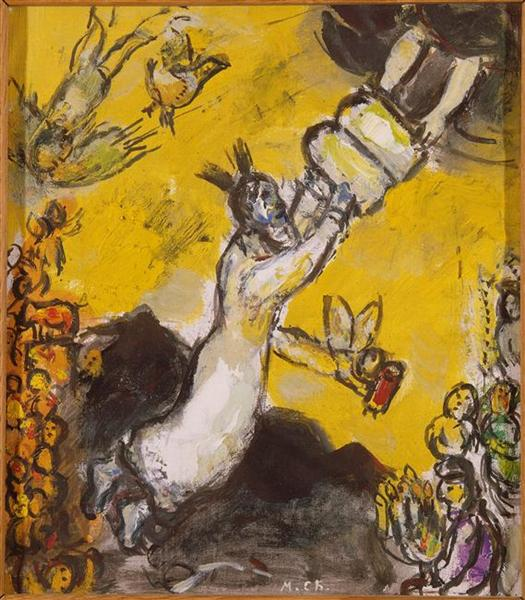
Moses receiving the Tablets of Law, by Marc Chagall, 1963

Therefore, the entire book of Deuteronomy looks forward toward a new existence in the Promised Land. This new society is to pursue justice and be devoted to righteousness. All Israel is to live in harmony with God and one another, enjoying the land and the covenant relationship.

The welfare of Israel depends upon upholding and maintaining the social and religious laws given by Yahweh. God’s commands are a divine gift, and if closely followed, will be the best humanitarian way of caring for the poor and disadvantaged, as well as bringing the people close to Yahweh.

The sacrificial system will revolve around a singular sanctuary in the religious capital. By locating sacrifices in a particular place, this has the effect of Jewish faith not becoming dependent on offerings, but instead on mercy, love, learning the law, and rituals that uphold reverence for God.

Perhaps the greatest of all the rituals is Passover. Israel’s experience of deliverance at the Red Sea and the centralization of worship in Jerusalem is remembered and celebrated at the festival of Passover every year.

In the original Passover, at the time of the exodus, the blood of a sacrificed lamb was smeared on the doorposts of each Jewish home. In doing this, it let the angel of death know to “pass over” that house, thereby only entering Egyptian homes that did not revere nor recognize God. This act was also the final miraculous act of ten plagues leveled on Egypt.

And There Was a Great Cry in Egypt, by Arthur Hacker, 1897

As the households of Egypt were grieving their dead, Israel was urged by the Egyptians to get out. Egypt feared what would happen if the Israelites remained. Therefore, Israel left post haste. They didn’t have any time for their bread to rise. The people ate unleavened bread so they could immediately leave Egypt.

So, from then on, every year in early Spring, Israel commemorates and remembers God’s deliverance of the people from slavery. God, through Moses, instructed the Israelites to mark Aviv as the first month; it is then that the Passover festival is to occur.

I believe that what we can takeaway from this Scripture, is that perhaps, we ought to stop trying to always have takeaways for everything – as if the Bible can be boiled down to some neat personal application for my life.

Aside from admitting I’ve had a bit of a cynical streak lately, we really must contend with seasons like Passover and Lent, and matters such as social justice and religious worship. These religious seasons are important enough to warrant what the late Eugene Peterson called “a long obedience in the same direction.”

By that phrase, Peterson meant that there are some spiritual practices that we must commit ourselves to year after year, even day after day, for the rest of our lives. Generations before did, and generations after us will need to, as well.

Spiritual growth and maturity take time; and we must patiently and consistently cultivate a sense of justice and a practice of righteousness over and over again.

Passover Seder, by Melita Kraus

One must fight for what they believe, each and every day. Spiritual growth takes a lot of time, grit, tenacity, and resilience. It requires patience and grace, perseverance and a good nature. And it is very much a skill which demands daily practice.

Contemporary society is obsessed with quick fixes and easy solutions. But the time-tested practices of Lent, rooted in the remembrances of Passover, are a Christian discipleship that is long on obedience in the same well-worn ancient directions.

We need to keep moving in the directions of deepening a life of prayer, learning the joy of service, growing in the worship of God, and discovering the virtues of humility and a concern for the welfare of everyone in the community.

In other words, to truly observe something, we need to do it, over and over, year after year. In observing the significant events and dates and seasons of the Christian Year, we can find the sort of spiritual support that will fortify our soul, and bless others.

Almighty and everlasting God, you hate nothing you have made and forgive the sins of all who are penitent: Create and make within us new and contrite hearts, so that we may acknowledge our guilt and lament our shame. Let us obtain from you, O merciful God, reconciliation through the Cross, and empowerment through the Spirit, to do justice, love mercy, and walk humbly with you. Amen.