The Penitent Soul Changes the World (Hosea 5:15-6:6)

Saint Dominic in Penitence, by Filippo Tarchiani, c.1607

I will return again to my place
    until they acknowledge their guilt and seek my face.
    In their distress they will beg my favor:

“Come, let us return to the Lord,
    for it is he who has torn, and he will heal us;
    he has struck down, and he will bind us up.
After two days he will revive us;
    on the third day he will raise us up,
    that we may live before him.
Let us know, let us press on to know the Lord;
    his appearing is as sure as the dawn;
he will come to us like the showers,
    like the spring rains that water the earth.”

What shall I do with you, O Ephraim?
    What shall I do with you, O Judah?
Your love is like a morning cloud,
    like the dew that goes away early.
Therefore I have hewn them by the prophets;
    I have killed them by the words of my mouth,
    and my judgment goes forth as the light.
For I desire steadfast love and not sacrifice,
    the knowledge of God rather than burnt offerings. (New Revised Standard Version Update Edition)

We are meant for righteousness, not wickedness. So, whenever we fail to do what is right, we will suffer pain. This is because wicked attitudes, words, and behavior go against how we were designed and created as humans.

There are times when we all transgress what is right by either doing outright wrong, or by failing to do what is good, right, and just when we have the opportunity to do so. Therefore, repentance is vital and necessary. That is, to practice something that seems to be lost in our contemporary language: penitence.

Penitence simply means to have regret over wrongdoing. When we are penitent, we seek to repent (turn from what is wrong and do what is right). God has no interest in those who offer the forms of repentance without any penitence. That’s why God told the ancient Israelites that love and knowledge are what’s important, more than sacrifices and offerings.

What’s more, penitence is necessary for spiritual maturation and growth. The penitent soul finds that one’s faults and wrongs can be transformed into assets – such is the power of God through one’s penitent repentance.

And even more, the individual who experiences penitence and repents of wrongdoing, is forgiven, leading the whole world to be forgiven along with them.

Just one penitent and repentant person will intercede and confess the sins of the world; and that can change everything. So, imagine when a community of forgiven persons are motivated to bring about humanity’s greatness and nobility through penitent prayer.

I want you to think this thought: Any sort of moral misdeed committed by an individual weakens the soul of the entire community, and indeed, all the world.

Every attitude and action has a consequence, whether good or bad. Penitence, repentance, and forgiveness are the mandatory practices to restoring and renewing a life-giving dynamic to everyone.

Thus, penitence brings healing to the world; the individual who repents is forgiven; and the whole world is forgiven with him.

The powers of evil want to keep us ignorant of such things – which is why knowledge of God is so very important. Ignorance inevitably leads to sin and to the construction of a false self, which then encrusts itself upon the soul.

Penitence and repentance remain as lights deep within a person, even if they are buried beneath all sorts of arrogance and bravado of the ego.

Change of our world and transformation of our lives will not come apart from a vigorous and popular education of God and God’s Word. With so much ignorance all around us, it is imperative that individuals and communities become familiar with how spiritual realities work.

Although it appears that sinister darkness is spreading across the world and into the depths of humanity, the hope and promise of light discerns that evil can and will be overcome.

Penitence is the key to the healing presence this world needs.

For those who have experienced the renewal and reformation of a forgiven life, the steadfast love of God’s grace is very much needed for those still stuck in the mud of wickedness.

In truth, the meanness of a person betrays how much anguish of soul they are actually experiencing. Their estrangement of God is such that they are in great spiritual pain.

So, every situation designed by God to evoke penitence and repentance within such a mean person leads not only to a struggle in the soul, but also to outward conflicts with others in the forms of bullying, arrogance, and hardness of heart.

Not only do we suffer because of another’s grotesque sin, so does God. The pain of the wicked person unfortunately works to bring others pain, including God.

The Lord observed the extent of human wickedness on the earth, and he saw that everything they thought or imagined was consistently and totally evil. So the Lord was sorry he had ever made them and put them on the earth. It broke his heart. (Genesis 6:5-6, NLT)

Both humanity and God are in anguish when the dark powers take hold within an individual, and in the community.

We must have the grace to bear with others and hold our ground, giving the Spirit of God time to bring about penitence and repentance. For our part, continual learning of divine things and a commitment to steadfast love becomes the hands and feet of our prayers.

When one suffers, we all suffer, because there is an inextricable connection between all people.

Regret, remorse, and sorrow over wrongdoing are the prerequisites for goodness to become ensconced in the world. Penitence serves both the individual and the community, preventing any poisonous root of bitterness to grow up and corrupt many people.

See to it that no one falls short of the grace of God and that no bitter root grows up to cause trouble and defile many. (Hebrews 12:15, NIV)

God and humanity are meant to be united. And the Lord will create whatever conditions are necessary for divisions to be healed, and for people to love one another and love God will all their hearts, souls, minds, and energy.

Almighty God, my heavenly Father: I have sinned against you, through my own fault, in thought, and word, and deed, and in what I have left undone. For the sake of your Son our Lord Jesus Christ, forgive me all my offenses; and grant that I may serve you in newness of life, to the glory of your Name. Amen.

The Fruit of the Spirit

The fruit of the Spirit is love, joy, peace, patience, kindness, goodness, faithfulness, gentleness, and self-control. (Galatians 5:22-23, CEB)

It takes little effort to have a bad attitude; to slip a bit of gossip into the day; or to go along with the crowd in a divisive conversation. However, it takes a good deal of humility, energy, and commitment in order to live into the fruit of the Spirit.

On the one hand, the believer in Jesus Christ has been graciously given such fruit; we possess it by means of the Spirit. On the other hand, it feels as if we still need this fruit to be given to us, because our daily experience of it is such a struggle.

For me, experiencing the fruit of the Spirit is a bit like buying something from Ikea; I have it, but it needs to be put together. And I’m not so good at making sense of the directions and actually getting the thing in working condition.

Yes, there will be some frustration tapping into our spiritual reservoir and accessing the fruit provided for us. Yet, it’s totally worth it. In fact, the nine elements of spiritual fruit mentioned in the New Testament book of Galatians are experiences people really want to have – whether they are Christian, or not.

One of the reasons folks may become overwhelmed with the Spirit’s fruit is that they look at those nine words as nine different “fruits.” However, the grammar of the text is clearly not plural but singular. In other words, the “fruit” of the Spirit is one packaged piece.

It may be tempting to relieve ourselves of any responsibility or accountability with this fruit by saying, “I’m good at being kind and good, but I really have problems with patience and self-control.”

But the text doesn’t allow for such thinking. To not possess any one of the nine words is to not have the entire nine. The Holy Spirit of God is not divided; when the Spirit gives, it’s the whole kit-and-caboodle.

After all, the believer in Jesus seeks to be a person of integrity and wholeness, being aligned fully in all aspects of life around the person and work of Christ. Any fragmentation belies the reality that one, no matter how apparently peaceful or gentle, is attempting to manifest spiritual fruit on one’s own power.

There is a big difference  between trying to control the process of Christian sanctification (becoming holy) and exercising self-control. And there is an even wider chasm between accessing and using the accepted spiritual fruit, and trying to go on a self-improvement project that is disconnected from God’s given grace.

In truth, believers already have everything they need for life and godliness in this present evil age (2 Peter 1:3). The seed has been firmly planted within the soul. We possess the fruit. Yet, that fruit must grow and mature before it is ripe enough to eat. There is still the work of cultivating and nurturing to do, so that we might flower and flourish.

We only need the essential conditions to grow. Any seed – no matter what kind – will grow and produce a harvest if it has the proper amounts of sun, rain, and good soil. Then, we never need to wonder what will happen; the seed will grow.

As spiritual farmers, we need to be daily working in the field our soul, keeping the weeds and the critters out, so that there is no obstacle or impediment to the growth and maturity of our precious fruit.

If we need to build a fence, we build it. If we must buy or borrow a hoe, we do it. Whatever needs to happen to guard what we possess, we are committed to doing it.

None of us ever produces a seed. Not even in this modern age of genetically modified seeds can we do this. The scientist only manipulates what is already there; he cannot create a seed ex nihilo.

So, we have this tremendous spiritual fruit, graciously given to us by means of God’s Spirit. Perhaps the million dollar question is:

How do I access this grace? How can I realize the fruit of love, joy, peace, patience, kindness, goodness, faithfulness, gentleness, and self-control in my life?

We have no further to look than to the very words of the Lord Jesus himself:

Very truly I tell you, unless a kernel of wheat falls to the ground and dies, it remains only a single seed. But if it dies, it produces many seeds. Anyone who loves their life will lose it, while anyone who hates their life in this world will keep it for eternal life. Whoever serves me must follow me; and where I am, my servant also will be. (John 12:24-26, NIV)

We must die to ourselves. There is no other way. Christ demonstrated the way by dying and being placed in the earth. Only then could he rise from death. And only then could his disciples have their faith come to fruition, spreading gospel seed throughout the world.

For one cannot have a resurrection unless there is first a crucifixion. There must be suffering before glory.

That, my friend, is the cost of discipleship. It’s the cost of realizing the spiritual fruit that you and I long for in our lives. This is the struggle we must go through to experience the life that is truly life.

Heavenly Father, in you I live and move and have my being. I humbly pray You so to guide and govern me by your Holy Spirit, that in all cares and occupations of my life I may not forget You, but remember I am ever walking in Your sight, exhibiting Your fruit; through Jesus Christ my Lord. Amen.

Anti-Intellectualism

Everyone with good sense
    wants to learn. (Proverbs 18:15, CEV)

Anti-intellectualism:

  1. opposition to or hostility toward intellectuals and the modern academic, artistic, social, religious, and other theories associated with them
  2. the belief or doctrine that intellect and reason are less important than actions and emotions in solving practical problems and understanding reality

Holy Scripture encourages knowledge, understanding, and wisdom. In order to be a truly wise and understanding person, there must be a combination of knowledge and experience. When these two elements come together, and are practiced over a long period of time, then spiritual maturity is realized.

In every church I’ve ever served across the decades there have been individuals and groups of people in my congregations who are anti-intellectual. They were not big fans of seminaries. They often mistrusted highly educated persons with multiple degrees. And they had a hard time submitting to any authority structure that smacked to them of being elitist.

Unfortunately, the majority of those persons, in my experience, refused to learn in any other way other than their own personal experience. I don’t think I need to tell you the many pitfalls such a stance creates: constant misinterpretation of situations; prejudice toward others whom they don’t understand; and chronic disobedience to every authority in their life.

It likely wouldn’t surprise you to know that these sorts of parishioners rarely, if ever, read their Bibles, or even seek to learn other than hearing Sunday sermons. They reek of spiritual immaturity and pride, being puffed-up with themselves that they aren’t like the elites in power.

Now imagine what a group of people like this would be like if they were in the highest levels of government… But we need not imagine; the reality is in front of us every day.

To understand the current political climate in the United States, it seems to me we need to see that the present governmental administration, at its heart, is an anti-intellectual movement.

Now please know that I am not saying that everyone in the administration is stupid. What I am saying is that many if not most Republicans have a deep seated problem with educational elites – hence the sustained attention on American universities, especially Harvard.

They believe themselves to be practical, no nonsense people who can get things done without umpteen committees and eggheaded reports. The problem, however, is that in their belief of experiential superiority, they’ve refused to listen. They end up making snap judgments of situations and other people. In other words, they can quickly make a disaster of things whenever they’re in charge.

Furthermore, what the anti-intellectuals end up doing most is grasping for as much worldly power as they can gain.

For Protestant Evangelicals, their desire for power stems from their perceived loss of a golden age of Christendom. Back then they were in power – prayer in schools, no abortion, the Ten Commandments in every court house, riding your bike in the neighborhood with safety, etc.

Yet, because there is such a paucity of listening and seeking to understand, the anti-intellectuals fail to understand that their own golden age was a bronze age of Jim Crow laws, failed reservation promises, and the need to operate in the shadows for all sorts of other persons.

Holy Scripture’s Book of Proverbs – which is a combination of accumulated knowledge and lived experience – has something to say about those who refuse to listen and learn from others:

With wisdom you will learn
what is right
    and honest and fair.
    with knowledge. (Proverbs 2:9-10, CEV)

Fools think they know
    what is best,
but a sensible person
    listens to advice. (Proverbs 12:15-16, CEV)


Stupidity leads to foolishness;
    be smart and learn. (Proverbs 14:18, CEV)

Fools have no desire to learn,
instead they would rather
    give their own opinion. (Proverbs 18:2, CEV)

Pride leads to destruction;
    humility leads to honor.
It’s stupid and embarrassing
to give an answer
    before you listen. (Proverbs 18:12-14, CEV)

An ignorant fool learns
    by seeing others punished;
a sensible person learns
    by being instructed. (Proverbs 21:11, CEV)

If we apply our hearts to wisdom, we will learn:

  • the pursuit of power at all costs creates stupidity
  • the disdain and/or ignorance of others has adverse consequences for all
  • there has always been an anti-intellectual strain throughout the history of the world (including U.S. history)
  • the act of placing blame on others (such as the so-called “elites”) will come back to bite us

It does no good to reason with an anti-intellectual, namely because they will not avail themselves of logic nor learning.

Instead, it is wise to treat an anti-intellectual like we ourselves would want to be treated: to have another listen to us and be curious about why we hold to what we hold, without judgment; and to have another respect our ability to choose for ourselves.

Can you imagine a world where we would all commit ourselves to listening and learning, acquiring knowledge, understanding, and wisdom? We would likely live in a very different world than the one we are in today.

May the course of this world be peaceably governed by divine providence. And may the church everywhere joyfully serve God in confidence and serenity. Amen.

The Divine Gardener

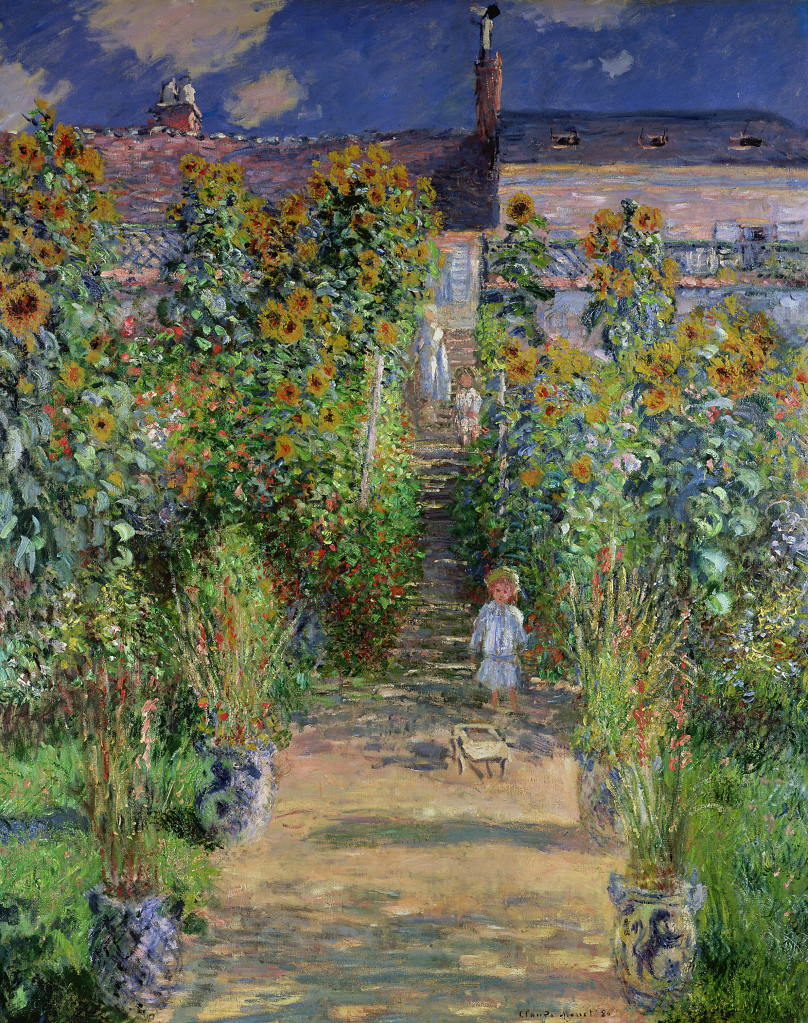
The Artist’s Garden at Vétheuil, by Claude Monet, 1881

The fruit of the Spirit is love, joy, peace, patience, kindness, goodness, faithfulness, gentleness, and self-control. (Galatians 5:22-23, Common English Bible)

Soon it will be Spring. Many people are already planning for the soil in fields and gardens to be turned over for planting and cultivating.

Healthy plants grow and feed many. They don’t simply occur by happenstance. And neither does things like morality, ethics, and living an altruistic life; they don’t just happen.

Virtue and a good life are the result of solid and robust inner work within the soul.

The daily overall trajectory of personal and institutional life demonstrates whether they are driven by egoistic desires, or influenced from an inner garden of delectable fruit which has been wisely plucked for others to enjoy.

 “A good tree doesn’t produce bad fruit, nor does a bad tree produce good fruit. Each tree is known by its own fruit. People don’t gather figs from thorny plants, nor do they pick grapes from prickly bushes. A good person produces good from the good treasury of the inner self, while an evil person produces evil from the evil treasury of the inner self. The inner self overflows with words that are spoken.”

Jesus (Luke 6:43-45, Common English Bible)

The Apostle James learned well from his Teacher when he said:

My brothers and sisters, can a fig tree produce olives? Can a grapevine produce figs? (James 3:12, Common English Bible)

The soul is a garden which must have a faithful gardener to continually attend to it. There is a constant need for paying attention to the plants through consistent weeding, watering, and nurturing the seeds placed in good rich soil.

If we will but only allow it, the Holy Spirit of God can be our Divine Gardener, being the elements we need for growth, maturity, and a good life which produces good succulent fruit for many to enjoy.

Apart from the Spirit’s warming, watering, and protecting, people can easily degenerate into all kinds of illicit thinking and behavior such as immorality, moral corruption, doing whatever feels good, idolatry, substance abuse, casting evil spells, hate, fighting, obsessive behaviors, violent anger, competitive opposition, conflict, selfishness, group rivalry,jealousy, and lying.

The Christian virtues which flower and produce the fruit of love, joy, peace, patience, kindness, goodness, faithfulness, gentleness, and self-control occur through a close intimate connection with the Divine Gardener. 

Our Divine spiritual Gardener knows that all things are connected – that below the surface the roots of every plant become connected with one another. There is really no such thing as a person who is disconnected from the rest of humanity.

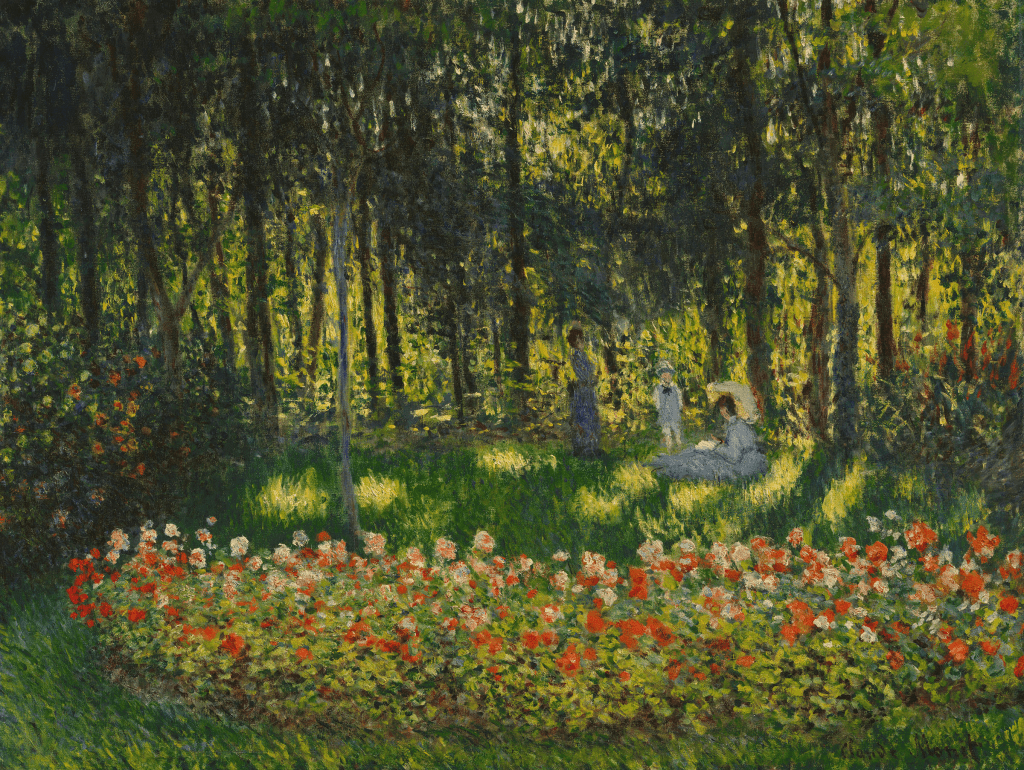
The Artist’s Family In the Garden, by Claude Monet, 1875

Thus, the Apostle Paul, having also learned well, understood that there are not spiritual “fruits,” but only spiritual “fruit.” That is, the nine virtues Paul mentioned are the “fruit of the Spirit,” not “fruits.”

In other words, all virtuous words and behavior are connected with each other. When a person or an organization has the Divine Gardener attending to them, all nine of the Christian values are a collective basket of fruit which cannot be separated from one another.

So then, if we look at the list of spiritual fruit in the New Testament book of Galatians and say something like, “Well, I’m pretty good at kindness and goodness, but I don’t have much peace or patience,” then what this really means is that we are likely doing kindness and goodness from a different place than by means of the Holy Spirit.

Because when the Spirit is manifested in us, we exhibit spiritual fruit. We cannot separate the nine spiritual virtues any more than we can separate the Trinity. They’re all one spiritual fruit, cultivated and produced within the inner person by the agency of God’s Spirit, our Divine Gardener.

Perhaps we need to consider what is happening in the ground, underneath the surface, which is the shadow side of our lives that no one sees.

For example, it could be that we are driven far more by our ego and our anxiety about most things than about genuine altruism and love. The results of our actions and words may look the same or similar, but the motivation might be far from truly altruistic.

Any sort of “fruit” will simply not last if our actions spring from a place of ego control and worry – because it is not of the Spirit.

Both persons and institutions must mortify (put to death) the deeds and the weeds of the sinful nature.

I have been crucified with Christ and I no longer live, but Christ lives in me. And the life that I now live in my body, I live by faith, indeed, by the faithfulness of God’s Son, who loved me and gave himself for me.

The Apostle Paul (Galatians 2:20, Common English Bible)

The Spirit will always have us in the good rich soil of Christ, so that when we are planted and receive the proper amounts of spiritual sun and living water, we will most certainly produce a hundredfold crop.

Then, we learn to make proper and right judgments about what is happening in our world. We are able to see the thief in the garden who cares only to pick fruit he has neither planted nor cared for, having no intention of sharing anything, but instead seeks to amass a gluttonous basket for his own self.

There is a great need for virtuous living, ethical sensibilities, and wise discernment among everyone in this world.

We are now observing what happens when a people are ignorant of how true righteousness, justice, goodness, and peace are grown and developed in any culture, society, and government. Fools are allowed to roam the garden, and they make a complete mess of things.

Let us all do our part in ensuring that genuine spiritual fruit is produced, coming from the true self. Disconnection, destruction, and chaos are the fruit of a bad tree. Then, it is only fit to cut down and thrown into the fire.

Jesus said:

“Every good tree produces good fruit, and every rotten tree produces bad fruit. A good tree can’t produce bad fruit. And a rotten tree can’t produce good fruit. Every tree that doesn’t produce good fruit is chopped down and thrown into the fire. Therefore, you will know them by their fruit.” (Matthew 7:17-20, Common English Bible)

Therefore, beware, watch out, and be wise in the way your own soul is cultivated, and how you discern the souls of others.

For the Christian, the season of Lent is the best and most appropriate time to focus upon spiritual disciplines which help connect us with Christ and with one another.

Daily attention to the garden of our soul prepares us for Holy Week by participating with Jesus in both his crucifixion and resurrection. All that is wrong and sinful in this old fallen world is put to death, and a new life of virtuous and altruistic living is enjoyed.

And the beauty of it all is that it will organically spring from the depths of a well-cultivated soul garden. The Divine Gardener stands ready with both hose and hoe to bring about the fruit of the Spirit.

Soli Deo Gloria