A View of Suffering (Job 36:1-23)

The Wrath of Elihu,” by William Blake (1757-1827)

Elihu continued:

“Bear with me a little longer and I will show you
    that there is more to be said in God’s behalf.
I get my knowledge from afar;
    I will ascribe justice to my Maker.
Be assured that my words are not false;
    one who has perfect knowledge is with you.

“God is mighty, but despises no one;
    he is mighty, and firm in his purpose.
He does not keep the wicked alive
    but gives the afflicted their rights.
He does not take his eyes off the righteous;
    he enthrones them with kings
    and exalts them forever.
But if people are bound in chains,
    held fast by cords of affliction,
he tells them what they have done—
    that they have sinned arrogantly.
He makes them listen to correction
    and commands them to repent of their evil.
If they obey and serve him,
    they will spend the rest of their days in prosperity
    and their years in contentment.
But if they do not listen,
    they will perish by the sword

    and die without knowledge.

“The godless in heart harbor resentment;
    even when he fetters them, they do not cry for help.
They die in their youth,
    among male prostitutes of the shrines.
But those who suffer he delivers in their suffering;
    he speaks to them in their affliction.

“He is wooing you from the jaws of distress
    to a spacious place free from restriction,
    to the comfort of your table laden with choice food.
But now you are laden with the judgment due the wicked;
    judgment and justice have taken hold of you.
Be careful that no one entices you by riches;
    do not let a large bribe turn you aside.
Would your wealth or even all your mighty efforts
    sustain you so you would not be in distress?
Do not long for the night,
    to drag people away from their homes.
Beware of turning to evil,
    which you seem to prefer to affliction.

“God is exalted in his power.
    Who is a teacher like him?
Who has prescribed his ways for him,
    or said to him, ‘You have done wrong’? (New International Version)
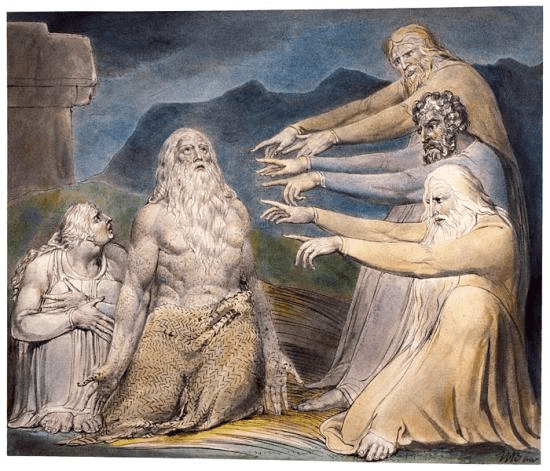
Job’s “friends” scorn him, painting by William Blake

I’m just going to go ahead and say it: Elihu was a jerk. His worldview wasn’t big enough to accommodate for Job’s awful suffering as anything but a chastisement from God.

Elihu embodied the proud person, full of himself, believing that he knows how the world works. But, in reality, he knows jack squat. The best thing Elihu did in the book of Job was to keep his mouth shut. The silence was actually helpful.

After Job lost everything and everyone dear to him (except his wife) he was understandably in tremendous grief. His lament needed to be heard – not responded to with the rebuttal of an ignoramus. Unfortunately, Elihu didn’t keep his mouth closed. He seems like a mere windbag, speaking a lot of words and saying nothing.

To be fair, Elihu gets a lot of information right; it’s just that his reasoning is narrow and misguided. He rightly affirms that God has incomparable power, and is the One who is able to punish the wicked and grant justice to the oppressed.

Yet, Elihu assumes – in his apparent black-and-white world – that anyone afflicted with such terrible events as Job is under the correction of God. The Lord is disciplining the person and teaching them a lesson about the error of their ways, he reasons.

That sort of logic betrays a very contractual sort of relationship with God – as if the Lord is only the high and transcendent plantation boss who singularly serves to maintain discipline and fealty amongst the ranks of inferiors. Elihu ignored the immanence of God in coming close to the brokenhearted and providing release for those in captivity.

In such a bifurcated world of a high God and low humanity, there are really only two choices whenever someone is in a situation like Job: either turn from your erroneous ways and serve God; or don’t, and die under the punishment of God.

But the book of Job challenges us on that kind of thinking and belief. The hard circumstances of people cannot neatly be categorized into the need for repentance – nor can a life of ease and wealth be considered a mark of divine favor.

Elihu was leaning toward viewing Job as a rebellious man who needed to admit his sin and submit to God. Yet, Job (and God!) knew better than this. And that is perhaps one of the most difficult aspects of horrible human suffering – that the sufferer must contend with persons who look at them askance as if they have done some egregious sin which offended God.

We know, as readers of the biblical book, that there was no wickedness or sin involved in Job’s suffering. Instead, there were unseen forces behind the scenes causing that suffering. In fact, just the opposite was at work: Job was suffering because of his incredible righteousness, and not by any wrongdoing on his part.

Most situations are complex and defy simple explanations or solutions. It is foolish to make assumptions based upon circumstantial evidence. Wanting quick and easy answers to the problems we face as humans is the path of simpletons.

In contrast to nice and neat mental categories, there are loving believers who are devoted to faith and patience, knowing that there can be more going on than what it seems on the surface. Listening and understanding is the path to wisdom, whereas entrenched opinions – offered as certainty of belief – is a way of dying in ignorance.

“Life’s but a walking shadow; a poor player, that struts and frets his hour upon the stage, and then is heard no more: it is a tale told by an idiot, full of sound and fury, signifying nothing.”

William Shakespeare, Macbeth

If we keep a focus on being helpful to the other, then we are less likely to offer unhelpful, even harmful, words. Knowing that life is much bigger than we can realize, is one good step toward that end.

O Lord our heavenly Father, whose blessed Son came not to be served, but to serve: We ask you to bless all who, following in his steps, give themselves to the service of others; endue them with wisdom, patience, and courage, that they may strengthen the weak and raise up those who fall, and, being inspired by your love, may worthily minister to the suffering, the friendless, and the needy, for the sake of him who laid down his life for us, your Son our Savior Jesus Christ. Amen.

The Seven Deadly Sins (Proverbs 12:10-21)

A 14th century personification of the Seven Deadly Sins, by Unknown artist

The righteous care for the needs of their animals,
    but the kindest acts of the wicked are cruel.

Those who work their land will have abundant food,
    but those who chase fantasies have no sense.

The wicked desire the stronghold of evildoers,
    but the root of the righteous endures.

Evildoers are trapped by their sinful talk,
    and so the innocent escape trouble.

From the fruit of their lips people are filled with good things,
    and the work of their hands brings them reward.

The way of fools seems right to them,
    but the wise listen to advice.

Fools show their annoyance at once,
    but the prudent overlook an insult.

An honest witness tells the truth,
    but a false witness tells lies.

The words of the reckless pierce like swords,
    but the tongue of the wise brings healing.

Truthful lips endure forever,
    but a lying tongue lasts only a moment.

Deceit is in the hearts of those who plot evil,
    but those who promote peace have joy.

No harm overtakes the righteous,
    but the wicked have their fill of trouble. (New International Version)

Many of the biblical proverbs are set as contrasts between the way of righteousness and the way of wickedness.

Being aware of both vice and virtue in our personal lives, the workplace, neighborhood, family, and faith communities can create an environment of trust, love, fellowship, and enjoyment. Intentionally pursuing the good, while identifying and forsaking the bad, contributes to a thriving community who intentionally cultivates righteousness.

It’s likely that you have heard of “the seven deadly sins.” In medieval Christianity, these were vices to avoid at all costs, because they eroded personal integrity and poisoned the social community. A “vice” is a bad habit which corrupts character and debases society.

The early church eventually formed a short list of the most corrosive vices, the seven deadly sins, which were considered the most heinous desires/actions of all. We find them in our proverbs for today.

The wicked covet the proceeds of wickedness. Desiring evil is a trap for them. They chase after sinister fantasies.

Lust is an intense desire, coupled with a lack of mental self-control, which is manifested in pursuing that desire in the heart. It is to have a passion for someone (or something) that is neither yours, nor meant for you. Lust leers at and indulges in selfish daydreams, without any concern for another person.

Do not desire to possess anything that belongs to another person—not a house, a wife, a husband, a slave, an ox, a donkey, or anything else. (Exodus 20:17, CEV)

The wicked have their fill of trouble. They’ve gobbled up evil as if dining at an all-you-can-eat buffet.

Whereas lust and covetousness is mostly a lack of mental self-control, gluttony is the lack of bodily self-control.

So, whether you eat or drink or whatever you do, you should do it all for God’s glory. (1 Corinthians 10:31, CEB)

Gluttony doesn’t stop eating, buying, talking, drinking, or binging. It only excessively indulges to the point of physical and/or relational sickness. Addictions and workaholism are some modern-day forms of gluttony – it consumes to the point where it cannot control the consumption any more. The thing desired and indulged becomes the master.

Observe the Sabbath and keep it holy. You have six days in which to do your work, but the seventh day is a day of rest dedicated to me. On that day no one is to work—neither you, your children, your slaves, your animals, nor the foreigners who live in your country. (Exodus 20:8-10, GNT)

The tools of greed are deceit and lies; the greedy person goes to just about any lengths to obtain more wealth. They will misrepresent another and spread gossip and slander to get what they want.

Do not tell lies about others.

The Ninth Commandment (Exodus 20:16, CEV)

Money. More money – is the mantra of the greedy person. It is to have an inordinate desire and pursuit of wealth. Just as sex and food are good, but have their proper boundaries, so money is both good and necessary. 

But money is powerful in more ways than one. It can take over a person’s life in such a way that charging exorbitant interest, rent, or price gouging is justified by satisfying the greed. The greedy person lives every waking moment for leveraging wealth to get more wealth.

People who want to be rich fall into all sorts of temptations and traps. They are caught by foolish and harmful desires that drag them down and destroy them. The love of money causes all kinds of trouble. Some people want money so much that they have given up their faith and caused themselves a lot of pain. (1 Timothy 6:9-10, CEV)

The sloth much prefers get-rich-quick schemes to actual hard work. They spend their time in worthless projects, and are easily annoyed at others.

Sloth is more than laziness. It is also failing to do good when it is in your power and ability to do so. To be slothful is to be indifferent to the great need of the world. 

Whereas the previous sins have a more active pursuit of some desire, the sloth is passive, not wanting to get involved in making a difference. The slothful person always has an excuse why they can’t participate; they expect everyone else to do the work. 

Do your work willingly, as though you were serving the Lord himself, and not just your earthly master.

Colossians 3:23, CEV

The irony is that for all of Ebenezer Scrooge’s hard work and thrift, he was really a sloth who had no intention of improving the condition of humanity; he depended on poor houses and work farms to do all the work. It took supernatural means to get him to think differently. It typically takes a lot for the sloth to go out of their way to honor, respect, and bless another.

You must honor and respect your father and your mother. Do this so that you will have a full life in the land that the Lord your God gives you. (Exodus 20:12, ERV)

A wicked person is often an angry person – so full of anger that they abuse their pets and animals who have done nothing against them. And they let their tongues wag and fly off the handle anytime they are perturbed.

Stop being angry!  Turn from your rage!  Do not lose your temper— it only leads to harm. (Psalm 37:8, NLT)

That doesn’t mean that anger itself is a bad thing. As with most things in life, anger has its proper place. For example, we ought to be angry in the face of evil perpetrators. Anger motivates us to not be slothful, but helpful. 

But excessive selfish anger is a vice. Whereas righteous anger seeks to help a victimized person or group, sinful anger is fueled by hatred. Whether it’s a violent verbal decapitation of another, or a deep seated bitterness, such anger destroys relationships – and even life itself.

No murder.

The Sixth Commandment (Exodus 20:13, MSG)

Envy and lust are kissing cousins. They both traffic in excessive desire for what they don’t possess. 

Envy rots the bones.

Proverbs 14:30, NIV

The subtle difference has more to do with the object of the affection. Lust leers at, longs for, a person who belongs to someone else. Envy fixes its gaze on a material possession or a respected position which someone else has. It is to have a passionate pursuit of taking over someone else’s job or keeping up with Jones’s.

For where there is envy and selfish ambition, there will also be disorder and wickedness of every kind. (James 3:16, NRSV)

The wicked and the proud share a table together for lunch every day. They don’t listen to anybody else, because they believe they already have the answers and know what is best.

Pride is an over-inflated view of one’s opinions, thoughts, and self. Proud persons have an overestimation of themselves. They seem to actually believe that if only others followed their thinking and advice, the world would be a better place.  

Every antagonist in the movies, comics, and classic literature are full of themselves. They justify stepping on others to achieve what they think is the greater good of imposing their agenda in the situation. It’s no wonder that in the Bible, Satan is the ultimate antagonist.

The proud must eventually contend with God. And the Lord has no allowance for the foolishness and idolatry of any human believing they know better.

“No other gods, only me.”

First Commandment (Exodus 20:3, MSG)

Consider the following questions:

How will you respond to the seven deadly sins?

In what ways and/or behaviors do you see these vices being manifested in both the church and the world?

What can the book of Proverbs bring to such a discussion?

Donkey Talk (Numbers 22:22-28)

The angel of the Lord meets Balaam with a sword, from “Bible Pictures and What They Teach Us” by Charles Foster, 1897

Balaam was riding his donkey to Moab, and two of his servants were with him. But God was angry that Balaam had gone, so one of the Lord’s angels stood in the road to stop him. When Balaam’s donkey saw the angel standing here with a sword, it walked off the road and into an open field. Balaam had to beat the donkey to get it back on the road.

Then the angel stood between two vineyards, in a narrow path with a stone wall on each side. When the donkey saw the angel, it walked so close to one of the walls that Balaam’s foot scraped against the wall. Balaam beat the donkey again.

The angel moved once more and stood in a spot so narrow that there was no room for the donkey to go around. So it just lay down. Balaam lost his temper, then picked up a stick and whacked the donkey.

When that happened, the Lord told the donkey to speak, and it asked Balaam, “What have I done that made you beat me three times?” (Contemporary English Version)

This is one of those stories which speaks for itself. It’s clear to see that the diviner Balaam made a jackass of himself. A dumb donkey could see things better than a famous seer.

The nation of Moab was afraid of Israel. Balak the Moabite got in touch with Balaam the diviner in order for him to put a curse on Israel. Even though Balaam had the sense to know that he could only speak what God told him, he was influenced by Balak through vanity, and enticed with a small fortune. So, off he went to Moab.

But God was angry with Balaam. Three times the angel of the Lord stood in the road to oppose Balaam. The donkey knew what was up, but Balaam was too dense – stubborn as a jackass – to what was going on. It took God talking through the donkey before Balaam could finally see the angel.

When God wants to speak and accomplish a divine purpose, the Lord can use anything or anybody to achieve it – even by means of a talking donkey.

In fact, throughout Holy Scripture, God oftentimes uses the weak to further the divine agenda. Whenever God determines something, it will happen, usually by means nobody ever expects.

Look at your situation when you were called, brothers and sisters! By ordinary human standards not many were wise, not many were powerful, not many were from the upper class. But God chose what the world considers foolish to shame the wise. God chose what the world considers weak to shame the strong. And God chose what the world considers low-class and low-life—what is considered to be nothing—to reduce what is considered to be something to nothing. (1 Corinthians 1:26-28, CEB)

If God can use a donkey as a teacher, then none of us need ever be discouraged. The Lord can and will use us to make a difference in this world. God takes special delight in choosing and using the nobodies of this world to fulfill divine purposes and to communicate important messages.

This is why we can always bank of the promises of God – because nothing and nobody can ever stand in the way of the Lord’s will. God is creative and determined, using whatever means and whomever God wants, in order to bring about the good and the right and the just, in this old fallen world.

Most of us don’t have to worry about having a big head or a vain spirit or being a famous prophet like Balaam. The majority of us struggle more with having a lower view of ourselves than we actually are.

God created us according to the divine will and in divine wisdom. The Lord has equipped you with your particular DNA both biologically and spiritually. And, most of all, each one of us has been stamped with the divine image and likeness of God. We carry within our very being the stuff of our Creator.

So, I hope it won’t take some donkey talk to help you see and understand who you are and what your purpose on this earth is for. And there is no need to consult a dubious diviner to try and obtain something that you already possess. Not even a jackass does that.

Our Father in heaven,
Reveal who you are.
Set the world right;
Do what’s best—
    as above, so below.
Keep us alive with three square meals.
Keep us forgiven with you and forgiving others.
Keep us safe from ourselves and the Devil.
You’re in charge!
You can do anything you want!
You’re ablaze in beauty!
    Yes. Yes. Yes. Amen. (Matthew 6:9-13, MSG)

Learning a Lesson from Balak and Balaam (Numbers 22:1-21)

Balaam and King Balak, by Maerten de Vos, 1585

Israel moved from there to the hills of Moab, where they camped across the Jordan River from the town of Jericho.

When King Balak of Moab and his people heard how many Israelites there were and what they had done to the Amorites, he and the Moabites were terrified and panicked. They said to the Midianite leaders, “That huge mob of Israelites will wipe out everything in sight, like a bull eating grass in a field.”

So King Balak sent a message to Balaam son of Beor, who lived among his relatives in the town of Pethor near the Euphrates River. It said:

I need your help. A large group of people has come here from Egypt and settled near my territory. They are too powerful for us to defeat, so would you come and place a curse on them? Maybe then we can run them off. I know that anyone you bless will be successful, but anyone you curse will fail.

The leaders of Moab and Midian left and took along money to pay Balaam. When they got to his house, they gave him Balak’s message.

“Spend the night here,” Balaam replied, “and tomorrow I will tell you the Lord’s answer.” So the officials stayed at his house.

During the night, God asked Balaam, “Who are these people at your house?”

“They are messengers from King Balak of Moab,” Balaam answered. “He sent them to ask me to go to Moab and put a curse on the people who have come there from Egypt. They have settled everywhere around him, and he wants to run them off.”

But God replied, “Don’t go with Balak’s messengers. I have blessed those people who have come from Egypt, so don’t curse them.”

The next morning, Balaam said to Balak’s officials, “Go on back home. The Lord says I cannot go with you.”

The officials left and told Balak that Balaam refused to come.

Then Balak sent a larger group of officials, who were even more important than the first ones. They went to Balaam and told him that Balak had said, “Balaam, if you come to Moab, I’ll pay you very well and do whatever you ask. Just come and place a curse on these people.”

Balaam answered, “Even if Balak offered me a palace full of silver or gold, I wouldn’t do anything to disobey the Lord my God. You are welcome to spend the night here, just as the others did. I will find out if the Lord has something else to say about this.”

That night, God said, “Balaam, I’ll let you go to Moab with Balak’s messengers, but do only what I say.”

So Balaam got up the next morning and saddled his donkey, then left with the Moabite officials. (Contemporary English Version)

 Art by Sefira Lightstone

Israel was at the cusp of finally entering the Promised Land. They had been delivered out of Egyptian slavery, wandered in the desert for forty years, and defeated all the tribes of the Transjordan in order to get to where they were going.

Fear had fallen on all the people surrounding Israel because of their success. The nation of Moab knew that Israel would not be defeated in battle; but maybe they could be defeated in a different way. So, they hired a professional seer to put a curse on Israel.

The seer, or diviner, Balaam, initially refused the offer, even though it was a lucrative one. But he finally acceded and went, with the caveat that he could only do what the Lord tells him to do.

Balak, the Moabite, desperately wanted Balaam to curse the Israelites. Balak essentially hired the most famous and effective diviner he could find. He fully expected all this to work in his favor, in order to give him an advantage over Israel.

Was Balaam a real prophet of God, or just a self-serving shaman? Although our text for today is essentially positive in its tone, subsequent generations look back on Balaam and understand him as in league with evil. (Numbers 31:8, 16; Joshua 13:22; Micah 6:5; Jude 11)

Although as biblical readers we might be somewhat flummoxed about what to really make of Balaam, he really serves as a mirror to the nature of humanity. For we are all people who are capable of both great evil and altruistic good, and everything in between. There is no such thing as a person who is all bad or all good; all of us are some sort of mix of the two.

Therefore, every one of us needs to be vigilant in how we shall then live – what choices we will make, what sort of goals we will establish, and what kind of people we will listen to and follow. If we seek to take some lessons from this story, perhaps we might do well to consider the motives of the main characters Balak and Balaam.

Balak was filled with dread and fear. Sickening fear and anxiety is most certainly one of the great emotional and spiritual hazards of our time. His debilitating fear was that he and his nation would be destroyed by Israel.

Yet, if you consider this, it is a groundless anxiety. Israel was all too willing to pass through on their way to the Promised Land without a fight. It was only when attacked that they fought back and destroyed other nations.

Balak wasted a bunch of wealth and worry on something that wasn’t even going to happen, unless he himself provoked it. It is likely that worry, fear, and anxiety, like Balak, is not serving you well; it’s keeping you under the tyranny of what might happen. And it is in such a state that we make poor decisions, such as consulting diviners to assuage us of the worry.

Balaam allowed himself to be manipulated into believing he could make his small fortune. After all, this nation of people needed him, and he perhaps vainly imagined he was doing the right thing and being above board.

But Yahweh is not like other gods. In reality there was no way Balaam was going to cajole God to get what he wanted. It may have worked that way in paganism, but wasn’t going to happen with the sovereign Lord of the universe. In the end, it was God who used Balaam for God’s own purpose – and not the other way around.

Some people want they want, and arrogantly assume that if they pray a lot and have their requests offered on many prayer chains, or that if they just use the right language and exhibit enough passion, that God will surely have to answer them and give them what they want. But Christian prayer is not like other prayer:

When you pray, don’t talk on and on as people do who don’t know God. They think God likes to hear long prayers. Don’t be like them. Your Father knows what you need even before you ask. (Matthew 6:7-8, CEV)

Everything comes down to trusting God and obeying his commands. When all is said and done, after all the fear and worry are spent, there is God, waiting for us to come and place faith in the divine law and promises.

Everything you were taught can be put into a few words:

Respect and obey God!
This is what life
    is all about.
God will judge
    everything we do,
even what is done in secret,
    whether good or bad. (Ecclesiastes 12:13-14, CEV) Amen.