
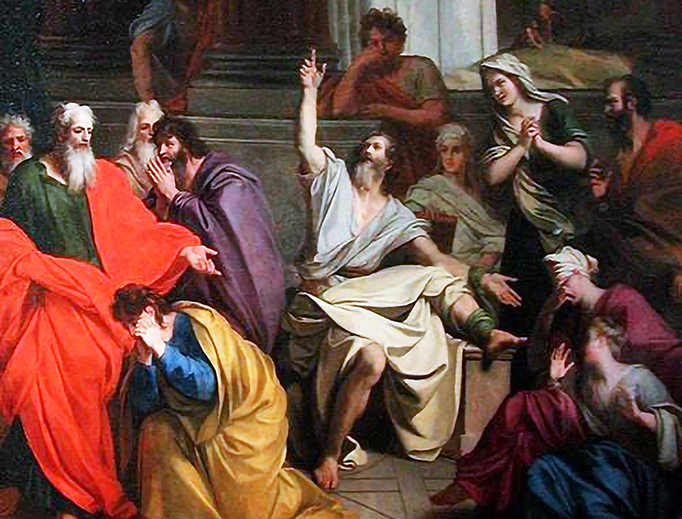
From Darkness and Death to Light and Life (Acts 20:1-16)

St. Paul Restoring Eutychus to Life, by Taddeo Zuccaro (1529-1566)

When the uproar had ended, Paul sent for the disciples and, after encouraging them, said goodbye and set out for Macedonia. He traveled through that area, speaking many words of encouragement to the people, and finally arrived in Greece, where he stayed three months.

Because some Jews had plotted against him just as he was about to sail for Syria, he decided to go back through Macedonia. He was accompanied by Sopater son of Pyrrhus from Berea, Aristarchus and Secundus from Thessalonica, Gaius from Derbe, Timothy also, and Tychicus and Trophimus from the province of Asia. These men went on ahead and waited for us at Troas. But we sailed from Philippi after the Festival of Unleavened Bread, and five days later joined the others at Troas, where we stayed seven days.

On the first day of the week we came together to break bread. Paul spoke to the people and, because he intended to leave the next day, kept on talking until midnight. There were many lamps in the upstairs room where we were meeting. Seated in a window was a young man named Eutychus, who was sinking into a deep sleep as Paul talked on and on. When he was sound asleep, he fell to the ground from the third story and was picked up dead. 

Paul went down, threw himself on the young man and put his arms around him. “Don’t be alarmed,” he said. “He’s alive!” Then he went upstairs again and broke bread and ate. After talking until daylight, he left. The people took the young man home alive and were greatly comforted.

We went on ahead to the ship and sailed for Assos, where we were going to take Paul aboard. He had made this arrangement because he was going there on foot. When he met us at Assos, we took him aboard and went on to Mitylene. The next day we set sail from there and arrived off Chios. The day after that we crossed over to Samos, and on the following day arrived at Miletus. Paul had decided to sail past Ephesus to avoid spending time in the province of Asia, for he was in a hurry to reach Jerusalem, if possible, by the day of Pentecost. (New International Version)

Paul Raises Eutychus to Life, by Gerard Hoet, 1728

The Apostle Paul was fresh off a riot in the city of Ephesus. Reading through the book of Acts in the New Testament, this almost seems like another day in the office for Paul. Everywhere he went, Paul created a stir – not on purpose – but just for being himself. Much like the Lord Jesus he served, Paul was a guy people either loved or hated.

We pick up Paul’s journey as he was heading to Macedonia. There were several companions who accompanied him, as was usual. The Apostle rarely, if ever, traveled alone; he was always in an entourage and mentoring others in the ways of Christian ministry.

This journey was different than the others. Paul knew what was coming for him. He was beginning a farewell tour, knowing that he would end up back in Judea – which may mean death for him.

One of the reasons there was such a commotion everywhere Paul went was because the Jews continually opposed him. But Paul was not deterred; he was determined to persevere, and especially to encourage the churches he had formed.

While in Troas, Paul met with the believers on a Sunday. Since this was a final message to those gathered, Paul did the longwinded preacher thing by talking until midnight. Apparently, all the young people were sitting in the back (some things never change) and one of them, Eutychus, fell asleep in the window where he was seated, and fell out of the window to the ground.

By the time Paul got to Eutychus, he was pronounced dead. But the Apostle wasn’t having it. He scooped up the young man into his arms and declared that life is still in him. Like the Lord Jesus before him, Paul restored the presumably dead person back to life.

This is the power of resurrection, specifically the spiritual power of Christ’s resurrection: Death doesn’t have the last word.

Paul was speaking at night, which is why there were many lamps lit in the place. Despite the light, Eutychus closed his eyes and succumbed to shutting out the light. He quite literally fell into darkness, and into the place of death.

Yet, it doesn’t take much light to dispel the darkness. A small candle is enough to luminate a way forward. Paul had more than a candle available to him; he had enough to literally light up Eutychus.

And then everybody went back upstairs and Paul did what any preacher worth their salt would do next: He kept preaching.

I’m sure Paul’s everlasting long sermon after that dramatic event with Eutychus centered on the message to “stay awake!” And indeed, that’s exactly what believers in Jesus are to do.

Then Jesus returned to his disciples and found them sleeping. “Simon,” he said to Peter, “are you asleep? Couldn’t you keep watch for one hour? Watch and pray so that you will not fall into temptation. The spirit is willing, but the flesh is weak.” (Mark 14:37-38, NIV)

Paul wanted to sail past the port of Ephesus in order to get to Jerusalem quicker. When he was previously in the city, and established a church of new believers out of their old paganism, he said to them:

For you were once darkness, but now you are light in the Lord. Live as children of light (for the fruit of the light consists in all goodness, righteousness and truth) and find out what pleases the Lord. (Ephesians 5:8-10, NIV)

The Apostle Paul was an intense guy. And that’s a good thing, when it’s channeled in ways of encouraging others, supporting them spiritually, and even raising someone from death.

Fortunately, the intensity of his light can still be seen these two millennia later.

O God, who for our redemption gave your only-begotten Son to the death of the cross, and by his glorious resurrection delivered us from the power of our enemy: Grant us so to die daily to sin, that we may evermore live with him in the joy of his resurrection; through Jesus Christ your Son our Lord, who lives and reigns with you and the Holy Spirit, one God, now and forever. Amen.

From the Overflow of the Heart, the Mouth Speaks (Luke 6:43-45)

Jesus said, “A healthy tree does not bear bad fruit, nor does a poor tree bear good fruit. Every tree is known by the fruit it bears; you do not pick figs from thorn bushes or gather grapes from bramble bushes. A good person brings good out of the treasure of good things in his heart; a bad person brings bad out of his treasure of bad things. For the mouth speaks what the heart is full of.” (Good News Translation)

I often find public confessions on television to be a rather disingenuous affair. Typically, celebrity apologies only take shape when one has been caught saying something and are called on the carpet.

Then, when the apology finally comes, it’s predictably odd and incongruent. The person says something to the tune of, “I’m sorry if I hurt anybody by what I said. Saying that really wasn’t me. I’m not really like that.”

Well, apparently you are! The offending words came out of your mouth, not somebody else’s. It is a lot easier, however, to see a problem in another and name it. To see and deal with our own stuff is different.

Just the other day, I made an off-the-cuff comment to a colleague. The person has an unusual first name (from my perspective) and so I blurted a quick pun of it in front of others when I greeted them. I thought nothing of it.

But later in the day, the person came to me privately. They gently let me know that my pun of their name was hurtful. My only saving grace was that I listened, didn’t go off on an explanation of why I said it, and offered a heartfelt apology with the promise to not use their name in that way again.

Jesus said that out of the overflow of the heart the mouth speaks. The words we say out loud betray what is truly inside us. In truth, I said what I said to my colleague, because I find their name to be strange. What was actually inside me came out of my mouth. And I’m an introvert. I can’t even imagine what extroverts have to go through!

To illustrate his point, Jesus used the metaphor of a tree. If the roots, the trunk, and the branches are good and healthy, then you can be sure the tree will produce good healthy fruit. However, if the tree is diseased, or infested with insects and rotting from the inside out, then no one can expect anything other than bad fruit that is not fit to consume.

Good Tree and Bad Tree, by Bible Art

If the fruit is bad, the tree is bad. If the words are hateful, sarcastic, passive-aggressive, manipulative, conniving, racist, hurtful, ignorant, mean, unjust, foolish, and either subtly or overtly abusive, then the person has a dark heart and is need of redemption, not excuses.

Conversely, if the words are affirming, encouraging, loving, compassionate, gentle, caring, direct, helpful, peaceful, kind, giving hope and life, then there is a good heart behind it.

Yes, bad hearts can parrot good words. However, those words are not genuine but mere rote recitations to achieve some sort of personal agenda.

And, of course, good people will occasionally say dumb or hurtful words – as I did with my colleague. In such times, let it be a reminder that we all have some shadowy places within our hearts – and that we must depend on God’s grace to enlighten those dark spaces.

It is best to observe patterns rather than focus on isolated events where either good or bad words were said. A consistent pattern of invalidating another’s experiences or feelings; intimidating or threatening others; dismissing or discounting someone’s input; or being unnecessarily blunt, are all major red flags pointing to a severe heart issue.

Evil does exist in the world. And if we are not vigilant to its insidious role in the crafting of words, wickedness can easily smack us upside the head when we aren’t looking.

The heart cannot be concealed forever. Eventually, the virtuous person will be shown as such by the stream of speech which pours forth from their heart, as if it were living water for others to drink and enjoy. Their words reflect their good character.

The wicked person, however, cannot keep the bad words down. Those vile words sit in the soul, poisoning and making the person ill. Then, all of a sudden, the evil words come up and out with a great vomitous heave and spew impurity and unholiness all over the innocent. Their words betray their foolish and poor character.

Every tree that does not bear good fruit will be cut down and thrown into the fire. The wicked heart will not be able to speak ill of others with impunity forever. They will be called to account for their abusive words, whether overtly violent, or subtly undermining.

The righteous heart, however, shall experience divine pleasure and reward, as if the careful construction of helpful and building up words win first-prize at the great heavenly fair.

The good person loves and does not hate. They are so far from harming anyone that they even pray and wish well for their enemies. They pray for blessings on those who curse them. There is an honest striving to speak good words to everyone, regardless of who they are.

The upright heart thinks the best of everyone and holds nothing over someone else’s head. A good heart condemns no one, leaving all judgment to God alone. It is patient with the most exasperating of people, praying they might come to their senses and become spiritually healthy.

The righteous are able to use their speech to admonish their neighbor with care and affection. They freely forgive, happily give, liberally encourage, and use their tongue to speak words of life. Indeed, their speech is wise, humble, full of grace, and above all, loving.

If there is a problem with words, it will not do to simply change the speech. That’s because it is a heart issue. And the heart must be willing to change and be transformed by sheer mercy.

Fortunately, God is the expert on renovating dilapidated hearts and performing effective heart transplants.

Jesus is the gracious carpenter. God is the divine surgeon. The Holy Spirit is the energetic power source. They are ready for the work. Will you consent to let them in?

Almighty God, to you all hearts are open, all desires known, and from you no secrets are hid: Cleanse the thoughts of our hearts by the inspiration of your Holy Spirit so that we may perfectly love you, and worthily magnify your holy Name; through Christ our Lord. Amen.

Fear or Faith? (1 Samuel 13:23-14:23)

The pass at Micmash had meanwhile been secured by a contingent of the Philistine army.

One day Jonathan said to his armor bearer, “Come on, let’s go over to where the Philistines have their outpost.” But Jonathan did not tell his father what he was doing.

Meanwhile, Saul and his 600 men were camped on the outskirts of Gibeah, around the pomegranate tree at Migron. Among Saul’s men was Ahijah the priest, who was wearing the ephod, the priestly vest. Ahijah was the son of Ichabod’s brother Ahitub, son of Phinehas, son of Eli, the priest of the Lord who had served at Shiloh.

No one realized that Jonathan had left the Israelite camp. To reach the Philistine outpost, Jonathan had to go down between two rocky cliffs that were called Bozez and Seneh. The cliff on the north was in front of Micmash, and the one on the south was in front of Geba.“Let’s go across to the outpost of those pagans,” Jonathan said to his armor bearer. “Perhaps the Lord will help us, for nothing can hinder the Lord. He can win a battle whether he has many warriors or only a few!”

“Do what you think is best,” the armor bearer replied. “I’m with you completely, whatever you decide.”

“All right, then,” Jonathan told him. “We will cross over and let them see us. If they say to us, ‘Stay where you are or we’ll kill you,’ then we will stop and not go up to them. But if they say, ‘Come on up and fight,’ then we will go up. That will be the Lord’s sign that he will help us defeat them.”

When the Philistines saw them coming, they shouted, “Look! The Hebrews are crawling out of their holes!” Then the men from the outpost shouted to Jonathan, “Come on up here, and we’ll teach you a lesson!”

“Come on, climb right behind me,” Jonathan said to his armor bearer, “for the Lord will help us defeat them!”

So they climbed up using both hands and feet, and the Philistines fell before Jonathan, and his armor bearer killed those who came behind them. They killed some twenty men in all, and their bodies were scattered over about half an acre.

Suddenly, panic broke out in the Philistine army, both in the camp and in the field, including even the outposts and raiding parties. And just then an earthquake struck, and everyone was terrified.

Saul’s lookouts in Gibeah of Benjamin saw a strange sight—the vast army of Philistines began to melt away in every direction. “Call the roll and find out who’s missing,” Saul ordered. And when they checked, they found that Jonathan and his armor bearer were gone.

Then Saul shouted to Ahijah, “Bring the ephod here!” For at that time Ahijah was wearing the ephod in front of the Israelites. But while Saul was talking to the priest, the confusion in the Philistine camp grew louder and louder. So Saul said to the priest, “Never mind; let’s get going!”

Then Saul and all his men rushed out to the battle and found the Philistines killing each other. There was terrible confusion everywhere. Even the Hebrews who had previously gone over to the Philistine army revolted and joined in with Saul, Jonathan, and the rest of the Israelites. Likewise, the men of Israel who were hiding in the hill country of Ephraim joined the chase when they saw the Philistines running away. So the Lord saved Israel that day, and the battle continued to rage even beyond Beth-aven. (New Living Translation)

The vicinity of Micmash (modern Mukmas) in Israel

Israel had demanded a king. The people wanted to be like everyone else in the world. All the other nations had a king. The Israelites believed that they needed one, too. (1 Samuel 8)

Not unlike today, Israel got a king who looked the part. Saul was tall, dark, and handsome. The only problem was that he didn’t act much like a king at all.

On the day he was anointed king, Saul hid in the baggage, like some guy ducking into a dumpster to avoid people chasing him. If the kings of other nations acted boldly on behalf of their subjects, Saul was not that sort of king. He seemed bent toward cowardice, and more concerned about his reputation than actually accomplishing anything.

Saul could have distinguished his royal kingship through listening to God and obeying the Lord; instead, his rule and reign was often marked by a half obedience, if he obeyed at all.

Old Testament stories are filled with contrasting characters. And in the narrative for today, there is a clear difference between King Saul and his son Jonathan. Saul was supposed to be leading the charge against the Philistine threat to Israel, but he was hiding out.

But Jonathan was determined to deal with the arrogant Philistines, even though it meant going against an entire garrison of troops with only his armor-bearer alongside him.

In the story, we find Saul and the army cowering in secrecy. But we find Jonathan in the bright light of day for the entire Philistine army to see. The contrast couldn’t be any more obvious:

  • Saul is afraid, and Jonathan is brave
  • Saul is fearfully passive; Jonathan is faithfully aggressive
  • Saul could only see reasons not to face the Philistines; Jonathan saw no obstacles to facing them, even though he had to scale crags and thorns in order to get to the Philistines

The opposite of faith is not unbelief; it’s fear. All of the Israelite soldiers were afraid, except Jonathan and his armor-bearer. The two of them had remarkable faith.

Jonathan had full confidence in the power of God. It wasn’t stupidity that led him toward an entire army by himself; it was the firm conviction that nothing is too difficult for the Lord.

It was neither pride nor glory-seeking that caused Jonathan to go, against all odds, to fight the Philistine army. He simply reasoned by faith that perhaps God would work on their behalf and bring about a great deliverance for Israel.

What’s more, Jonathan trusted the Lord without making assumptions that God would act in a particular way. There wasn’t any ‘name-it-and-claim-it’ theology happening with him.

Indeed, God did intend to defeat the Philistines. Maybe the Philistines thought Jonathan was bluffing by coming up to them; and they were going to teach this guy a lesson! But false confidence is typically shown through talking smack, whereas real confidence is born of faith.

Trust fully expects God to show up and take on injustice, unrighteousness, and arrogant pride.

Jonathan did some damage; and God got into the thick of it by directly intervening. The Lord turned the tables by bringing great fear on the Philistines. This turning of the tables emboldened the Israelites. The result was a decisive victory for Israel, leaving Philistia slack-jawed and confused.

We may be uncertain about the future; but if we are pursuing a good thing, and are confident in God’s power, there’s no need to be afraid in pursuing it.

We are free to step out in faith and attempt great things for the sake of the Lord, knowing that God may indeed bless our trusting initiative.

Almighty and everlasting Father, you have given the Holy Spirit to abide with us forever: Bless us with divine grace and presence so that, being preserved in true faith and confident hope, we may fulfill all the good that is in our mind and heart to do; through Jesus Christ your Son, our Lord, who lives and reigns with you, in the unity of the Holy Spirit, one God, today and always. Amen.

A King Is Anointed (1 Samuel 10:1-8)

Samuel anoints Saul as king, by Unknown artist

Then Samuel took a flask of olive oil and poured it on Saul’s head and kissed him, saying, “Has not the Lord anointed you ruler over his inheritance? When you leave me today, you will meet two men near Rachel’s tomb, at Zelzah on the border of Benjamin. They will say to you, ‘The donkeys you set out to look for have been found. And now your father has stopped thinking about them and is worried about you. He is asking, “What shall I do about my son?”’

“Then you will go on from there until you reach the great tree of Tabor. Three men going up to worship God at Bethel will meet you there. One will be carrying three young goats, another three loaves of bread, and another a skin of wine. They will greet you and offer you two loaves of bread, which you will accept from them.

“After that you will go to Gibeah of God, where there is a Philistine outpost. As you approach the town, you will meet a procession of prophets coming down from the high place with lyres, timbrels, pipes and harps being played before them, and they will be prophesying. The Spirit of the Lord will come powerfully upon you, and you will prophesy with them; and you will be changed into a different person. Once these signs are fulfilled, do whatever your hand finds to do, for God is with you.

“Go down ahead of me to Gilgal. I will surely come down to you to sacrifice burnt offerings and fellowship offerings, but you must wait seven days until I come to you and tell you what you are to do.” (New International Version)

Events were in motion. The priest and prophet Samuel was quite aware of the happenings. But the would-be king Saul was not at all savvy to what was transpiring.

While out and about engaging in his regular circuit ministry as judge in Israel, Samuel presided over the sanctuary feast. Saul was the unbeknown guest of honor. He had been picked out and placed at the head of the table. Only Samuel knew what was going on.

Without calling any attention to it, God was at work behind the scenes. The Israelites had petitioned for a king. They were of an attitude that we might imagine them being a bunch of malcontent children who complained to God saying, “All the other nations have a king. Why don’t we? We need a king, too! Give us a king! We want a king!” Who knows but that there maybe was a bit of stomping the foot along with the demand.

Sometimes what we think we want is not what we need.

Despite the people’s frame of mind and heart, and refusal of Samuel’s warning to them, the Lord decided to grant them a king. And Saul was the one chosen by God.

The actual anointing of the king, and setting him apart for that service, happened in private between Samuel and Saul. The priest poured oil on the head of Saul – which was a symbolic way of installation, as well as a sign of God’s blessing on him for a special position of leadership. This is why kings were often referred to as “the Lord’s anointed.”

Samuel anointed Saul as king. Art by Sefira Lightstone

As contemporary readers of the Bible, and separated by thousands of years of ancient Israelite culture, we may fail to grasp how radical this event is in Jewish history. Israel went centuries without any king at all; and now, at this point with Samuel and Saul, they have their first one.

This was a moment that changed everything for Israel. Even though Saul becoming king in Israel, this would likely not be identified by anybody as a seminal event in the Bible. Yet, just because it originally came without any glitz or ornate ceremony, the establishment of a kingship was a watershed moment, nonetheless.

But that’s typically how many things in life shake-out. People pray in the privacy of a secret prayer closet, or decide to step out with obedient faith for a seemingly insignificant place in time. There are no paparazzi or reporters, no large crowds or anyone really paying attention.

We choose to do something in the obscurity of our mundane daily lives. But the Lord is directing us, moving us toward something we could never imagine was going to happen. Big consequences can come about through the smallest acts of humility and quiet obedience.

Hopefully, we are more like this, than like the people who whined and clamored for a king.

Saul was anointed king. The people needed to know it. And Saul needed to be prepared for being a new sort of leader. Israel had to realize that God was setting up the kingship; it wasn’t just a thing Samuel came up with.

Therefore, three signs were given for Saul to expect. Each sign became progressively bigger so that the public could see and know that Saul is the person for whom God anointed.

Up to this point, Saul was really nothing more than another person in Israel. He never went to King’s College and learned how to be royal, simply because there was no such thing. But that was no problem for God. The Lord has the power and authority to turn anyone into a different person – including a king who can lead the people.

The only thing Saul had to do is listen to Samuel and obey the Lord. That’s it. Nothing more. Samuel would keep doing what he’s always been doing; and God will do what God has always done. Saul only needed to hear and do.

However, we can anticipate what happens whenever we humans are left to do nothing but listen and obey; we far too often hear and get anxious. And in our anxiety, we think we heard something different than what we really heard.

Things get complicated pretty fast when anxiety gets in the mix. Yet, to listen and obey is really quite simple, at its core.

Whenever things get crazy and complicated for you, I wonder if its really more complicated in your head or your heart than it really is. Perhaps it might be a lot simpler and calmer if you and I just did what we need to do, when we need to do it, without overthinking things.

Part of the reason the new kingship changed everything so much, is that after Saul became king, things got complicated pretty fast. And I think you know why…

O God, the source of all health, well-being, and peace: So fill my heart with faith in your love and trust in your divine will, that with calm expectancy I may make room for your power to possess me, and gracefully accept your leading in my life. Amen.