In the Middle of Trouble (1 Samuel 19:8-17)

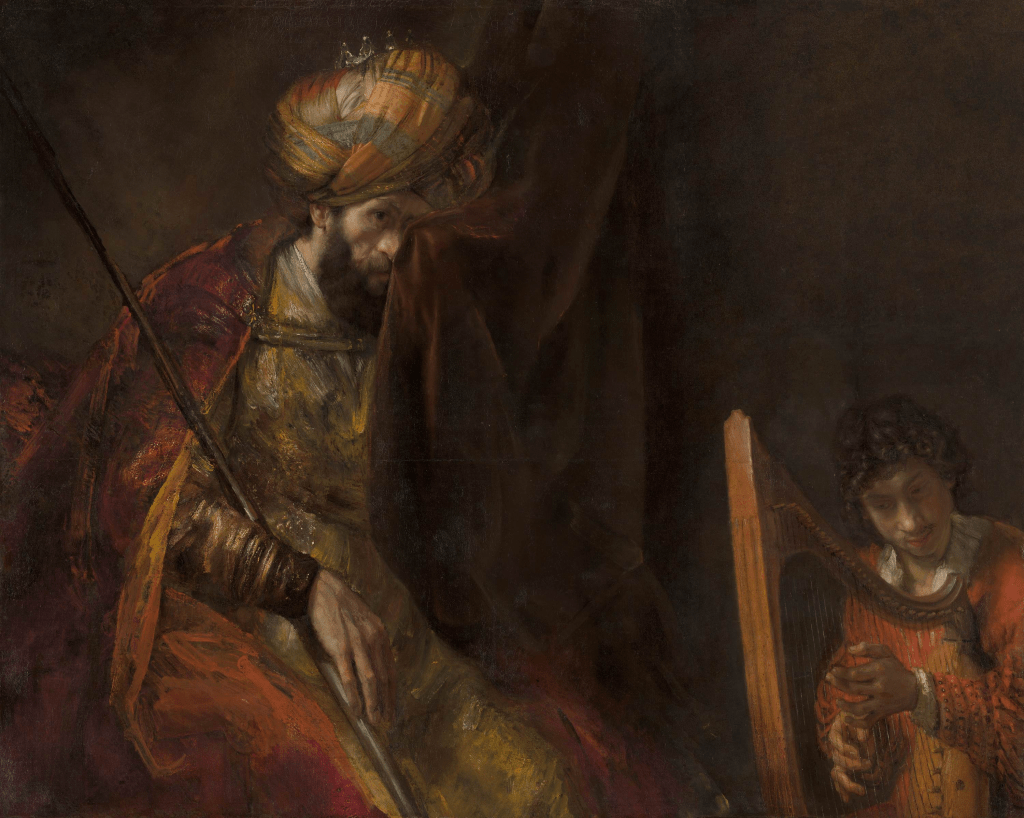
Saul and David, by Rembrandt, c.1655

Once more war broke out, and David went out and fought the Philistines. He struck them with such force that they fled before him.

But an evil spirit from the Lord came on Saul as he was sitting in his house with his spear in his hand. While David was playing the lyre, Saul tried to pin him to the wall with his spear, but David eluded him as Saul drove the spear into the wall. That night David made good his escape.

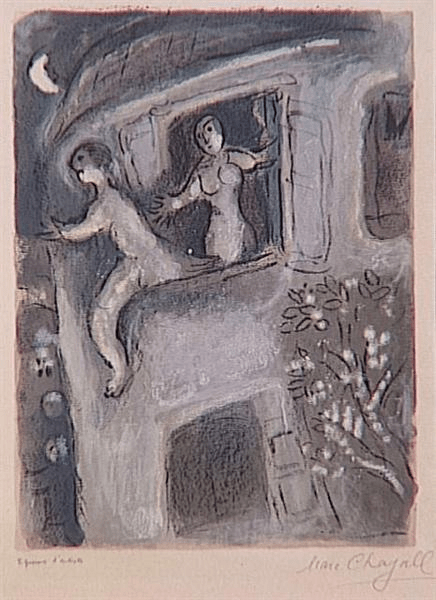
Saul sent men to David’s house to watch it and to kill him in the morning. But Michal, David’s wife, warned him, “If you don’t run for your life tonight, tomorrow you’ll be killed.” So Michal let David down through a window, and he fled and escaped. Then Michal took an idol and laid it on the bed, covering it with a garment and putting some goats’ hair at the head.

When Saul sent the men to capture David, Michal said, “He is ill.”

Then Saul sent the men back to see David and told them, “Bring him up to me in his bed so that I may kill him.” But when the men entered, there was the idol in the bed, and at the head was some goats’ hair.

Saul said to Michal, “Why did you deceive me like this and send my enemy away so that he escaped?”

Michal told him, “He said to me, ‘Let me get away. Why should I kill you?’ (New International Version)

We humans are living in a fallen world and a broken planet. Conflict and trouble is certain. It’s not a matter of if we are going to face it, but when. How will we handle conflict when it comes?

Saul’s Jealousy of David

King Saul had a growing jealousy of David. It became bad enough that Saul tried to arrange things so that David would be killed on a Philistine battlefield. But that plan completely backfired, and David became even more successful.

In Saul’s downward spiritual and emotional spiral, he brazenly created intentional conflict in order to do away with David altogether. Fortunately, Saul’s son Jonathan talked his father down peacefully. David was restored to the king’s court and out of trouble, at least for the moment.

Little did Jonathan realize how far gone his father had become. The incident of Saul telling his soldiers to kill David proved to still be an open case. It didn’t take Saul very long to renege on his promise to Jonathan, and actively went back to his old jealous ways.

David Eludes Saul’s Spear

Saul’s Attempt on David, by Gustave Doré, 1877

There was a direct relationship between David’s good spirit of integrity and success, and the wicked spirit which came upon Saul. King Saul, in his anger toward David and disobedience toward God, had clearly given ground to evil in his life.

Saul could not get a grip on his jealous feelings, and was ticked-off that David’s popularity kept growing, no matter the situation. In a fit of impulsive rage, Saul hurled his spear at David. Since David was agile, and Saul was a bad thrower, a tragic death was avoided.

At that point, David realized he needed to get out and stay away for good. David was in one of those rare situations in which a person may be so hell bent on damaging another person that drastic measures need to be taken.

Michal Helps David Escape

Most conflicts are, of course, complicated. And it’s not unusual for trouble to be a family affair. Michal was Saul’s daughter, which made David Saul’s son-in-law (and for Saul, David’s outlaw). It seems that the marriage arrangement was originally made so that Saul could keep a close eye on his rival.

Michal understood her father well enough to know that Saul meant business in handling David. So, she set up a plan for her husband’s escape, and covered for him to dear old dad.

Michal Saves David from Saul, by Marc Chagall, 1960

It appears we start to get a glimpse of insight into Michal’s character. Her possession of household gods, along with her ability to be an effective liar in order to save her own neck, ought to give us some pause. As the story of David develops in the biblical narratives, we will indeed see Michal’s true colors.

Thus far in the life of David, we see an innocent man treated unfairly and unjustly. Yet, we get no hint of bitterness or revenge from him. Instead, here is a guy who only tried to do what is best for his people Israel, and most of all, live faithfully to his God.

In contrast, Saul became increasingly frustrated and bitter, not looking to the Lord who put him on the throne. Instead, he made devious plans to destroy a man who was only trying to do him good.

Conclusion

Self-centered jealousy and bitter anger poisons a person’s spirit and turns it toward evil. If left unchecked and unchanged, it becomes gangrene of the soul. And when that happens, the only option is to cut off the affected damaged dead part. Like a withered tree or vine, it is uprooted and thrown into the fire.

Jesus said, “I am the vine; you are the branches. If you remain in me and I in you, you will bear much fruit; apart from me you can do nothing. If you do not remain in me, you are like a branch that is thrown away and withers; such branches are picked up, thrown into the fire and burned.” (John 15:5-6, NIV)

Please be encouraged to know that if you are in the middle of a conflict you didn’t cause with a person who seems not to care, it doesn’t have to result in you becoming despondent, damaged, or destroyed.

No matter the circumstance, the consistent path of the faithful person is humility, gentleness, righteousness, mercy, purity, and peace. Situations will change, and people may be fickle; but your consistent daily walk of faith need not deviate at all.

Because God is with us, and the Lord loves us, we can handle and endure anything from anyone.

Listen to my prayer.
    I am so weak.
Save me from those who are chasing me.
    They are stronger than I am.
Help me escape this trap,
    so that I can praise your name.
Then good people will celebrate with me,
    because you took care of me. Amen. (Psalm 142:6-7, ERV)

How To Respond In a Conflict (1 Samuel 19:1-7)

David and Jonathan, by He Qi

Saul told his son Jonathan and all the attendants to kill David. But Jonathan had taken a great liking to David and warned him, “My father Saul is looking for a chance to kill you. Be on your guard tomorrow morning; go into hiding and stay there. I will go out and stand with my father in the field where you are. I’ll speak to him about you and will tell you what I find out.”

Jonathan spoke well of David to Saul his father and said to him, “Let not the king do wrong to his servant David; he has not wronged you, and what he has done has benefited you greatly. He took his life in his hands when he killed the Philistine. The Lord won a great victory for all Israel, and you saw it and were glad. Why then would you do wrong to an innocent man like David by killing him for no reason?”

Saul listened to Jonathan and took this oath: “As surely as the Lord lives, David will not be put to death.”

So Jonathan called David and told him the whole conversation. He brought him to Saul, and David was with Saul as before. (New International Version)

King Saul was a two-faced, fickle, and disintegrated soul who continually had divided loyalties between Israel and himself. Unfortunately, himself usually won out.

In today’s story, Saul was not so far gone into his self-centeredness that he couldn’t hear the voice of reason. Yet, that voice never lasted too long for him.

As for David, he was the runt of the family, the youngest of eight sons. The runt is always given the grunt work in the family. So, David spent a lot of time out with the sheep by himself, tending to their needs, and protecting them from predators. He eventually found himself in the court of King Saul and distinguished himself as an ideal soldier and leader in the Philistine wars with Israel.

Saul and David, by Rembrandt (1606-1669)

But all of David’s success only increased Saul’s jealousy. On several occasions, the paranoid Saul tried to kill David – who was faithful and did not deserve such treatment from the king.

Saul eventually abandoned all pretense and ordered his son Jonathan and the soldiers to put David to death. He went public with his attacks against David. Saul felt driven to desperate measures, feeling that his authority, popularity, and position were threatened.

This situation, of course, created a conflict of loyalties for Jonathan who wanted to honor his father and king, but who also loved David as himself (1 Samuel 18:1-3). Jonathan was that voice of reason, appealing to his father’s rational self, urging him not to go down such a dark path in killing a righteous person.

Jonathan let Saul know that it was in his best interest to let David live. He reminded Saul that David was the Lord’s instrument who had defeated Israel’s enemies and that Saul had rejoiced in his success. What’s more, Jonathan appealed to justice; David’s death would be totally unwarranted.

Saul would prove to be a guy who continually reneged on his promises with impunity. He was Exhibit A of the person with a divided mind who swayed back and forth in his decisions.

King Saul could not accept the fact that God was with David, and not with him. Saul’s initial jealousy came out in subtle plans to diminish David so that he himself would remain the popular one with power and control.

But, as biblical readers and listeners, we know where this sort of attitude is headed. God is concerned with a humble attitude and obedient actions – which David had, and Saul increasingly didn’t.

So, Saul began openly announcing plans for David’s demise. Although he would not be successful, trying again and again to do so, David’s life was turned upside-down.

David did nothing wrong. In fact, he did everything right and actually helped soothe Saul with harp music when he was not doing well. Even though David is exactly who the nation of Israel needed, and precisely the person Saul needed, he was the target of assassination.

Just because we may go about our work, and the way we live our life, with unassuming humility and quiet obedience, does not mean everything will be unicorns and butterflies. There always seems to be a jealous person lurking in the shadows planning for our downfall.

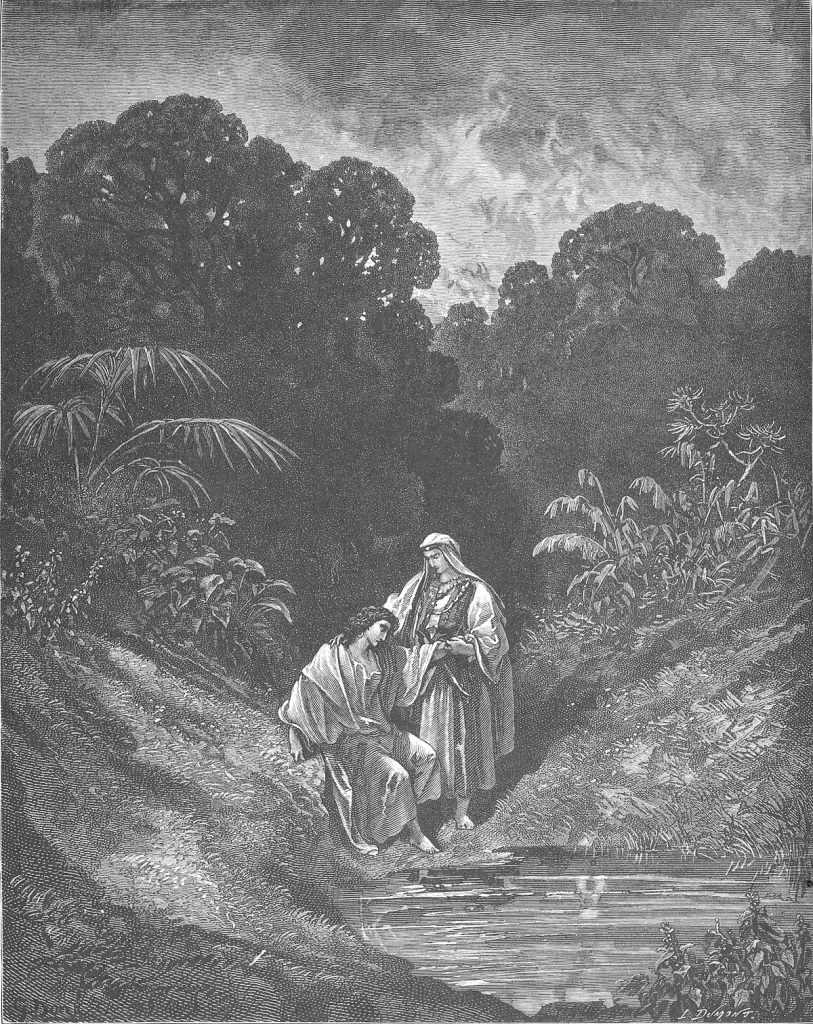
David and Jonathan, by Gustave Doré (1832-1883)

In such times, we are in solidarity with our Lord. And it is of great practical help whenever we have a person like Jonathan in our life who is willing to be a peacemaker.

Jonathan willingly stepped into the situation between his father Saul and his best friend David. Despite the family pressure, Jonathan urged Saul not to sin against an innocent man of integrity. David had risked his life for Israel and Saul’s kingdom.

Saul was persuaded, at least temporarily, to lift the death sentence and restore David to his rightful place in the court – all because of Jonathan’s efforts.

Notice that Jonathan did not exacerbate the situation by taking sides or using harsh language. In truth, we all need a friend who is willing to help us in difficult times, with careful and deft words which brings calm instead of chaos.

A gentle answer turns away wrath, but a harsh word stirs up anger.

Proverbs 15:1, NIV

Conflict only escalates out of control without a non-anxious presence to diffuse things.

For David’s part, he wisely didn’t try to vindicate himself by responding to Saul’s anger with more anger. Instead, he trusted God and let the person who could make the difference, Jonathan, do so.

It is important whenever someone comes to us in order to vent about another person, or makes irrational pronouncements about what they’re going to do to them, to help the situation and not add fuel to the fire.

If we take some relational cues from Jonathan, we will seek to be calm and respond with sensitivity and gentleness to the nonsensical wrath of the person speaking offensive words.

What’s more, when being the target of someone’s verbal assault, we must be careful not to fight fire with fire. Let’s remember that our humble and gentle words put us in good company with the righteous throughout history who have responded with faith and patience to trouble.

O God, the source of all spiritual and emotional health: So fill my heart with faith in your love, that with calm expectancy I may make room for your power to possess me, and gracefully accept your presence to make all the difference in my hardship. Amen.

Be Helpful, Not Harmful (Psalm 119:113-128)

I hate two-faced people,
but I love your teachings.
You are my hiding place and my shield.
My hope is based on your word.
Get away from me, you evildoers,
so that I can obey the commandments of my God.
Help me God, as you promised, so that I may live.
Do not turn my hope into disappointment.
Hold me, and I will be safe,
and I will always respect your laws.
You reject all who wander away from your laws,
because their lies mislead them.
You get rid of all wicked people on earth as if they were rubbish.
That is why I love your written instructions.
My body shudders in fear of you,
and I am afraid of your regulations.

I have done what is fair and right.
Do not leave me at the mercy of those who oppress me.
Guarantee my well-being.
Do not let arrogant people oppress me.
My eyes are strained from looking for you to save me
and from looking for the fulfillment of your righteous promise.
Treat me with kindness,
and teach me your laws.
I am your servant.
Help me understand
so that I may come to know your written instructions.
It is time for you to act, O Lord.
Even though people have abolished your teachings,
I love your commandments more than gold, more than pure gold.
I follow the straight paths of your guiding principles.
I hate every pathway that leads to lying. (God’s Word Translation)

I don’t know about you, but disingenuous people drive me nuts. This is the type of person who is nice as pie to your face, but then walks away and talks smack about you to another. They seem to always have an agenda in order to get ahead, gain power, and be in the know, so that they can have leverage against you.

There are other people who try to avoid doing wrong and always try to do right. There are yet others who either bulldoze or sleepwalk through life, doing what they will, with impunity, unaware of how they’re damaging people’s lives. And then there are those who try to steer clear of what they consider the biggie sins, while having no problem indulging in so-called little sins. 

Selfishness, self-centeredness, and unawareness of the self’s impact on this world will create all sorts of problems for others. Indeed, sin is messy business. 

No matter the form or the attempt at dealing with one’s selfish proclivities, the bottom line is that we all engage in such behavior because it benefits us, that is, we like doing it. We might not always like the consequences and the fallout of self-centered living, but it sure feels good while it lasts.

Humanity needs a complete reorientation of the heart. Rather than hating every way that doesn’t benefit me, we must learn to hate every way which is contrary to God’s good commands.

The psalmist proclaims and affirms that all God’s precepts are right. It’s important to hate every false path which deviates from the true self and the common good of all persons. 

If we indulge in self-centered ways because we like them, the road to thinking of others and their needs is learning to hate my false self and false belief systems – to loathe them so much that it’s like a nasty stench in our nostrils. 

Hating sin comes from the acquired taste of loving God’s commandments. When we come around to cherish and desire God’s Word, then selfish sinful desires gradually become so odious to us that we want nothing to do with them.

The reason the psalmist could proclaim such an extended love song to the commands of God, is that he tried them, ate them, and imbibed them. And how good they were! It caused him to forsake every selfish way in trying to achieve human enjoyment. 

I encourage people to have a solid plan for reading (or listening to) Scripture every day – because it really has the power to reorient us from being selfish jerks who harm others to becoming unselfish thinkers who help others.

Scripture changes our taste buds. Sustained, consistent, daily eating of the psalms will teach us to want God and God’s ways – while forsaking the dark path of insolence and oppression in order to satiate our own selfish wants.

The psalmist committed himself to avoiding worthless selfish situations, as well as steering clear of harmful people with the propensity to doing wrong. They are fickle, double-minded, two-faced people, divided in their loyalties.

On one side of their mouth, they talk a good line about faith; and then talk out the other side of their mouth, spewing a bunch of worthless gobbledygook which, at the least, adds no value to anything, and, at worst, wrecks good plans and harms others.

If there are people in authority over us who don’t give a wit about our most cherished values, we will likely find ourselves tasked with doing things which rub against our understanding of Holy Scripture. In this state of moral distress, we are pushed, pulled, and tested in our single-minded devotion by the double-minded selfish person to do what we are uncomfortable with.

In the stress and crucible of trouble, we need the courage to speak up, despite the fear of repercussions. And that strength is only possible if we have a resilient spirit with the capacity to sustain our personal integrity in the face of distress. That is, we need God and God’s Holy Word.

Scripture and fellow believers provide support; we need to care for one another as a community of redeemed persons who seek to live into the words of ways of almighty God.

It can be tricky business, wisely trying to discern between what we to accept and what to pushback against. Yet, with God, God’s Word, and God’s people, we possess all the resources required in living the spiritual life and navigating the selfish world we inhabit.

Almighty God, I pray that you will deal with me according to your steadfast love and teach me your statutes. I am your servant; give me understanding so that I might know and live by your commands and forsake the evil of the world. Amen.

The Lord’s Will Be Done (Acts 21:1-16)

The Prophecy of Agabus, by Louis Chéron, 1687

After we had torn ourselves away from them, we put out to sea and sailed straight to Kos. The next day we went to Rhodes and from there to Patara. We found a ship crossing over to Phoenicia, went on board and set sail. After sighting Cyprus and passing to the south of it, we sailed on to Syria. We landed at Tyre, where our ship was to unload its cargo. 

We sought out the disciples there and stayed with them seven days. Through the Spirit they urged Paul not to go on to Jerusalem. When it was time to leave, we left and continued on our way. All of them, including wives and children, accompanied us out of the city, and there on the beach we knelt to pray. After saying goodbye to each other, we went aboard the ship, and they returned home.

We continued our voyage from Tyre and landed at Ptolemais, where we greeted the brothers and sisters and stayed with them for a day. Leaving the next day, we reached Caesarea and stayed at the house of Philip the evangelist, one of the Seven. He had four unmarried daughters who prophesied.

After we had been there a number of days, a prophet named Agabus came down from Judea. Coming over to us, he took Paul’s belt, tied his own hands and feet with it and said, “The Holy Spirit says, ‘In this way the Jewish leaders in Jerusalem will bind the owner of this belt and will hand him over to the Gentiles.’”

When we heard this, we and the people there pleaded with Paul not to go up to Jerusalem. Then Paul answered, “Why are you weeping and breaking my heart? I am ready not only to be bound, but also to die in Jerusalem for the name of the Lord Jesus.” When he would not be dissuaded, we gave up and said, “The Lord’s will be done.”

After this, we started on our way up to Jerusalem. Some of the disciples from Caesarea accompanied us and brought us to the home of Mnason, where we were to stay. He was a man from Cyprus and one of the early disciples. (New International Version)

The Apostle Paul was on his farewell tour, visiting the believers in churches he planted during his missionary journeys.

The visit to Ephesus was especially heart wrenching; everyone knew this was the last time they would see each other. Paul had spent considerable time in Ephesus establishing the church, and went through a lot with the people. They cared for one another deeply, which is seen in their praying meeting on the beach.

Paul was determined to get back to Jerusalem. Everyone knew that Paul would likely be imprisoned or killed or both by returning there. After the tears were shed, Paul and his coterie of people got on a ship and sailed toward Judea.

Once in Judea, Paul and his companions encountered some characters in the city of Caesarea, including four sisters who had the gift of prophecy, and a man named Agabus who was also a prophet.

The Apostle had been warned several times about going back to Jerusalem. Agabus joined the voices by giving a word by means of the Holy Spirit that Paul would meet persecution if he continued on his journey.

Agabus did some rather dramatic Old Testament prophetic type stuff with Paul. Although others interpreted the message of Agabus as a warning to not go into the lion’s den of inevitable persecution, the prophecy itself is only descriptive of what will happen, and not prescriptive of what should be done.

It’s important to distinguish what the Holy Spirit reveals and commands. We ought only to smush the revelation and the commands together when the Spirit does that. In the case of Agabus and Paul, it was only a revelation. And Paul picked up on that immediately. He knew what he was in for, and was okay with it.

The bottom line for the Apostle Paul was that he felt compelled to head for Jerusalem and face whatever he needed to face there. He was determined to personally bring both spiritual encouragement and economic relief for the people in Judea.

It seems that nobody wanted to see Paul get hurt, arrested, killed, or all three; and that’s more than understandable. Yet, the Apostle himself was convinced of what he should do; and no amount of trying to persuade him otherwise was going to work. So, Paul continued his journey.

The believers came around to saying, “The Lord’s will be done.” And that’s really what we all eventually must come to accept – that participation with what God is doing in the world, in a place, and with us personally, is the thing that counts.

Even Jesus needed to get to that point, so maybe we ought to cut others (and ourselves) some slack when it comes to accepting the situation we are called to be in.

 “Father, if you are willing, take this cup from me; yet not my will, but yours be done.”

Jesus (Luke 22:42, NIV)

No one, especially me, is saying that it’s easy to face adversity and hardship for a certain time and place in your life (or the life of someone you love). In fact, much like Jesus in the garden, it is often agonizing. But moving ahead and doing it we shall, if the Lord’s will is plain to us.

One of the reasons why Paul could be so resolute, and do what he did, was because of the support he continually had around him with his traveling companions.

I often ask people if they are part of a church. Some folks take this as a rebuke and instantly feel guilty that they haven’t attended a worship service for a long while. But the reason I ask is that I’m wondering about their sources of support.

Whenever people are going through hard times, its very helpful to have a faith community who they can rely upon and lean into. Since Paul was rarely alone, he had a consistent supportive presence of people who knew him well, and the circumstance he was enduring.

And I’m hoping that same thing for you – to have a good support system in place for help in following through with the will of God, as you understand it. Because if you are convinced of what you must do, and have people to support you in doing it, no matter what happens, then you can endure a lot, as well as learn a lot.

Lord God almighty, help me grow in discernment and making decisions. Jesus, you know the intensity of our struggle when God’s will conflicts with our desires. Equip and enable me to do your revealed will with a glad and sincere heart. May your will be done, in the power of the Holy Spirit. Amen.