Two Are Better Than One (Ecclesiastes 4:9-16)

Together, by Tamara McCarty

Two are better than one,
    because they have a good return for their labor:
If either of them falls down,
    one can help the other up.
But pity anyone who falls
    and has no one to help them up.
Also, if two lie down together, they will keep warm.
    But how can one keep warm alone?
Though one may be overpowered,
    two can defend themselves.
A cord of three strands is not quickly broken.

Better a poor but wise youth than an old but foolish king who no longer knows how to heed a warning. The youth may have come from prison to the kingship, or he may have been born in poverty within his kingdom. I saw that all who lived and walked under the sun followed the youth, the king’s successor. There was no end to all the people who were before them. But those who came later were not pleased with the successor. This too is meaningless, a chasing after the wind. (New International Version)

Our very brains and bodies were created and hard-wired for relational connection and support. To have a friend is more than a nice thing; it is vital for our survival and wellness.

If disconnected and absent from friends for too long, we become like Tom Hanks in the movie “Castaway.” We end up talking to volleyballs and personifying them as our best friend.

The neurophysiological mechanisms of the human body are designed for human social interaction. For example, the parasympathetic system of the vagus nerve connects the brain’s emotional and cognitive areas to intestinal functions. This is why whenever we are lonely or have relational problems, we may feel sick to our stomach, or have trouble eating anything, or overeat to deal with the emotions.

First and foremost, friends are people who offer each other complete permission to be themselves; they are permission givers. When we are socially and relationally well, our body’s endocrine system can relax and do it’s necessary job of regulation. That’s because we are able to relax completely in the presence of another person who we know will accept us as we are.

Real friendship always requires a deep surrender to the mixing of souls that a friendship brings into being. To have such a friend is a blessing and a rare gift.

Because of friendship’s special and sacred nature, it is necessary to unite with someone who shares your basic values. This means that we need not turn someone away because they don’t match our perfect picture of what a beloved friend is, nor must we settle for a lesser relationship than we deserve.

In order to live and survive, we humans have three necessary requirements in life: food, shelter, and someone else to love and be loved by. If we have these, then there is nothing else we really need; everything else is just filler. Yet, there’s no need for filler whenever you are already full of friendship.

There is yet another friendship which is important for humans to thrive. We are creatures, created by a relational God. Even though humanity may be estranged from divinity – whether we realize it, or not – we are all on a journey back home to a relationship with God.

We need companions through this journey of our earthly life. And the Teacher of Ecclesiastes tells us that in these friendships we find some security against thieves, accidents, and the chill of the night. Indeed, a friend and companion makes life more safe, satisfying, and comfortable.

Which is why, again, our choice of friends and companions along life’s way are important. It is of vital significance whether those closest to us are wise or foolish.

A wise companion helps us stay on task, and encourages us to persevere in doing right. Such a friend assists us in living a good life full of justice and attention to the common good of all persons.

But a foolish companion drags us down into laziness and gossip; they only help us toward selfish interests that help no one. Might as well eat and drink all you want today, for tomorrow we die, they say.

That sort of counsel will not be found on any successful life plan.

We need solid friends who give us sound advice and counsel. And we also need a friend who is willing to accept our own sage insights.

Those who refuse to take advice, and those who listen to foolish counsel, are headed for disaster.

A fickle crowd who is easily swayed, and equally difficult to please, is a group of people who may know each other, but nobody is a friend. That’s because it takes true companions to get things done and work effectively together toward worthy goals.

Businesses everywhere could use some time reflecting on such relational realities as that.

By Bible Art

And a crowd who chases after the latest fad which comes along is a group of people who have not yet understood how much they need the acknowledgement and leading of their Creator.

Apart from the pursuit of both divine and human friendship, people feel as if they need those fillers in their life. So, they end up having absurd strivings to accumulate wealth, money, stuff, prestige, position, and power. They buy into the notion that they can be radically independent, and use others to get what they want.

Good relationships, however, which seek the betterment of the other and give themselves to something higher and greater than themselves, will find all the riches in life they need.

Neither poverty nor riches has anything to do with life’s ultimate satisfaction and fulfillment. Whether one realizes the “American dream” or not, makes no difference whatsoever.

Accomplishing personal goals means very little, if you have no one to share it with, and no one who says “thank you” for what you’ve done (because you didn’t do anything for them, but for yourself).

In the end, all is meaningless, because everything is temporary… that is, except relationships.

Friendships and true companions are permanent. Relationships are the only thing we take with us. The wise person knows that the world truly spins on the axis of Love.

Loving Creator, God and Father of all, You are the provider of all good things. I pray You to  bring good friendships into the life of all your people. Open my eyes to see people who need me to be a friend for them. Help me to be the friend I desire and long to have; and to serve my fellow humanity. Give us all a friend who will exhort us when needed, be gracious in our weakness, forgive our offenses, and bear our burdens. Amen.

Work, Love, and Dignity (Proverbs 27:1-27)

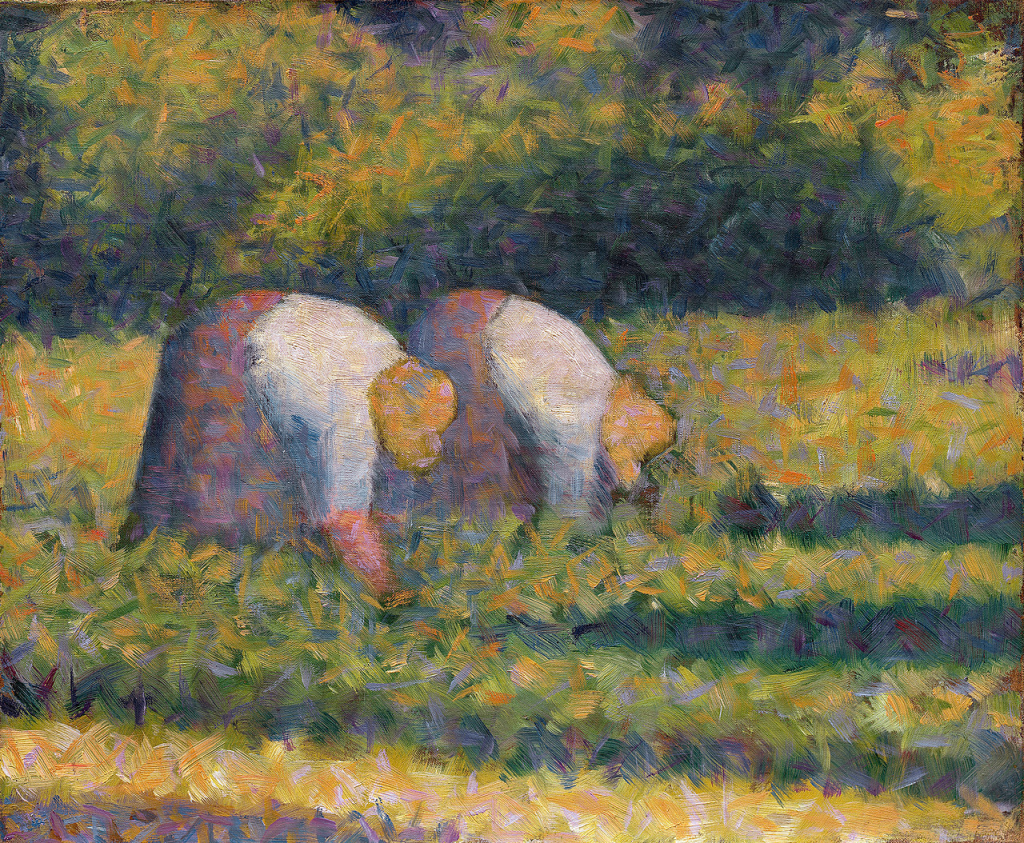
Farm Women at Work, by Georges Seurat (1859-1891)

Do not boast about tomorrow,
    for you do not know what a day may bring.

Let someone else praise you, and not your own mouth;
    an outsider, and not your own lips.

Stone is heavy and sand a burden,
    but a fool’s provocation is heavier than both.

Anger is cruel and fury overwhelming,
    but who can stand before jealousy?

Better is open rebuke
    than hidden love.

Wounds from a friend can be trusted,
    but an enemy multiplies kisses.

One who is full loathes honey from the comb,
    but to the hungry even what is bitter tastes sweet.

Like a bird that flees its nest
    is anyone who flees from home.

Perfume and incense bring joy to the heart,
    and the pleasantness of a friend
    springs from their heartfelt advice.

Do not forsake your friend or a friend of your family,
    and do not go to your relative’s house when disaster strikes you—
    better a neighbor nearby than a relative far away.

Be wise, my son, and bring joy to my heart;
    then I can answer anyone who treats me with contempt.

The prudent see danger and take refuge,
    but the simple keep going and pay the penalty.

Take the garment of one who puts up security for a stranger;
    hold it in pledge if it is done for an outsider.

If anyone loudly blesses their neighbor early in the morning,
    it will be taken as a curse.

A quarrelsome wife is like the dripping
    of a leaky roof in a rainstorm;
restraining her is like restraining the wind
    or grasping oil with the hand.

As iron sharpens iron,
    so one person sharpens another.

The one who guards a fig tree will eat its fruit,
    and whoever protects their master will be honored.

As water reflects the face,
    so one’s life reflects the heart.

Death and Destruction are never satisfied,
    and neither are human eyes.

The crucible for silver and the furnace for gold,
    but people are tested by their praise.

Though you grind a fool in a mortar,
    grinding them like grain with a pestle,
    you will not remove their folly from them.

Be sure you know the condition of your flocks,
    give careful attention to your herds;
for riches do not endure forever,
    and a crown is not secure for all generations.
When the hay is removed and new growth appears
    and the grass from the hills is gathered in,
the lambs will provide you with clothing,
    and the goats with the price of a field.
You will have plenty of goats’ milk to feed your family
    and to nourish your female servants. (New International Version)

Hard Work

The Lord God took the man and put him in the Garden of Eden to work it and take care of it. (Genesis 2:15, NIV)

Work itself is not a result of humanity’s fall. Before Adam and Eve disobeyed God, they were tasked to work and take care of the Garden of Eden. Therefore, work is inherently good. Yet, hard labor is certainly a result of the fall.

What we humans ought to have done through our created nature, now because of the fall into sin and disobedience, we have to work with focused deliberate intention. And even then, we often don’t perform our work as we would like.

“Cursed is the ground because of you;
    through painful toil you will eat food from it
    all the days of your life.
It will produce thorns and thistles for you,
    and you will eat the plants of the field.
By the sweat of your brow
    you will eat your food
until you return to the ground,
    since from it you were taken;
for dust you are
    and to dust you will return.” (Genesis 3:17-19, NIV)

This is why wise persons throughout the ages have given priority to hard work, and branded laziness as detrimental to our human welfare.

Much of our labor is menial and mundane, no matter what the work is. Yet, through vision and persistence, the fruit of our labor eventually breaks through. It is important for us to keep our nose to the grindstone, namely, because this is what it takes to produce, and to keep ourselves out of trouble!

Like a shepherd who cares for the sheep, we are to be present, pay attention, do whatever it takes to help the sheep flourish, and hang in there through the thick and thin of the job.

Diligence and consistency are vital to our hard work. The temptation of get-rich-quick schemes and other supposedly easy paths to success and wealth sometimes rear their heads to lure us away from our daily chores.

Well-kept sheep will produce wool and milk for several years. Riches and achievements and accolades, however, do not necessarily last for long.

Affectionate Love

Hard work and relationships nurtured by affectionate love are meant to go hand-in-hand. In other words, ideally, the duty and diligence of our daily tasks, and the consistency of establishing relational well-being with others, is well-balanced and works seamlessly together.

Loving another entails both encouragement and correction, heartfelt words as well as open words of rebuke. That is, we continually think of what another needs, and what is best for the community as a whole.

Our love must entail what is good for the one being loved, for the one doing the loving, and for the whole community to which both belong. Love leaves angry speeches and jealous motives behind and doesn’t utilize them, because they are tools of hate and hurt.

Gracious Dignity

Everyone is responsible to extend basic human kindness to one another, without exception. We are to listen to and honor our parents and elders; practice self-control and patience with all; and use gentle words in every communication.

Poise under pressure, and motivation to do what is right and good helps to lift the worth and dignity of others. We extend this to people for no other reason than that it is another human being who is in front of us; this is a person in God’s image.

God created mankind in his own image,
    in the image of God he created them;
    male and female he created them. (Genesis 1:27, NIV)

All persons have inherent worth as image-bearers of God. The wise person amongst us knows this and continually applies it in all their words and actions toward others.

Wise people also understand the value of hard work, and the intrinsic worth of work itself. Furthermore, they discern that love is to be the motivation and animating principle in doing work and working with others.

The bottom line of all the proverbial wise saying in today’s lesson is that we are to help and encourage others through both our words and our working actions. Our individual lives are to benefit the whole community, so that we are a blessing to others, as well as to receive blessings from those around us.

In engaging a healthy rhythm of giving and receiving, we reverse the curse, and enable the world to return to Eden.

Almighty God, we pray that You will bless all of our various labor and work in the world. Help us to pray fervently, diligently work hard, and give liberally. In all that we do, enable us to do it with all the love You provide. Amen.

Nothing Makes Sense (Ecclesiastes 1:1-18)

Statue of “The Thinker,” by Auguste Rodin, 1880. Photo by Robert Reynolds.

When the son of David was king in Jerusalem, he was known to be very wise, and he said:

Nothing makes sense!
Everything is nonsense.
    I have seen it all—
    nothing makes sense!
What is there to show
for all of our hard work
    here on this earth?
People come, and people go,
but still the world
    never changes.

The sun comes up,
    the sun goes down;
it hurries right back
    to where it started from.
The wind blows south,
    the wind blows north;
round and round it blows
    over and over again.
All rivers empty into the sea,
    but it never spills over;
one by one the rivers return
    to their source.

All of life is far more boring
    than words could ever say.
Our eyes and our ears
are never satisfied
    with what we see and hear.
Everything that happens
    has happened before;
nothing is new,
    nothing under the sun.
Someone might say,
    “Here is something new!”
But it happened before,
    long before we were born.
No one who lived in the past
    is remembered anymore,
and everyone yet to be born
    will be forgotten too.

I said these things when I lived in Jerusalem as king of Israel. With all my wisdom I tried to understand everything that happens here on earth. And God has made this so hard for us humans to do. I have seen it all, and everything is just as senseless as chasing the wind.

If something is crooked,
    it can’t be made straight;
if something isn’t there,
    it can’t be counted.

I said to myself, “You are by far the wisest person who has ever lived in Jerusalem. You are eager to learn, and you have learned a lot.” Then I decided to find out all I could about wisdom and foolishness. Soon I realized that this too was as senseless as chasing the wind.

The more you know,
    the more you hurt;
the more you understand,
    the more you suffer. (Contemporary English Version)

There’s an awful lot of nonsense in this old world. Arguably, the wisest person who ever lived, King Solomon, said that everything is nonsense, and all things are meaningless.

That’s probably why the Book of Ecclesiastes isn’t at the top of most people’s reading list. Admittedly, in many ways, it’s a depressing read.

Yet, maybe we are being led to consider that it really isn’t our task or purpose to understand everything in this world. After all, if a wise guy like Solomon didn’t make heads nor tails of it all, why in tarnation would you or I try to do so?

This doesn’t mean we don’t understand anything; it just means that we don’t have the ultimate answers on the universe’s workings. And if we try to have perfect knowledge of all things, it will be a fool’s errand. That’s because only God has ultimate understanding and perfect knowledge of everything and everyone.

So then, what do we do? Glad you asked. We accept our limitations, and thereby, it is likely we will gain more understanding than any other way we try.

Meister Eckhart, a medieval Catholic monk, had some sage observations in this short poem:

What is the prayer

of a heart loosed

from all the things

that crowd our lives

and worry our minds

from day to day?

it is coming to that

place within us where

not knowing is the

mark of faith,

not wanting

the work of hope,

and not demanding

the gift of love.

Meister Eckhart talked of acceptance, and letting go of expectations. Learning to allow things to go as they will go, to be okay with not always having to have answers for everything, and refusing to control people and outcomes, is not only the path to acceptance, but is also the way of peace and less anxiety.

Likely, the best that we can do every day is to show up, pay attention, speak the truth in love, and don’t be married to the consequences.

If we can accept our limitations and weaknesses, and embrace the mysteries of life, then a whole world of discernment and wisdom can open to us within the narrow scope of our very mortal lives.

Indeed, we can find a sense of satisfaction and happiness in who we are, and what our place is in this very big world. Yet, this only comes with some significant struggle. Taking the easy path only results in cheap counterfeit contentment.

We will need to become comfortable with mystery and paradox, the knowledge that comes with not knowing, and upside-down theology. These are our keys to the secrets of life.

We must rid ourselves of the idea that Scripture is merely a life map that shows how and where to live. Holy Scripture may be a map, yet, it will point us in directions we may not want to go; and may even tell us to be in two places at once.

To try and make the Bible neat and tidy, with clear answers to modern day questions, is probably why such persons avoid the Book of Ecclesiastes as if it were the plague.

In reality, Ecclesiastes is a book that stands the orderly nature of life on its end. It is the scriptural place where playing by the rules and believing the right things won’t give you the good life you’re searching for.

Eventually, everyone encounters a dark night of the soul in which the death of a loved one, a failed relationship, or the loss of health turns our neatly ordered world upside-down to the point where we don’t recognize who we are, or what the world really is anymore.

These are times when our platitudes of simple faith are impotent to help us. Trust and belief are still important and vital, but they are no longer as understandable and intelligible as they once were.

It is imperative in these times that we doubt and question things; and even question God. A genuine robust faith is one that has been gained by plodding through the muck of anger, and even depression.

Authentic belief is neither cheap nor easy. It engages more than a few mental thoughts; it also goes to the heart and the gut, often with heart-rending emotions and gut-wrenching insights.

The Book of Ecclesiastes is a book for all of us. But it must not be read lightly nor flippantly. It’s contents need to be grappled with. Simply reading the last page of the book and making a faith declaration from that place will not only get you nowhere, it is also potentially damaging.

Only engage this material if you are brave enough, have some chutzpah within you, and are willing to reconsider and perhaps let go of all previous settled ideas about how the world is, or at least, how it should work.

So, if you want some quick answers to life’s meaning and purpose, Ecclesiastes is not the place to look. There are plenty of charlatans out there who would be happy to give you such information.

But if you are searching for something real and authentic, genuine and lasting, then be prepared for a tough, yet fruitful, slog through the “meaningless” meanderings of Ecclesiastes.

Only the courageous and the vulnerable should enter.

O God, I am very sorry that I have sinned against you and for all the wrongs I have done and the good I have not done. Forgive me, and grant me strength and wisdom to amend my life.

I offer you praise and thanksgiving, for creation and all the blessings of this life, for redemption, faith, and love; and for the means of grace and the hope of glory. Amen.

The Ways of Wisdom (Proverbs 30:18-33)

There are four things that are too mysterious for me to understand:

an eagle flying in the sky,
a snake moving on a rock,
a ship finding its way over the sea,
and a man and a woman falling in love.

This is how an unfaithful wife acts: she commits adultery, takes a bath, and says, “But I haven’t done anything wrong!”

There are four things that the earth itself cannot tolerate:

a slave who becomes a king,
a fool who has all he wants to eat,
a hateful woman who gets married,
and a servant woman who takes the place of her mistress.

 There are four animals in the world that are small, but very, very clever:

Ants: they are weak, but they store up their food in the summer.
Rock badgers: they are not strong either, but they make their homes among the rocks.
Locusts: they have no king, but they move in formation.
Lizards: you can hold one in your hand, but you can find them in palaces.

There are four things that are impressive to watch as they walk:

lions, strongest of all animals and afraid of none;
goats, strutting roosters,
and kings in front of their people.

If you have been foolish enough to be arrogant and plan evil, stop and think! If you churn milk, you get butter. If you hit someone’s nose, it bleeds. If you stir up anger, you get into trouble. (Good News Translation)

If there is an overall theme in the wise sayings from this chapter in the Book of Proverbs, it is that we ought to renounce arrogant greed; while at the same time, we should uphold and embrace a humble life of contentment.

The four lists of wisdom address four observations of creaturely ways on this earth: mysterious ways, antisocial ways, instinctive ways, and impressive ways. We are meant to observe that each of these four numbered lists contain wisdom that is available to all of us, that is, if we will but apply the observational understanding to our own lived situations.

Mysterious Ways

The first list observes four invisible ways; the way of the eagle, snake, ship, and man, all leave no trace of where they have been and what they are up to. Thus, their ways are mysterious, causing us to wonder what is really going on with them.

Why is the eagle flying, the snake moving over the rock, the ship navigating the water, and the man interacting with the woman?

We are to apply wisdom to our circumstances, and discern that a single act of one being is, in reality, up for interpretation. We simply do not know why each is doing what they’re doing.

As wise persons, we understand that intentions and motivations vary from person to person, and from one observer to another.

The eagle may be enjoying the spread of his wings and the feel of the wind; or he might be the predator surveying the land to attack an unsuspecting fish or squirrel.

The snake may be seeking to warm himself in the sun, or he could be slithering with malevolent intent.

The ship may be hauling needed goods to bring into port; or it might be moving to pirate others and steal.

And the man may be intending to love a fair maiden; or he might be attempting to seduce her for his own advantage.

The point is that we must be wise and discerning, not always having a singular interpretation or belief about what we are seeing and observing. What at first glance may appear innocuous, may in fact come from a place in the heart of covetous greed, and vice versa.

Antisocial Ways

The second list, dealing with general societal roles, cites four instances of role reversal which turns the social order into antisocial ways that cause trouble in society.

A slave who becomes king may believe that he knows better than the ruler. He probably talked about how he could do a better job. Yet, when given such a responsible position, such a person is way out of their expertise and depth. Statecraft is a real thing; and if one hasn’t been duly trained in it, and had some experience in it, things will go south quickly.

A fool who has all he wants to eat is like the person without any self-control. He goes out to eat at an all-you-can-eat buffet; and it will not end well, especially if it’s done a regular basis.

A hateful woman who gets married is a train wreck waiting to happen. I’m not sure I need to comment on this, because likely you are already covering your eyes, imagining what will happen in such a relationship.

And a servant woman who takes the place of her mistress has perhaps had a fantasy about how easy it is to be in charge and simply tell others what to do. Little does she know how stressful it truly is to be in charge and be the administrator of an entire household. Like the slave becoming a king, she will soon learn that the role she coveted is not all it’s cracked up to be.

All four of these persons do not (yet) have the wisdom to fulfill a role; they need training, experience, and a proper character to do the job. Their limited perspectives, and their foolish character, will lead to disaster.

Instinctive Ways

The third list, dealing with natural instincts, cites four creatures who model survival because of their instincts and wisdom, not their strength.

An ant may be small, and not carry near as much as a bigger creature, yet they have sense enough to diligently work and have everything they need when it is needed.

Rock badgers compensate for any lack of strength by making their home a fortress where a much stronger creature cannot penetrate. They have sense enough to know how to live in safety.

Locusts are many. Even though they have no leader, and are small creatures, they know enough to move together and work together in order to accomplish thriving and flourishing on this earth.

And even though lizards are common, and not all that difficult to catch and possess, nevertheless they can be found in high places. They are taken care of by bigger and greater creatures than themselves.

When any creature lives into their true self, and doesn’t try to be something they are not, their needs are cared for. Humanity could take a big lesson from such small creatures about how to get along in life.

Impressive Ways

The fourth list, dealing with displays of majesty, cites four creatures who are stately in their appearance because of their position, design, and context.

Lions are majestic creatures. Their very appearance and the sound of the male’s roar elicits awe and fear in others. This is an important part of how the lion pride gets around in this world and is able to meet their own needs.

Goats and roosters strut around like the own the place. Their sense of presence and confidence is palpable. If you’re ever around them, you’ll need to match or exceed their level of acting in charge.

Which is precisely what a king does within his realm. Each of these four are an example of taking charge and acting the part that you ought to be playing.

Whereas the earlier list had examples of people who were trying to act a role they weren’t ready for, this list of examples are creatures who are living into the role they need to exhibit, no matter whether they feel brave or competent, or not.

Concluding Ways

The wise person takes the time to observe, listen, and learn from a variety of sources, including all of creation. Everything and everyone can teach us, that is, if we will but put ourselves in a position to learn from them.

The first two lists describe people who covet for more, and are discontent with their situation. The last two lists observe creatures who know their limits and weaknesses, yet nevertheless, have found resilient ways to meet their needs – ways that are consistent with who God created them to be.

So, which way will you go?

Almighty God, I humbly ask that You fill me with the Spirit of wisdom and revelation in the knowledge of You. Open the eyes of my heart to see Truth more clearly. Sharpen my spiritual discernment to distinguish good from evil, good from bad, better from best.

Help me not lean merely on my own finite understanding, but trust wholeheartedly in Your infinite wisdom given to me in creation. May divine wisdom from above flow through me each day in thought, word, and action. Amen.