A Reason To Hope (Ruth 2:15-23)

When she got up to glean, Boaz instructed his young men, “Let her glean even among the standing sheaves, and do not reproach her. You must also pull out some handfuls for her from the bundles and leave them for her to glean, and do not rebuke her.”

So she gleaned in the field until evening. Then she beat out what she had gleaned, and it was about an ephah of barley. She picked it up and came into the town, and her mother-in-law saw how much she had gleaned. Then she took out and gave her what was left over after she herself had been satisfied. 

Her mother-in-law said to her, “Where did you glean today? And where have you worked? Blessed be the man who took notice of you.”

So she told her mother-in-law with whom she had worked, saying, “The name of the man with whom I worked today is Boaz.” 

Then Naomi said to her daughter-in-law, “Blessed be he by the Lord, whose kindness has not forsaken the living or the dead!” Naomi also said to her, “The man is a relative of ours, one of our nearest kin.”

Then Ruth the Moabite said, “He even said to me, ‘Stay close by my young men until they have finished all my harvest.’ ” 

Naomi said to Ruth, her daughter-in-law, “It is better, my daughter, that you go out with his young women, otherwise someone might bother you in another field.” 

So she stayed close to the young women of Boaz, gleaning until the end of the barley and wheat harvests, and she lived with her mother-in-law. (New Revised Standard Version)

Ruth was both a widow and a foreigner from Moab. She and her mother-in-law Naomi had no land. Widowed foreign women were likely to be poor. They were vulnerable to abuse by being out in the fields during harvest time, trying to glean whatever leftovers they could find after the harvesters came through.

The covenant code of Israel prescribed laws concerning how to treat the poor. There was even instruction on what to do in just such a situation of the landowning harvester Boaz and the poor gleaner Ruth:

“When you reap your harvest in your field and forget a sheaf in the field, you shall not go back to get it; it shall be left for the alien, the orphan, and the widow, so that the Lord your God may bless you in all your undertakings. When you beat your olive trees, do not strip what is left; it shall be for the alien, the orphan, and the widow.

“When you gather the grapes of your vineyard, do not glean what is left; it shall be for the alien, the orphan, and the widow. Remember that you were a slave in the land of Egypt; therefore I am commanding you to do this. (Deuteronomy 24:19-22, NRSV)

The law stipulated a spirit of generosity toward the poor in the land. The reason for the law is that the Israelites had been slaves in Egypt, and experienced the cruelty of abusive slavedrivers. Israel was to remember this, and ensure that no foreigners would experience what they themselves had to go through for 400 hundred years in Egypt.

Ruth gleaning, by James Tissot, c.1898

Fortunately for Ruth, Boaz was an observant Jew, concerned for the intent and spirit of God’s law. He held to the covenant law both legally and spiritually.

Boaz remembered God’s grace to Israel. He blessed Ruth, and commended her for placing herself in God’s hands.

If not for the covenant code’s opportunity for the poor to glean, Boaz would have faced a dilemma. Once he became aware Ruth and Naomi’s poverty, he surely would not have let them starve. Yet, neither would he likely have made them dependent upon himself.

It is important to preserve the dignity of people, which is why the Old Testament is filled with social and economic laws concerning the poor in Israel.

Ruth was given the chance to glean and work for the harvest. This allowed her to use the grain for making bread. Furthermore, her own labor freed herself and her mother-in-law from being dependent as beggars. All of this helped make the two of them less vulnerable to exploitation by those with little concern for God’s covenant code.

Rather than being smothered either by sheer dependency, or through being used and exploited, God’s law operated as intended, thanks to the pious concern of Boaz.

This did not go unnoticed by Naomi. She clearly saw the gracious hand of God acting through Boaz.

Regardless of who we are, whether rich or poor, old or young, we can be gracious. We can commit ourselves to working hard for one another. We can be concerned for the common good of everyone.

God’s grace turns our hearts and minds, our heads and hands, toward ensuring that all persons have what they need to grow, thrive, and flourish in this life. This is exactly what biblical justice is all about. It’s what Boaz was about.

This will include concerns about equity. A just society will involve some sort of distribution of resources. It will mean making sure that our collective values, communal priorities, and social structures uphold the inherent dignity of human life. We will protect the most vulnerable among us.

A culture attuned to grace will champion the underprivileged and not use them as political pawns to achieve personal goals. A people focused on grace will place faith in God’s presence and provision for us all.

Those with much will care for the disadvantaged, and will uphold laws that do so. Those with little will take advantage of opportunities to both receive and give, and will make their voices heard on behalf of the needy.

Since God is just toward all, so we who are created in God’s image are to also be just.

Since God is good in all that God does, we too, are to be good.

Since God is gracious, merciful, and kind to the poor, so we are to be full of grace, mercy, and kindness.

Since God is love, so we are to love, not hate.

Faith and hope are born within the heart, because there is a reason to do so. Let us all be the people who give others a reason to trust God, hope for a better tomorrow, and love, despite any unloving situations.

Soli Deo Gloria

Showing Kindness (Ruth 2:10-14)

Calling in the Gleaners, by Jules Breton, 1859

Then she fell prostrate, with her face to the ground, and said to him, “Why have I found favor in your sight, that you should take notice of me, when I am a foreigner?” But Boaz answered her, “All that you have done for your mother-in-law since the death of your husband has been fully told me, how you left your father and mother and your native land and came to a people that you did not know before. May the Lord reward you for your deeds, and may you have a full reward from the Lord, the God of Israel, under whose wings you have come for refuge!” Then she said, “May I continue to find favor in your sight, my lord, for you have comforted me and spoken kindly to your servant, even though I am not one of your servants.”

At mealtime Boaz said to her, “Come here and eat some of this bread and dip your morsel in the sour wine.” So she sat beside the reapers, and he heaped up for her some parched grain. She ate until she was satisfied, and she had some left over. (New Revised Standard Version)

Ruth and her mother-in-law Naomi were widows, living in the land of Moab. But Naomi decided to go back to Judah, to her hometown of Bethlehem. She and her husband had originally left because of a great famine.

Naomi had encouraged Ruth to remain in her own country, among her own people. But Ruth insisted on remaining and being with Naomi. But just because the two of them had each other, and they were in Naomi’s native land, it did not mean things were going to be easy or better.

The truth was that that Ruth and Naomi had next to nothing. It was common that during the harvest, the less fortunate folk would walk a ways behind the workers who were gleaning the fields, in order to pick up what was left behind.

Picking up after the workers in the field is precisely what Ruth went out to do. Naomi was too old for the work, so it was up to Ruth. The field that Ruth ended up walking, belonged to a man named Boaz.

Depending upon the owner of the land, the poor folk who came to walk the fields were treated either with kindness or contempt. Boaz was the sort of person who was attentive to God’s law, and sought to do what was right. He knew what Torah said:

“‘When you reap the harvest of your land, do not reap to the very edges of your field or gather the gleanings of your harvest. Leave them for the poor and for the foreigner residing among you. I am the Lord your God.’” (Leviticus 23:22, NIV)

Boaz had taken notice of Ruth. He approached her and told her to remain in his field and stay close to his workers. Boaz also commented to Ruth that he instructed the young men working for him to leave her alone and not bother her. He let Ruth know that she could drink from the vessels appropriated for his laborers.

This was a kindness which was overwhelming to Ruth. As a foreigner and a widow, she was not expecting anything from anyone in Judah. And yet, here is this man extending mercy to her.

One of the reasons Boaz showed kindness to Ruth is because he had heard about her commitment to Naomi, and admired her courage and spunk in coming to a land which was not her own.

Indeed, the picture we gain is that Ruth was a modest and faithful person, upright, diligent, and full of kindness. She understood who she was, where she was, and she was willing to do whatever she could for the sake of her dear mother-in-law.

Ruth had faith that Naomi would lead her well, and to a life of commitment to both God and God’s people. Ruth’s bravery and willingness to submit to Naomi is a beautiful portrayal of faith, hope, and love.

We can be inspired from such courage. For we, too, must take risks and allow ourselves to venture out into places we aren’t familiar with.

We will do well to understand that it was Ruth’s willingness to act, and her commitment to the life she chose, that helped bring about a family and an adopted community which she did not think possible.

It would be good for each of us to take the time to get a long look at our own lives. We must decide what risks we will take, and which things to avoid, and then go out in faith and perform those actions to the best of our ability, and with the grace which God grants us.

In stepping out and acting with kindness and commitment, Ruth discovered God’s care when she and Naomi were in poverty.

The blameless spend their days under the Lord’s care,
    and their inheritance will endure forever.
In times of disaster they will not wither;
    in days of famine they will enjoy plenty. (Psalm 37:18-19, NIV)

Boaz eventually found the blessing of family through his own act of kindness toward Ruth. He was well-off and had plenty, yet he used his privilege to bless others.

Command those who are rich in this present world not to be arrogant nor to put their hope in wealth, which is so uncertain, but to put their hope in God, who richly provides us with everything for our enjoyment. Command them to do good, to be rich in good deeds, and to be generous and willing to share. In this way they will lay up treasure for themselves as a firm foundation for the coming age, so that they may take hold of the life that is truly life. (1 Timothy 6:17-19, NIV)

So, whether we are poor or rich, underprivileged or privileged, we all can find ways to show kindness and live on this earth in peace and goodwill.

How, then, will you live?

O Lord, give me strength today to show kindness in all that I do. Help me to open my arms to those less fortunate and extend my hand to those who may need it, so that they may see You in my kind words and actions. Amen.

The Almighty Has Dealt Bitterly with Me (Ruth 1:18-22)

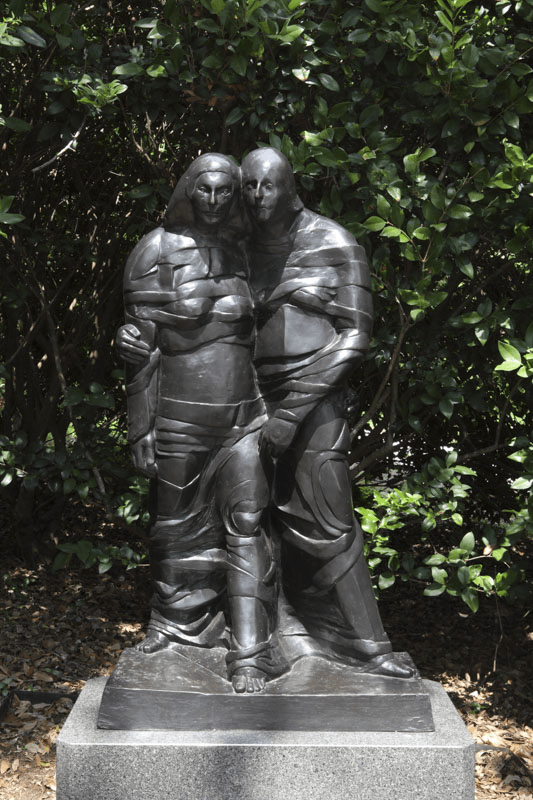
Statue of Ruth and Naomi, by Leonard Baskin (1922-2000)

When Naomi saw that she was determined to go with her, she said no more to her.

So the two of them went on until they came to Bethlehem. When they came to Bethlehem, the whole town was stirred because of them, and the women said, “Is this Naomi?” She said to them,

“Call me no longer Naomi;
    call me Mara,
    for the Almighty has dealt bitterly with me.
I went away full,
    but the Lord has brought me back empty;
why call me Naomi
    when the Lord has dealt harshly with me
    and the Almighty has brought calamity upon me?”

So Naomi returned together with Ruth the Moabite, her daughter-in-law, who came back with her from the country of Moab. They came to Bethlehem at the beginning of the barley harvest. (New Revised Standard Version)

A famine in Judah had brought Naomi and her husband Elimelech to the country of Moab. While there, they had two sons who eventually married two Moabite women: Orpah and Ruth. Over time, each of the husbands died, leaving Naomi and her two daughters-in-law as widows.

Naomi heard that things were finally better in her native Judah. So, she decided to go there, alone. Naomi encouraged her daughters-in-law to remain with their own people and remarry. Orpah did so. Ruth, however, wasn’t having it.

Ruth was determined to stay with her mother-in-law – which meant that she would enter Judah as a foreigner. Despite Naomi’s insistence that Ruth do what is best for herself, Ruth stuck with Naomi.

Once they arrived, the people of Naomi’s hometown were surprised to see the two of them. Naomi was not shy about communicating her bitterness in losing a husband and two sons. She commented that God had turned against her and made her life hard and bitter.

In saying that the Lord had emptied her and brought calamity, Naomi was not speaking against God. Rather, Naomi was expressing some significant theology that has become lost to many modern day Christians around the globe.

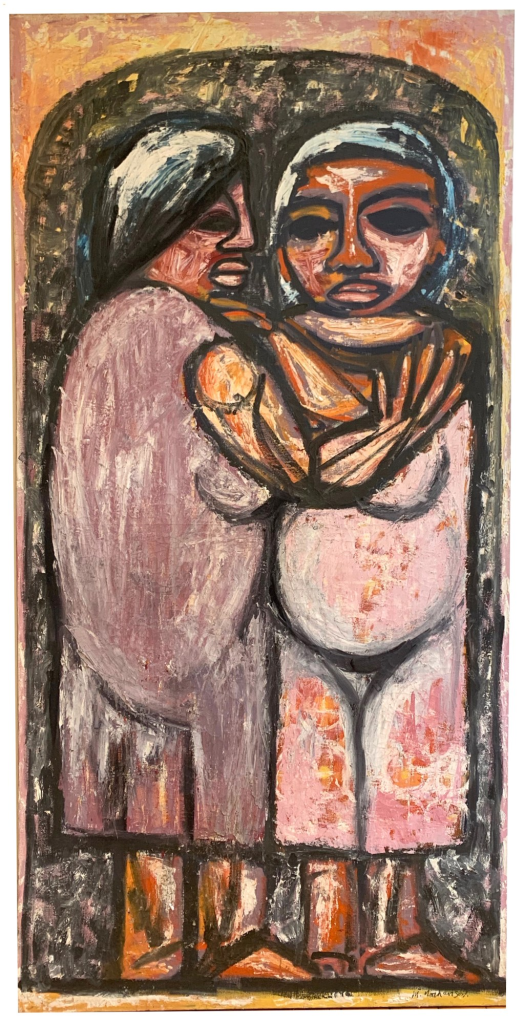
Ruth and Naomi, by Morris Nathanson (1927-2022)

I believe that Ruth was not expressing something malevolent about God, but rather made a statement of faithful recognition, not unlike what Job had to say when he lost his family and his health:

“Naked I came from my mother’s womb, and naked shall I return there; the Lord gave, and the Lord has taken away; blessed be the name of the Lord.” (Job 1:21, NRSV)

No one can escape the dark side of life. Yet, we can deal with that darkness intelligently. It is most necessary to be aware that light creates a shadow that was not there before. The bigger and brighter the light, the bigger and darker the shadow.

There is a centuries old idiom which says, “You can’t have your cake, and eat it, too!” This is a proverbial way of saying that we cannot expect everything to always be good in this life; we must also accept that we cannot always have our way, and that we will go without, experiencing loss.

Whether we want to acknowledge it, or not, an integral part of life is receiving some bad things from God. The Lord does not just go around dispensing everyone’s wishes and making everything a utopia of unicorns and butterflies.

God is most certainly benevolent; yet God also brings darkness to people. We cannot have the Light of the world without experiencing the world’s darkness. Another way of stating this is that a very big God creates quite a large shadow.

In Christianity, the predominant symbol is the cross. The Cross of Christ is both light and dark. Christians may reflexively associate the cross with salvation from sin, while forgetting that the cross is an instrument of torture and death, a tool of execution, like an electric chair.

We must honor the axis crossing at the center of the cross. It is the place of equilibrium, the place of wholeness, where we have the opportunity of integrating all of that unwanted grief and loss into our lives. Failing to do this, let alone neglecting to acknowledge the shadowy places of our hearts, brings harm and hurt to ourselves and to the world.

Naomi acknowledged the shadow. She accepted the darkness, which enabled her to return to her homeland of Judah, the very place where the God of light and dark is worshiped.

I’m not talking about the sort of darkness that is malevolent and mean-spirited, the darkness which comes from Satan. I’m talking about the darkness which weans us away from all things and the ways that hinder us from knowing God.

This is what St. John of the Cross was referring to in naming the dark night of the soul. In our quest to experience union with God, we journey through the darkness, and learn that purification isn’t simply putting something impure away. Purity of heart comes through joining with the God who is pure love itself.

“In the dark night of the soul, bright flows the river of God.”

St. John of the Cross

God loves us so much as to be nailed to a cross and suffer darkness. The Christian is to take up their cross and follow Jesus. That is, we embrace the darkness with an honest engagement of God and God’s world, and through a vulnerable assessment of our own shadow.

For if we fail to acknowledge our shadow, we shall fail to be in union with God.

Not only do many people disown the parts of themselves they don’t like, but they do the same with God – thus making God into their own image of how God should be, instead of taking God as God is.

If you have ears to hear, take this to heart: To accept and honor your own shadow is a profound and necessary spiritual discipline. By “shadow” I mean all of the characteristics of myself that I withhold from others, so that they will only see what I want them to see.

We often put a false self out into the world, for others to see. It is a sort of psychological clothing we wear, much as we have actual clothing. Whether the clothes are real or metaphorical, we dress ourselves in the particular way we want to be seen.

Naomi was a true Israelite, showing her honest true self. There was no separation or division between the inner self and the self she presented to others.

I tend to think that Naomi knew something about God that many don’t know today – and was therefore able to be faithful to both her people and her God.

It is no wonder, then, that Ruth wanted to remain with her mother-in-law Naomi, who was a real person acknowledging the real God.

Almighty God and Father, maker of heaven and earth, of all that is seen and unseen: You are the God of light who illumines our way. And You are the God of darkness who is shadowed in mystery. In knowing You, may I know myself; and in knowing myself, may I more fully know You. Amen.

Accountability Is Real, and It Matters (Ezekiel 14:12-23)

The word of the Lord came to me: “Son of man, if a country sins against me by being unfaithful and I stretch out my hand against it to cut off its food supply and send famine upon it and kill its people and their animals, even if these three men—Noah, Daniel and Job—were in it, they could save only themselves by their righteousness, declares the Sovereign Lord.

“Or if I send wild beasts through that country and they leave it childless and it becomes desolate so that no one can pass through it because of the beasts, as surely as I live, declares the Sovereign Lord, even if these three men were in it, they could not save their own sons or daughters. They alone would be saved, but the land would be desolate.

“Or if I bring a sword against that country and say, ‘Let the sword pass throughout the land,’ and I kill its people and their animals, as surely as I live, declares the Sovereign Lord, even if these three men were in it, they could not save their own sons or daughters. They alone would be saved.

“Or if I send a plague into that land and pour out my wrath on it through bloodshed, killing its people and their animals, as surely as I live, declares the Sovereign Lord, even if Noah, Daniel and Job were in it, they could save neither son nor daughter. They would save only themselves by their righteousness.

“For this is what the Sovereign Lord says: How much worse will it be when I send against Jerusalem my four dreadful judgments—sword and famine and wild beasts and plague—to kill its men and their animals! 

“Yet there will be some survivors—sons and daughters who will be brought out of it. They will come to you, and when you see their conduct and their actions, you will be consoled regarding the disaster I have brought on Jerusalem—every disaster I have brought on it. You will be consoled when you see their conduct and their actions, for you will know that I have done nothing in it without cause, declares the Sovereign Lord.” (New International Version)

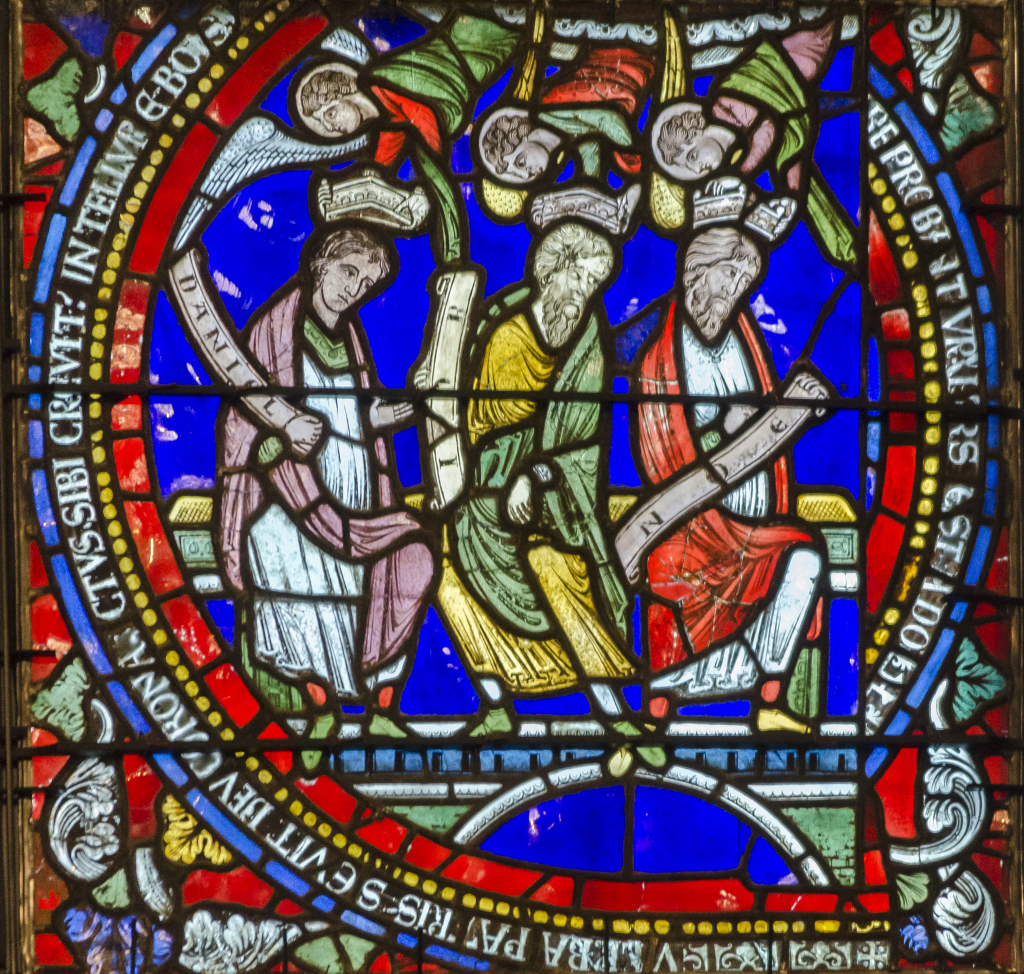
Stained glass of the three righteous men: Daniel, Job, and Noah

No person, group, institution, or nation can act unjustly forever. The prophet Ezekiel made it clear that everyone will be held accountable for injustice and wickedness, for crimes against humanity and against God.

Furthermore, there is no nation or group which can rely on a few persons who do right, while the rest of the people swim in injustice and unrighteousness. Righteous persons save only themselves; they cannot make decisions and take over the life of another person.

Ezekiel wanted to make sure his listeners got the message of individuals only saving themselves, and not riding on the coattails of others. The prophet went out of his way to communicate that each individual person will be held responsible for their own actions; they will be judged on what they themselves have done, and not what another has or has not done.

Even the family of a righteous person will not be spared divine judgment because of that individual’s righteousness. One shall be held accountable for what that one has done, period.

Specifically, in the text, God was ready to execute judgment on Jerusalem. War, wild animals, famine, and disease would come upon them because of unfaithfulness, injustice, and unrighteousness.

Just because the city had the temple, this would not save them. Just because there are a few righteous persons in the city, they would not save it. Just because a close loved one is faithful and righteous, will not mean that God would spare the city.

A few good works of a few people, do not cancel out pervasive and consistent evil which is perpetrated by many people. Each person is responsible for their own behavior. No one gets a pass, simply because they know certain people and are well-connected.

Evil is evil, no matter whether it is perpetrated by believers or unbelievers. No nation, and no person, is off the hook; all persons will be held accountable for doing justice, loving mercy, and walking humbly with God.

Even if three of the most righteous persons show up – Noah, Daniel, and Job, who were famous for their moral integrity – their combined righteousness and faithfulness would not keep away divine judgment from happening in an immoral and unethical society. Only those three alone would be delivered.

There is no such thing as salvation by proxy. Each individual person must work on themselves, without blaming others, inordinately depending on others, nor ignoring God and wishing God did not see, or does not exist at all.

Evil persons do not get any preferential treatment from God, just because they have a prominent position or are famous. The Lord, as Sovereign of the universe, has every right to exact divine retribution. And God will do it without showing favoritism.

Just as God shows mercy without prejudice, so will God extend judgment without any prejudice.

The presence of great light means that there is also the presence of great darkness. If we want a great God of love and mercy, then we must also accept the God of wrath and judgment; and vice versa.

We are made in God’s image, and not the other way around. It is our task to submit to the high, holy, and sovereign Lord of all. It is not God’s job to be the divine Santa Claus who submits to us. The Lord is no divine genie who we can keep in a bottle, and summon whenever we so desire.

No matter one’s theology or spirituality, everyone discerns that they are to be responsible in this life, and are accountable to forces greater than themselves.

This is one of those universal realities that all of us need to sync our lives with – or suffer the consequences.

Almighty God and Sovereign Lord of all, I embrace my accountability to you. Forgive me for when I live as though I need not give an account of what I said and did. I affirm that I am accountable for how I treat others; and I realize that what I do to others, positive or negative, I am doing to you, their Creator. Sustain me in faith and patience, I pray. Amen.