The Wealth and Wisdom of Solomon (2 Chronicles 9:29-31)

King Solomon, by British artist Simeon Solomon, c.1874

Everything else Solomon did while he was king is written in the records of Nathan the prophet, Ahijah the prophet from Shiloh, and Iddo the prophet who wrote about Jeroboam son of Nebat. After Solomon had ruled 40 years from Jerusalem, he died and was buried in the city of his father David. His son Rehoboam then became king. (Contemporary English Version)

The life of King Solomon can be found in the biblical books of 1 Kings (chapters 1-11) and 2 Chronicles (chapters 1-9). Solomon is also traditionally viewed as the author of three biblical books: Ecclesiastes, Proverbs, and Song of Songs.

Solomon was the son of Bathsheba and King David. He is most known for building the first Jerusalem Temple, as well as his immense wealth, wisdom, and numbers of wives.

Although his reign as king was marked by peace and prosperity, it fell apart after his death. Late in his life Solomon succumbed to worshiping many other gods, which the biblical editor connects with the split of the kingdom under his son Rehoboam.

King Solomon presides over the Old Testament as a sort of larger than life individual. He reigned over a united kingdom of Israel and Judah nearly a thousand years before Christ.

Coming to the throne after his father’s death, Solomon carried out a purge. He cunningly did away with his older brother Adonijah, and the commander of the army Joab. Both of them were characters only concerned with themselves and not the overall good of the kingdom. (1 Kings 2:13-46)

Once firmly ensconced in power, Solomon famously asked God for wisdom – after the Lord came to him in a dream and offered to grant the king any wish he wanted. In asking for wisdom instead of riches, glory, or long life, God was pleased to give him a great degree of discerning wisdom that no one before or since would ever have. (1 Kings 3:5-15)

The Judgment of King Solomon, by Frans Floris, c.1547

The proof of King Solomon’s wisdom came in many forms, including the rendering of justice. The biblical story is told of two women who came before the king, both claiming to be the mother of a baby. Solomon called for a sword and said the solution to the dilemma would be to cut the baby in two, and give each half to each woman.

One woman finds the solution agreeable, but the other woman protested, stating that she would give up the child rather than see the baby killed. King Solomon therefore concluded that this woman, not the other, was the child’s mother. (1 Kings 3:16-28)

King Solomon engaged in many building projects, but none more great than the Temple. To this day, Jerusalem continues as the center of Jewish prayer and worship. Indeed, Solomon’s impact is felt all these millennia later.

And then there were the wives. Lots of them. According to scripture, Solomon had 700 wives and 300 concubines (a concubine was a lesser wife who was not born of royalty or nobility). Many of his wives worshiped gods other than the Lord, which is why Solomon eventually allowed idols into the city.

A famous encounter with Solomon included the Queen of Sheba, which is a story told in both 1 Kings and 2 Chronicles. The country of Sheba, in the south of the Arabian peninsula, heard about Solomon’s renown. The queen decided to travel to Jerusalem with a large entourage in order to meet him for herself.

The Visit of the Queen of Sheba to King Solomon, by Edward Poynter, 1890

The queen was overwhelmed with what she saw and experienced; and was so impressed with Solomon’s wisdom and wealth that she gifted him with spices, precious gems, and gold from her own country. All sorts of various Jewish stories came out of this original biblical account.

The many wives of Solomon included women from the nations God commanded the Israelites not to marry, because they would lead their husbands astray to worship foreign gods. And that is exactly what happened, even to the wisest man in the world.

Because of this, we get some different takes on Solomon’s spiritual commitment in scripture and according to tradition. On the one hand, Solomon is presented as fully devoted to God, and careful to worship the Lord and communicate divine precepts. Yet, on the other hand, the Bible doesn’t hedge from stating that Solomon committed evil in God’s sight and was not loyal like his father David.

In truth, we are all a bit of a mix of sinner and saint, showing steadfast loyalty in many ways, along with a curious bent toward indulging our desires and letting them carry us to unfaithful places.

Yet, no one can doubt King Solomon’s influence and legacy on the religious world. His writings and collection of wise sayings, along with the colorful stories, are still read and retold by Jews and Christians to this day.

The biblical text tells us that after ruling for four decades, King Solomon was laid to rest in Jerusalem. He was the last ruler of a united Jewish kingdom. Because of this, and his legendary wisdom and wealth, Solomon’s reign is remembered by many as a golden era in history.

But whatever you think about the story of Solomon’s life, his legacy of proverbial sayings and experiential truth can continue to inform and teach us. Our lives will never come close to Solomon’s material riches, but perhaps we can gain something of the immaterial blessings through his wisdom.

Almighty God, I humbly ask that You grant me wisdom to make sound choices and decisions. Open my eyes to see Your truth clearly. Give me spiritual discernment to distinguish right from wrong. Help me not rely solely on my own limited understanding, but trust in Your wisdom to guide my steps. Grant me a heart eager to gain wisdom from Your Word and wise counselors. Let Your wisdom shape my thoughts, words, and actions each day. Amen.

Learn a Lesson from Conflict (2 Samuel 10:13-19)

David Attacks the Ammonites, by Gustave Doré, 1866

Then Joab and the troops with him advanced to fight the Arameans, and they fled before him. When the Ammonites realized that the Arameans were fleeing, they fled before Abishai and went inside the city. So Joab returned from fighting the Ammonites and came to Jerusalem.

After the Arameans saw that they had been routed by Israel, they regrouped. Hadadezer had Arameans brought from beyond the Euphrates River; they went to Helam, with Shobak the commander of Hadadezer’s army leading them.

When David was told of this, he gathered all Israel, crossed the Jordan and went to Helam. The Arameans formed their battle lines to meet David and fought against him. But they fled before Israel, and David killed seven hundred of their charioteers and forty thousand of their foot soldiers. He also struck down Shobak the commander of their army, and he died there. When all the kings who were vassals of Hadadezer saw that they had been routed by Israel, they made peace with the Israelites and became subject to them.

So the Arameans were afraid to help the Ammonites anymore. (New International Version)

Outward Conflict with Ammon

You would think that showing basic human kindness to another would always end well… Yet, not always. And King David found that out, the hard way.

David, having become king of Judah and Israel, demonstrated that his reign would be characterized by extending the sort of mercy and kindness that is characteristic of God.

Whereas David’s kindness was most often accepted, when it came to King Hanun and the Ammonites, it was misunderstood and rejected. The Ammonites humiliated King David’s sent ambassadors.

The delegation wanted to express David’s condolences to Hanun in the event of his father’s death. Then, after the Ammonites saw that King David was upset about how his ambassadors were treated, they mobilized a mercenary force of Arameans with Hadadezer leading the charge.

Both the Ammonites and the Arameans underestimated the experience and skill of the Israelite army under their commander Joab. Even though Joab was outnumbered, he conceived of a strategy that evened the odds.

All of this conflict, with preparations for battle and an escalating war, came about because a king wanted to show kindness to another. Indeed, this can be a very messed-up world that we inhabit!

The result of it all is that the Ammonites and the Arameans were soundly defeated by a smaller, yet much stronger, army with King David at the head. The Arameans became subject to Israel, and the Ammonites were left slack-jawed, not knowing what hit them.

Inner Conflict with Oneself

So, here we have David, who like all of us, is a bundle of contradictions. On the one hand, King David had his heart set on showing kindness and reflecting the heart of God in his rule and reign. And on the other hand, David is a soldier and a man of blood, who does an awful lot of killing people in his lifetime.

King David is both a paragon of moral behavior, and an example of immoral living.

He did not lift a finger against his former king who was trying to kill him; and evidenced a tender spirit through musical skill and an ability to write the psalms and songs of Israel.

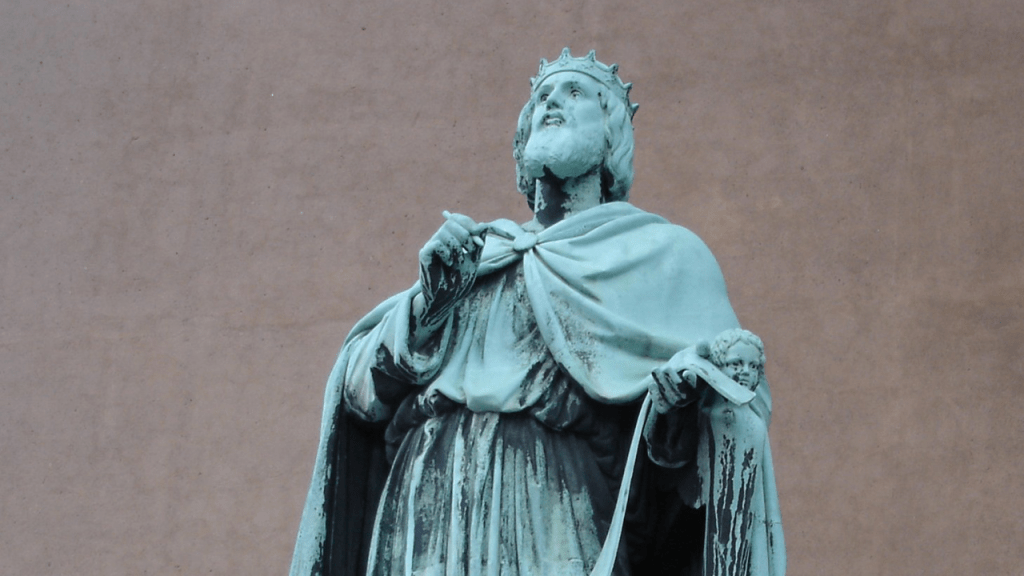
Statue of King David, Copenhagen, Denmark

Yet also, King David demonstrated for us some of the worst immorality, of which is clearly seen in the next few chapters of his story in the book of 2 Samuel. Throughout David’s adult life, he took thousands of human lives in battle.

He came to fame by beheading Goliath; made his mark in Israel by killing Philistines for King Saul; survived in the wilderness while Saul was trying to kill him by killing Amalekites; and secured Israel’s borders through an enormous amount of killing.

I won’t do to simply say that the people David killed had it coming to them, or that he did all the things he did for the sake of the nation. That sort of reductionism smacks of mental laziness and purposeful ignorance.

Coming to Grips with Conflict

At the least, it seems to me that we must accept the biblical narratives as they are, and not as we want them to be, whenever there is difficulty in understanding a story.

We have the human condition in front of us every time we read a scriptural story. Either making it all good, or all bad, just won’t do – because all of us, like David, are a bundle of contradictions and paradoxes that often don’t make sense.

It turns out that, throughout Holy Scripture, we find stories of people who are no better and no worse than we ourselves. The ancient persons, like David, are those for whom a gracious God chose to use and work through – despite either their sinning or their saintliness.

We get a glimpse of how things were and how the Lord operated through the people of the time in their own political, social, economic, and religious contexts.

God comes to us, not merely from the outside by simply mandating commands and imposing control, but enters our lives on the inside, taking us as we are and graciously working with and within us to accomplish good and just purposes on this earth.

And, as it turns out, God uses whomever God wants to use, without doing some sort of divine screening interviews to find out who the most moral candidate is available for the job.

If you are looking for a bottom line in all of this mayhem, then I believe it is this: God loves us. God is with us. And God holds us – all of us, with our maddening combinations of kindness and kookiness – to establish a truly right and benevolent world characterized by humility, gentleness, mercy, purity, and peace.

It’s a rather long and messy process of bringing in such a way of life, but God is patient and will take the centuries and even the millennia needed to accomplish it.

It’s Not All About Human Conflict

Although we are a flawed and fallible people, we are nevertheless God’s people. At the end of it all, we discover that none of this was really a story about Ammonites or Israelites or David or Joab or anyone else; it is actually a story about God – because God is both the object and subject of every biblical narrative.

And what we discover about God is that there are divine initiatives happening all the time which are meant to help us and save us from ourselves. The Lord is sovereign over all creation, and brings salvation despite what we do or don’t do.

God’s kindness – shown and expressed through our own human kindness – will eventually and always win the day.

Almighty and everlasting God, whose will it is to restore all things in your well beloved Son, the King of kings and Lord of lords: Mercifully grant that the peoples of the earth, divided and enslaved by sin, may be freed and brought together under his most gracious rule; who lives and reigns with you and the Holy Spirit, one God, now and forever. Amen.

A Plan That Backfired (1 Samuel 4:1-22)

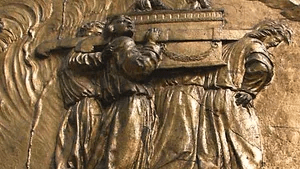
Transporting the Ark of the Covenant, Cathedral of Sainte-Marie, Auch, France

Now the Israelites went out to fight against the Philistines. The Israelites camped at Ebenezer, and the Philistines at Aphek. The Philistines deployed their forces to meet Israel, and as the battle spread, Israel was defeated by the Philistines, who killed about four thousand of them on the battlefield. When the soldiers returned to camp, the elders of Israel asked, “Why did the Lord bring defeat on us today before the Philistines? Let us bring the ark of the Lord’s covenant from Shiloh, so that he may go with us and save us from the hand of our enemies.”

So the people sent men to Shiloh, and they brought back the ark of the covenant of the Lord Almighty, who is enthroned between the cherubim. And Eli’s two sons, Hophni and Phinehas, were there with the ark of the covenant of God.

When the ark of the Lord’s covenant came into the camp, all Israel raised such a great shout that the ground shook. Hearing the uproar, the Philistines asked, “What’s all this shouting in the Hebrew camp?”

When they learned that the ark of the Lord had come into the camp, the Philistines were afraid. “A god has come into the camp,” they said. “Oh no! Nothing like this has happened before. We’re doomed! Who will deliver us from the hand of these mighty gods? They are the gods who struck the Egyptians with all kinds of plagues in the wilderness. Be strong, Philistines! Be men, or you will be subject to the Hebrews, as they have been to you. Be men, and fight!”

So the Philistines fought, and the Israelites were defeated and every man fled to his tent. The slaughter was very great; Israel lost thirty thousand foot soldiers. The ark of God was captured, and Eli’s two sons, Hophni and Phinehas, died.

That same day a Benjamite ran from the battle line and went to Shiloh with his clothes torn and dust on his head. When he arrived, there was Eli sitting on his chair by the side of the road, watching, because his heart feared for the ark of God. When the man entered the town and told what had happened, the whole town sent up a cry.

Eli heard the outcry and asked, “What is the meaning of this uproar?”

The man hurried over to Eli,who was ninety-eight years old and whose eyes had failed so that he could not see. He told Eli, “I have just come from the battle line; I fled from it this very day.”

Eli asked, “What happened, my son?”

The man who brought the news replied, “Israel fled before the Philistines, and the army has suffered heavy losses. Also your two sons, Hophni and Phinehas, are dead, and the ark of God has been captured.”

When he mentioned the ark of God, Eli fell backward off his chair by the side of the gate. His neck was broken and he died, for he was an old man, and he was heavy. He had led Israel forty years.

His daughter-in-law, the wife of Phinehas, was pregnant and near the time of delivery. When she heard the news that the ark of God had been captured and that her father-in-law and her husband were dead, she went into labor and gave birth, but was overcome by her labor pains. As she was dying, the women attending her said, “Don’t despair; you have given birth to a son.” But she did not respond or pay any attention.

She named the boy Ichabod, saying, “The Glory has departed from Israel”—because of the capture of the ark of God and the deaths of her father-in-law and her husband. She said, “The Glory has departed from Israel, for the ark of God has been captured.” (New International Version)

It was a really bad day. Yet, it wasn’t a day disconnected from other days. This particular day had been coming for quite some time.

The Philistines and the Israelites were continually going at each other. They had been enemies for a long time. But the Philistines were only the surface problem. The real issue had been building ever since Eli and his sons Hophni and Phineas were the priests in Israel.

They were tasked with the sacred responsibility of caring for the Tabernacle – the tent which housed the Ark of the Covenant – and attending to the people’s worship and sacrifices. But they had been terribly irresponsible in their work. As biblical readers, we are meant to feel the building tension of inevitable divine intervention of judgment against the injustice that was happening.

In one of the many military battles which took place against the Philistines, the Israelites suffered loss. So, someone had the bright idea of perhaps getting God involved. No one perceived, however, the involvement the Lord was planning. God was ready to deal with the wickedness in Israel.

The Ark of the Covenant was brought from Shiloh to the front lines. This, of course, meant that the persons who handled sacred objects, Hophni and Phineas, would have to be the ones who bring it. We sense as readers that in spite of the Ark’s symbolism of God’s presence with the Israelites, this move isn’t going to end well for Israel.

The story is leading us to an important point: Faithfulness to the invisible God is much more important and powerful than a visible sacred object. The Ark of the Covenant is a symbol of what is right and just; it is not a supernatural talisman to ward off a bad and stressful situation.

Many in Israel were faithful to the Lord. Israel’s leaders, however, were not. In an age old story that has kept repeating itself up to the present time, the people keep supporting a bad government which does not serve the common good of all persons; it only serves itself.

What is interesting here is that God neither fights against the Philistines, nor the Israelites. The Lord simply didn’t show up. God was absent and did not help Israel. The divine intervention turned out to be no intervention at all.

The entire Ark of the Covenant plan completely backfired. The Philistines, understanding the brevity of the situation, were emboldened to fight like never before – thus bringing devastation on the battlefield to Israel. The narrator takes note to let us know the impact this has on the old priest Eli, his two sons, and the rest of that family.

Superstition will get us nowhere – especially when we are looking for solutions to problems we created for ourselves by ignoring righteousness and justice. The hard work of doing what is right cannot be substituted with magic.

There is big difference between believing in God and becoming superstitious and wanting easy solutions to complex problems. God is not, cannot, and will not be contained in a box – even if it’s the Ark of the Covenant.

Eternal God, in whose perfect kingdom no sword is drawn but the sword of righteousness, no strength known but the strength of love: So mightily spread abroad your Spirit, that all people may be gathered under the banner of the Prince of Peace, as children of one Father; to whom be dominion and glory, now and forever. Amen.

Face Reality (Numbers 20:22-29)

Aaron’s Death, by David Roberts, 1842

The whole community of Israel left Kadesh and arrived at Mount Hor. There, on the border of the land of Edom, the Lord said to Moses and Aaron, “The time has come for Aaron to join his ancestors in death. He will not enter the land I am giving the people of Israel, because the two of you rebelled against my instructions concerning the water at Meribah. Now take Aaron and his son Eleazar up Mount Hor. There you will remove Aaron’s priestly garments and put them on Eleazar, his son. Aaron will die there and join his ancestors.”

So Moses did as the Lord commanded. The three of them went up Mount Hor together as the whole community watched. At the summit, Moses removed the priestly garments from Aaron and put them on Eleazar, Aaron’s son. Then Aaron died there on top of the mountain, and Moses and Eleazar went back down. When the people realized that Aaron had died, all Israel mourned for him thirty days. (New Living Translation)

There is a tendency for us “enlightened” humans to believe that we are far more advanced than our ancestors – who did not know all that we very smart people today know.

Such a mental stance only demonstrates that perhaps we are getting more stupid as the centuries and the millennia wear on.

Despite all of our accumulated knowledge and research, and incredible technical advances, we have (in my humble opinion) strayed rather far from a wise understanding of anthropology and theology. In other words, many people in this contemporary world have little to no idea about who they are, why they are here, and what to do when life and death happens.

The death of Aaron the priest happened over 3,500 years ago. Yet, here I am, referencing it. Why? Because there is meaning to it. The ancients have a great deal to teach us, that is, if we have the spiritual and emotional ears to hear, and eyes to see. Notice just some of the lessons they continue to teach us…

The Need to Accept Death

Just as we have all been born into this world, we shall all die someday. If we are such an enlightened people, it would seem to me that we all might have highly developed coping skills, strategies, and ways of honoring and accepting the inevitable death of another – not to mention having adequately prepared for our own demise.

And yet, we go on, day after day, as if we will live forever. Then, when someone we care about dies, it’s as if we cannot believe it has happened. But there is only one sure event in this life, and that is death. It is inexorably coming, whether we like it, or not.

It also seems to me that a great deal of contemporary religious piety is shallow, and does not plumb the depths of real spiritual substance. The irony of it, for many, is that they long for heaven, but ignore death. This is nothing but the denial of reality. Our very real lives here and now must be contended with, including the inevitable death to come.

Reality is the one substantial door that must be acknowledged, experienced with all of our senses and emotions, and passed through – not denied. Only through complete acceptance of this world can the greater reality of the world to come be truly known.

Fantasy and endless gospel songs about heaven can only lead us astray. We picture a future of our own imaginations, which deludes and dulls us of how to actually pass from one dimension to another.

Death was a daily reality amongst the Israelites in their forty years of desert wandering. They understood that each individual passing was inextricably connected to the whole of the community.

John Donne was an Anglican priest and poet in seventeenth century England. He was insistent that all humanity is connected, that whatever happens to one of us, happens to all of us. I take some liberties in contemporizing his Old English language written in 1627:

“No one is an island, entirely independent. Every person is a piece of the continent, a part of the main body of land. If a clod of dirt happens to be washed away by the sea, the whole land mass is the less, just as if an entire peninsula fell off into the water. Whether a friend dies, or anyone in the world dies, it diminishes me because I am involved in the whole of humanity. Therefore, never question to know for whom the bell of death tolls; it tolls for you.”

John Donne (1572-1631)

The Need for Bereavement

A story is told of an old Sufi mystic who visited a sheikh in Baghdad. He found the sheikh gazing into a bowl filled with water. So, he inquired about this odd practice. The sheikh replied that he was watching the moon in the basin. To which the Sufi mystic cried out:

“Unless you have a boil on the back of your neck, lift up your head and look at the sky! There you will see the moon as it is, and not in this basin. Why are you leaning over basins, when all you are really doing is depriving yourself of what you are really looking for?”

Sufi Master, 13th century

As a Pastor and Chaplain who engages in a lot of grief support for those who have lost loved ones to death, and who has dealt with hundreds of people with significant emotional issues, I can say that a lot of people’s grief goes unattended. A good many people go looking for comfort, all by themselves, in staring into a bowl of water.

Death is real. And when someone close to us dies, it hurts like hell. It’s as if somebody came along and pulled the rug out from underneath us. We are flat on our backs and unable to get up.

The only way we can get back up is with the help of others. When Aaron died, the entire community mourned for a full month. Perhaps nothing speaks more to the modern delusion of death and grief than of taking a day or two off work, then expecting to return as if nothing ever happened. No wonder so many people end up in significant depression and anxiety.

The Need for God

Ignoring God is what got the Israelites in their predicament of desert wandering in the first place. And it is also what got both Aaron and Moses a refusal by the Lord to enter the Promised Land.

God isn’t some genie in a bottle that we can control, or a divine Santa to receive presents from. Like death, God is a reality that must be contended with. To go your own way, and decide which commands and instructions you’d like to keep, and which one’s you’ll discard, will not end well – not to mention simply stating that there is no God at all.

Humans are creatures, formed by their Creator. Obedience to God is vital, not optional, because the Lord’s presence is much like the unseen and constant force of gravity. You ignore it at your own peril.

Although we have a lot of freedom in how we can live our lives, and the choices we can make, there yet remains a basic way of existence for everyone. And that way is meant for good, not evil; it has its foundation in the character of God. The Lord is pure love, justice, righteousness, and goodness.

Therefore, as people in God’s image and likeness, we too, are to live in a way that is just, right, good, and loving. To not live in this way would be like walking off the roof of your house because you don’t believe in gravity – then blaming God for your broken body (and soul).

The Need for Ritual in Transition

Israel was transitioning from desert wandering to entering the Promised Land. They were also transitioning leadership from Aaron to Eleazar. And it was all acknowledged with rituals to help people make those transitions.

The community did not simply get an email from Moses informing them of a new priest and welcoming Eleazar to the company. There was an extended time of mourning the loss of Aaron, and a meaningful ritual that demonstrated the change of leaders.

Transitions can be hard. But with every change there is a transition time that must be faced and walked through. Rituals can help us with that. If we ignore this reality, we will find ourselves unable to navigate changes that we personally never asked for. 

The following are some things that I have found helpful in handling change and dealing with the transition from one reality to another:

  1. Maintain personal spiritual rituals. If the change is one that I did not choose, then having regular times of silence and solitude, prayer and bible reading, fasting and journaling help me make sense of what is happening and put it in proper perspective.
  2. Maintain personal health rituals. Freaking out by burning the candles at both ends, forgetting to eat sensibly, and ignoring exercise only exacerbates the change and makes the transition time unbearable.  Instead, take the time necessary to remain healthy through proper sleep, nutrition, and activity.
  3. Grieve and ritualize your losses. Lament, I would argue, is a spiritual practice – a necessary one. It is also biblical.  To focus on next steps without acknowledging transition is to set oneself up for later emotional difficulty and/or trauma. Unpack the heart and allow yourself to feel the loss.
  4. Be patient. Rituals cannot be hurried. The Lord cares more about our spiritual growth and character development than avoiding painful transitions. Let God teach you all that you need to learn.

Institutions and faith communities are sometimes notorious for being inflexible and allergic to change. But, after all, they are made up of real flesh and blood people. To struggle with change is to be human.

Let’s first help ourselves to know how to cope with needed transitions so that we can do the important work of transitioning others from one spiritual place to another. 

It’s high time for us to face the reality that the ancients have much to teach us – including ancient literature such as the Bible.