Wisdom for Life (Proverbs 11:1-31)

The Lord detests dishonest scales,
    but delights in an accurate weight.
When pride comes, so does shame,
    but wisdom brings humility.
Integrity guides the virtuous,
    but dishonesty ruins the treacherous.
Riches don’t help in the day of wrath,
    but righteousness rescues from death.
The righteousness of the innocent makes their path straight,
    but the wicked fall in their wickedness.
Those who do right are saved by their righteousness,
    but the untrustworthy are caught by their own desires.
When the wicked die, their hope perishes.
    Yes, any hope based on money perishes.
The righteous are saved from distress,
    and the wicked take their place.
The godless destroy their neighbors by their words,
    but the righteous are saved by their knowledge.
When the righteous succeed, a city rejoices;
    when the wicked perish, there are shouts of joy.
A city is honored by the blessing of the virtuous;
    it is destroyed by the words of the wicked.
Whoever despises their neighbor lacks sense;
    a sensible person keeps quiet.
A slanderer walks around revealing secrets,
    but a trustworthy person keeps a confidence.
Without guidance, a people will fall,
    but there is victory with many counselors.
Guaranteeing the debt of a stranger brings big trouble,
    but the one who refuses to shake hands will be secure.
A gracious woman gains honor;
    violent men gain only wealth.
Kind persons benefit themselves,
    but cruel people harm themselves.
The wicked earn false wages,
    but those who sow righteousness receive a true reward.
The righteous are headed toward life,
    but those who pursue evil, toward death.
The Lord detests a crooked heart,
    but he favors those whose path is innocent.
The evil person will surely not go unpunished,
    but the children of the righteous will escape.
Like a gold ring in a pig’s nose
    is a beautiful woman who lacks discretion.
The desires of the righteous end up well,
    but the expectations of the wicked bring wrath.
Those who give generously receive more,
    but those who are stingy with what is appropriate will grow needy.
Generous persons will prosper;
    those who refresh others will themselves be refreshed.
People curse those who hoard grain,
    but they bless those who sell it.
Those who look for good find favor,
    but those who seek evil—it will come to them.
Those who trust in their wealth will wither,
    but the righteous will thrive like leafy trees.
Those who trouble their family will inherit the wind.
    The fool will be servant to the wise.
The fruit of the righteous is a tree of life,
    and the wise gather lives.
If the righteous receive their due on earth,
    how much more the wicked and sinners? (Common English Bible)

The good and the bad, the wise and the foolish, the righteous and the wicked. When it comes to proverbial wisdom, there are two kinds of people: Those who take a right, just, and good path of life; and those who take the wrong exit, practice injustice, and embrace being bad.

We are all, of course, a strange amalgam of sinner and saint. Everyone has some altruism, along with a devious bent. So, life really comes down to our choices. Will our decision-making be wise, or foolish?

This is where the Book of Proverbs helps us. It lays out a prudent course of action for us, so that we can gain a perspective on the consequences of those actions, whether good or bad.

We have to carefully weigh our decisions and consider the likely outcomes of the choices we make.

As we decide, keep in mind that honesty is the best policy (11:1-4); choices have consequences (11:5-6); certain choices lead to rewards (11:7-10); good brings good, and bad brings bad (11:11-31).

Honesty Is the Best Policy

Making the decision to be honest in all things is what builds our capacity to resist evil. Poor choices often come from simply giving in, because we don’t have our resistance to saying “no” built up yet.

Humility enables us to keep our minds on the task at hand, rather than compromise on our integrity in order to achieve something we believe we need or want. The humble person understands that all things are a gift from God – and that the Lord can give, and the Lord can take away. Humility teaches us to say, “Blessed be the name of the Lord.”

When we are emptied of self-promotion, and filled with honest humility, righteousness results. And the righteous person automatically and reflexively denies all evil and wickedness.

Choices Have Consequences

Just because no one sees it, doesn’t mean there won’t be consequences. And just because there was no lightning strike from God immediately after a transgression, doesn’t mean that God’s judgment isn’t coming later.

I talk to far too many people, in my line of work as a hospital chaplain, who are filled with regret about some decision they made earlier in their life. Because now they are experiencing the physical consequences of that choice (and the emotional and relational consequences, as well).

A set of choices made earlier in life not only have real consequences later that one can see and feel; those decisions also erode the ability to make sound decisions in the present. It is a tough uphill struggle to gain some spiritual and emotional health, whenever any reserve of righteousness was not properly developed and maintained.

Certain Choices Lead to Rewards

Conversely, however, consistently good decisions, made over a stretch of time, provide solid spiritual and emotional dividends from which we can draw from in difficult times.

The chief reward for the righteous is that they have a robust life of faith and goodness because of their relationship to the Lord and a good supportive community of persons.

Foolish living leads to punishment; wise living leads to reward. A good life is really a reward itself. That’s because we are meant to live this way, to be merciful and just in all we do, walking humbly with our God. (Micah 6:8)

When the wicked die, that’s it. But when the righteous die, they leave a profound legacy in the form of others who have been encouraged, helped, and loved by their righteousness. They carry on the legacy of good. It makes a big difference.

I cannot imagine any greater reward than to know that I have been faithful to my God, and good to my fellow humanity. Such persons become like a great cloud of witnesses, testifying to the worth of investing in wisdom and humility.

Good Brings Good, Bad Brings Bad

A just and good life inspires others, invigorates groups of people, and leads to holistic health of individuals. Purity of heart is beneficial to the individual, and is contagious to the community.

A foolish life trusts in their own bad attitudes and personal opinions – and then they will wonder why they don’t get anywhere in life, and nobody wants to be around them.

King Solomon himself, gatherer of the biblical proverbs, knew all too well about both the good and the bad, and their eventual outcomes.

Solomon was quite humble and wise at the beginning of his reign. He did everything his father David asked of him, and more. But his wild success as king gradually brought him to acquire more stuff, more wives, and to fudge on the responsibilities and requirements of being king.

If a guy like King Solomon, who was the wisest person who ever lived, can ignore his own nation’s God and Holy Scripture to get whatever he wanted, then how much more do we, who have less wisdom, need the grace of loving people speaking truth to our hearts?

The people we surround ourselves with, no matter who we are, is vitally important. Everyone needs loving persons around them who will tell them what they need to hear in a spirit of love and grace. 

None of us do well with success unless we have humble and wise persons close to us who have the gumption and the grace to speak into our lives to help us, not hurt us. When we don’t have that, things go sideways.

I encourage you to go back and read Proverbs chapter 11 again, slowly, letting its wisdom seep into you. Also, a good practice is to read a chapter of Proverbs each day for the next month; and to occasionally, in the future, come back to this practice.

May the proverbial biblical wisdom fill your heart and your mind, so that you are able to make sage decisions in all of the various circumstances you encounter in this life. Amen.

Abundant Life (1 Kings 8:1-21)

Solomon dedicates the Temple at Jerusalem, by James Tissot (1836-1902)

Solomon then summoned to Jerusalem the elders of Israel and all the heads of the tribes—the leaders of the ancestral families of the Israelites. They were to bring the Ark of the Lord’s Covenant to the Temple from its location in the City of David, also known as Zion. So all the men of Israel assembled before King Solomon at the annual Festival of Shelters, which is held in early autumn in the month of Ethanim.

When all the elders of Israel arrived, the priests picked up the Ark. The priests and Levites brought up the Ark of the Lord along with the special tent and all the sacred items that had been in it. There, before the Ark, King Solomon and the entire community of Israel sacrificed so many sheep, goats, and cattle that no one could keep count!

Then the priests carried the Ark of the Lord’s Covenant into the inner sanctuary of the Temple—the Most Holy Place—and placed it beneath the wings of the cherubim. The cherubim spread their wings over the Ark, forming a canopy over the Ark and its carrying poles. These poles were so long that their ends could be seen from the Holy Place, which is in front of the Most Holy Place, but not from the outside. They are still there to this day. Nothing was in the Ark except the two stone tablets that Moses had placed in it at Mount Sinai, where the Lord made a covenant with the people of Israel when they left the land of Egypt.

When the priests came out of the Holy Place, a thick cloud filled the Temple of the Lord. The priests could not continue their service because of the cloud, for the glorious presence of the Lord filled the Temple of the Lord.

Then Solomon prayed, “O Lord, you have said that you would live in a thick cloud of darkness. Now I have built a glorious Temple for you, a place where you can live forever!”

Then the king turned around to the entire community of Israel standing before him and gave this blessing: “Praise the Lord, the God of Israel, who has kept the promise he made to my father, David. For he told my father, ‘From the day I brought my people Israel out of Egypt, I have never chosen a city among any of the tribes of Israel as the place where a Temple should be built to honor my name. But I have chosen David to be king over my people Israel.’”

Then Solomon said, “My father, David, wanted to build this Temple to honor the name of the Lord, the God of Israel. But the Lord told him, ‘You wanted to build the Temple to honor my name. Your intention is good, but you are not the one to do it. One of your own sons will build the Temple to honor me.’

“And now the Lord has fulfilled the promise he made, for I have become king in my father’s place, and now I sit on the throne of Israel, just as the Lord promised. I have built this Temple to honor the name of the Lord, the God of Israel. And I have prepared a place there for the Ark, which contains the covenant that the Lord made with our ancestors when he brought them out of Egypt.” (New Living Translation)

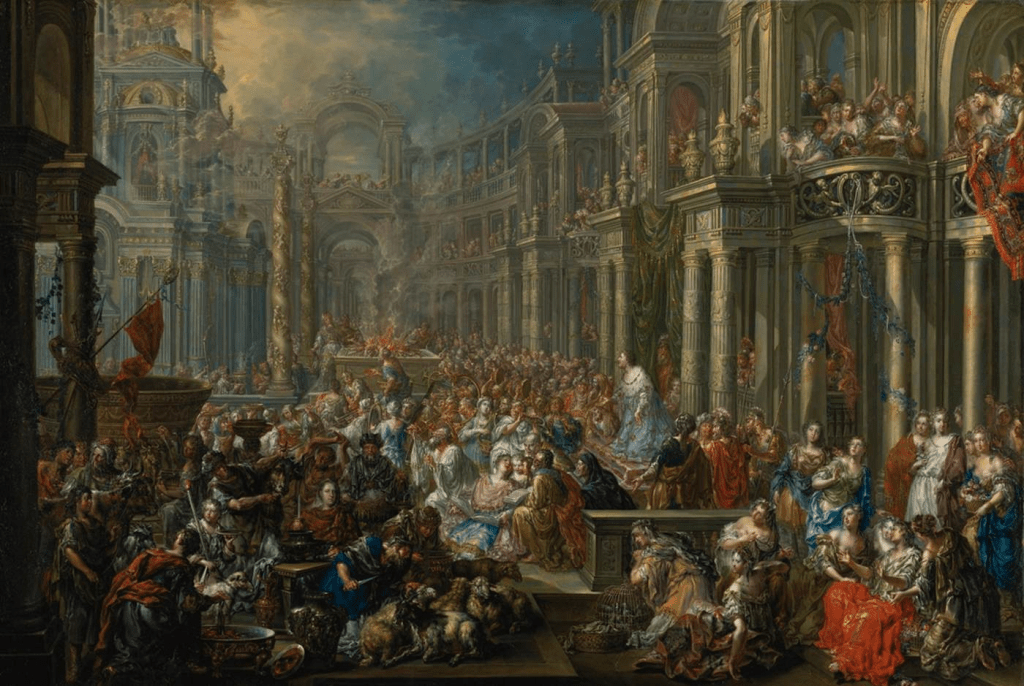
Dedication of Solomon’s Temple in Jerusalem, by Johann Georg Platzer (1704-1761)

I admit, at many times, that I am prone to melancholy. I tend to be quick at accepting blame, and rather slow at owning my good work. Another way of putting this is that it is easier to give than to receive.

Those who have endured a lot of hard circumstances, and persevered through many adversities, can sometimes be reticent to accept the good, the abundant, and the beautiful, whenever it comes to us in this life.

Waiting for the other shoe to drop, far too many people hold back themselves from receiving and enjoying the really good things in life. They worry that the goodness will disappear, or be taken away; and so, they withhold gratitude and blessing, whenever they are in the presence of great abundance.

Just so you know, in case there are those of you who need to hear it spelled out plainly: That’s messed up.

People are meant to be abundantly generous, as well as wildly receptive. It’s likely why there are so many spiritually unhealthy persons in the world.

Bless their hearts, they give a lot, without receiving much, and then their spiritual diarrhea makes it so they can’t give anymore. And they oftentimes give to those who are in such a habit of receiving (and not giving) that the receiver’s spiritual constipation becomes a terrible problem.

Let’s avoid both extremes by letting ourselves both give and receive with equal abandon. No one can be spiritually growing, healthy, and mature without the dynamic of giving and receiving.

Solomon knew how to do both. King Solomon was the king of abundance. He accepted and received big; and he gave and blessed big. Nobody before him or after him received and gave more.

The Temple, in all of its glory and grandeur, with the Ark of the Covenant encrusted with gold as the central object in the building, was all for a God who doesn’t live in houses, a God who is invisible.

In Solomon’s dedication of the Temple, he made it clear that the God of Israel is not, and cannot, be restricted to, or located within, a single place. Thus, the Lord is limitless, and not subject to any human manipulation.

God is free to give with great abandon. And God is also free to take away. Blessed be the name of the Lord God. If we continually try and anticipate or predict what God will do, we will likely be a nervous ball of anxiety all of the time, wondering when the unexpected and/or unwanted will visit us.

It is much better to receive the good things the Lord gives us, and enjoy them while we have them.

“I came that they may have life and have it abundantly.”

Jesus (John 10:10)

Nothing is permanent, with the exception of relationships and love. So, if we can connect the temporal material things of this life in service to the immaterial realities of this universe, then we are in a position to experience peace, joy, and satisfaction.

If and when the material disappears, or is taken away, then it shall neither defeat us, nor destroy us. For our relational connections with God and others exist, and are free flowing, with the energy of gracious receiving and giving as the conduit of abundant life.

Melancholy is important and has its place for us in this present life; yet, so do things like celebration, dedication, joy, exuberance, emotional commitment, and open love. Indeed, to have these in abundance is a reflection of the God of abundance, in whose name we are bold to pray:

God of abundance, you have fed us with the bread of life and cup of salvation; you have united us with Christ and one another; and you have made us one with all your people in heaven and on earth. Now send us forth in the power of your Spirit, that we may proclaim your redeeming love to the world and continue forever in the risen life of Christ our Savior. Amen.

Dealing with Injustice (1 Kings 1:28-48)

Bathsheba appeals to David, by Arent de Gelder, c.1685

Then King David said, “Call in Bathsheba.” So she came into the king’s presence and stood before him.

The king then took an oath: “As surely as the Lord lives, who has delivered me out of every trouble, I will surely carry out this very day what I swore to you by the Lord, the God of Israel: Solomon your son shall be king after me, and he will sit on my throne in my place.”

Then Bathsheba bowed down with her face to the ground, prostrating herself before the king, and said, “May my lord King David live forever!”

King David said, “Call in Zadok the priest, Nathan the prophet and Benaiah son of Jehoiada.” When they came before the king, he said to them: “Take your lord’s servants with you and have Solomon my son mount my own mule and take him down to Gihon. There have Zadok the priest and Nathan the prophet anoint him king over Israel. Blow the trumpet and shout, ‘Long live King Solomon!’ Then you are to go up with him, and he is to come and sit on my throne and reign in my place. I have appointed him ruler over Israel and Judah.”

Benaiah son of Jehoiada answered the king, “Amen! May the Lord, the God of my lord the king, so declare it. As the Lord was with my lord the king, so may he be with Solomon to make his throne even greater than the throne of my lord King David!”

So Zadok the priest, Nathan the prophet, Benaiah son of Jehoiada, the Kerethites and the Pelethites went down and had Solomon mount King David’s mule, and they escorted him to Gihon. Zadok the priest took the horn of oil from the sacred tent and anointed Solomon. Then they sounded the trumpet and all the people shouted, “Long live King Solomon!” And all the people went up after him, playing pipes and rejoicing greatly, so that the ground shook with the sound.

Adonijah and all the guests who were with him heard it as they were finishing their feast. On hearing the sound of the trumpet, Joab asked, “What’s the meaning of all the noise in the city?”

Even as he was speaking, Jonathan son of Abiathar the priest arrived. Adonijah said, “Come in. A worthy man like you must be bringing good news.”

“Not at all!” Jonathan answered. “Our lord King David has made Solomon king. The king has sent with him Zadok the priest, Nathan the prophet, Benaiah son of Jehoiada, the Kerethites and the Pelethites, and they have put him on the king’s mule, and Zadok the priest and Nathan the prophet have anointed him king at Gihon. From there they have gone up cheering, and the city resounds with it. That’s the noise you hear. Moreover, Solomon has taken his seat on the royal throne. Also, the royal officials have come to congratulate our lord King David, saying, ‘May your God make Solomon’s name more famous than yours and his throne greater than yours!’ And the king bowed in worship on his bed and said, ‘Praise be to the Lord, the God of Israel, who has allowed my eyes to see a successor on my throne today.’” (New International Version)

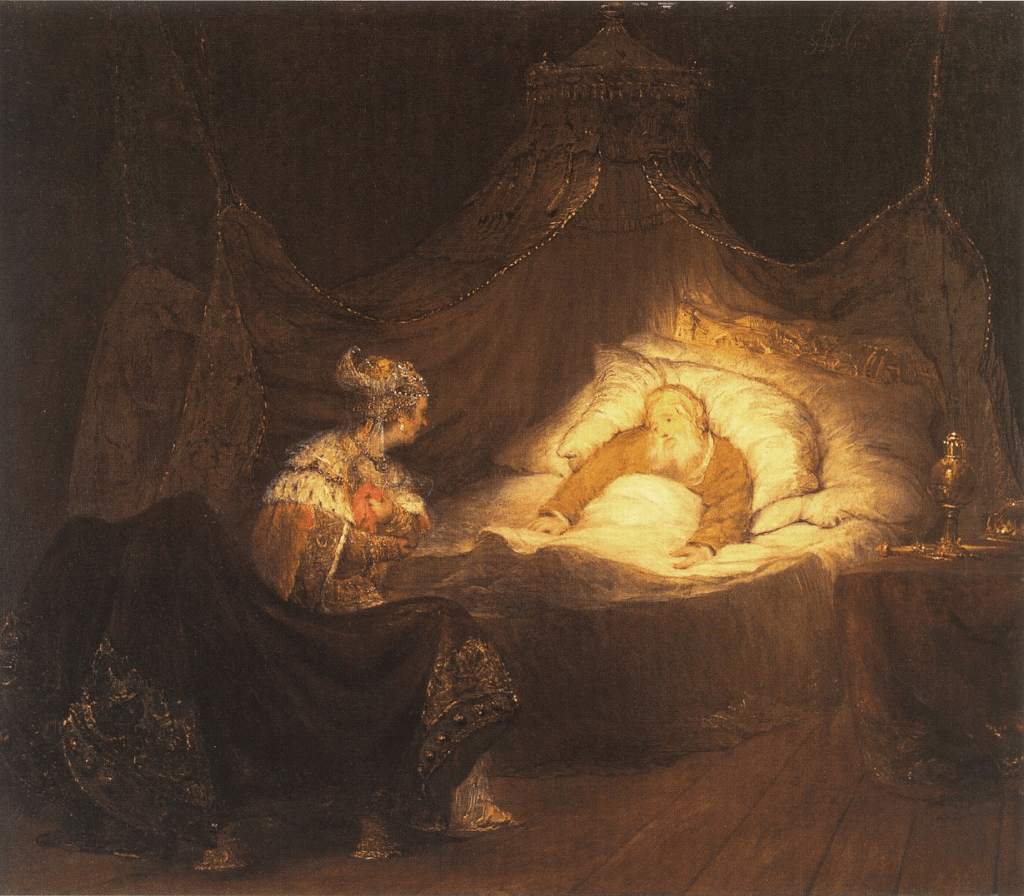
Solomon at the deathbed of King David, by Giulio Romano (1499-1546)

One of King David’s sons, Adonijah, was a stinker. He tried to pull a fast one on his aging father, in order to try and take the throne. But some of the people caught wind of what was afoot.

Even Nathan the prophet got involved and gave some sage instructions to Bathsheba, Solomon’s mother, so that the king’s wishes could come to fruition – namely, that Solomon would succeed David.

As a result, despite King David’s struggles toward the end of life, he had enough wherewithal to attempt some decisive leadership. He confirmed Solomon as his royal successor.

Despite Adonijah’s attempt to take advantage of his father’s failing capacity and execute a coup d’état, the king immediately took action by anointing and enthroning Solomon without any delay.

The installation of Solomon as king was accomplished so quickly that it caught the conniving Adonijah and his cohorts off guard. King David may have lost several steps in his old age, but he was still someone to be reckoned with. That underestimation would cost the connivers dearly.

To be honest, I don’t like Adonijah. And that’s what the storyteller wants us to feel. We are meant to read the narrative and walk away saying to ourselves that we don’t want to be like Adonijah; we don’t want injustice to have the day; instead, we want King David’s wishes honored, and to see a just and right Ruler ensconced as king.

The Lord is a just God. And since we are people created in God’s image and likeness, we have an inherent sense of justice down deep inside us. So, it drives people nuts whenever there are things happening which are not right nor good.

Everyone faces injustice, and things that are not right, in this life. The trick is to deal with it, without becoming unjust ourselves. It’s not an easy thing to do. It’s tough. So, how do we maintain being just while handling injustice?

The feeling of helplessness is rather uncomfortable, even painful. It doesn’t feel good to think that your efforts at doing right and being just don’t accomplish much of anything, and are only a drop in the bucket of what’s needed. It also doesn’t feel right whenever we see others going through injustice, and we have little to no way in helping the situation.

The first step in dealing with the world’s injustice is to acknowledge it. Don’t purposely ignore it, avoid it, or pretend that it isn’t there. Everything in life must be acknowledged before anything can be done about it – whether it’s dealing with an event, or your own emotions.

So, it is imperative that your care for yourself. And it’s the most important thing in being of service and help to others. Attend to the whole self – body, mind, emotions, and spirit – because it is necessary in order to move through unjust circumstances with health, confidence, and sobriety.

When facing injustice and dealing with it, no matter whether it concerns yourself or another, it’s good to keep in mind that our brains tend to gravitate toward the negative, to the detriment of seeing good and positive things.

Therefore, we must work at keeping our “compassion quotient” high, and not let our compassion turn to fatigue, then burn-out.

It seems that King David continually worked on maintaining a robust spirit and healthy self, so that, even when he was old, his compassionate and wise instincts kicked in – the ones he had spent a lifetime developing.

In contrast, Adonijah appears to have nurtured a self-centered and bitter spirit. He did not attend well to his spiritual and emotional health. His mind turned to the dark thoughts of intrigue and rebellion. Arrogance clouded his right mind. This would not end well for him.

Dealing with injustice is never easy. And it very much requires us to be healthy and just ourselves, so that when we are faced with issues of justice, we can deal with them in a good and right manner.

Almighty God, you have given all peoples one common origin.
It is your will that they be gathered together
as one family in yourself.
Fill the hearts of humanity with the fire of your love
and with the desire to ensure justice for all.
By sharing the good things you give us,
may we secure an equality for all
our brothers and sisters throughout the world.
May there be an end to division, strife and war.
May there be a dawning of a truly human society
built on love and peace. Amen.

Trust vs. Anxiety (Isaiah 30:15-18)

The holy Lord God of Israel
    had told all of you,
“I will keep you safe
if you turn back to me
    and calm down.
I will make you strong
    if you quietly trust me.”

Then you stubbornly said,
“No! We will safely escape
    on speedy horses.”

But those who chase you
    will be even faster.
As few as five of them,
or even one, will be enough
    to chase a thousand of you.
Finally, all that will be left
    will be a few survivors
as lonely as a flag pole
    on a barren hill.

The Lord God is waiting
to show how kind he is
    and to have pity on you.
The Lord always does right;
he blesses those who trust him. (Contemporary English Version)

God’s plan for our lives calls for times of retreat and renewal, of quiet patience and perseverance, for restraint and waiting.

Ancient Judah was experiencing one of their many periods of rebellion toward God’s commands. One of the things that happens – whether in ancient times or today – is that whenever we go off the road of God’s ways, our lives become characterized by a grand self-help program.

Those in the Judean royal court could not wait on God. They had to do something about Assyria. The Assyrian Empire was waning, and Judah wanted to take advantage of it, seeing an opportunity for some relative autonomy.

So, many of the activists in the royal court rushed to Egypt for help – not at all considering to turn toward God and wait on the Lord. God blesses those who trust and wait on divine promises and initiative. But, in their anxiety, the people of Judah would not exercise faith and patience.

As a result, the enemy would overtake them. The people’s refusal to take the quiet course would not end well for them.

On many days, as I attend to the hospitals for which I work, I visit many hurting people, including patients, their families, and teammates. In my time there, I deal with a vast array of emotional problems, spiritual struggles, and mental disorders. One of things I have discovered through this work is that people’s internal issues absolutely need to be expressed, out loud, to someone who cares and knows what to do with those expressions.

And this is not only a modern problem; the need to deal with our internal stuff has been there throughout all of human history. Every culture and society who does not attend well to personal and communal spiritual health is literally killing their bodies – because body and soul are inextricably connected in a union as one.

It continually amazes me that people who think nothing of going to a medical doctor, an emergency room, or having a surgery, would never think of getting help when their minds are mixed up, emotions are frayed, and spirits are downcast.

Stubbornly holding onto self-help to handle a spiritual crisis, refusing help from others, and ignoring God, is just as sure to kill you as believing that chest pains, shortness of breath, and inability to walk across the room will simply get better on its own.

Conversely, isolating oneself and calling it “waiting on God” and remaining passive – when the Lord has clearly told us to be active – will accomplish the same ends as the committed self-help person. Faith and action are not mutually exclusive terms. It takes some wisdom to know when to retreat, pray, and be patient; and when to take initiatives of faith, and trust God to work through action.

Rebellion gets us nowhere. It’s what puts us in the awkwardness of making bad decisions and discernments. The Lord had told the people of Judah to stay put and not rely on Egypt to help them. There were clear instructions through the prophets about what to do. But the people were too anxious, too impatient, wondering too much about whether God would show up or not.

The Spirit God gave us does not make us afraid. His Spirit is a source of power and love and self-control.

2 Timothy 1:7, ERV

No matter where we have been or what we have done, the Lord is continually waiting on us – and will consistently respond with grace and mercy to our petitions and overtures to live for God. It’s never too late to flee to God in quiet trust.

Running to God is not escaping our problems. Rather, the Lord enables us to face both our outward situations, as well as our inward thinking and feeling. It’s easy to engage in busywork and keep active when we are anxious; yet it is very difficult to sit still before God and be alone. Silence and solitude put us face to face with ourselves. And doing that is what many people would rather avoid.

“I’ll do it myself!” is the cry of many a person who is mentally, emotionally, and spiritually overwhelmed. That approach, however, is a highway to the grave. And, in fact, it is a stubborn rebellion that puts a stiff arm to God.

I’m not saying that opening-up is easy; I am stating that it is necessary to our spiritual and emotional health. It might be helpful to begin communicating with some vulnerability and authenticity to God. The following are some appropriate ways that might help:

  1. Be congruent between the outer self and inner self. Make sure your outside affect and behavior is congruent with your inside feelings and thoughts. If you are discouraged on the inside, but wear a smile and pretend to be spiritually with it, you’re not fooling God. You cannot receive grace apart from humble authenticity.
  2. Focus on feelings. You won’t get struck by lightning if you express your anger, or other emotions, to God. Be aware of how you are feeling. In fact, ask the Lord to help you understand your feelings. Share them openly as much as you can.
  3. Change questions into statements. Sometimes, when we have an attitude or a feeling, we’re afraid to say it and be open. So instead, we ask a question. Try changing questions such as “Do you love me?” into “I love you.” And, “Do you want me to do this?” to “I want to do your will.”
  4. Speak in the first person. Begin sentences with “I” instead of “you,” For example, ” I am happy that you are with me,” instead of asking, “Are you there?”
  5. Say out loud what you really want and need. It’s okay to do that. This is when it is appropriate to ask questions. The Lord’s ear is ready to listen.

Patient and confident trust in God is always a better option than anxious and nervous striving by yourself.

O God, the source of all health: So fill my heart with faith in your love, that with calm expectancy I may make room for your power to possess me, and gracefully accept your healing; through Jesus Christ our Lord. Amen.