Welcome, friends! Jesus let us in on how the world can be changed. For that to happen, there are some things we will need to die to. Click the videos below, and let’s find out….
John 12:20-33, Pastor Tim Ehrhardt
From the album by the Oslo Gospel Choir, “We Lift our Hands, Part 2” 2006
May the peace of God which surpasses all understanding, keep our hearts and minds in the knowledge and love of God, and of his son Jesus Christ our Lord; and the blessing of God almighty, the Father, the Son, and the Holy Spirit be amongst us and remain with us forever. Amen.
O give thanks to the Lord, for he is good; for his steadfast love endures forever. Let the redeemed of the Lord say so, those he redeemed from trouble and gathered in from the lands, from the east and from the west, from the north and from the south….
Some were sick through their sinful ways, and because of their iniquities endured affliction; they loathed any kind of food, and they drew near to the gates of death. Then they cried to the Lord in their trouble, and he saved them from their distress; he sent out his word and healed them, and delivered them from destruction. Let them thank the Lord for his steadfast love, for his wonderful works to humankind. And let them offer thanksgiving sacrifices, and tell of his deeds with songs of joy. (NRSV)
I’ve always found it a bit curious that there are people who continually equate the God of the Old Testament as nothing but a vengeful and wrathful God, continually perturbed and upset, exasperated with us stupid little sinful people. Certainly, there are sections in Scripture dealing with God’s wrath and the divine action spurred from not being okay with injustice running amok on the earth.
Everything God does comes from a place of love.
The Lord has never been okay with sin because it damages and destroys people who are meant for better things. Which is why, when people are in need and cry out to the Lord, God is there for them.
Far more prevalent is the reality that the Old Testament is thickly populated with references to God’s “steadfast love.” This is God’s covenant-keeping love. It is the kind of love that holds on and doesn’t let go. It’s the type of love that is tirelessly gracious, merciful, and kind. It is the love that has compassion on the needy and mercifully does something about their plight.
In today’s psalm, even when there were people sick and in distress because of their own doing, their own sin, and their own fault, God saved them from their mess. That, my friend, is precisely what God does – expertly delivers people with care and precision.
So then, we truly need to get some robust theology to overwhelm and break those old nasty ideas about a fickle God who shakes his finger at us when we screw up and gives a big disappointed *sigh* over our dumb decisions. Just as the psalms steadily and persistently portray to us a God of abiding love, they also equally tell us of a God who is “slow to anger,” not going off the handle quickly. (Psalm 86:15, 103:8, 145:8)
Know deep in your soul that God shows steadfast love.
God doesn’t tell us “I told you so” or “that’s what you get for sinning,” like some obnoxious and overzealous schoolgirl. Nope. God delivers and does it because of steadfast love. It flat out gives God pleasure to save and redeem wayward folk.
That’s why I believe people all over the world have learned to sing the praises of the God of the Bible. It’s why persons from every walk of life and every culture have found God as the great lover of humanity. Their overflowing response to such a loving God is singing, praising, thanking, and offering their lives to the great Lover of their souls.
If you or someone you know struggles with seeing God as capricious, indifferent, or angry, then I strongly urge a steady and daily diet of the psalms over the course of the next month. Call it an intervention of psalms. Reading just five psalms per day gets you through all one-hundred fifty of them in a month. More than that, pray the psalms. Allow them to give you a new perspective on the world, relationships, and self.
“God’s love is like when you sit in front of a fire in winter — you are just there in front of the fire. You don’t have to be smart or anything. The fire warms you.”
Desmond Tutu
This prolific reading of the psalms is not some new or weird thing. It has been around for an awfully long time. The daily recitation of the entire Book of Psalms was an early monastic custom, especially among the Desert Fathers of the 3rd and 4th centuries. By the time Saint Benedict came along with his Rule for monks (c.515 C.E.) many communities had settled on the weekly praying of the entire Psalter. As good old Benedict said, praying less than a full psalter a week betrays “extreme indolence and lack of devotion.”
That might seem over the top to modern readers, yet the big idea is that once the steadfast love of God from the psalms gets into your spiritual bloodstream, the praying and singing of the psalms becomes a delight. I can testify to that. Seems I cannot ever get enough of the psalms. Which really means I love the steadfast love of God!
The Psalms are, I believe, the fulcrum of the Holy Scriptures. They recite and reflect upon the historical acts of God in the Old Testament. They tell of the Lord’s continuing covenantal care for people. The Psalms express the full gamut of human emotion and spiritual devotion of the people of God. Reciting the Psalms aloud frequently puts us in good company with our spiritual ancestors in the faith.
So, what the heck are you waiting for? Go ahead. Read and recite today’s psalm over again and again. Let them do their gracious work in your spirit.
God of all that is good, your steadfast love has been shown to millions who find in you the desire of their hearts. May I see your overflowing goodness, your steadfast love, and your infinite mercy operating in this broken world and in my needy heart; through your Son, my Savior, Jesus Christ, who with you and the Holy Spirit lives and reigns forever. Amen.
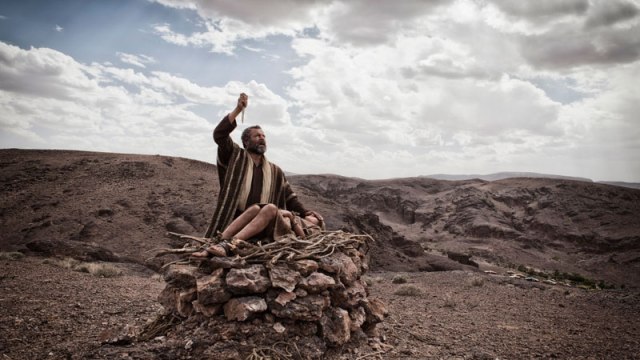
The Lord said, “Go get Isaac, your only son, the one you dearly love! Take him to the land of Moriah, and I will show you a mountain where you must sacrifice him to me on the fires of an altar.” So, Abraham got up early the next morning and chopped wood for the fire. He put a saddle on his donkey and left with Isaac and two servants for the place where God had told him to go.
Three days later Abraham looked off in the distance and saw the place. He told his servants, “Stay here with the donkey, while my son and I go over there to worship. We will come back.”
Abraham put the wood on Isaac’s shoulder, but he carried the hot coals and the knife. As the two of them walked along, Isaac said, “Father, we have the coals and the wood, but where is the lamb for the sacrifice?”
“My son,” Abraham answered, “God will provide the lamb.”
The two of them walked on, and when they reached the place that God had told him about, Abraham built an altar and placed the wood on it. Next, he tied up his son and put him on the wood. He then took the knife and got ready to kill his son. But the Lord’s angel shouted from heaven, “Abraham! Abraham!”
“Here I am!” he answered.
“Don’t hurt the boy or harm him in any way!” the angel said. “Now I know that you truly obey God, because you were willing to offer him your only son.”
Abraham looked up and saw a ram caught by its horns in the bushes. So, he took the ram and sacrificed it in place of his son.
Abraham named that place “The Lord Will Provide.” And even now people say, “On the mountain of the Lord it will be provided.”
The Lord’s angel called out from heaven a second time:
You were willing to offer the Lord your only son, and so he makes you this solemn promise, “I will bless you and give you such a large family, that someday your descendants will be more numerous than the stars in the sky or the grains of sand along the beach. They will defeat their enemies and take over the cities where their enemies live. You have obeyed me, and so you and your descendants will be a blessing to all nations on earth.”
Abraham and Isaac went back to the servants who had come with him, and they returned to Abraham’s home in Beersheba. (CEV)
The biblical character of Abraham is synonymous with faith. And for good reason. God had told Abraham he would have a son with his wife Sarah. This would not be unusual except for the fact the couple were well advanced in age, and Sarah was incapable of having children. Infertility is not just a modern problem; it has always existed. Yet, despite the overwhelming odds, Abraham believed God. Years later and with a mix of patience and impatience from the would-be parents, the promise from God was realized. Abraham and Sarah had a son, Isaac.
“Child of the promise.” That was Isaac’s moniker – which makes the command coming from God so incredibly perplexing: Take your son, the child of the promise, and go to the mountain and sacrifice him there. Huh? What the…! But it only seems strange and super-weird to us. We get no reaction from Abraham, no questioning, no talk back. He simply went about the business of saddling up the donkey, chopping some wood for the sacrifice, and took his only son with him on the journey to the mountain.
We might wonder what was going through Abraham’s mind through all of this. While you and I might try and figure out if we really heard God or not, Abraham had a history of talking with God. He knew God’s voice as well as he knew his own. Abraham was well down the road of relationship with the God he served. We get an insight from the author of Hebrews into Abraham’s thought process, a line of thinking consistent with a person who has a regular habit of talking with God:
“Abraham had been promised that Isaac, his only son, would continue his family. But when Abraham was tested, he had faith and was willing to sacrifice Isaac, because he was sure that God could raise people to life. This was just like getting Isaac back from death.” (Hebrews 11:17-18, CEV)
Abraham did not try and figure out God’s mind. He didn’t get into a debate with God about the contradiction of ethics he was being asked to do. He just obeyed. Abraham reasoned that it didn’t matter if Isaac were killed because God could raise him from death. This, of course, is not what happened. It was all a test of faith. Abraham knew beyond a shadow of a doubt that God is the Lord who provides.
You and I rarely know why we are facing the unwanted and unasked for circumstances we are enduring. We don’t always know what in the world God is thinking. Yet, like Abraham, if we have a spiritual history of walking with God and hearing the Lord’s voice, we don’t hesitate to respond. We are convinced God will provide. Obedience for the follower of Christ is not a burden but a privilege, even when we are being tested beyond our seeming emotional ability to do it.
Sovereign Lord, your ways are sometimes strange and confusing. Yet, I know that everything you do is always right, just, and good. It is to your gracious and merciful character that I know you will provide. My allegiance is to you, in the Name of Jesus Christ, through the power of the Holy Spirit. Amen.
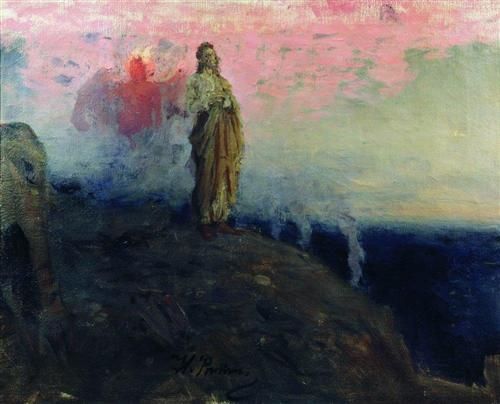
Jesus Tempted by Russian painter Ilya Repin (1844-1930)
Jesus was led by the Spirit into the wilderness to be tempted by the devil. After fasting forty days and forty nights, he was hungry. The tempter came to him and said, “If you are the Son of God, tell these stones to become bread.”
Jesus answered, “It is written: ‘Man shall not live on bread alone, but on every word that comes from the mouth of God.’”
Then the devil took him to the holy city and had him stand on the highest point of the temple. “If you are the Son of God,” he said, “throw yourself down. For it is written:
“‘He will command his angels concerning you, and they will lift you up in their hands, so that you will not strike your foot against a stone.’”
Jesus answered him, “It is also written: ‘Do not put the Lord your God to the test.’”
Again, the devil took him to a remarkably high mountain and showed him all the kingdoms of the world and their splendor. “All this I will give you,” he said, “if you will bow down and worship me.”
Jesus said to him, “Away from me, Satan! For it is written: ‘Worship the Lord your God and serve him only.’”
Then the devil left him, and angels came and attended him. (NIV)
In our most vulnerable moments, the devil attempts to swoop in and offer his demonic delights for us to consider. We call it “temptation.” Indeed, it can be quite alluring to entertain ways of getting what we need and want through avenues other than God.
In the desert, the place of preparation for ministry, Jesus fasted and prayed forty days. If ever there was a time when Jesus would be vulnerable to alternative religion, the devil mused, wringing his demonic hands together with wicked delight, it would be out in the desert by himself. So, Satan tempted Jesus with three whoppers he thought would get to Jesus, for sure. Having tempted Jesus with food and a way to fame, and having failed both times, Satan gave his final temptation.
To us this temptation to bow down and worship Satan seems like a no-brainer. Well, of course, no one would do such a thing as this, especially Jesus. And he did not. But it was still tempting. It really was. Jesus knew very well what was ahead of him. He had just spent forty days in an intense orientation for an upcoming three years of hard ministry with an end of tortuous death to look forward to.
Satan presented to Jesus an alternative way, a different path to achieve his purpose for being on this earth. Jesus could have it all without the three years, without the hard slugging to communicate the kingdom of God has come. Most of all, Jesus could circumvent the cross and establish his rule over all the earth – all pain free! The temptation, yes, was very tempting. Become King Jesus now with no suffering.
This has always been one of our great temptations, as well: Take the easy path. Get what you want, what you deserve, now, with no hardship.
The values of God’s kingdom include trust, patience, and perseverance. Temptation insists we need none of those hard things to be successful. Satan is the original slickster, marketing his quick and easy wares for people to buy into the notion that life can lived without pain and hardship, and with wild success, right now. The scary thing about it is that Satan can deliver… but it will cost us our very lives. Slavery to sin is the price we pay for hitching our hopes to the quick and easy.
The Christian season of Lent is a time for the slow, patient, deliberate development of the soul in attachment with the Lord Jesus. Engaging in spiritual disciplines is hard. It is difficult to fast and pray. Growing in Christ is slow and takes a great deal of learned perseverance. Far too many of us are tempted to circumvent the hard work of discipleship and simply have a spiritual professional distill everything we need into one hour on Sunday morning. Or we fabricate our own religious practice and beliefs, picking and choosing what fits our lifestyle, as if convenience and comfort are the summum bonum of life, instead of worship.
Christ was able to face down temptation because the desert strengthened him. Yes, he was vulnerable. But he was not weak. If we want to handle temptation, it will take Lent to help us. It will take the desert to spiritually form us and prepare us for godly ministry that puts the devil in his place.
Lord Jesus, you are the king of all creation. Just as you chose the hard path of God’s kingdom, so help me to persevere with faith and patience. May my life reflect your words and ways, in the power of the Holy Spirit. Amen.








 Rev. Tim Ehrhardt