God’s Glory Is Everywhere (Psalm 19)

The heavens declare the glory of God,
and the sky displays what his hands have made.
One day tells a story to the next.
One night shares knowledge with the next
without talking,
without words,
without their voices being heard.
Yet, their sound has gone out into the entire world,
their message to the ends of the earth.
He has set up a tent in the heavens for the sun,
which comes out of its chamber like a bridegroom.
Like a champion, it is eager to run its course.
It rises from one end of the heavens.
It circles around to the other.
Nothing is hidden from its heat.

The teachings of the Lord are perfect.
They renew the soul.
The testimony of the Lord is dependable.
It makes gullible people wise.
The instructions of the Lord are correct.
They make the heart rejoice.
The command of the Lord is radiant.
It makes the eyes shine.
The fear of the Lord is pure.
It endures forever.
The decisions of the Lord are true.
They are completely fair.
They are more desirable than gold, even the finest gold.
They are sweeter than honey, even the drippings from a honeycomb.
As your servant I am warned by them.
There is a great reward in following them.

Who can notice every mistake?
Forgive my hidden faults.
Keep me from sinning.
Do not let anyone gain control over me.
Then I will be blameless,
and I will be free from any great offense.

May the words from my mouth and the thoughts from my heart
be acceptable to you, O Lord, my rock and my defender. (God’s Word Translation)

Today’s psalm is a celebration of God’s self-revelation. Through both nature and law, the Lord has graciously made the divine life known to humanity. What’s more, God’s moral and ethical teachings provide insight for living a good life. All of this is for the common good of everyone.

The vision of the psalm is of a personal God, not an abstract deity who is aloof from creation. Through both land and law, there is the Lord of life, desiring humanity to know the divinity which infuses it all and has people’s best interests continually at the forefront of providence and goodwill.

The created world witnesses to God. Creation manifests the glory of its Creator. Each creature and every created thing have the capacity to acknowledge and declare their Originator. That which has no mouth can speak. Those with no vocal cords have a voice. We can hear them, that is, if our ears are open to listen.

The creation is not God. Yet the created world and order knows the Lord so intimately that it sometimes seems as if the sun, the trees, the mountains, and the meadows are divine. The divine stamp is there, testifying with mysterious unspoken words to a glorious God who desires to be known.

So, the Lord graciously gave us law. God’s righteous and good law flows seamlessly from God’s good character. Law is the divine medium for humanity, a guide for human life toward thriving and flourishing on God’s good earth.

We were put on this planet with instructions on how to get along on it. It is when we throw out the rulebook and improvise that we tend to get into all kinds of trouble.

Yet, even when we go our own way and dig our own grave, and end up falling into it, God is there. Grace is available for the asking, redeeming the wayward life.

Deliverance is a real possibility, to set us aright again, and restore us to our full luster as people created in the image of God. Law and land converge to guide us into grateful living, into the wisdom of dealing rightly in all things.

Wisdom in the Old Testament is the combination of knowledge and practice. It is the application of God’s self-revelation to concrete situations in life. We live wisely when we get to know the sovereign God of creation and use the Lord’s revealed mores and ethos as our guide in daily experiences.

We need God’s gracious revealed law. It’s not just for theology nerds or spiritual eggheads; God’s law is for everyone – the learned and the unlearned. Every one of us needs the guidance and direction of God’s Holy Word, and the careful application of it to all our circumstances. That’s wisdom.

You and I are shaped and formed as godly people as we allow God’s Word to awash us and seep into our souls.  Reading this psalm out loud slowly and contemplatively more than once is an opportunity to let our common ordinary experiences transform into divine appointments.

God’s glory is everywhere. We just need the deep spirituality given to us to help us see divine glory in all the myriad ways it comes to us every day.

Clean the slate, God, so we can start the day fresh! Keep me from stupid and idiotic sins, from thinking I can take over your work. Then I can start each day sun-washed, scrubbed clean of sin’s awful grime. Let me not be found in the dominion of darkness but bask in the glorious light of your glory. Accept both my words and my life when I place them on the morning altar, O God, my Rock, my Deliverer, my Redeemer, my All. Amen.

Impatient (Genesis 16:1-6)

Sarai and Hagar, by Cody F. Miller

Now Sarai, Abram’s wife, had borne him no children. But she had an Egyptian slave named Hagar; so she said to Abram, “The Lord has kept me from having children. Go, sleep with my slave; perhaps I can build a family through her.”

Abram agreed to what Sarai said. So after Abram had been living in Canaan ten years, Sarai his wife took her Egyptian slave Hagar and gave her to her husband to be his wife. He slept with Hagar, and she conceived.

When she knew she was pregnant, she began to despise her mistress. Then Sarai said to Abram, “You are responsible for the wrong I am suffering. I put my slave in your arms, and now that she knows she is pregnant, she despises me. May the Lord judge between you and me.”

“Your slave is in your hands,” Abram said. “Do with her whatever you think best.” Then Sarai mistreated Hagar; so she fled from her. (New International Version)

In a convoluted series of decisions, mostly outside of her control, Hagar became pregnant with Abraham’s son. Although it may seem strange to us today, the practice of building a family line through a surrogate – in this case the slave of the household’s mistress Sarai – was not an unusual way of handling infertility in the ancient world.

Yet, things went awry with that approach. God had promised that a son of Abram’s own flesh and blood would inherit the divine covenant. But it wasn’t happening quickly enough for his wife Sarai. And this impatience led to the worldly approach of trying to gain an heir.

Impatience

Throughout Holy Scripture, patience is a virtue, as well as a spiritual practice to be cultivated. Impatience is the ants-in-your-pants response of wanting something now, without all the fuss and effort of planting and cultivating. The inability to wait is the desire for an instant harvest of righteousness.

The spiritual life of patience, however, like every other virtue, requires progressive growth over a long period of time. That is the only way of attaining any sort of spiritual maturity in this life. To go with shortcuts, or ingenious plans for quickness and efficiency, will not end well.

And it only short circuits the spiritual growth and formation of the believer. Like a farm-factory-raised animal who has been given growth hormones to speed things along, the fallout is the mistreatment of creatures – both animal and human – in shortened lifespans and poor quality of life.

Perhaps the original ancestor of Sarai, Eve, also had a bit of impatience in wanting to gain wisdom, now, from the tree of the knowledge of good and evil. And maybe the original ancestor of Abram, Adam, was okay with letting Eve follow through with an impatient plan.

It could be that both Adam and Abram just wanted to keep their spouses happy; and so, they let them do whatever the heck they wanted in order to keep the peace. It certainly wouldn’t be the only time this ever happened in history.

A commitment to submitting to the process of developing patience is a must – otherwise, the believer will give up and retreat into half-baked ideas for getting what they want, without all the hard work. We also need to realize that patience itself is a great reward, and worth all the energy it takes to possess it.

Be patient, then, brothers and sisters, until the Lord’s coming. See how the farmer waits for the land to yield its valuable crop, patiently waiting for the autumn and spring rains. You too, be patient and stand firm, because the Lord’s coming is near.

James 5:7-8, NIV

What’s more, the effects of impatience are murmuring and complaining to God and others, leading to depression and anxiety. That’s what happened to the ancient Israelites in the desert when it was taking too long to get to the Promised Land:

They traveled from Mount Hor along the route to the Red Sea, to go around Edom. But the people grew impatient on the way; they spoke against God and against Moses, and said, “Why have you brought us up out of Egypt to die in the wilderness? There is no bread! There is no water! And we detest this miserable food!” (Numbers 21:4-5, NIV)

Worldliness

If we give the attainment of patience it’s due attention, then a lot of ungodly worldliness can be avoided. In Holy Scripture, “the world” is many times used not as a reference to the people of the earth, but as an inordinate interest in, concern with, or devotion to the systems, organizations, and institutions of this world that operate by unjust means.

Do not love the world or anything in the world. If anyone loves the world, love for the Father is not in them. For everything in the world—the lust of the flesh, the lust of the eyes, and the pride of life—comes not from the Father but from the world. The world and its desires pass away, but whoever does the will of God lives forever. (1 John 2:15-17, NIV)

Worldliness, then, is an obstacle to that which is good, right, and just; it is in opposition to and independence from God. In short, worldliness isn’t some sort of sophisticated intelligence, but is a way to get what we want apart from virtue and godliness. But God’s grace can be our teacher to a better way of life:

For the grace of God has appeared that offers salvation to all people. It teaches us to say “No” to ungodliness and worldly passions, and to live self-controlled, upright and godly lives in this present age, while we wait for the blessed hope—the appearing of the glory of our great God and Savior, Jesus Christ.

Titus 2:11-13, NIV

Conclusion

Patience is one of the hardest lessons in life to learn. Yet, a devotion to becoming skilled in the art of patience, and of forsaking the practice of impatience, can reap both existential and eternal rewards. And it will keep us from going down the path of worldly temptation; and delivered from the machinations of the evil one.

Perhaps with patience, Sarai could have avoided mistreating her servant; and maybe Abram could have stood up and held her accountable. Together, they would eventually embrace faith in it’s fullness and enjoy the blessing of a son from Sarai’s own womb. Yet, today’s Old Testament lesson would always serve as part of their history to learn from. And, thankfully, we can learn from it, as well.

Almighty God, support your people and grant us patience in all our circumstances and miseries.
Lord, when in the midst of trials and temptations, suffering and injustice, give us patience.
When wracked with pain, illness, and lack of sleep, give us patience.
When burdened with afflictions, wonderings, and loneliness, give us patience.
When overcome by fear, and all our spiritual energy is dried up, give us patience.
When distractions grab our attention, bring us back, and grant us patience, O Lord. Amen.

A Desert Spirituality (Mark 1:9-15)

In those days Jesus came from Nazareth of Galilee and was baptized by John in the Jordan. And just as he was coming up out of the water, he saw the heavens torn apart and the Spirit descending like a dove upon him. And a voice came from the heavens, “You are my Son, the Beloved; with you I am well pleased.”

And the Spirit immediately drove him out into the wilderness. He was in the wilderness forty days, tested by Satan, and he was with the wild beasts, and the angels waited on him.

Now after John was arrested, Jesus came to Galilee proclaiming the good news of God and saying, “The time is fulfilled, and the kingdom of God has come near; repent, and believe in the good news.” (New Revised Standard Version)

40 Days of Desert

We are in the season of Lent in the Christian Year. Beginning with Ash Wednesday, Christians take a forty-day journey, leading to Holy Week and Easter. Jesus spent forty days in the desert being tempted by Satan. So, the Church remembers this event with the season of Lent.

This is the season in which many Christians give focus to the temptations we face on a regular basis. We intentionally practice spiritual disciplines, such as fasting, and give up something for six weeks, so that we might become aware of our attachments to other things and how much we rely on them, instead of trusting God.

It was important for Jesus to be in the desert; and it’s necessary for us, as well. Jesus retraced the steps of the ancient Israelites, who wandered in the desert for forty years before entering the Promised Land. The people needed to re-connect with God, after having failed in their faith. Trust had to be strengthened and developed before they could be ready to receive God’s promises.

Jesus accomplished what others did not: He faced down the devil and overcame temptation in the desert. 

The forty days were a necessary preparation for the upcoming three years of ministry that would culminate in Christ’s death, burial, and resurrection. Before any of that could happen, Jesus had to experience the desert.

We, like Jesus, need a desert spirituality. The desert forms us into followers of Jesus by learning to overcome temptation, so that we will not be shaped into followers of Satan. God desires to strengthen our faith, and facing down the temptations of Satan are crucial to our spiritual development.

For Christians, the desert becomes the gymnasium where we are broken down through the stress of temptation, so that we might become spiritually stronger in our faith. Without this kind of spiritual training, we become vulnerable to Satan’s accusations, and easy prey to his temptations.

Christ’s Desert

After the baptism of Jesus, the Spirit flung him into the desert. There was real danger in the desert, wild animals and all. Yet, put in that situation and having come through it, Jesus was able to deal with the crafty pursuits of Satan to distract him from his mission. 

Throughout the Gospel of Mark, after tossing demons out of people, Jesus commanded the unclean spirits not to tell anyone who he was. Part of what was going on, is that Satan wanted to tempt Jesus to gain fame and power through popularity and accolades. But that was not the way of Jesus. He was not going to bring in the kingdom of God through the avenues of careful marketing and brand recognition.

Another practice of Jesus throughout his ministry was to seek places for solitude and prayer. The needs Jesus daily faced were large and vast and never ended. Yet, he resisted working without any rest or guidance in prayer. 

A temptation could have been to please people and never get away to pray. Yet, through solitude and prayer, Jesus connected with his Father; he moved from place to place proclaiming the good news of God’s rule and reign. Jesus did not succumb to the temptation to settle in one place and build a petty kingdom of his own, apart from the Father.

As Jesus walked the countryside telling people of repentance and faith, he often spoke in parables that were designed to foster thought and reflection. Jesus was not duped by the temptation to always be black and white about everything, merely giving the bottom line of his teaching to people. 

Christ did not teach in order to get immediate results, or to let people know which side he was on concerning the issues of the day. Instead, Jesus was about the business of building something permanent that would far outlast his short three years of ministry.

Because of the desert, and through his Father’s affirmation, Jesus lived a unique three years on this earth that has never been equaled before or since.

Our Desert

Years ago, I went on a leadership retreat in the Canadian wilderness. We were so far out in the sticks that we needed special first aid training before leaving, because if someone got severely injured it would be hours before he could receive any medical attention. There was no cell phone service, no towns, no anything except mile after square mile of wilderness. 

We were continually vigilant to not attract bears. The wilderness can be a dangerous place. One day, we were each dropped off on our own personal islands for an entire day, alone. Being face to face with yourself can be hard to deal with, which is what a desert experience does – it exposes the idols of our hearts and the ways in which we are tempted.

A person does not need to be in the Canadian wilderness or in the actual desert to experience the effects of desert life. The Holy Spirit has a way of throwing us into the desert through a change of circumstance, so that we will exercise our spiritual muscles and get in spiritual shape. 

The top three temptations that people face on a daily basis are: 

  1. Worry and anxiety
  2. Procrastination and putting things off
  3. Gossip and other sins of the tongue 

So, how do we face down those temptations and retrace our steps back to the path of God? Here are some lessons I have learned in my own desert experiences:

  1. Know your weaknesses. Know yourself, and the temptations directed at you. The three I just mentioned all come from a tendency toward perfectionism. We worry about the future, of not saying or doing something perfectly. So, we procrastinate for fear of screwing up and not being perfect. And we gossip to others about their faults and weaknesses because it maintains the illusion that our perfectionism is intact, at least as compared to others. Perfectionism is slavery. For freedom Christ has set us free. Stand firm, therefore, and do not submit again to a yoke of slavery. (Galatians 5:1, NRSV)
  2. Understand the importance of timing. When are you at your weakest, and vulnerable to temptation? What triggers you to sin? Whenever kids act up, we first wonder if they are tired or hungry or have some other need. It’s the same with us. Carrying sleep debt, skipping meals, or eating junk food because we are in a hurry, will set us up for temptation. Elijah faced down four-hundred prophets of Baal, then fell apart when one woman, Jezebel, went after him. He needed food and rest. Discipline yourselves; keep alert. Like a roaring lion your adversary the devil prowls around, looking for someone to devour. (1 Peter 5:8, NRSV)
  3. Look to God and others. Don’t rely solely on your own willpower; or believe that you can resist temptation all by yourself, all the time. Even Jesus looked both to his Father and his disciples. Then Jesus went with them to a place called Gethsemane, and he said to his disciples, “Sit here while I go over there and pray.” He took with him Peter and the two sons of Zebedee and began to be grieved and agitated. Then he said to them, “My soul is deeply grieved, even to death; remain here, and stay awake with me.” And going a little farther, he threw himself on the ground and prayed, “My Father, if it is possible, let this cup pass from me, yet not what I want but what you want.” Then he came to the disciples and found them sleeping, and he said to Peter, “So, could you not stay awake with me one hour? Stay awake and pray that you may not come into the time of trial; the spirit indeed is willing, but the flesh is weak.” (Matthew 26:36-41, NRSV)
  4. Have a plan. Flying by the seat of your pants will not always work. The clever see danger and hide, but the simple go on and suffer for it. (Proverbs 22:3, NRSV) One of the ways I personally resist temptation is by having a daily plan of worshiping God, praying, and reading Scripture at set times throughout the day. For me, it’s significant to have more than a few minutes of “quiet time” in the morning.
  5. Overcome evil with good. Do not be overcome by evil, but overcome evil with good. (Romans 12:21, NRSV) Applying this to the top three temptations people face, that means worriers will love their enemy and pray for those who persecute. For the procrastinator, it means to take intentional steps of faith and risk, being real and vulnerable with others through accountable relationships. For the gossip, they will seek to speak words of encouragement that build others up.
  6. Know that you are never alone. Angels attended Jesus. Even the Son of God was not on his own.  Whatever you are facing is likely not unique to you. Others face it, too. Our brothers and sisters throughout the world are undergoing the same kind of problems when they seek to walk with Christ.

Let the desert shape and strengthen your faith. If the Holy Spirit has thrown you into a dry place, then instead of bucking the situation and complaining about it, learn all you can about resisting temptation so that you can come out the other end a stronger, more faithful follower of Jesus Christ. 

May it be so, to the glory of God.

Jesus the Mentor (Mark 3:13-19)

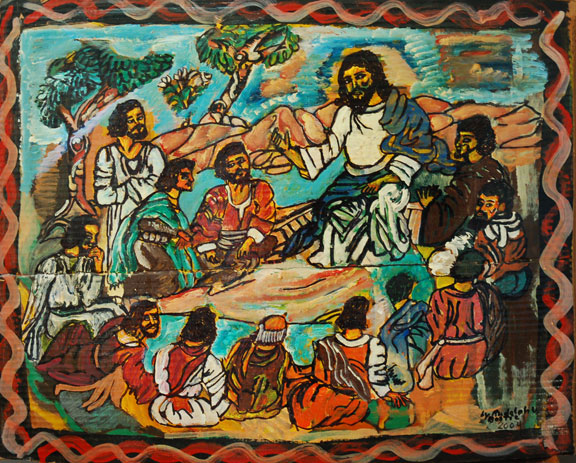
Jesus and the Disciples, by Rudolph Bostic

Jesus went up on a mountainside and called to him those he wanted, and they came to him. He appointed twelve that they might be with him and that he might send them out to preachand to have authority to drive out demons. These are the twelve he appointed: Simon (to whom he gave the name Peter), James son of Zebedee and his brother John (to them he gave the name Boanerges, which means “sons of thunder”), Andrew, Philip, Bartholomew, Matthew, Thomas, James son of Alphaeus, Thaddaeus, Simon the Zealotand Judas Iscariot, who betrayed him. (New International Version)

For me, every place in Holy Scripture is significant, even the seemingly mundane portions of it. Today’s verses might appear rather insignificant. However, there is some important meaning to recording who Christ called as his disciples and why he did it.

Jesus appointed twelve Jewish men to be his close disciples, his apostles. In choosing them, let’s not read into it something that isn’t there. This choosing, in no way, is meant to convey that church leadership boards are always supposed to have twelve men. It seems to me, that if such churches believe this, they ought to go all the way by insisting that they ought also to be Jewish Christians – no Gentiles on the election ballot at the annual meeting!

Excluding women, maintaining a particular number of people to a group, or considering only one ethnicity to leadership is nowhere to be interpreted in this text of Scripture. I can imagine Jesus sitting at the right hand of the Father raising a Spock-like eyebrow to such hermeneutical gymnastics and stating the lone word, “fascinating!”

A disciple is a follower. An apostle is one who is sent out with a specific purpose. Jesus called these particular people in order to send them out with a mission. In other words, Christ’s disciples are really missionaries. And these apostles, these missionaries, are appointed in order that they might be with Jesus, follow him everywhere, learn from him, and then have the received authority to go out and accomplish the mission given them to do.

An apostle can only properly carry out the instructions of the Teacher by first being a disciple who spends copious amounts of time in that Teacher’s presence. Indeed, if we are looking for some contemporary application in these more mundane texts of Scripture, let us find here an insight into our own Christian formation.

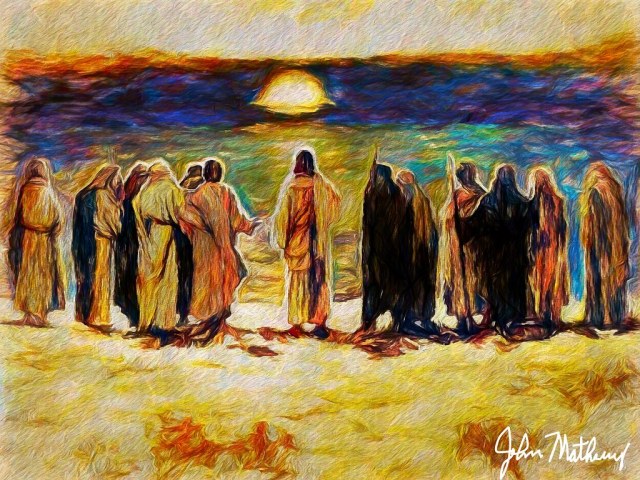
Jesus and the Disciples, by John Mathews

Christian ministry is rightly patterned after the Teacher we follow, Jesus our Lord. Christ himself demonstrated for us the way of mentoring or discipling, through his own words and actions. He called particular individuals, taught them, and equipped them for spiritual warfare in this world by granting them authority to do the work.

If we need a pattern, there it is. It’s a model of mentoring others in the ways of Christian mission and ministry. The idea is that we call, teach, equip, and authorize others in the words and ways of Jesus. I really don’t much care what you call it: Christian discipling, relational mentoring, small group teaching, spiritually forming, or any other word or phrase.

The important thing is to actually understand and do this very Christ-like work of developing mature followers of Jesus who can do the important work of spiritual warfare and ministry, then in turn, develop others. We are to pass on a body of faith and doctrine, of mission and ministry, to a group of people who will do the work. And they then do the same for others.

I rather like the word “mentoring” because for most people it evokes the idea of putting time and effort into some relationships for a specific purpose. And when we look at Christianity as a great mentoring project, perhaps we will see why church is becoming a byword in many parts of the Western world. This also ought to perhaps clue us into how we might move forward as Christians.

I am suggesting that, generally speaking, we have neglected this pattern of Jesus in calling, teaching, equipping, and authorizing. It is one large reason why there is such a decline in church attendance (and participation) in the West. And until we collectively take up this mantle of mentoring ministry, we shall continue to lessen, because we are irrelevant to people’s daily lives – both inside and outside the church.

As a first course of action, I invite you – no matter your age or stage in life – to make it a priority to simply “hang out” with individuals and groups of people. Maybe that sounds like an extrovertish sort of thing to do. However, this invitation is coming from me, an introvert. I didn’t say you have to be the life of the party, or engage in a lot of talking. But I am saying that mature followers of Jesus ought to strongly consider some intentional relationships with people other than family and a few friends.

Hang out around any given church, on any given Sunday, after any given worship service, and you are likely to see small groups of people talking with each other. Those groups typically center around friends according to age. What is often lacking are intentional interactions between the generations.  

Ethiopian Orthodox Church depiction of Christ and his disciples

The younger generations (particularly persons aged 18-29) often need and want to have relationships with more experienced (older!) believers in the faith. Younger adults, however, tend to lack the confidence to go after older adults in order to be mentored or influenced by them. I believe the onus is on the older generations to go after the younger.  

Maybe I’m just old, but it seems like younger generations have an incredible array of relationships, differing levels of friendship, and a complexity to their interactions that I didn’t have “back in my day.” What’s different, it seems, is that their relationships are more gray, and less black and white. And they appear to do a solid amount of hanging out.

Hanging out is typically sitting around with a group of people, eating and drinking, watching movies, studying (or doing bible study) or any other activity. Its doing just about anything, but doing it together with others. And this is the perfect environment for initially establishing how to begin living into the words and ways of Jesus to mentor others.

One of the things we older folks can do is to really understand the reality of younger generations’ relational interactions. For example, when I lived in a university town I used to often just “hang out” with college students, with no agenda other than just being with them. The local Perkins restaurant was at its busiest at midnight, filled with college students hanging out.

There are places in every town and city where young adults go, especially the bar scene. Bars aren’t just places to drink, but are locations of conviviality where persons have the chance to be around one another in a kind of secular church where fellowship happens, looking for a chance to relate meaningfully with others.

All people desire intimacy and want to know that someone else cares about them. This is a very real and felt need. How that need is going to be met can be either legitimate or illegitimate. And we can help with that.

One of the best things we can do for others is to communicate to them that we “have their back,” that we care, love, and genuinely like them.

No one can sniff out a disingenuous attitude quite like a young adult. So, our interactions have to be an authentic desire to be around them. Also, this does not mean we have to pretend to be younger than we are. Instead, one of the greatest needs a young person has is to be in a mentoring relationship with someone older and wiser who can help them navigate life and bring some sort of definition to relationships that they may lack.

The older generations could learn to “hang out” with younger generations and find individuals for whom they can build a solid one on one or group relationship with. If they can have such relationships now, it will serve them for a lifetime.

It seems to me that, as I look at the biblical text, being a mentor, and walking alongside another with love, grace, and wisdom, is built into Christianity by Jesus himself. So, let’s consider how we might best go about this important work.

May your love overflow more and more with knowledge and full insight to help you to determine what really matters, so that in the day of Christ you may be pure and blameless, having produced the harvest of righteousness that comes through Jesus Christ for the glory and praise of God. (Philippians 3:9-11, NRSV)