The Effects of Bad Decisions (2 Samuel 12:15-25)

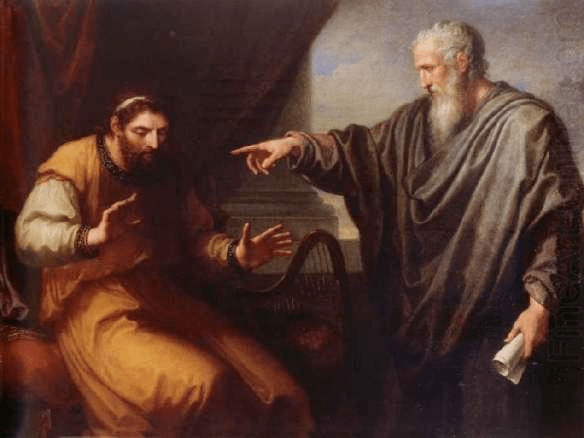
David and Nathan, by Angelika Kauffman (1741-1807)

After Nathan had gone home, the Lord struck the child that Uriah’s wife had borne to David, and he became ill. David pleaded with God for the child. He fasted and spent the nights lying in sackcloth on the ground. The elders of his household stood beside him to get him up from the ground, but he refused, and he would not eat any food with them.

On the seventh day the child died. David’s attendants were afraid to tell him that the child was dead, for they thought, “While the child was still living, he wouldn’t listen to us when we spoke to him. How can we now tell him the child is dead? He may do something desperate.”

David noticed that his attendants were whispering among themselves, and he realized the child was dead. “Is the child dead?” he asked.

“Yes,” they replied, “he is dead.”

Then David got up from the ground. After he had washed, put on lotions and changed his clothes, he went into the house of the Lord and worshiped. Then he went to his own house, and at his request they served him food, and he ate.

His attendants asked him, “Why are you acting this way? While the child was alive, you fasted and wept, but now that the child is dead, you get up and eat!”

He answered, “While the child was still alive, I fasted and wept. I thought, ‘Who knows? The Lord may be gracious to me and let the child live.’ But now that he is dead, why should I go on fasting? Can I bring him back again? I will go to him, but he will not return to me.”

Then David comforted his wife Bathsheba, and he went to her and made love to her. She gave birth to a son, and they named him Solomon. The Lord loved him; and because the Lord loved him, he sent word through Nathan the prophet to name him Jedidiah. (New International Version)

The backstory to today’s Old Testament lesson is that King David not only screwed up, but he also jumped off the diving board into a big nasty pool of immoral excrement.

He saw a woman, Bathsheba, and had to have her. Thinking of only his desire, and not her needs, or that she was a married woman, he used his royal authority to get her. And he slept with her. What’s more, she became pregnant by the king.

At that point, David went to the dark side by covering up his immorality and shame. He eventually went so far as to ensure that Bathsheba’s husband, Uriah (who was both an upright man and an innocent victim) was killed in battle. The king again used his authority to arrange a murder to look like a death in military battle.

With Uriah dead, David brought Bathsheba to his palace as another one of his wives. And no one was the wiser… Except God, who was very displeased with the entire affair. So, the Lord sent Nathan the prophet to David. Through the savvy use of parable, Nathan was successful in helping the king to see his own terrible guilt.

To King David’s credit, he came to the point of recognizing his great faults, and repented of his awful doings. And to God’s credit, David was forgiven.

However, despite the reality of repentance and forgiveness, there are still consequences to our actions. And what is heartbreaking, is that the effects of our bad decisions and bad actions can and do affect others.

As a result of one man’s sin, a woman was violated, a man was murdered, and a baby was conceived, born, and soon died.

Bathsheba attends to her child as David fasts and prays, by W.A. Foster, 1897

King David came to the point of understanding this reality. True repentance, forgiveness, and faith, leads us to a real life which exudes genuineness and authenticity. It won’t undo the past; yet, it will affect the present, and can change the future – that is, if we let mercy and grace have its way.

David’s genuine fatherly love came from his restored place, and was shown by his authentic grieving and mourning. He did not want Bathsheba’s baby son to die. Yet, the child did die. Unfortunately, innocent people often become collateral damage because of another’s unthinking actions.

The king’s behavior, after the child died, shows his pained acceptance of the situation. And his consoling of Bathsheba is the first real evidence we have of David thinking of her instead of himself.

The story reassures us that God loves the next child born from Bathsheba and David. This baby (the future King Solomon) will not pay for his father’s crimes; nor will any other child that David fathers.

The typical trajectory of David’s life was to learn from God’s law and from the experiences God gave him. Yet, in the case of Bathsheba and Uriah, King David ended up learning the hard way that he could not rest on his laurels once he was in a secure and successful place in his life.

Maybe because David spent so much of his adult life facing life-and-death situations, that once he could relax a bit and not have to worry about his life, he let his spiritual and emotional guard down and fell into sin.

After committing adultery, David found himself in a spiritual and emotional place he had never been in before. Yet, instead of confessing his crime to God and making things right with Bathsheba and Uriah, he worked to cover up everything.

Specifically, shame is the place that David had never experienced before, at least to this degree. And when shame gets its poisonous talons into us, it is very hard to be open, real, genuine, and authentic.

In an effort to keep the secrets, the lies morph into more bad decisions, and more bad decisions become ever-increasing bad actions. It becomes a downward spiral of icky guilt which will never be assuaged apart from the divine tools of confession, repentance, faith, and reconciliation.

I trust and hope that it will not take a prophet like Nathan to show you and I how egregious some of our decisions and actions actually are.

Instead, we can make the daily decision to practice our spiritual disciplines, so that when we find ourselves in that good position of no longer having to fight for survival, we will be able to exercise wisdom from the largess of God’s grace which fills us.

Have mercy on me, O God,
    according to your unfailing love;
according to your great compassion
    blot out my transgressions.
Wash away all my iniquity
    and cleanse me from my sin. Amen. (Psalm 51:1-2, NIV)

Recover the Relational Commands (1 Timothy 6:13-16)

In the sight of God, who gives life to everything, and of Christ Jesus, who while testifying before Pontius Pilate made the good confession, I charge you to keep this command without spot or blame until the appearing of our Lord Jesus Christ, which God will bring about in his own time—God, the blessed and only Ruler, the King of kings and Lord of lords, who alone is immortal and who lives in unapproachable light, whom no one has seen or can see. To him be honor and might forever. Amen. (New International Version)

Jesus is Lord, and Ceasar is not. The Apostle Paul’s letter to Timothy, in some ways, could be summed up in this way.

As Timothy ministered to the fledgling church in Ephesus, he was to continually keep his eyes on Jesus and take his cues for ministry on the apostolic teaching handed down to him. Timothy was not to get caught up in the fear of living in an Empire that commanded fealty to Ceasar as the supreme being over all.

Timothy was to flee all that is contrary to the sound doctrine of Christian faith. He was instead to pursue righteousness, godliness, faith, love, endurance and gentleness. Paul encouraged and exhorted Timothy to fight the good fight of the faith; and take hold of the eternal life to which he was called. Timothy was to live into his confession of Christ and his call from God.

Embrace Jesus as Lord, and quit trusting in Ceasar as Lord.

Although we see nothing subversive about today’s New Testament lesson, it very much was when Paul originally wrote it. The Apostle was essentially saying that, as Timothy goes about pastoring the church at Ephesus within the Roman Empire, he must always uphold the sovereignty and lordship of Jesus Christ as supreme – which, if seen by Roman authorities, would be taken as a subversive action against the state.

The Empire cares about submission to the state, and would see Jesus as Lord as Timothy and Paul teaching people to submit to a different ruler than Ceasar. And they would be right because neither Paul nor Timothy had any intention of engaging in the cult of Ceasar.

Contrary to the Roman imperial gods, and Ceasar himself, Paul lifted up the God who gives life to everything. It is this God – embodied in the Lord Jesus Christ – whom Timothy is encouraged to maintain a steadfast and consistent commitment to. And, what’s more, this commitment is to be carried out without any spot or blame.

Timothy had no need to bully people or shame others into accepting and holding onto the gospel. The means and the methods of how we embrace our charge from God matters a lot. By persevering in faith, holiness, and humility, Timothy would preserve himself and be of benefit to his listeners.

Believers are to keep up this spiritual commitment until Christ returns. It is always open season on gospel proclamation and Christian growth and maturity – lived with a gracious spirit.

By looking to Jesus, followers of Christ can maintain their witness. Times of discouragement are bound to come. And in those difficult seasons of life, we are not to change or switch our allegiance to the political powers. As important as government is, politicians are not saviors; and a particular system of government is not going to deliver us from our greatest oppressions.

The Apostle Paul described Jesus as the King of kings and Lord of lords, the blessed and only Ruler. Christ is  sovereign over all earthly powers.

Furthermore, God alone is immortal and lives in unapproachable light. God is pure light, and in the Lord there is no darkness. God’s glory is bright and blinding; therefore, no one can see God. To this God deserves honor and might forever.

The mighty and holy God will fulfill all divine promises. Paul was looking to reinforce some courage in Timothy by reminding him of the sort of God they both serve.

In our current and contemporary world, it’s easy to become discouraged. Injustice abounds. Hardness of heart is everywhere. An inability to truly see one another is rife. And people look everywhere and to anyone who appears successful. They want to know the secret in how to survive and thrive on this earth, in their workplaces, and in their homes.

But it’s no secret. The hard work of relationships is what it takes – both human and divine. There is no replacement or surrogate work to the labor of investing yourself into others lives. There’s no substitute for a relationship with God which involves prayer and basic Scripture reading, worship and spiritual disciplines; and face to face relations with actual real people – getting to know them, their joys, their fears, and what motivates them.

Until we recover things such as spiritual mentoring, spiritual practices, group prayer, congregational worship, and create the time for relationships, we shall continue to struggle with a fundamentally broken world and all of its dysfunctional relationships.

No matter the organization, the neighborhood, the family, or the church, we need real people to do honest real work. Whenever a manager, a block captain, a parent, or a pastor allows themselves to be vulnerable and authentic – and lives on the same level as those they serve – then no one is looking for a secret sauce to success.

The Christian’s path of life is always to involve humility, gentleness, mercy, purity, and peacemaking, in doing the work of right relations with the people around them. This is the way of Christ.

Trying to discover a process or a system – apart from the muck of relationships – will fail, every time. This is the way of Ceasar.

Paul took the time and invested the effort into his relationship with Christ. Then, he put himself in a position to mentor others in the faith. Furthermore, he encouraged people like Timothy to do the same. Apart from this work, there is no Christianity.

Believers in Jesus are here today because of Paul and Timothy and the body of teaching and work they passed on to others who, in turn, did the same.

You then, my son, be strong in the grace that is in Christ Jesus. And the things you have heard me say in the presence of many witnesses entrust to reliable people who will also be qualified to teach others. (2 Timothy 2:2, NIV)

It’s time to roll up your sleeves and fulfill the calling you have received, the calling of righteousness (right relationships) with both God and others – because Jesus is Lord, and Ceasar is not.

Eternal Father, you gave to your incarnate Son the holy name of Jesus to be the sign of our salvation: Plant in every heart, we pray, the love of him who is the Savior of the world, our Lord Jesus Christ; who lives and reigns with you and the Holy Spirit, one God, in glory everlasting. Amen.

Spiritual Strength (Daniel 10:2-19)

At that time I, Daniel, mourned for three weeks. I ate no choice food; no meat or wine touched my lips; and I used no lotions at all until the three weeks were over.

On the twenty-fourth day of the first month, as I was standing on the bank of the great river, the Tigris, I looked up and there before me was a man dressed in linen, with a belt of fine gold from Uphaz around his waist. His body was like topaz, his face like lightning, his eyes like flaming torches, his arms and legs like the gleam of burnished bronze, and his voice like the sound of a multitude.

I, Daniel, was the only one who saw the vision; those who were with me did not see it, but such terror overwhelmed them that they fled and hid themselves. So I was left alone, gazing at this great vision; I had no strength left, my face turned deathly pale and I was helpless. Then I heard him speaking, and as I listened to him, I fell into a deep sleep, my face to the ground.

A hand touched me and set me trembling on my hands and knees. He said, “Daniel, you who are highly esteemed, consider carefully the words I am about to speak to you, and stand up, for I have now been sent to you.” And when he said this to me, I stood up trembling.

Then he continued, “Do not be afraid, Daniel. Since the first day that you set your mind to gain understanding and to humble yourself before your God, your words were heard, and I have come in response to them. But the prince of the Persian kingdom resisted me twenty-one days. Then Michael, one of the chief princes, came to help me, because I was detained there with the king of Persia. Now I have come to explain to you what will happen to your people in the future, for the vision concerns a time yet to come.”

While he was saying this to me, I bowed with my face toward the ground and was speechless. Then one who looked like a man touched my lips, and I opened my mouth and began to speak. I said to the one standing before me, “I am overcome with anguish because of the vision, my lord, and I feel very weak. How can I, your servant, talk with you, my lord? My strength is gone and I can hardly breathe.”

Again the one who looked like a man touched me and gave me strength. “Do not be afraid, you who are highly esteemed,” he said. “Peace! Be strong now; be strong.”

When he spoke to me, I was strengthened and said, “Speak, my lord, since you have given me strength.” (New International Version)

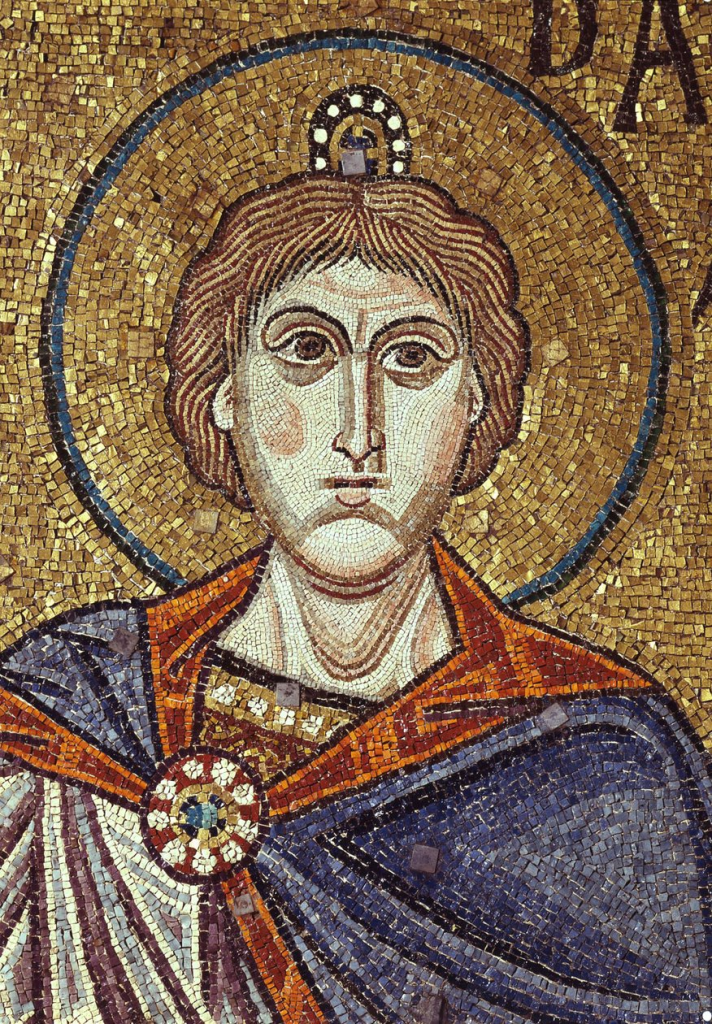
Byzantine mosaic of the prophet Daniel, 12th century, in St. Mark’s Basilica, Venice, Italy

Perhaps you, like me, have had the experience of praying, and feeling as if those prayers were only bouncing off the ceiling and never heard by God. But the Lord has been watching and listening all along. Although we may not get an immediate response, we will most certainly receive an answer to our prayers.

I am encouraged that God listened and was attentive to Daniel. The prophet had put himself in a position to hear God, so that when the Lord responded, Daniel was able to receive what was given to him.

The spiritual disciplines which Daniel was practicing almost seems like the guy was observing Lent. For three weeks, he gave up certain foods, did not eat meat, drank no wine; and he didn’t take a bath. He did all of this because he was troubled in spirit.

Daniel’s outward practices were congruent with his inward disposition. This is a far cry from our modern predilection for keeping up appearances, even though we are dying inside. But Daniel was not like us. He stopped his normal routines in order to give himself to prayer and a partial fast.

The Jews had been in exile for 70 years, and there was no sign of them going back to Jerusalem. And that troubled Daniel to no end – because the prophet Jeremiah had said the people would be in captivity for that long (Jeremiah 29:10). Daniel knew that fulfillment of the Lord’s promises would come by living in Palestine, and not by being exiled in Babylon.

While Daniel and his friends were together in a prayer meeting, Daniel experienced a vision; it was as if the veil separating this three-dimensional space from the spiritual dimension was lifted, and Daniel could see what was happening in the invisible realm.

Daniel’s prayers were being heard; they were not bouncing off the ceiling. And they were heard, I believe, because Daniel prayed according to his understanding of what God wants. He desired to participate in what God wanted, and not what he himself necessarily wanted.

And that is essentially what the Lord Jesus taught his followers in how to pray. We need not try and persuade God, as if we must be spiritual lawyers advocating for what we want. The Lord does not operate by twisting arms or harassing people; and neither ought we to try and treat God that way.

Prayer puts us in sync with what God wants. And as we desire to do God’s will, our prayers will reflect that desire. We only then need to ask. (Matthew 6:5-15; James 4:1-3)

Although God answers prayer, those responses are not always immediately put into effect. Daniel’s vision allowed him to see that there are other forces at work – dark forces – that oppose what God is doing. Sinister monkey wrenches are thrown into good plans and responses for people.

Behind the scenes of our lives, there are invisible powers which are influencing people. This is why our ultimate struggle is not on this visible realm; it is, instead, against the invisible demonic spirits of this present evil age.

Daniel saw and heard that behind the affairs of this world is a hierarchy of evil which seeks to control us for purposes contrary to God’s justice, peace, and goodness. Yet there is also an angelic host who are involved in ensuring that the Lord’s will is accomplished on this earth as it is always done in heaven.

Therefore, sometimes our delays in answered prayer have nothing to do with us; it may be because there is a great conflict happening in a dimension that you and I don’t see. In fact, if we do not have immediate answers to prayer, this is precisely the best time to persevere in prayer and not give up.

Through our perseverance in prayer, like Daniel, we are strengthened in faith. Our connection with God brings us peace and courage, emboldening us for continued wrestling in prayer and dealing with the structural and systemic evil that exists everywhere.

Faith is a belief in things we cannot see. Hope is the confidence of things which can happen. Love is a culmination of faith and hope coming together in order to make a difference in this fallen world. The Lord provides all the strength we need for the struggle. And there is perhaps no better model of how to deal with things and gain spiritual power than the prophet Daniel.

Strengthen us, O Lord, by your grace, so that we may overcome all spiritual enemies; and with pure hearts serve you; through Jesus Christ our Lord, who lives and reigns with you and the Holy Spirit, one God, for ever and ever. Amen.

The Temptation of Jesus (Matthew 4:1-11)

Temptation of Jesus by Gustave Doré (1832-1883)

Then Jesus was led by the Spirit into the wilderness to be tempted there by the devil. For forty days and forty nights he fasted and became very hungry.

During that time the devil came and said to him, “If you are the Son of God, tell these stones to become loaves of bread.”

But Jesus told him, “No! The Scriptures say,

‘People do not live by bread alone,
    but by every word that comes from the mouth of God.’”

Then the devil took him to the holy city, Jerusalem, to the highest point of the Temple, and said, “If you are the Son of God, jump off! For the Scriptures say,

‘He will order his angels to protect you.
And they will hold you up with their hands
    so you won’t even hurt your foot on a stone.’”

Jesus responded, “The Scriptures also say, ‘You must not test the Lord your God.’”

Next the devil took him to the peak of a very high mountain and showed him all the kingdoms of the world and their glory. “I will give it all to you,” he said, “if you will kneel down and worship me.”

“Get out of here, Satan,” Jesus told him. “For the Scriptures say,

‘You must worship the Lord your God
    and serve only him.’”

Then the devil went away, and angels came and took care of Jesus. (New Living Translation)

Get Thee Behind Me Satan, by Ilya Repin, 1895

In our most vulnerable moments, there are dark forces that attempt to swoop in and offer demonic delights for us to consider. This is what we call “temptation.” Indeed, it can be quite alluring to entertain ways of getting what we need, and want, through dubious avenues and shadowy back alleys, other than the light of God.

In the desert, the place of preparation for ministry, Jesus fasted and prayed forty days and nights. If ever there was a time when Jesus would be vulnerable to alternative religion, the devil mused, wringing his demonic hands together with wicked delight, it would be out in the desert by himself.

So, Satan tempted Jesus with three whoppers he thought would get to Jesus, for sure. Having tempted Jesus with food and a way to fame, and having failed both times, Satan gave his final temptation, and his best effort at getting Jesus to take a different path.

To us this temptation to bow down and worship Satan seems like a no-brainer. Well, of course, no one would do such a thing as this, especially Jesus. And he did not. But it was still quite tempting, and this why: Jesus knew very well what was ahead of him.

He had just spent forty days in an intense orientation for an upcoming three years of hard ministry with an end that he knew would be characterized by torture and a horrendous death. If there was a way to get around all that pain and suffering, maybe Jesus would take it. 

Satan presented to Jesus an alternative way, a different path to achieve his purpose for being on this earth. Jesus could have it all without the three years, without the hard slugging to communicate the kingdom of God has come. Most of all, Jesus could circumvent the cross and establish his rule over all the earth – all pain free! The temptation, yes, was very tempting. Become King Jesus now with no suffering.

This has always been one of our great temptations, as well: Take the easy path. Get what you want, what you deserve, now, with no hardship. 

The values of God’s kingdom include trust, patience, and perseverance. Temptation insists we need none of those hard things to be successful.

Satan is the original slickster, marketing his quick and easy wares for people to buy into the notion that life can lived without pain and hardship, and with wild success, right now! The scary thing about it is, Satan can deliver… but it will cost us our very lives. Slavery to sin is the price we pay for hitching our hopes to the quick and easy.

The Christian season of Lent is a time for the slow, patient, deliberate development of the soul in attachment with the Lord Jesus. Engaging in spiritual disciplines is hard. It is difficult to fast and pray. Growing in Christ is slow and takes a great deal of learned perseverance.

Far too many of us are tempted to circumvent the hard work of discipleship and simply have some spiritual professionals distill everything we need into one hour on Sunday morning, or in a nice neat 5-minute devotional.

For yet another easy alternative, it could be that we opt to fabricate our own religious practices and beliefs, picking and choosing what fits our lifestyle, as if convenience and comfort are the summum bonum of life, instead of worship.

Christ was able to face down temptation because the desert strengthened him. Yes, he was vulnerable. But he was not weak. If we want to handle temptation, it will take the hard slog of Lent to help us. It will require the desert to spiritually form us and prepare us for godly ministry that puts the devil in his place.

Lord Jesus, you are the king of all creation. Just as you chose the hard path of God’s kingdom, so help me to persevere with faith and patience. May my life reflect your words and ways, in the power of the Holy Spirit.  Amen.