The Divine/Human Dialogue (Psalm 95)

Psalm 95: “If today you hear His voice, harden not your heart.” By Gina Lazarchik

Come, let us sing to the Lord!
    Let us shout joyfully to the Rock of our salvation.
Let us come to him with thanksgiving.
    Let us sing psalms of praise to him.
For the Lord is a great God,
    a great King above all gods.
He holds in his hands the depths of the earth
    and the mightiest mountains.
The sea belongs to him, for he made it.
    His hands formed the dry land, too.

Come, let us worship and bow down.
    Let us kneel before the Lord our maker,
    for he is our God.
We are the people he watches over,
    the flock under his care.

If only you would listen to his voice today!
The Lord says, “Don’t harden your hearts as Israel did at Meribah,
    as they did at Massah in the wilderness.
For there your ancestors tested and tried my patience,
    even though they saw everything I did.
For forty years I was angry with them, and I said,
‘They are a people whose hearts turn away from me.
    They refuse to do what I tell them.’
So in my anger I took an oath:
    ‘They will never enter my place of rest.’” (New Living Translation)

Praise and thanksgiving.

Complaining and grumbling.

Those two phrases are antithetical to each other.

And yet, out of the same mouth can come both worship and whining.

Maybe the psalmist was trying to teach us a thing or two by inviting us to sing and bow to the Lord, as well as hear God’s voice.

Worship and listening are meant to go hand in hand. Revelation and response are to be the spiritual rhythm of the believer. True worship is a divine conversation between us and God. The Lord speaks. We listen and answer. Back and forth we go together. God and God’s people are to be involved in a divine/human dialogue.

When the worship rhythm is off, then our response will be off.

And that is what happened to the ancient Israelites. They were miraculously delivered from their cruel bondage in Egypt. You can imagine the kind of praise and worship service the people had in the desert! After four-hundred years of slavery, freedom!

Yet, before you know it, the thanksgiving turned sour; there began some rumblings of grumbling.

At the first encounter of adversity, when there was no water to drink, it was as if the people had some sort of collective dementia take them over. Suddenly, hearts started hardening. Soon, everything coming out of the mouth was a constant stream of complaints, as if the entire world revolved around the complainers.

One minute, hands are raised in praise; the next minute, those same hands clench into fists shaking at God.

The people forgot that life is an ongoing dialogue with God – and not a one and done conversation of revelation and response.

God acted by delivering the people. The people responded with praise and thanksgiving. And they didn’t want it to stop. Yet, all of life is a rhythm. What goes up, comes down. Good times eventually fade into tough times. The real muster of any person or group is the response when the hardship comes.

The Lord purposely brought the Israelites out into the desert to face a difficult circumstance. God was teaching them to trust. The Lord wanted a response of faith and prayer to the adverse situation.

But the people weren’t looking for a dialogue. They were looking for water. And when they didn’t have it, their hearts hardened through murmuring, bellyaching, and dissatisfaction. Then, all the people could see was their own stuff – blinding them to others, especially God.

However, God was still in the conversation. The generation who saw the incredible deliverance from bondage would die in the desert, never setting eyes on the Promised Land. And it all began because of grumbling.

We need to take complaining seriously. Why? Because it rots the soul, like Mr. Grinch who incessantly complained every year about Christmas. Grumbling makes one into a Grinch-like creature, like the song says:

You’re as cuddly as a cactus
You’re as charming as an eel…

You got termites in your smile
You have all the tender sweetness
Of a seasick crocodile…

Your heart’s an empty hole
You got garlic in your soul.

It was only when the Grinch forsook his isolation of complaining and began connecting in conversation with the folks in Whoville, that he had his rhythm restored.

When the divine/human rhythm is off kilter, what will it take to get it back?

The author of the New Testament letter to the Hebrews helps us here. After quoting our psalm lesson for today, the writer responded to the biblical revelation by saying:

Be careful, brothers and sisters, that none of you ever develop a wicked, unbelieving heart that turns away from the living God. Encourage each other every day while you have the opportunity. If you do this, none of you will be deceived by sin and become stubborn. 

After all, we will remain Christ’s partners only if we continue to hold on to our original confidence until the end. Scripture says, “If you hear God speak today, don’t be stubborn. Don’t be stubborn like those who rebelled.” (Hebrews 3:12-15, God’s Word Translation)

Revelation and response is the rhythmic dynamism of the Christian community.

Lone Ranger Christians are an oxymoron, as well as moronic. We are hard-wired by God for community. All of us need to encourage one another – every day. Without the communal connections of encouraging conversations, it will be difficult to sustain a divine dialogue of God speaking, with people listening and responding in obedient faith.

Celebration is wonderful. We need times and experiences of celebrating deliverance from bondage. Eventually, when Christ returns, there will be unending worship in the form of jubilation.

That time is not yet here. This side of heaven, we must learn to engage God in ways which address our hardships and difficulties. Otherwise, our hearts will become stubborn and hard.

Let your heart become open enough to receive encouragement. And let it also be brave enough to encourage others.

Lord Jesus Christ, by your patience in suffering you caused earthly pain to be holy. And you gave us the example of obedience to your Father’s will. Be near me in my time of weakness and pain. Sustain me by your grace so that my strength and courage may not fail. Heal me according to you will. Help me always believe that what happens to me here is of little account if you hold me in eternal life, my Lord and my God. Amen.

Spiritual Confidence (2 Corinthians 3:4-11)

Such confidence we have through Christ before God. Not that we are competent in ourselves to claim anything for ourselves, but our competence comes from God. He has made us competent as ministers of a new covenant—not of the letter but of the Spirit; for the letter kills, but the Spirit gives life.

Now if the ministry that brought death, which was engraved in letters on stone, came with glory, so that the Israelites could not look steadily at the face of Moses because of its glory, transitory though it was, will not the ministry of the Spirit be even more glorious? If the ministry that brought condemnation was glorious, how much more glorious is the ministry that brings righteousness! For what was glorious has no glory now in comparison with the surpassing glory. And if what was transitory came with glory, how much greater is the glory of that which lasts! (New International Version)

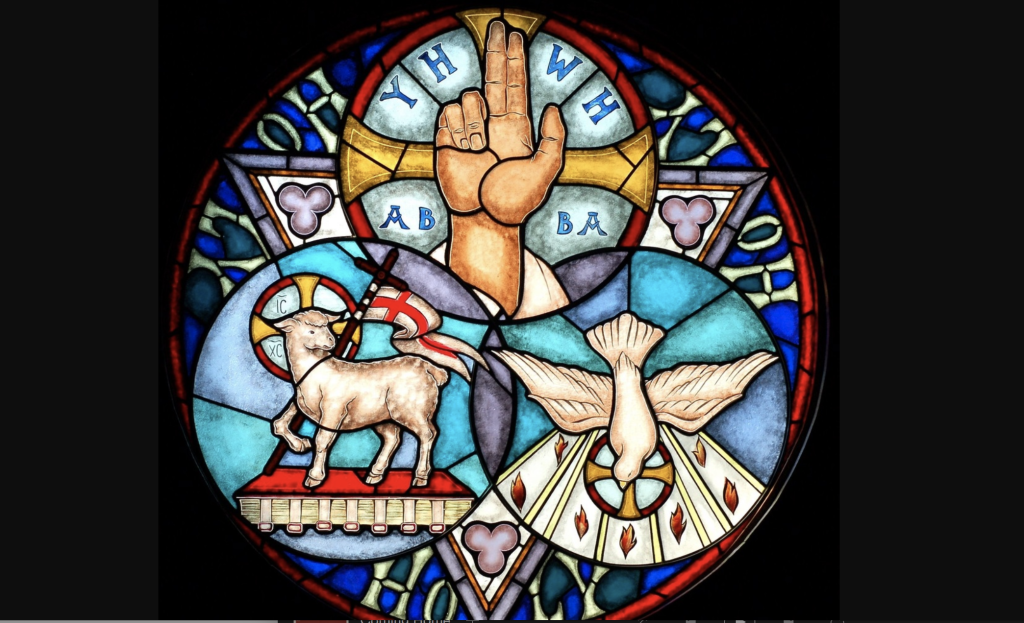
The Christian religious tradition holds to the great Three-in-One of God – God is indivisibly One, and at the same time, a Trinity of Father, Son, and Spirit. Christians typically have no problem expressing their prayers and devotion to the Persons of the Father and the Son, as well as connecting their ministry efforts to them. 

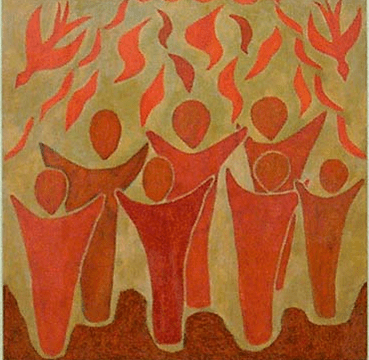
However, when it comes to the Spirit, this Person of the Holy Trinity is often referred to as an “it” or a “force.” Yet, the Holy Spirit is as much God and a Person as the heavenly Father and the Savior, Jesus Christ. The Spirit is the One who provides the guidance and energy for Christian ministry – and not the Law.

We very much need the Holy Spirit of God. Without the Spirit’s help, Jesus is merely looked at as one person out of thousands of individuals crucified in history; and only an example of one who was martyred for his faith. But Jesus is infinitely more than that. 

Christ is the Son of God, the Savior of the world. Through Jesus Christ’s life, death, resurrection and ascension, people can be redeemed from empty lives, saved from destructive life-patterns, and given the kind of security and purpose in life that God intended from the beginning for people to possess. 

And the Spirit of God is the One that takes these redemptive events of Jesus and applies them to our lives. Apart from the Holy Spirit, we are lost, because we are unable to see the genuine spiritual truth about the cross of Jesus Christ unless God the Holy Spirit breaks into our lives and does an intervention – showing us our denial about how we are really doing and our delusions about who we really are (1 Corinthians 2:1-16).

This, then, is the basis for spiritual confidence. And this sort of confidence does not and cannot come from obedience to the Law.

Admitting that we absolutely need the Holy Spirit of God means that the power of Christianity does not reside with me or you; power for the Christian life rests upon Jesus Christ and him crucified, with the Spirit witnessing to us of this truth. 

In other words, we are largely powerless. 

Now, I realize this is not a popular message, especially in Western society. That sounds ridiculous to a particularly can-do kind of people, like most Americans. We believe we’ve done fairly well on our own, thank you very much. A couple of cars, a house, a job, and a family. I work hard. I’ve earned my stuff and my accomplishments. 

But the thing is, any worldly success may lead us to the delusion that we have the power to do what we want – as if I am the sole captain of my soul. I did it. And I did it my way.

“Oh, sure,” many a person may reason, “we have problems just like everybody else. After all, I can’t control everything!” Yet, we are not powerless just because we have difficult circumstances and a few problem people in our lives. “God will step in a take-over where I leave off, right?” Wrong. 

It’s all wrong, because it’s based in one’s effort to obey a personal creed, the rules of the game, or even the Law and the Ten Commandments. But if we could really do it on our own, there’s no need for any of this spiritual stuff.

In truth, apart from the Holy Spirit of God, we are unable to be Christians and live the Christian life. If we think we manage our lives just fine, with a bit of help from God, then we are likely in denial. We are probably placing ourselves at the center of the world; and believe we should be able to deal with whatever comes in life. 

Whenever the consistent response to adverse situations, or the realization that we are not handling something well, is to try and fix ourselves, then we are surely living in the delusion that we hold the power to change – independently without anyone or anything helping us.

If our first reaction to adversity or problems is:

  • Searching Google for more knowledge
  • Dealing privately with personal issues
  • Expecting that willpower should be enough

Then, we are feeding the delusion that we do not really need the Holy Spirit of God; we are actually believing that we need more effort, or information, in order to find the power to overcome whatever is in my life that needs overcoming.   

Unfortunately, it typically takes a tragedy or crisis to break our delusions of power. Let me ask: How bad must we hurt before we admit that we are not managing our lives well at all, and that the real power to change resides with the Holy Spirit?

Our spiritual power and confidence resides in the cross of Jesus Christ, with the Holy Spirit testifying to us of God’s great grace. 

The Apostle Paul believed this with all his heart. Although he was a very intelligent and learned person, he did not rely on his abilities, but on God’s. 

The cross of Jesus is not just an historical event, but an ongoing reality for us to experience victory over all the brokenness of this world, and all the mess we have made of things by putting ourselves at the center of the universe. 

We need the Holy Spirit of God to intervene and apply Christ’s finished work to us. 

None of this means that the Law, or that you, are bad. Both you and the Law are good. It’s just that we, by ourselves, and the Law by itself, are inadequate to save, deliver, and overcome. For that, we need God’s Spirit, and to tap into the spiritual reality that exists.

If the Ten Commandments were introduced with glory, and we ourselves were created with glory, then how much more glory and life is there through an intimate relation with the Spirit?

O God of peace, who has taught us that in returning and rest we shall be saved, in quietness and confidence shall be our strength: By the might of your Spirit lift us, we pray, to your presence, where we may be still and know that you are God; through Jesus Christ our Lord. Amen.

Share Your Story (Psalm 107:1-16)

Psalm 107, by Erin Beardemphl

O give thanks to the Lord, for he is good,
    for his steadfast love endures forever.
Let the redeemed of the Lord say so,
    those he redeemed from trouble
and gathered in from the lands,
    from the east and from the west,
    from the north and from the south.

Some wandered in desert wastes,
    finding no way to an inhabited town;
hungry and thirsty,
    their soul fainted within them.
Then they cried to the Lord in their trouble,
    and he delivered them from their distress;
he led them by a straight way,
    until they reached an inhabited town.
Let them thank the Lord for his steadfast love,
    for his wonderful works to humankind.
For he satisfies the thirsty,
    and the hungry he fills with good things.

Some sat in darkness and in gloom,
    prisoners in misery and in irons,
for they had rebelled against the words of God
    and spurned the counsel of the Most High.
Their hearts were bowed down with hard labor;
    they fell down, with no one to help.
Then they cried to the Lord in their trouble,
    and he saved them from their distress;
he brought them out of darkness and gloom,
    and broke their bonds apart.
Let them thank the Lord for his steadfast love,
    for his wonderful works to humankind.
For he shatters the doors of bronze
    and cuts in two the bars of iron. (New Revised Standard Version)

Every person of faith has a story, a testimony of God’s redeeming, saving, and loving deliverance from trouble. And each one of those stories is sacred and special; no one story is better or greater than another. There’s no need, therefore, to act like you’re taking a course in comparative storytelling – as if you don’t have nearly the spiritual testimony of someone else.

The fact of the matter is that there is no trouble like your own personal trouble. Although others can relate to elements of each of our stories, no one else knows what your own experience is like. The old black spiritual is right in saying. “Nobody knows the trouble I’ve seen. Nobody knows but Jesus.”

It’s important to have others empathize with us and help normalize the experience we are going through. It’s necessary to have another validate our emotions and affirm the feelings we’re feeling. And, even after that, there’s nothing quite like a compassionate and caring Being who intimately knows everything about your trouble, how you experience it, and steps-in according to perfect divine timing, to bring uplift, hope, and salvation.

There is such a Being. God. Yahweh. The Lord. Pure Goodness. Redeemer. Savior. And most of all, Lover who is infinite Love with a capital “L.”

Why am I so confident about such a Being as this? Did I take too much methadone? Am I only an old fart who still believes in God? Or perhaps, you think, I’m a weird sort of giddy about God because of the Bible. Well, yes, and no. Scripture – especially the Psalms – just happens to put into words my actual experience and emotions.

But I don’t much care about parsing out whether I’m a deluded metaphysician or a sappy magpie or whatever other label gets affixed to me. It just doesn’t matter – because every epistemic fiber of my lower case being resonates with the upper case Being who bestows steadfast love because that Being’s character is actually made up of Love. It’s as if God is the biggest ultimate Teddy Bear, stuffed with holy love for all creation.

And, what’s more, this God seems to specialize and enjoy paying attention to the least, the lost, and the lowly among us humans. I was once in such a deep, dark, dank, black hole of spiritual nothingness that I knew I could never get out of, that is, on my own. I needed deliverance, or there wouldn’t be any hope whatsoever.

Others have experienced something akin to wandering alone out in a desert spiritual wasteland with no water, no food, no nothing but oppressive heat and loneliness. And others have had the trouble of real flesh and blood people seeking to do them harm, both physically and mentally. Yet others felt like they were bereft of options on a plantation of slavery in which all they could do was work like animals just to survive another day.

What all these persons have in common is that they cried out to the Lord, the maker of heaven and earth. And most of them didn’t just do it once; some cried out until they had no voice and were too weak to even speak anymore.

God showed up. God also showed off. Not only was there deliverance, but there was also an upgrade. For me, it was not like Tim 2.0, but Tim 1,000.0 – a filling of divine grace that goes beyond mere words. Because of God’s grace and love in my own life, it has enabled me to tap into that storehouse of mercy and pray with spiritual confidence.

When my dear wife had a spine surgery several years ago and awoke from it unable to move her legs, I prayed. I asked for mercy. I pleaded for grace. And I did it for hours at the foot of her hospital bed. I remember that I stubbornly would not accept the fact that she could not move her lower body.  And I decided to stand there and pray until I got an answer from God.

Eventually, I prayed myself asleep. My wife woke me up sometime in the early morning the next day. She told me to pull back the covers and look at her right big toe…. She could give it an ever-small twitch. We called the nurse, who was so excited that she called everyone she could get a hold of.

With a dozen hospital staff huddled around the hospital bed, my wife proceeded to give that big toe a hearty move. The staff erupted with clapping, and I am not kidding when I say that we had a party with noise and shouts in a hospital room at 4am. Nobody cared we were going nuts. I certainly did not.

My friend, God is still in the business of answering prayer, of showing up and showing off.

Through the hard times, the good times, and the confusing times, the Lord is our constant ballast for all seasons of life, whether good or bad. And I love God for that abiding presence. I can also give testimony that through all of the adverse situations my wife and I have faced, we have learned to stop, be still, and find that all we ever wanted we already have, even when everything changes.

Psalm 107 lets us know that personal testimony expressed to the community is an important aspect of strengthening everyone’s faith. Our stories are important, and they are meant to be shared. The spiritual and emotional health of us all is at stake.

Accept, O Lord, our thanks and praise for all that you have done for us. We thank you for the splendor of the whole creation, for the beauty of this world, for the wonder of life, and for the mystery of love.

We thank you for the blessing of family and friends, and for the loving care which surrounds us on very side.

We thank you for setting us at tasks which demand our best efforts, and for leading us to accomplishments which satisfy and delight us.

We thank you also for the disappointments and failures that lead us to acknowledge our dependence on you alone.

Above all, we thank you for your Son Jesus Christ; for the truth of his Word and the example of his life; for his steadfast obedience, by which he overcame temptation; for his dying, through which he overcame death; and for his rising to life again, in which we are raised to the life of your kingdom.

Grant us the gift of your Spirit; that we may know you and make you known; and through your Spirit, at all times and in all places, may give thanks to you in all things. Amen.

Whoever Believes (John 3:14-21)

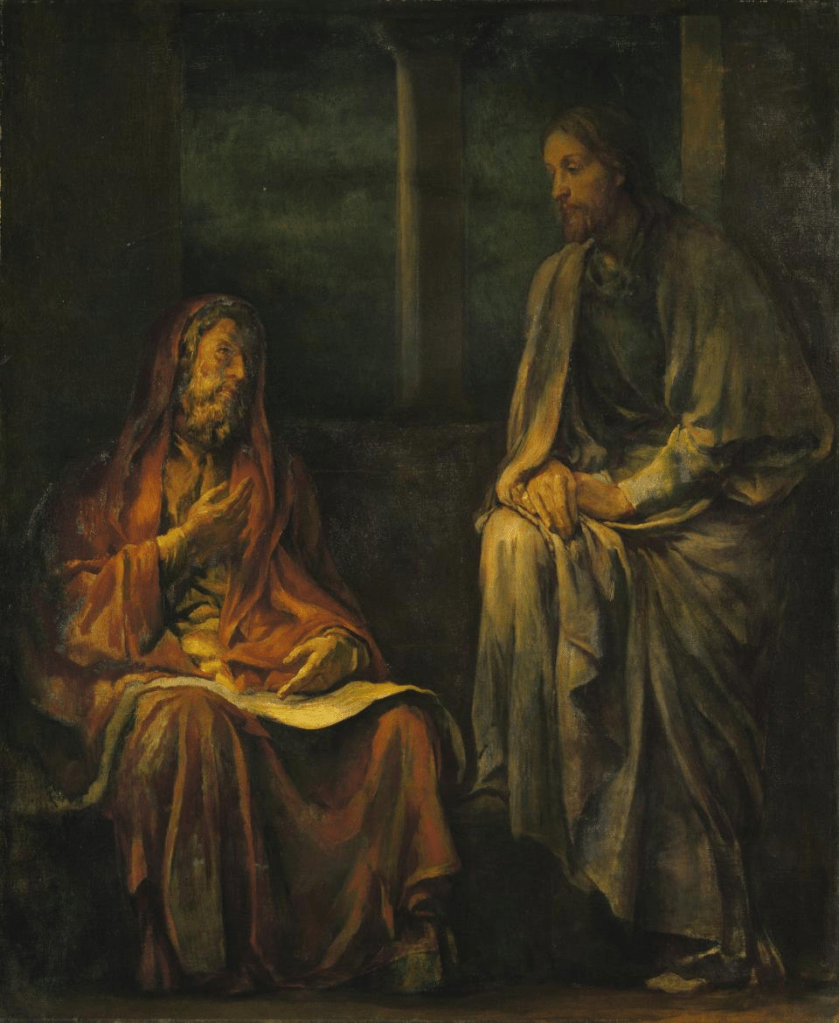
Interview Between Jesus and Nicodemus, by James Tissot (1836-1902)

Just as Moses lifted up the snake in the wilderness, so the Son of Man must be lifted up,that everyone who believes may have eternal life in him.”

For God so loved the world that he gave his one and only Son, that whoever believes in him shall not perish but have eternal life. For God did not send his Son into the world to condemn the world, but to save the world through him. Whoever believes in him is not condemned, but whoever does not believe stands condemned already because they have not believed in the name of God’s one and only Son. 

This is the verdict: Light has come into the world, but people loved darkness instead of light because their deeds were evil. Everyone who does evil hates the light, and will not come into the light for fear that their deeds will be exposed. But whoever lives by the truth comes into the light, so that it may be seen plainly that what they have done has been done in the sight of God. (New International Version)

For many, the truth about God’s purposes in Christ is confusing, even troubling. It was for Nicodemus. And even though there many today who simplify the exchange between Jesus and Nicodemus with a single Bible verse of John 3:16, taking a good look at the Gospel of John puts most of us with Nicodemus.

Nicodemus, a learned Jewish scholar, a Pharisee, found Christ’s words both confusing and troubling because it required him to let go of everything he understood – to let go and become like a newborn baby, receiving and discovering the world on new and different terms. In other words, Nicodemus had to unlearn some things before he could learn truth.

There are some things that are hard to grasp, not because they are so intellectually challenging, but because those things ask a lot of us, demanding our very lives. And so, we don’t so much want to understand; it would require a radical change.

But why would anyone not want to understand the good news that God so loved the world that gave the Son so that we may believe and have eternal life? Because we would then have to contend with the ways Jesus describes himself.

Jesus likened himself to the serpent that Moses lifted up in the desert (John 3:14; Numbers 21:4-9). In that story of Moses in the Old Testament book of Numbers, God sent poisonous snakes into the Israelite camp as punishment for the people’s incessant complaining against God.

Then, when the people repented, God told Moses to make a bronze snake, put it on a pole, and lift it up, so that anyone bitten by one of the poisonous snakes could see it and live. Jesus likened himself to the story. In the same way the bronze snake was lifted on a pole, Jesus explained that so must the Son of Man be lifted up, or exalted high above the people.

Visit of Nicodemus to Christ, by John La Farge, 1880

In the typical language of the Apostle John, using double meanings to a single concept, he meant to communicate that Jesus would be physically lifted onto the cross, above the people; and also that Jesus would be lifted up by God as the exalted One above all creation. (John 8:28; 12:32)

Just as the ancient Israelites were facing death because of their sin, and deliverance because of God’s action through Moses, so people everywhere in every age face the consequences of their sinful complaining; yet through the action of God through Christ’s crucifixion, resurrection and ascension, they can look up to the exalted and glorified Lord and receive deliverance from sin, death, and hell.

There is more to looking up at the lifted One than a mere incline of the head and eyes. In modern terms, we would refer to the sheer action of looking as an intellectual assent to faith. The Apostle John, however, means to have us believe, not simply acknowledge.

Jesus did not tell Nicodemus to simply acknowledge him as Savior, to accept him into the heart, and so, be saved. No, this was an encounter that left an intelligent man and an accomplished scholar scratching his head in bewilderment as he went back out into the darkness.

Today’s Gospel lesson is a story about how any one of us might reject the light offered to us because of the way it exposes what is dark within us. Therefore, to believe requires ultimate trust in another. It isn’t to acknowledge that Jesus was real and had an actual ministry on earth; it’s more than believing something happened in history in the ancient world of the first century.

To believe is to let our own lives be transformed by the Jesus we encounter in this story. And here is what that means:

  1. Realizing and becoming aware of the ways we are complicit in and benefit from having our loyalties elsewhere, other than Jesus. To believe demands us answering the question: Whom shall you serve?
  2. Placing our ultimate trust, allegiance, and loyalty in Jesus Christ. To believe begs the question: To whom will you commit all that you have, and all that you are?
  3. Forsaking all other competing loyalties and “gods,” including both secular and religious deities. To believe means a single-minded devotion, which asks of us all: To whom and to what will you forsake in order to embrace Jesus?
  4. Confronting inconvenient truths of our own personal values which clash with Christ’s ideals of righteousness. To believe presses us to answer the question: To whom and for what are you truly living for?
  5. Willing to die to self and to anything that would hinder knowing Jesus and him crucified, risen, ascended, and coming again. To believe forces us to ask ourselves: Am I willing to die for Jesus?

While there is nothing in this world worth killing for, there are things worth dying for. The lifting up of Jesus lets us know that the true life God has promised us is not the life that we can secure for ourselves through self-interest, caution, and theological debate.

Most merciful God,
we confess that we have sinned against you
in thought, word, and deed,
by what we have done,
and by what we have left undone.
We have not loved you with our whole heart;
we have not loved our neighbors as ourselves.
We are truly sorry and we humbly repent.
For the sake of your Son Jesus Christ,
have mercy on us and forgive us;
that we may delight in your will,
and walk in your ways,
to the glory of your Name. Amen.