Deliver Us From Evil (Psalm 144:9-15)

I will sing a new song to you, God.
    I will sing praises to you on a ten-stringed harp,
        to you—the one who gives saving help to rulers,
        and who rescues his servant David from the evil sword.
Rescue me and deliver me from the power of strangers,
        whose mouths speak lies,
        and whose strong hand is a strong hand of deception,
    so that our sons can grow up fully, in their youth, like plants;
    so that our daughters can be like pillars carved to decorate a palace;
    so that our barns can be full, providing all kinds of food;
    so that our flocks can be in the thousands—
        even tens of thousands—in our fields;
    so that our cattle can be loaded with calves;
    so that there won’t be any breach in the walls,
    no exile, no outcries in our streets!

The people who have it like this are truly happy!
    The people whose God is the Lord are truly happy! (Common English Bible)

And lead us not into temptation, but deliver us from evil.”

Jesus (Matthew 6:13, KJV)

Evil lurks everywhere. It resides in the human heart, hidden in the dark shadows, coming out sideways through shameful lies and guilty actions.

The presence of evil is also found throughout the world in every institution, organization, and group, ensconced as systemic injustice – hoarding resources for the powerful at the expense of the powerless; showing prejudice and favoritism to some, while ignoring others.

Since there is wickedness found in all places and with all people, evil needs to be dealt with and expunged from both hearts as well as institutions and organizations. Part of the solution is to do away with all obstacles which stand in the way of human flourishing.

Save us from the Evil One. (Matthew 6:13, ERV)

To be sure, the heart of humanity must be dealt with and be the focus of change. Yet, if we only focus one-dimensionally on evil, it will persist, and even grow into monstrous proportions, unless we equally direct our right and just efforts on structural and systemic evil.

People and their institutions need deliverance from the power of evil in the world. And for that to happen, the hindrances and handicaps to human thriving must be eliminated.

Our entire concept of salvation needs a fuller scope. Not only do individuals need personal deliverance from sin, death, and hell, so do entire societies. Complete systemic rescue from oppressive obstacles is a must. Far too many people in this fallen world are weighed down from institutional sin.

Christ obeyed God our Father and gave himself as a sacrifice for our sins to rescue us from this evil world.

Galatians 1:4, CEV

In looking at the need for deliverance from evil in a different context, the genius of the American experiment was that the founding fathers (and mothers!) of the United States created a political and societal system which sought to eliminate class distinctions and allowed people of lower means to achieve land ownership and business acumen simply through hard work and thrift.

Unfortunately, the experiment only extended mostly to landowning white men. Native American and African American people still had huge systemic obstacles to overcome. And the new republic had different expectations for women.

It took a Civil War and decades of grueling work to address political and social change (not to mention religious). We are still today laboring to truly give liberty and justice for all, and to achieve the ideal of an egalitarian nation.

We, as both individuals and citizens, need divine intervention through deliverance. Like Gilligan and the crew of the Minnow stranded on a deserted island, we seek to be rescued – knowing we need help beyond ourselves for salvation.

Rescue us from the evil one. (Matthew 6:13, NRSV)

The psalmist looked ahead in hope, convinced that a good God will deliver and provide good people with everything they need to thrive and flourish in this life, and in the life to come.

If God doesn’t fight our overwhelming battles for us, we are lost. This present darkness, this both ancient and contemporary evil, is an extremely powerful foe. However, the Lord is greater and will have the last word.

Christianity asserts that Jesus is the pioneer of our salvation, and the once for all answer to the problem of evil, for both the world and the human heart. Christ, in other words, is the fulfillment of the psalmist’s prayers for deliverance, health, and hope.

Protect us from evil. (Matthew 6:13, CEV)

In his earthly ministry, Jesus did not give explanations for our pain and sorrow. Instead, Jesus comes where our pain is most acute, and takes it upon himself – bringing healing and hope.

The Lord tackles evil, not by having a Zoom conference on the subject of wickedness, but by allowing evil to do its worst to him. Christ exhausts evil by draining it of its power, emerging resurrected with new life for all.

The good news: Jesus is Lord and has defeated the powers of evil.

Now, renewal and reform can occur. Hearts can change. Systems can be revamped. God’s new world has begun.

God rescued us from the control of darkness and transferred us into the kingdom of the Son he loves. He set us free through the Son and forgave our sins. (Colossians 1:13-14, CEB)

I, personally, am a Christian because I believe God is the one who satisfies the passion for justice, the longing for spirituality, the hunger for relationship, and the yearning for beauty. I see God in Jesus of Nazareth, the world’s true Lord.

Hope, like the psalmist expressed, is what you get when you realize a different worldview is possible. Hope springs to life when those who feel the brunt of evil in the world become acutely aware that the rich, the powerful, and the unscrupulous are not the ones really in charge.

“Our task as image-bearing, God-loving, Christ-shaped, Spirit-filled Christians, following Christ and shaping our world, is to announce redemption to a world that has discovered its fallenness, to announce healing to a world that has discovered its brokenness, to proclaim love and trust to a world that knows only exploitation, fear and suspicion…” N.T. Wright

May you be delivered from evil, and saved from the Evil One. May you know the Savior, and take solace in his peace. And may you be buoyant in faith, confident in hope, and overflowing with love. Amen.


Developing the Skill of Wisdom (Colossians 1:9-14)

Colossians 1:9-10, by Bible Art

For this reason, since the day we heard about you, we have not stopped praying for you. We continually ask God to fill you with the knowledge of his will through all the wisdom and understanding that the Spirit gives, so that you may live a life worthy of the Lord and please him in every way: bearing fruit in every good work, growing in the knowledge of God, being strengthened with all power according to his glorious might so that you may have great endurance and patience, and giving joyful thanks to the Father, who has qualified you to share in the inheritance of his holy people in the kingdom of light. 

For he has rescued us from the dominion of darkness and brought us into the kingdom of the Son he loves, in whom we have redemption, the forgiveness of sins. (New International Version)

When I was younger, I played a lot of ping-pong. And I got good at it. In fact, during a several months stretch, back-in-the-day, I had a record of 156-2. Not bad.

That kind of record was only possible because of the two reasons that make any skill an accomplishment:

  1. Knowledge. I learned the game of ping-pong and eventually knew it inside and out.
  2. Experience. I practiced for hundreds, if not thousands, of hours in developing my technique.

The sort of knowledge that Paul was talking about was more than information and intellectual understanding; he used a specific word (in the Greek language – ἐπιγινώσκω, pronounced “EPee-gi-NOS-ko) which refers to knowledge gained by experience.

In English, we need to put two words together in order to communicate Paul’s concept: experiential knowledge – an understanding which is gained by continual repetition and practice until there is proficiency.

There are just some things that can only be learned and integrated into life through constant use and development over time. And this is precisely how a person becomes mature in life:

Growth + Time = Maturity.

And with maturity comes the wisdom to live life as it meant to be lived. This means that wisdom doesn’t come overnight or quickly; to be wise requires a great deal of learning, effort, experience, and time.

The wisdom and understanding Paul refers to is not some sort of secret information which has to be accessed through careful initiation into a group of people who have the inside knowledge. No, this is wisdom which can be gained by anyone who embraces a life of faith and spiritual discipline.

The highest form of knowledge for the Apostle Paul is knowing God in Christ.

This sort of knowledge is an understanding of salvation, and experiencing deliverance from guilt, shame, and the false self. Such knowledge is evidenced by the fruit of the Spirit in living a life of love, joy, peace, patience, kindness, goodness, faithfulness, gentleness, and self-control. (Galatians 5:22-23)

Colossians 1:11, by Bible Art

From the outside of Christianity looking in, it may appear that this is all a grand achievement of the human will. But it isn’t. On the inside, the Christian life is thoroughly a work of God’s glorious power, bringing new life, and effecting spiritual growth and maturity into a wise and good way of life.

We did not deliver ourselves. God did. The Lord transferred our membership from the realm of darkness to the empire of light. Christians are simply people who have been redeemed by God in Christ. Our liberation is because of God’s gracious forgiveness of sins.

Forgiveness, however, is not the end game. Forgiveness frees us to pursue the spiritual life without guilt and shame hindering us and weighing us down all the time. Forgiveness opens us to the possibilities of positive and life-giving relational connections with God and other people.

In our relationship with God, prayer becomes the conduit of divine/human conversation. That connection, in the past, had blockage because of our unhealthy lifestyles. But it is now unobstructed because of God’s gracious intervention by Jesus, in the Spirit.

So, when it comes to our interactions in prayer, there’s no need to invent a new game; we just need to learn the one we’ve got, and put in the hours of work necessary to become accomplished at it. 

Today’s New Testament lesson is a prayer from the Apostle Paul to the Colossian Church. His prayer for them was singular: To have wise minds and spirits, that is, to have knowledge of God – an understanding of who God is and how God operates.

To learn divine ways is to acquire the skill of wisdom.

Paul prayed for a reason: so that we might live our lives in a way which pleases God and enables us to sustain a lifetime of spiritual growth. 

As people created in God’s image and likeness, we are hard-wired with a spirit which needs strengthening and exercise. That happens as we put in the constant repetitions of connecting with the divine and putting in the time on our knees – praying daily for ourselves and others to mature in faith so that we might all together act wisely and justly in this world, for the life of the world.

A good place to start is to use Paul’s prayer as our own. Never has there been such a need than now for us to know how to apply wisdom in the places and in the circumstances we’ve never been in before. 

For wisdom to happen, we must grow in our knowledge by putting in the hours of prayer.

The skill of wisdom doesn’t magically happen. Wisdom is the culmination of acquired understanding; a lot of practice exercising love in the places where love is not; and engaging in a lifetime project of becoming knowledgeable through constant learning, struggling, and growing.

Direct me, O Lord, in all my doings with your most gracious will and wisdom. Further in me your continual help – that in all my work and in all I do and say, I may glorify your holy name; and, by your mercy, obtain the life that is truly life; through Jesus Christ, my Lord.  Amen.

The Wounded Healer (Psalm 18:1-6, 43-50)

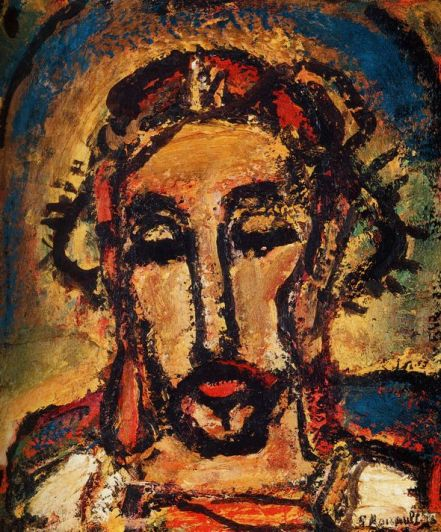
By French painter Georges Rouault (1871-1958)

I love you, Lord;
    you are my strength.
The Lord is my rock, my fortress, and my savior;
    my God is my rock, in whom I find protection.
He is my shield, the power that saves me,
    and my place of safety.
I called on the Lord, who is worthy of praise,
    and he saved me from my enemies.

The ropes of death entangled me;
    floods of destruction swept over me.
The grave wrapped its ropes around me;
    death laid a trap in my path.
But in my distress I cried out to the Lord;
    yes, I prayed to my God for help.
He heard me from his sanctuary;
    my cry to him reached his ears…

You gave me victory over my accusers.
    You appointed me ruler over nations;
    people I don’t even know now serve me.
As soon as they hear of me, they submit;
    foreign nations cringe before me.
They all lose their courage
    and come trembling from their strongholds.

The Lord lives! Praise to my Rock!
    May the God of my salvation be exalted!
He is the God who pays back those who harm me;
    he subdues the nations under me
    and rescues me from my enemies.
You hold me safe beyond the reach of my enemies;
    you save me from violent opponents.
For this, O Lord, I will praise you among the nations;
    I will sing praises to your name.
You give great victories to your king;
    you show unfailing love to your anointed,
    to David and all his descendants forever. (New Living Translation)

King David, the psalmist, had no problem with publicly expressing his great feeling of love for God. His desire was to be thoroughly devoted to the Lord; and he confidently discerned God as the source of his strength.

What’s more, David freely recognized God as the One who brought him deliverance. David cried out in distress. In his despair and desperation, he looked to the Lord, and God responded.

This is in contrast to those who complain about God and consider the Lord as distant and uncaring – if existing at all. David’s experience was that of being heard by God. And he wanted everyone to know, so that the faithful may be encouraged.

David didn’t want people becoming discouraged because of the bitterness of others who accuse God of being unconcerned.

The psalmist was not just talking about some mundane request, like asking for parking spot close to the building. David was in a life-and-death situation, stressful beyond imagination. Things were not looking good for him.

It seemed that the insolent, who think God isn’t watching, believed they could act unjustly and do whatever they wanted. Sadly, their lust for power and control blinds them to the larger reality of an invisible God who sees, and who responds at just the right time.

David wanted people to remember and not to forget about the saving actions of God. Because by keeping in mind who God truly is, then we can have confident trust, and will live in a way that is right, just, and good.

“Our service will not be perceived as authentic unless it comes from a heart wounded by the suffering about which we speak.”

Henri Nouwen

A good, right, and just life is always the appropriate response to divine mercy and deliverance. We are saved from evil, so that we might live in the spiritual freedom of purity and peace. And David gave God some due praise, adoration, and thanksgiving for rescuing him from his enemies.

Since David went through all of the adversity, hardship, stress, and suffering of dealing with unjust people, he was in a position to be a wounded healer for us.

A wounded healer is not someone who endorses a victim mentality. Rather, this is a person who has been profoundly hurt – physically, mentally, emotionally, or spiritually – and comes through the experience with an ability to be present with others and help facilitate healing in those who suffer.

Surely he took up our pain
    and bore our suffering,
yet we considered him punished by God,
    stricken by him, and afflicted.
But he was pierced for our transgressions,
    he was crushed for our iniquities;
the punishment that brought us peace was on him,
    and by his wounds we are healed. (Isaiah 53:4-5, NIV)

We all suffer and face various hard circumstances. And we are all changed by the hurtful encounters. But we don’t all respond the same way to that adversity. The difficult experiences of pain lead us to become either bitter or better.

If we have a wounded healer in our life, there is a good chance that we will be able to move through the hardship and come to a place of gratitude for what the Lord has done for us and how God brought us deliverance.

“As followers of Jesus we can also allow our wounds to bring healing to others.”

Henri Nouwen

Deliverance may not end up looking like anything we anticipate. If we are stuck on particular outcomes and have a singular expectation, then we may very well miss the Rescuer when the ship of salvation shows up.

Yet, if we can remain open to and aware of God – as well as of what’s going on inside us – then we shall likely experience healing for our deep wounds of pain. And we will embrace the scars it leaves as a reminder of the Lord’s deliverance.

It could be that things don’t change, at least like we want. In such times, perhaps the greatest healing that can take place is to be healed from the need for healing.

The Lord shows unfailing commitment and steadfast love to the faithful, to those who seek God. We shall find the divine in all circumstances, that is, if we seek God with all our heart.

“You will seek me and find me when you seek me with all your heart.” (Jeremiah 29:13, NIV)

Pain cannot be taken away unless we enter into it. So, it only makes sense to me, that we have a guide like the psalmist to lead us, and a Savior like Jesus to rescue us.

“Wholeness is not achieved by cutting off a portion of one’s being, but by integration of the contraries.”

Carl Jung

May you be patient in suffering, as Christ was in his earthly pain.

May the Lord be near you in your time of weakness and wondering.

May God sustain you by divine grace, and grant you courage not to have a failure of faith.

May you know healing of both body and soul.

And may you always believe that what happens to you in this present life is of little account if you hold Christ in eternal life. Amen.

Victory Over the Power of Evil (Luke 4:31-37)

He went down to Capernaum, a village in Galilee. He was teaching the people on the Sabbath. They were surprised and impressed—his teaching was so forthright, so confident, so authoritative, not the quibbling and quoting they were used to.

In the meeting place that day there was a man demonically disturbed. He screamed, “Stop! What business do you have here with us, Jesus? Nazarene! I know what you’re up to. You’re the Holy One of God and you’ve come to destroy us!”

Jesus shut him up: “Quiet! Get out of him!” The demonic spirit threw the man down in front of them all and left. The demon didn’t hurt him.

That knocked the wind out of everyone and got them whispering and wondering, “What’s going on here? Someone whose words make things happen? Someone who orders demonic spirits to get out and they go?” Jesus was the talk of the town. (The Message)

During his earthly life and ministry, Jesus was a Deliverer and a Liberator; he came to save people from their guilt and shame, and to free the world from the clutches of evil.

And so, it was inevitable that Jesus would come into conflict with the forces of darkness.

In today’s story, Jesus had a confrontation with an unclean spirit, that is, a demon who is an ally of the devil. The particular demon was not only speaking for himself, but also for his fellow band of wicked spirits.

Christ’s ministry put him in direct opposition to the hosts of Satan. The nub of the issue for the demon was whether Jesus had come for their immediate destruction. Jesus, however, wasn’t in the habit of answering questions from demons.

So, Christ rebuked the demon, told him to get out of the person he was influencing. And that is exactly what happened. The writer, Luke, pointed out that this demonstrated Christ’s authority, that it even includes the power to command unclean spirits, and out they go.

And that is how the liberating and saving ministry of Jesus began.

In the Gospel of Luke, this account of Jesus being confronted by a demon happens just after Christ’s 40 days of being tempted in the desert, even by Satan himself. So, the entire demonic realm was alert to beginning ministry of Christ. They went after Jesus right away, perhaps trying to trip him up before he could get any ministerial momentum.

Jesus was teaching on the Sabbath in the town of Capernaum. We ought not to be surprised that a demonized man was among those observing the Sabbath. The wise believer will be savvy to this reality.

Furthermore, we aren’t told who the man was or of any symptoms he may have had. Apparently, he presented himself as a normal Jewish villager. So, we ought not to think that anyone being demonized will necessarily demonstrate madness or illness of some sort.

The demon was perhaps more aware of who Jesus was than anyone else there on that Sabbath Day in Capernaum. He acknowledged Christ’s power and mission. Jesus indeed came to destroy the power and influence of evil in the world.

You believe that there is one God. Good! Even the demons believe that—and shudder.

James 2:19, NIV

Since Jesus Christ is the rightful authority over all, that means Satan and his wicked spirits are not; and they must submit to that true and real power.

Truth and doctrine are not only about objective facts and right belief. Even though our thinking is important and critical, there is more to it than that: Orthodoxy (right belief) requires orthopraxy (right actions).

A right truth that is only described is not the whole truth. In reality, a false witness and a liar may state the truth, but not entirely, withholding important information; thus, impairing any sort of right action from taking place.

Gaslighting relatives, oppressive bosses, and tyrannical rulers who tell some truth, and even support some good things, are still gaslighting and oppressing others with their narcissistic brand of leadership.

Truly, believers in and followers of Jesus can sometimes be duped into supporting evil leaders who use all sorts of unjust tactics, just because that leader tells the part of truth I want upheld.

Jesus saves; he is Savior of the world – but that is only part of the truth. We must also ask: What has Christ come to save us from? Not just our mistakes, mess-ups, and sins. Christ came to deliver us from the very power of evil that supports injustice and unrighteous behavior to begin with.

If we merely view Jesus as our personal Savior from hell after we die, then we will likely focus almost exclusively on heaven. But if we see all the freedom we need from unhealthy behaviors and unjust ways, then we view Christ as so much more than a fire insurance policy.

We need a more expansive understanding of Christ’s cross. Yes, Jesus died for our sins. Yet, he also died to conquer evil; Christ made it possible for us to become liberated from the shackles of systemic sin and structural evil, as well as personal guilt. In other words, Christ came to topple all evil, and not just human foibles.

And this was why the dark powers of Satan, and his demons, were so afraid of Jesus. They knew their time was short. There is yet another power that has a hold on us today – and that is the reality that many people no longer believe in demons and devils and dark forces.

Since we are a technically advanced people with great understanding of medical science, we now know all sorts of things which cause physical and mental illness. Ancient people did not know about human hormones and chemicals, and the impact of genetic codes on our health. They had no idea about bacteria and viruses, microbes and hygiene.

Therefore, we can jettison all this mumbo-jumbo about demons, right?… Not so much.

Even with all of our modern (and postmodern) explanations for the body and brain, we are still finding ourselves having to contend with the mystery of evil, and the malevolent suffering it causes us.

We modern folk can certainly provide a lot of insight into the cause and effect of particular symptoms a person has according to their biology. And yet, that doesn’t take away the presence of malevolent forces on this earth.

Even with all of our understanding, evil still resides within organizations, institutions, and even faith communities. The meanness and malevolence, the injustice and the ingratitude, and the profound violence (both verbal and physical) which one human being can exact on another is still here – and some would argue that it’s worse than ever.

Knowing something isn’t the same as doing it. If that were true, then education ought to deliver us from evil. Even some intelligent and objective people, who are fluent in facts and figures, still use their calculations for evil.

No matter our creeds or convictions, whether we are religious or not, all of us seem to have a collective sense that this old world of ours is profoundly broken.

All the research dollars in the world has not produced a solution to fix evil. And even if we could completely understand evil, that isn’t the same as ridding ourselves of it.

What’s more, those who put all their trust in changing things through modern means (which means without God) have been some of the worst offenders of producing wars, political tyranny, and gross injustice.

To put all of this perhaps more succinctly in the form of question: We know and understand a lot in combating disease, disaster, and death; but does all of that insight do away with the evil of it? Are things less tragic now?

I argue that is has not. Evil is still evil. Chronic pain, homelessness, poverty, injustice, and health inequities are still wreaking their evil on people.

I believe that evil really does exist, even if it has different language today than it did in the ancient world.

There is real opposition, conflict, and confrontation from evil today. The victory Christ has achieved over the forces of evil has a 2,000 year track record of helping people experience renewed lives, even when their bodies are wasting away.

In the end, the victory of Jesus Christ shall become evident to all the world. Overcoming evil doesn’t come from us, but from God. We can and we must deal with evil in this world. But we are not the Savior or the Liberator.

We need faith in the Son of God who loved us and gave himself for us. Amen.