Waiting with Hope (Romans 8:22-25)

Art depicting cracked earth, a dry riverbed, white plastic shapes, a lack of life and the red glow of fire. The figures are separated, lacking any real connection. By artist Chris De Hoog

For we know that all creation has been groaning as in the pains of childbirth right up to the present time. And we believers also groan, even though we have the Holy Spirit within us as a foretaste of future glory, for we long for our bodies to be released from sin and suffering.

We, too, wait with eager hope for the day when God will give us our full rights as his adopted children, including the new bodies he has promised us. We were given this hope when we were saved. (If we already have something, we don’t need to hope for it. But if we look forward to something we don’t yet have, we must wait patiently and confidently.) (New Living Translation)

Salvation is not only personal; it’s also cosmic.

That is, freedom from the power of sin, death, and hell is not only for an individual person, but this deliverance is for all of creation, for the entire earth.

So then, all of creation – not just people – long for and groan for the advent of Christ. My oak tree in the backyard longs for it. My dog whines for it. When it rains, the sky is wondering how long it will have to keep up its tears.

Together with the entire cosmos, we look forward to the complete fulfillment of our inheritance as God’s creation, as God’s creatures.

Since that is true, it is Christians who need to see the privilege and responsibility of conducting ourselves with unity, harmony, and non-violence. We are to live this way because we are foreshadowing the end of the world’s story.

There is a day coming when there will be no more malevolent and selfish posturing for power and control. No more oppression and victimization. No more injustice.

And we have the chance to begin living that way now, and not only in a future time. We get to do this because of Christ.

But that doesn’t mean we don’t suffer anymore. Presently, along with all creation, we have pain like that of a woman in childbirth. This is no papercut inconvenient pain; this is “I hurt like hell” pain. That sort of pain has us awaiting the redemption of our bodies.

I work as a hospital chaplain. Every day, I see suffering, some of it unimaginable. I listen to stories of people longing for healing, and grasping at hope. And I hear plenty of groaning (both the actual physical groans, as well as the more quiet internal sighs and groans).

I say to you: The human body is not meant to be destroyed. Our physical selves are not destined for elimination. No, our bodies are meant to be redeemed; they are meant for salvation. It will not always be this way!

So, we hope.

The Christian has the confident expectation that not only is the soul redeemed, but the body, as well. We can enjoy spiritual salvation now. But we must wait for the physical deliverance. There must be patience on our part until Resurrection Day.

The Apostle Paul was calling on believers to hope. Five times he said it in only two verses. Paul was emphasizing the need for spiritual endurance because we have not yet arrived.

In case you haven’t noticed, we aren’t in heaven; this isn’t a renewed earth; people around the globe are not all presently singing kumbaya together.

Therefore, it is imperative that we live with the tension between the “now” and the “not yet.” It’s a weird existence, this Christian life. But, in reality, we exist in the paradox of being saved now, and not yet being saved.

Another way of putting this is that God’s adopted children have not yet received their inheritance.

But that doesn’t mean we’ve been left to ourselves. We have the first fruits of our salvation: the Holy Spirit.

We presently, right now, enjoy a real and significant portion of God’s freedom and deliverance. We have God’s gift of presence. There is the continuing presence of Jesus Christ with us, the blessed Holy Spirit.

And this divine presence is what today helps us to endure and hold onto hope. By holding this future hope, we learn to accept, cope, and transcend our circumstances through love.

Therefore, since we have been made right in God’s sight by faith, we have peace with God because of what Jesus Christ our Lord has done for us. Because of our faith, Christ has brought us into this place of undeserved privilege where we now stand, and we confidently and joyfully look forward to sharing God’s glory.

We can rejoice, too, when we run into problems and trials, for we know that they help us develop endurance. And endurance develops strength of character, and character strengthens our confident hope of salvation. And this hope will not lead to disappointment. For we know how dearly God loves us, because he has given us the Holy Spirit to fill our hearts with his love. (Romans 5:1-5, NLT)

The very suffering which we so often try to avoid and get out of, becomes the means of connecting us with Christ and with others.

The problem becomes the answer.

The Spirit groans with our own spirit, and we all become connected together.

I point out, however, that not everyone wants this sort of connection. There are many people who want nothing to do with solidarity.

Some folks want to remain in their own little huddle or small world; and they take offense at anyone outside of their group who seeks to understand and connect with that group’s suffering.

Although everyone’s pain and suffering is unique – and no one can fully know another’s sorrow – that does not mean solidarity and connection are impossible, or undesirable.

I don’t need to have cancer in order to connect with a cancer patient. I don’t have to become victimized to show genuine empathy and extend competent comfort. Yet, sadly, some persons only want connection and consolation from a certain person or group.

But I say to that: Who are you to tell God whom God can love you through?

To suffer is one thing, because we all must suffer in some way. But to compound your suffering by your own volition is another thing altogether.

You deserve better than harming yourself through cutting off help.

It could be that today is the day you reach out to that person you know will be there for you. Or, perhaps now is the time to quite putting off making space for prayer and reflection.

Whatever it is that you need to do, it’s okay to do it, without putting it off until tomorrow.

Lord Jesus Christ, by your patience in suffering you hallowed earthly pain and gave us the example of obedience to your Father’s will: Be near me in my time of weakness and pain; and sustain me by your grace, so that my strength and courage may not fail. Heal me according to you will; and help me always to believe that whatever happens to me here is of little account if you hold me in eternal life. Amen.

Telling a Story of Faith (Deuteronomy 26:5-10)

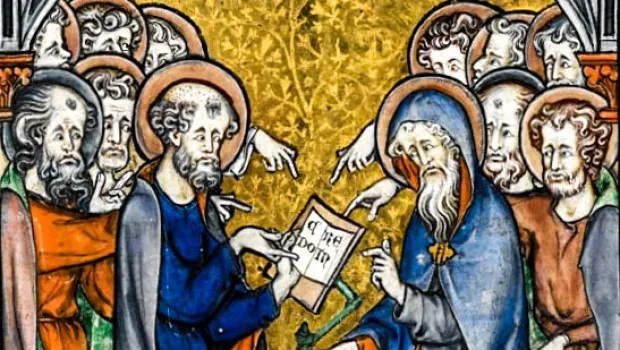
A 13th century artwork depicting the Apostles writing the Creed

Then, standing there in front of the place of worship, you must pray:

My ancestor was homeless,
an Aramean who went to live
    in Egypt.
There were only a few
    in his family then,
but they became great
and powerful,
    a nation of many people.

The Egyptians were cruel
    and had no pity on us.
They mistreated our people
    and forced us into slavery.
We called out for help
to you, the Lord God
    of our ancestors.
You heard our cries;
you knew we were in trouble
    and abused.
Then you terrified the Egyptians
with your mighty miracles
    and rescued us from Egypt.
You brought us here
and gave us this land
    rich with milk and honey.
Now, Lord, I bring to you
the best of the crops
    that you have given me.

After you say these things, place the basket in front of the Lord’s altar and bow down to worship him. (Contemporary English Version)

Forty years of wandering throughout the desert, in the backside of the wilderness. Having been delivered out of Egypt by the mighty hand of God, the Israelites were on a very circuitous journey to the Promised Land.

The Book of Deuteronomy is a restatement of the people’s history and God’s law for the generation about to enter the land of Canaan. Moses told the people that when they enter the land and have their first harvest of crops, they are to remember and give thanks for all their blessings.

People need to be reminded of important things. Sometimes, in the middle of success and good fortune, we can forget to savor the moment, neglect to appreciate what it took to get to this place, and fail to celebrate with others the God who has made good things happen.

Interestingly, in appreciation for the abundance of a harvest, Moses did not tell the people to give thanks for the weather or the crops themselves. Rather, they were exhorted to recall and retell the story of Israel and their ancestors.

Through historical narrative, the Israelites tethered themselves to their present reality. They located themselves in the past, as contemporary links in a holy chain that stretched generations, all the way back to the patriarch Jacob.

This sort of relational and generational gratitude is in stark contrast to what current cultural appreciation and thanksgiving is, for cars, homes, jobs, resources, and stuff. Although thankfulness is appropriate and necessary for those things, none of it is lasting and sustainable.

Beneath all of the purchased things and electronic devices is a longing for connection, a desire to know who we are, where we came from, and what our true roots are.

Greater emotional health comes from knowing where we came from. Our connections to family, friends, church, and community are a vital and essential piece of living a good life with satisfaction and contentment.

Healthy roots enable us to respond well to the challenges of life with strength and resilience.

One way to recall and remember is to recite a creed. Sadly, many churches today recoil at reciting creeds and confessions, as if this were a bad thing. But there is significance and power to a group of people who stand and recite an ancient creed together.

The Christian ecumenical church creeds, including the Apostles’ Creed, Nicene Creed, and Athanasian Creed, capture the settled convictions of early believers in Jesus as they struggled to express their faith in the church and the world.

Those creeds are a part of us, and of our collective spiritual history as the people of God. There are yet other kinds of creeds, as well. We have an even more ancient creed expressed in today’s Old Testament lesson – the sort of creed that tells a story.

Moses gave the Israelites some parting instructions to follow for their future worship in the Promised Land. When they enter the land a bring in their harvest, they were to bring the first-fruits of their crops to the priest, and then profess a creed, which is really a story, a historical narrative of God’s people.

Every Jewish farmer and worshiper who brought their crop to the priest would recite the creed about their ancestors suffering in Egypt and being redeemed by God through a great deliverance. God granted them the gift of land, a promised place to call their own.

We as the people of God must discern the importance of embracing the story of redemption, of crying out and being delivered from the shackles of sin, death, and hell. We receive this salvation with thanksgiving and joy.

Christians tell their story of deliverance not only through the ancient ecumenical creeds, but also through the sacramental means of communion. The Table proclaims the life and death of Christ, given for us, and for our salvation. It is a story with deep roots in the life of Israel.

Believers in Jesus are invited to participate is something bigger than themselves. The Christian’s story begins not at Pentecost in the New Testament, but in the promise to Abraham way back in the Old Testament.

The blessing given to Abraham was a blessing for all nations, not just Israel (Genesis 12:1-3). Knowing the roots of our spiritual life and Christian faith helps inform us how we are to live out that faith and life in this present time.

Within Christianity, our history and story is much bigger than Europe and Western civilization. The earliest church began in the Middle East. Ancient Christian traditions and churches still exist, and worship today in places like Egypt and Ethiopia. There are presently large numbers of Christians in every part of the world, especially in Latin America, Asia, and Africa.

Essentially, we are the lost, the last, the forgotten, the outsiders who cried out to God. And the Lord rescued us, blessed us with every spiritual blessing in Christ, and gave us the privilege of being ambassadors for Christ in the world.

We belong to God. Along with believers throughout the ages, and across the world, we declare:

I believe in God, the Father almighty,
creator of heaven and earth.

I believe in Jesus Christ, his only Son, our Lord.
He was conceived by the power of the Holy Spirit
and born of the Virgin Mary.
He suffered under Pontius Pilate,
was crucified, died, and was buried.
He descended to the dead.
On the third day he rose again.
He ascended into heaven,
and is seated at the right hand of the Father.
He will come again to judge the living and the dead.

I believe in the Holy Spirit,
the holy catholic Church,
the communion of saints,
the forgiveness of sins,
the resurrection of the body,
and the life everlasting. Amen.

With God In the Dark (Psalm 3)

By Unknown Artist

Lord, I have so many enemies!
    So many are standing against me.
So many are talking about me:
    “Even God won’t help him.”
But you, Lord, are my shield!
    You are my glory!
    You are the one who restores me.
I cry out loud to the Lord,
    and he answers me from his holy mountain.
I lie down, sleep, and wake up
    because the Lord helps me.
I won’t be afraid of thousands of people
    surrounding me on all sides.

Stand up, Lord!
    Save me, my God!
In fact, hit all my enemies on the jaw;
    shatter the teeth of the wicked!
Rescue comes from the Lord!
    May your blessing be on your people! (Common English Bible)

I don’t like cockeye arrogant people. It irks me when a person believes that their way is the only way. Such persons within the church tend to think God is always on their side. Their pride leads them to believe that God won’t help anyone who differs from them.

That sort of arrogance causes the proud person to become a self-appointed judge of all things. So, they have no problem believing that they are God’s instrument of judgment toward those who don’t agree with them.

Ironically, in their delusion, enemies of God actually believe they are on God’s side.

These were the sort of persons that opposed the psalmist, King David. They thought they knew better about how to reign over a kingdom than David did. So, David prayed with a lot of flavor for God to disprove the arrogant assertions of his enemies.

David rightly asserted that trust has its foundation in God, and not in the beliefs of humans. He discerned that God is his shield and protection against the foe. David believed that the power of God can repel any attack, as well as restore anyone to any position, as God sees fit.

The contrast in the psalm is between humble David and his proud enemies. David was the sort of person who called on God when he was in trouble. David’s enemies were the kind of people who first formed their own opinions and laid their own plans, then told God to bless what they came up with.

That’s not only the difference between humility and pride; it is also the difference between wisdom and foolishness, intelligence and stupidity.

Whatever David’s opponents would do is no match for the protective encircling presence of God around him. Although proud enemies are like wild animals with powerful jaws, God can snatch anyone out of their teeth.

Even though David’s enemies advanced against him with arrogant self-confidence, God can rescue anyone from any army. No plan formed against the godly person shall succeed. The Lord can deliver one from any and every situation.

With God, one’s fear is mitigated by faith; and sleep eventually comes with a relaxing trust in the Lord. The faithful Christian arises with a prayer in their heart saying:

Almighty God, everlasting Father, you have brought me in safety to this new day. Preserve me with your mighty power, that I may not fall into sin, nor be overcome by adversity. And in all I do today, direct me to the fulfillment of Your purposes, through Jesus Christ my Lord. Amen.

The godly understand that the Lord never slumbers nor sleeps. God is ever-present with needed watch-care. And so, we declare along with the psalmist:

I look to the hills!
    Where will I find help?
It will come from the Lord,
    who created heaven and earth.

The Lord is your protector,
and he won’t go to sleep
    or let you stumble.
The protector of Israel
doesn’t doze
    or ever get drowsy.

The Lord is your protector,
there at your right side
    to shade you from the sun.
You won’t be harmed
by the sun during the day
    or by the moon at night.

The Lord will protect you
and keep you safe
    from all dangers.
The Lord will protect you
now and always
    wherever you go. (Psalm 121, CEV)

Even though the believer may become burdened with distress and adversity, without any sign of relief, they never cease to cry out and call upon God. They trust in God’s promises. They support themselves with their knowledge of God. They endure and persevere through all things.

In the end, the faithful will realize blessing and goodness. The unfaithful and arrogant won’t.

Perhaps you have been tossing and turning every night. If you sleep at all, your dreams are nightmares. During the day you might have the wherewithal to resist doubt and distress. But at night, your defenses are down, and waves of anxiety come upon you like a bunch of unwanted thugs.

In your disquieted state, make your repose to God. There is no shame in discouragement and defeat, for all the godly will suffer in some way. You shall ultimately prove victorious over all your fears, because of your reliance upon the Lord.

Whereas the ungodly puffed up person relies upon themselves, they shall be overcome by the smallest of perils. They do not realize that the routines of prayer, mindfulness, self-awareness, and the singing of hymns regulate and regimen the mind, even when unwanted situations persist for days, weeks, months, or even years at a time.

The unfaithful don’t understand that consistent rhythms of faithfulness done day after day, despite one’s circumstances, leads to a good life.

This liturgy of life in communing with God perhaps happens best at night.

On my bed I remember you;
    I think of you through the watches of the night. (Psalm 63:6, NIV)

In the night, Lord, I remember your name,
    that I may keep your law. (Psalm 119:55, NIV)

If you are a night owl, then use the time after everyone is in bed to take advantage of the quiet time with God. Your faith can be and is being forged in those dark hours after sunset. Allow yourself to fall asleep in God’s protective hands.

If you are a morning person, arise before the dawn and let the unhindered time when everyone else is sleeping bring you close to God in prayer and devotion. Let the coming of the day be shaped by the consistent discipline of scripture reading and contemplative prayer.

I rise before dawn and cry for help;
    I have put my hope in your word. (Psalm 119:147, NIV)

May the dark hours be to you blessing and honor. May the glory and power of God be seen, even in the night. For God sees you, and is with you, now and forever. Amen.

Sing a New Song (Psalm 98:1-5)

Oh, sing to the Lord a new song!
For He has done marvelous things;
His right hand and His holy arm have gained Him the victory.
The Lord has made known His salvation;
His righteousness He has revealed in the sight of the nations.
He has remembered His mercy and His faithfulness to the house of Israel;
All the ends of the earth have seen the salvation of our God.

Shout joyfully to the Lord, all the earth;
Break forth in song, rejoice, and sing praises.
Sing to the Lord with the harp,
With the harp and the sound of a psalm, (New King James Version)

I still remember, years ago when I was in college, a guy with a pony tail and wearing flip-flops, walking up with a guitar on his back in front of a gathering of fellow students who were Christians.

Yet, most evident, was his broad smile which seemed to engulf his entire face. He talked about his life before Christ – which was all of his life up until the week before – and what Jesus had done for him.

Then, he took his guitar and announced that he wrote a song to this very text, the first few verses of Psalm 98. I wish I had a recording of it, especially because of how he sang it with such volume and exuberance, as if the words had just been crafted yesterday.

Even though the psalm is ancient, the psalmist himself was inviting people to sing a song infused with a new perception of life on this earth.

There is always plenty of room to reflect on what God has done, and is doing, in this very big world. Not only can we consider the immensity and intricacy of the created order, but we can also declare all the things we cannot detect with our five senses.

And perhaps those are the things which impact us the most, when we sense and feel the reality of God’s work in the world, and in our lives. At least that’s what my pony-tailed smiling friend was so excited about.

The things which exist beyond our normal human experience are no less real than our daily mundane activities. This is the realm where the Lord makes the greatest impact of all. God hasn’t only done great things, but has done great things for me.

We have to use metaphors and personifications in order to even begin understanding the wonder and awe of God’s saving power in our very real here-and-now lives. God’s mighty right hand and holy arm of power speak to the incredible strength and authority which can reach into the thickest and nastiest of garbage dumpsters to pull out the pearl of great price, that is, you and me.

Consider God, the One who puts all things right, and is just and good in all things – paying attention to the least of us, and lifting up with divine deliverance from the most dire and awful of circumstances.

Indeed, the Lord has made God’s salvation known, and revealed God’s righteousness to the nations.

Sometimes it takes someone with a fresh new song to wake us up to the reality that we can discern the activity of God every day, in all the ordinary and myriad ways of our lives. Along with all of creation, and pony-tail guy, we join the chorus of those who are already singing with the unique voice God provided for us.

And those many songs all include, at their center, the reality that before I chose God, God chose me; that when I forget, God remembers; that with my waxing and waning of love, God is consistently steadfast and faithful with love; and that God provides salvation, and judges the people with equity, even when I show favoritism.

With each new testimony of God’s saving work, it becomes harder and harder for others to insist that God is absent, hidden, or negligent. God is there. God is here. God is everywhere.

We can get so wrapped up in our own small worlds, and our own little safe places, where everyone looks like me, acts like me, and thinks like me. But the world is much bigger than our contrived spaces in which we can set ourselves up as master and commander.

The Lord mercifully breaks through all of our puny posturing and petulance, and saves us from ourselves. God pushes and cajoles us to see beyond the end of our noses. We are moved to see a new perspective we haven’t noticed before.

And once we make out what God is doing, and does for me, then bursting into song with shouting and volume is the organic response to our experience. If you think about it, there is really no other way to respond, once you have gotten a glimpse of God’s activity, and discerned something that was previously undiscernible.

Even the rocks will cry out in the face of such love and grace.

It’s okay to open your mouth, once your eyes have been opened, and let a new song come tumbling out. Because joy is the response of being delivered from what once bound us.

Gracious and Loving God, you have filled the world with beauty: Open our eyes to behold your gracious hand in all these works; that, rejoicing in your whole creation, we may learn to serve you with gladness; for the sake of him through whom all things were made, your Son Jesus Christ our Lord.