His Resurrection Is Ours

The Resurrection, by Andrea Mantegna, c.1458 C.E.

The story of Christianity, the very heart and essence of the religion, is a tale of transformation from all the obstacles, impediments, and barriers which confine or cripple. The person and work of Jesus accomplished this. In his earthly ministry, Christ continually called people to transformative change into the reality of God’s gracious and benevolent realm.

“I have come to give the good life, a life that overflows with beauty and harmony.”

Jesus (John 10:10, First Nations Version)

Christ’s resurrection made possible our own transformative new life. This is both exciting and scary. Resurrection is frightening because it’s a call to live a life without any of the walls which have defined us and/or imprisoned us.

The massive stone covering the tomb of Jesus Christ was rolled away. He walked out of the grave by the power of resurrection. The cave of death was changed into the place of liberation.

That place is a powerful image of moving aside any and all obstacles to our own faith and freedom. The prison doors have been opened. Our self-contrived inner prisons, as well as the unjust shackles placed upon us, have dropped away.

As a result, those who have been exiled, excommunicated, and treated as expendable are visited by the luminous healing presence of God’s great liberating force: resurrection.

All of these words may either seem strange and/or compelling. If this is the case, it is a sad situation. Because it’s quite necessary that we become familiar with such language. Unfortunately, the gap between the world we are presently living in, and the world our hearts yearn to know, is quickly coming to an unsustainable place of high stress.

There is now a profound disconnect between the love deep inside us, and the way in which we are living our day-to-day lives on this earth. The issue has become so great as to warrant the need for resurrection.

And I am not simply addressing Christians. In his earthly ministry, Jesus was not only talking to his own Jewish people; he came for the whole world. Jesus is for everyone – whether we acknowledge him according to Christian dogma and doctrine, or not.

The evil gaslighting sort of person wants you to believe that you are alone, bereft of any help – that somehow you need to assert yourself aggressively into the dog-eat-dog world. Wickedness always looks to chaos and war as the path to gaining the life one wants.

But Jesus is the bridge to another kind of thinking, another sort of life. He is the guide to the greatest power which exists in the world: Love. And Love is why resurrection is a reality.

Although we suffer from systemic evil and all kinds of structural “ism’s” in this world, our shackles and chains have been largely forged by ourselves, through spiritual ignorance and misunderstandings of who we are and why we are here.

Resurrection opens us to new life. It provides identity, purpose, and passion to live the good life. Even though we live in this world below, our answers to living in the here-and-now are found in the world above.

All of us have experienced walking a dark path in life. But now it is high time to walk away from uncontrolled emotions and evil ways. There are plenty of lying spirits who intend on deceiving you and I for their own selfish purposes. Instead, we can refuse and resist such evil.

We can live in ways that represent the good, the right, and the just. We can experience living a resurrected life. Let us choose the pure path of the new person in Christ, the person you and I were created to be.

The telltale signs of the person living into resurrection are a deep feeling for the pain of others, kindness, humility of heart, a gentle spirit, and long-suffering patience with others. Such persons wear forgiveness like a well-worn pair of jeans.

This is the path of resurrection, the way of unity, peace, and harmony. And these qualities will always guide us and inform us in helpful and sacred ways.

Our current global decline comes from an accumulation of greed and sheer lovelessness. But the possibility of rebirth, of resurrection, rises from our deep universal yearning for the good and the true. It comes from our radical willingness to change and live a different counter-cultural life.

Resurrection does not occur because of lofty thoughts; it comes from a humble, and contrite heart which yearns for a better and more sacred existence.

Only until we find our present life on this world as intolerable with its injustice and persistent carelessness, will we see that we must put love where love is not.

The great lesson of resurrection is that Love makes all things right.

May resurrection move from being merely a theological concept, to a powerful reality that permeates and fills your life with meaning, power, and love. Amen.


It’s All About Love (Song of Songs 2:1-7)

I am a rose of Sharon,
a lily growing
in the valleys.

[ GROOM ]

Like a lily among thorns,
so is my true love among the young women.

[ BRIDE ]

Like an apple tree among the trees in the forest,
so is my beloved among the young men.
I want to sit in his shadow.
His fruit tastes sweet to me.
He leads me into a banquet room
and looks at me with love.
Strengthen me with raisins
and refresh me with apples
because I am weak from love.
His left hand is under my head.
His right hand caresses me.

Young women of Jerusalem, swear to me
by the gazelles
or by the does in the field
that you will not awaken love
or arouse love before its proper time. (God’s Word Translation)

Notice how the flowers grow in the field. They never work or spin yarn for clothes. But I say that not even Solomon in all his majesty was dressed like one of these flowers. (Matthew 6:28-29)

Love the Lord your God with all your heart, with all your soul, and with all your strength. (Deuteronomy 6:5)

As long as I have you, I don’t need anyone else in heaven or on earth.

Psalm 73:25

There is nothing quite like a field of flowers. Along the coastal plain of the Mediterranean Sea, south of Mount Carmel, is Sharon. In the ancient world, there was found crocuses, tulips, and hibiscus.

These days, in the Spring of the year, one can see bindweed and pimpernel, sage and iris, as well as orchids and poppies. In addition, lilies bloom throughout the valleys of the Middle East. In the Spring, flowers are commonplace in the valleys and countryside.

In today’s Old Testament lesson, the bride in this poetic ode to love and beauty, is saying there is nothing special about her. There are many women, and she in no way stands amongst them all.

Love says otherwise. Love picks out the individual. In the Song, the groom views the bride as if a flower among thorns. There is a beauty that attracts him to her. She may be a commoner, yet her beautiful qualities stand out and are attractive. All others pale in comparison to her.

Likewise, the bride basks in the security of the groom, finding all others tasteless compared to him. He is like an apple tree that provides shade, and whose fruit is delicious.

There is a mutual attraction that is life-giving and beautiful. It is more than a fleeting infatuation. They see within each other the qualities which will bind and sustain them when there are rough times and hard roads.

Beauty is much more than outward appearance. It is the endearing inner qualities of a good and right spirit, which is outwardly seen in a visage of compassion and caring, gentleness and humility, purity and peace.

Such beauty, in and out, causes one to swoon with love – hence, making one love-sick. Love is powerful. It is not to be corrupted by the lust which only views another as an object to be gained.

We are to let the beauty and power of love develop, grow, and mature. The flowers of the field may seem to spring up overnight. However, the seeds and the bulbs have been awaiting the right time to take root, break the ground, grow up, and flower.

Love is both endearing and enduring. Love is to be nurtured and cultivated. It cannot be hurried. Love is an attention to the whole person, and seeks to endure for the long haul. It maintains a beautiful commitment into the growing coldness of autumn, and holds vigil through the season of winter. Love isn’t going anywhere.

But I am talking about Christ the groom, and Church the bride. Spiritual commitment is not really measured in doctrinal statements and dogmatic theology. It is shown and known by embracing Love with a capital “L.”

God is Love. Yes, God does loving deeds and actions. Yet, we are told that the very nature and character of God is Love. Jesus is Love incarnate, the embodiment of what Love sees and does in this world.

I am, of course, taking a decidedly Christian approach to the Song, and an allegorical view of it. This is why, if we delight in knowing and enjoying the Song, we discover the way to genuine spirituality, and the key which unlocks the whole of Holy Scripture.

Not everyone, of course, will agree with me or choose to go down this allegorical path. Perhaps this is why we have so much religion nowadays which is devoid of love, and chooses to focus on sterile doctrinal checklists to which we must ascribe.

Please don’t hear what I am not saying. Doctrine is important. Theology is a must. But if our doctrine and theology has no beauty, and has no thoughts of love, and is not basically oriented in the direction of love, then I strongly argue that it isn’t doctrine or theology at all!

“And what is proper love? One should love the Lord with an exceeding great and very strong love so that the soul be tied to the love of the Lord, finding itself totally absorbed in it, as if he were suffering of lovesickness, when his mind is never free because of love for that woman, and he is obsessed with her, whether sitting down, or standing up, even when he is eating and drinking. More than this should the love for the Lord be in the heart of those who love him, meditating on it constantly, even as God has commanded us: ‘With all your heart and with all your soul.’” – Maimonides, Jewish Rabbi and philosopher (1138-1204, C.E.)

We were created by God for love. God longs to love us; and we are to love God with our entire self – heart, soul, mind, and strength. What’s more, our own love for one another is shaped by the love we receive from God.

Indeed, the biblical book, Song of Songs, is not only in the literal middle of the Old Testament; it is also in the very heart of it. It is all about Love.

Bless us with Love, O Merciful God;
That we may Love as you Love!
That we may show patience, tolerance,
Kindness, caring and love to all!
O Compassionate One, grant compassion unto us;
That we may help all fellow souls in need!
Bless us with your Love, O God.
Bless us with your Love. Amen.

A Thunderous Beauty (Psalm 68:24-35)

Your solemn processions are seen, O God,
    the processions of my God, my King, into the sanctuary—
the singers in front, the musicians last,
    between them young women playing tambourines:
“Bless God in the great congregation,
    the Lord, O you who are of Israel’s fountain!”
There is Benjamin, the least of them, in the lead,
    the princes of Judah in a body,
    the princes of Zebulun, the princes of Naphtali.

Summon your might, O God;
    show your strength, O God, as you have done for us before.
Because of your temple at Jerusalem,
    kings bear gifts to you.
Rebuke the wild animals that live among the reeds,
    the herd of bulls with the calves of the peoples.
Trample under foot those who lust after tribute;
    scatter the peoples who delight in war.
Let bronze be brought from Egypt;
    let Cush hasten to stretch out its hands to God.

Sing to God, O kingdoms of the earth;
    sing praises to the Lord,
O rider in the heavens, the ancient heavens;
    listen, he sends out his voice, his mighty voice.
Ascribe power to God,
    whose majesty is over Israel
    and whose power is in the skies.
Awesome is God in his sanctuary,
    the God of Israel;
    he gives power and strength to his people.

Blessed be God! (New Revised Standard Version)

From psalm to psalm, the entire biblical psalter is consistent in praising God. Foremost among the praise is celebrating God’s inherent character, and for how that divine character acts with power and grace in the world.

Since God is an infinitely immense Being, our human language cannot begin to adequately contain or describe such incredible divinity. Yet, words are what the psalms have for trying to communicate the attributes of such an awesome God.

That’s why the use of metaphors is significant. Whenever we can picture something we are familiar with, then imaginatively place God alongside it, it helps give us at least a rudimentary idea and feeling of who God is, what God is all about.

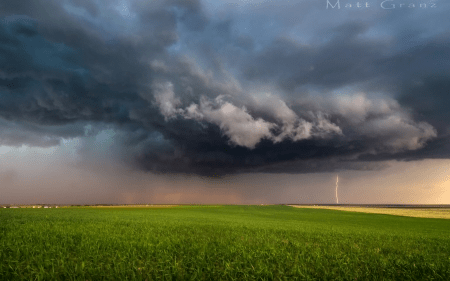
To gain a glimpse of God’s majesty and sovereignty over the universe, the psalmist invites us to see with our spiritual eyes that God riding the sky; and to hear with our spiritual ears the thunderous shout that roars and reverberates throughout the cosmos.

Along with our eyes and ears, we are invited to respond by using our power of words and speech to proclaim God’s power. And, I must say, that power is well beyond our ability to describe.

With all of the powerful forces in this world, they are but a mere puff of breath to the God who reigns supreme over all powers, both in heaven and on earth. God’s power is a thunderous beauty. God’s splendor and strength rise larger than thunderheads.

Having grown up in Midwest America, I’ve seen my share of large thunderheads (massive cumulus clouds which form just before a storm), thunderstorms replete with bright lightning and noise so awesome it shakes the farmhouse, and tornados with such force that they rip the roof off a barn as if it were a Lego building.

The appropriate response to such a great God is to make music for the One who strides the ancient skies in a heavenly chariot; and yet stoops to listen and care about puny humans.

The reasonable response to such a breathtaking God is to listen to the divine voice thundering in the world, and submit to the sound which seems like it might split the heavens open.

To gain a mere glimpse of God’s strength and power will inevitably result in a response of giving up our all to the Lord of the universe – everything we have, and all that we are.

To know, even a tiny smidgeon, of such a God will bring our own loud shouts of proclaiming God’s goodness, grace, and generosity to anyone who will listen to us.

To glimpse what the psalmist sees will consume us with awe, as we intuitively connect with the glory which is constantly streaming from heaven.

What’s more, God shares divine strength with people. God doesn’t have to do that. The Lord has no obligation to do so. Yet, it happens, despite our fickle praise and inconsistent devotion.

So, let’s give our highest praise to the God of the psalms. Let’s imbibe of God’s thunderous presence among us.

I guarantee that it will make us happier than a gopher in soft dirt; or a butcher’s dog; or a unicorn eating cake on a rainbow.

Eternal Trinity – blessed Father, Son, and Spirit – the awesome God whom I serve: The more I enter you, the more I discover, and the more I discover, the more I seek you. A massive thunderhead is but a small cloud next to you, the Godhead, the incredible Three-in-One.

Through you, almighty Lord, I shall come to know myself and my world. And that knowledge is a mighty love for humanity which spans longer and higher than the universe itself. May the love, unity, harmony, community, goodness, and power which is always present within yourself, mighty God, be present with me, your servant.

For just a molecule of You is enough to power me for eternity. Praise the Lord! Amen.