Welcome, friends! On this bitterly cold day, may the gracious warmth of Jesus infuse your spirit with peace and joy in the Holy Spirit. Click the videos below and let us discover the spiritual health and life of Christ our Lord…
Mark 1:29-39
Words by Edward Mote, Music by William B. Bradbury, A Cappella Arrangement by David Wesley
Now to him who is able to do immeasurably more than all we ask or imagine, according to his power that is at work within us, to him be glory in the church and in Christ Jesus throughout all generations, forever and ever! Amen.
The Solitude of Christ by French painter Alphonse Osbert, 1897
As soon as they left the synagogue, they went with James and John to the home of Simon and Andrew. Simon’s mother-in-law was in bed with a fever, and they immediately told Jesus about her.So, he went to her, took her hand, and helped her up. The fever left her, and she began to wait on them.
That evening after sunset the people brought to Jesus all the sick and demon possessed. The whole town gathered at the door, and Jesus healed many who had various diseases. He also drove out many demons, but he would not let the demons speak because they knew who he was.
Incredibly early in the morning, while it was still dark, Jesus got up, left the house, and went off to a solitary place, where he prayed. Simon and his companions went to look for him, and when they found him, they exclaimed: “Everyone is looking for you!”
Jesus replied, “Let us go somewhere else—to the nearby villages—so I can preach there also. That is why I have come.” So, he traveled throughout Galilee, preaching in their synagogues, and driving out demons.
A man with leprosy came to him and begged him on his knees, “If you are willing, you can make me clean.”
Jesus was indignant. He reached out his hand and touched the man. “I am willing,” he said. “Be clean!” Immediately the leprosy left him, and he was cleansed.
Jesus sent him away at once with a strong warning: “See that you don’t tell this to anyone. But go, show yourself to the priest and offer the sacrifices that Moses commanded for your cleansing, as a testimony to them.” Instead, he went out and began to talk freely, spreading the news. As a result, Jesus could no longer enter a town openly but stayed outside in lonely places. Yet the people still came to him from everywhere. (Mark 1:29-39, NIV)
Solitude by Russian painter Tatiana Yushmanova
We need rhythm. Everything in life is rhythmic. Each new year moves with the rhythm of the four seasons. Our hearts beat in rhythm. When we walk, our gait is in a distinct rhythm. When talking, we speak with a rhythmic cadence. We sing and make music because of rhythm. We need healthy rhythms of waking and sleeping.
When our rhythm is off, we are off. Busy or unhealthy lifestyles can insidiously drag us away from the spiritual rhythms we need for healthy living. Over time, it may go unnoticed that our rhythm is off. For many folks, normal is getting dressed in clothes bought for work, driving through traffic in a car still being paid for, to go to a job to pay for the clothes, car, house, and other stuff that is left empty of life all day to afford to live in it. Many people are oriented more by the rhythms of work, school, and sports than by a connection to the life, death, and resurrection of Christ.
Our 24/7 world demands more time and resources, convincing us we can never slow down or take a break. Some people know their rhythm is off and out of sync with God’s ways but feel powerless to change it. So, how do we restore the unforced rhythms of God’s grace to the center of our stressed and chaotic lives without being overwhelmed by a new set of time commitments? To have healthy rhythms of life, we must look to Jesus.
Jesus was continually filled with the life of God the Father and therefore was always overflowing with that life to others. Christ had a rhythm of life which was oriented around times of inner solitude with his heavenly Father, and times of outward spiritual care to people. Jesus needed regular, dedicated time for solitude and prayer for the rigors of ministry. So then, how much more do we!
There are two distinct sections in today’s Gospel lesson: Christ’s outward healing ministry; and his inward attention to solitude and prayer. By examining Jesus and following his rhythms of life, we can find the way to living healthy fulfilled spiritual lives as Christians.
The outward healing ministry of Jesus was powerful and effective.
Jesus was committed to helping and healing people with the authority given him. Peter’s mother-in-law was sick. Every sickness in the ancient world was serious and could easily result in either permanent physical damage or death. In a clear demonstration of power, Jesus simply took her by the hand and raised her up to new life. As soon the fever left her, the woman immediately began serving the people in the house. The proper response to being healed by Christ is to become a servant of others.
13th Century Byzantine Church mosaic of Jesus healing Peter’s mother-in-law
Jesus and the disciples were in the little village of Capernaum, and being a small town, the news spread quickly of what happened with Peter’s mother-in-law. As a result, by evening, every sick and demonized person in the village showed up to see Jesus. Christ healed them all and confronted the demonic among them. Jesus wanted to avoid creating a circus and desired to move about freely, so he commanded the demons not to speak, because they knew who he was and what he was up to.
Healing is wonderful. Talking about it, not so much. Discussing healing is difficult because seeing one person healed and restored while another person is not, defies simple answers. So, I offer a few biblical observations about this human conundrum we all have likely experienced.
Healing narratives in the Gospels say much more about Jesus than about us.
Jesus has the power and authority to overthrow demons, cure the incurable, and restore people to health. It is all a sign that the kingdom of God is near, and when the kingdom comes in all its fullness, there will be no more sickness, pain, or demonic influence.
Good health, security, and safety are not necessarily a sign of God’s presence any more than pain and suffering are signs of God’s punishment, or a lack of personal faith.
We have enough stories in the Bible to let us know we are not privy to the big picture of what God is doing. We will not always see what the Lord is up to and very well may never have an answer to our questions, this side of heaven.
Every person who is healed today will eventually get sick again and someday die.
Even Lazarus, whom Jesus raised from the dead, died again. The ultimate meaning of any person’s healing is more than the physical – it affects the entire person – body, mind, emotions, soul, and spirit. For example, forgiveness is many times the needed miracle before any kind of physical healing can occur.
Sometimes the greatest miracle of all is our response to sickness and suffering. A surgeon, Richard Selzer, describes one such miracle: “I stood by the bed where a young woman lies in post-op after surgery, her mouth twisted looking clownish. A tiny twig of the facial nerve, the one to the muscles of her mouth, has been severed to remove a tumor in her cheek. Her young husband is in the room. He stood on the opposite side of the bed as if I were not really in the room, his full attention on her. She asked me, ‘Will my mouth always be like this?’ ‘Yes, it will, because the nerve has been cut,’ I say. She nodded somberly. But the young husband began to smile. He said, ‘I like it; it is kind of cute.’ He bent down to kiss her crooked mouth and I was close enough to see how he twisted his own lips to accommodate hers, to show her that their kiss still works.”
Perhaps the kind of healing we all need is the ability to receive God’s love in the person of Jesus who has accommodated himself to us.
Christ did not spend every waking moment with people, teaching and healing. Jesus knew that working without prayer, rest, and solitude is not realistic and rarely ends well.
The inward prayer and solitude of Jesus caused him to be powerful and effective.
Early the next morning after a day of healing ministry, Jesus got up and went to be alone with the Father. The fact that Peter and the disciples hunted him down when they could not find him, shows they did not quite see the same value of solitude that Jesus did. In Christ’s healthy rhythm of life, he included significant doses of solitude with his Father.
It is important for believers to spend generous portions of time with God. If we fail to do this, God has ways of getting our attention. We must slow down and calm our racing thoughts enough to listen. Human suffering is a great way to meet Jesus! We cannot rush from task to task and expect to live a healthy spiritual life. We need time with Jesus.
“Without great solitude, no serious work is possible.”
Pablo Picasso
Only through a healthy rhythm of life that includes solitude and prayer will we have clear direction for our daily lives, and wisdom for sound decision-making. Jesus came away from his time of solitude having re-connected with his purpose for being on earth. It was his clear conviction that he must travel and not just stay in one place.
Traveling is important to the Christian life. I am not talking about moving from state to state like I have done in my life; I mean that we must keep moving, like walking across the room to engage others we do not know. Our lives become stagnant when we only ever interact in our small circle of friends and family.
So, Jesus traveled throughout Galilee, convinced to do so through his time of solitude and prayer, to spread the good news of God’s benevolent kingdom and drive out demons wherever he went. Even in this we are to imitate our Lord.
Driving out demons is, yes, a literal reference. The demons were driven out so that people could be liberated and experience freedom and connection in community, since most demonized people were always in solitude. They were freed so that they could have healthy rhythms of life of not just solitude but of ministry, service, and community. Hell is a separation from God and others. Jesus came to bring relational health and wholeness through relational connection.
Conclusion
Both continual work and prolonged withdrawal from others is unhealthy. To always be working and serving eventually leads to bitterness, exhaustion, and burn-out. To always be alone (even in a crowd) and not serving leads to spiritual sickness. It may be counter-intuitive for us to break away from work, but solitude and prayer will help us more productive.
If we are constantly on the go, there is healing available through solitude. If we are continually withdrawn from others, then the healing we need will come through engaging with others and moving past passivity.
To attach and detach, to connect and let go, to engage and desist, are spiritual rhythms of life that we must hone and practice so that we will be healthy persons for ourselves and for others.
Praise the Lord! Because it is good to sing praise to our God! Because it is a pleasure to make beautiful praise!
The Lord rebuilds Jerusalem, gathering up Israel’s exiles. God heals the brokenhearted and bandages their wounds. God counts the stars by number, giving each one a name. Our Lord is great and so strong! God’s knowledge cannot be grasped! The Lord helps the poor, but throws the wicked down on the dirt!
Sing to the Lord with thanks; sing praises to our God with a lyre! God covers the skies with clouds; God makes rain for the earth; God makes the mountains sprout green grass. God gives food to the animals— even to the baby ravens when they cry out. God does not prize the strength of a horse; God does not treasure the legs of a runner. No. The Lord treasures the people who honor him, the people who wait for his faithful love. (CEB)
Early each morning I rise, take the dog for a short walk, make a cup of coffee, then open the life-giving message from the God of the Bible. I read out loud – slowly, mindfully, carefully – allowing the words to seep and make their way down into my soul.
The Holy Spirit of God gently nudges, sometimes forcefully hurls, me toward a verse, phrase, or word from the text. Contemplating, ruminating, thinking about the Holy Scripture begins to set the trajectory of my day. God is throughout the hours, as I move from one to the next. Sometimes the Lord and Scripture are very much at the forefront of my thinking, other times in the background shaping how I speak and act, and always on my heart enlarging it and filling it with his grace.
Most of life is lived in the mundane. The banality of life is the norm, even in times of change. While others run from prayer to prayer looking for miracles and the next big spiritual high, the one who is patient… waits… and honors God… has a treasure within which transcends language or outward fanfare. The settled conviction of the person in continual communion with the God of the universe peacefully waits for faithful, steadfast, committed, divine love.
There is no description for such a divine/human spiritual relation which exists, giving patience to the penitent and joy to the heart of God. Such love exists beyond the plane of daily news crises and the continual hum of the crowd. Indeed, the Lord God Almighty, Creator of heaven and earth, has stooped to cup his hands and treasure the creature formed in the divine image.
“Prayer is an act of love; words are not needed. Even if sickness distracts from thoughts, all that is needed is the will to love.”
Teresa of Ávila
Patience is not a bore. To wait is to be at peace. Because God is there. And it is good to be full of God.
O God of peace, you are the one who has taught us that in returning and rest we shall be saved, in quietness and in confidence shall be our strength: By the might of your gentle Spirit, lift us, we pray, to your loving presence, where we may be still and know that you are God; through Jesus Christ our Lord. Amen.
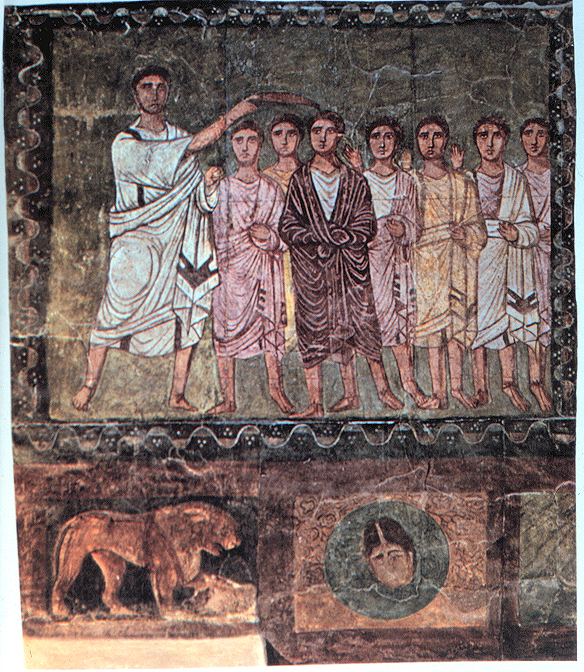
Samuel Anoints David as King, Syrian Orthodox Church, 3rd Century C.E.
The Lord said to Samuel, “How long will you mourn for Saul, since I have rejected him as king over Israel? Fill your horn with oil and be on your way; I am sending you to Jesse of Bethlehem. I have chosen one of his sons to be king.”
But Samuel said, “How can I go? If Saul hears about it, he will kill me.”
The Lord said, “Take a heifer with you and say, ‘I have come to sacrifice to the Lord.’ 3 Invite Jesse to the sacrifice, and I will show you what to do. You are to anoint for me the one I indicate.”
Samuel did what the Lord said. When he arrived at Bethlehem, the elders of the town trembled when they met him. They asked, “Do you come in peace?”
Samuel replied, “Yes, in peace; I have come to sacrifice to the Lord. Consecrate yourselves and come to the sacrifice with me.” Then he consecrated Jesse and his sons and invited them to the sacrifice.
When they arrived, Samuel saw Eliab and thought, “Surely the Lord’s anointed stands here before the Lord.”
But the Lord said to Samuel, “Do not consider his appearance or his height, for I have rejected him. The Lord does not look at the things people look at. People look at the outward appearance, but the Lord looks at the heart.”
Then Jesse called Abinadab and had him pass in front of Samuel. But Samuel said, “The Lord has not chosen this one either.” Jesse then had Shammah pass by, but Samuel said, “Nor has the Lord chosen this one.” Jesse had seven of his sons pass before Samuel, but Samuel said to him, “The Lord has not chosen these.” So, he asked Jesse, “Are these all the sons you have?”
“There is still the youngest,” Jesse answered. “He is tending the sheep.”
Samuel said, “Send for him; we will not sit down until he arrives.”
So, he sent for him and had him brought in. He was glowing with health and had a fine appearance and handsome features.
Then the Lord said, “Rise and anoint him; this is the one.”
So, Samuel took the horn of oil and anointed him in the presence of his brothers, and from that day on the Spirit of the Lord came powerfully upon David. Samuel then went to Ramah. (NIV)
Solitude by Polish artist Piotr Dura
Appearances can be deceiving. One of the best ways to see beyond mere physical sight is to engage in the spiritual practice of solitude. Solitude is not loneliness but a deliberate retreat from normal routines to be alone with the Lord. The faith of both Samuel and David were strengthened through solitude. It prepared them for public service and made them godly. Because they had established patterns of being alone with God, they had an inward solitude even when in a crowd. That is why Samuel could have an interaction with the Lord, even when among lots of people.
Solitude is important because it is the true path to listening well. A person whose faith has been shaped through solitude has an ability to carry on a dialogue with God while, at the same time, having a conversation with others.
Christ’s relationship with the Father was formed through solitude. Jesus was able to have simultaneous conversations with God and people since he practiced solitude on a regular basis. Jesus began his ministry with solitude (Matthew 4:1-11); made major decisions through solitude (Luke 6:12); and taught his disciples to practice solitude (Matthew 17:1-9; 26:36-46).
Solitude is necessary because engaging the world is important. Effective interaction with others requires times of retreat for solitude with God. Solitude as a spiritual discipline:
Gives us freedom from the need for constant noise and activity.
Allows God to shape our faith rather than conform to the world.
Liberates us from other people’s expectations for us.
Helps quiet internal noise and racing thoughts so we can better listen to God.
Provides the opportunity for reflection upon and preparation for future events.
Creates encouraging speech for the benefit of others.
Fuels a desire to keep practicing solitude because of its benefit.
Solitude taught Samuel obedience.
Samuel learned obedience through years of solitude with old Eli the priest. “Speak Lord, for I am listening” became a way of life for Samuel, as he was trained in how to listen well.
Samuel’s greatness as the Judge of Israel did not lie in his original ideas or the initiatives he took, but in simple obedience to the commands of God. Years of obscurity and solitude as a child created the ability to hear and carry-out what the Lord told him to do.
Even Samuel, as godly as he was, could not rely on personal observations about choosing the next king of Israel. Because he had long years of practicing solitude with the Lord, Samuel was able to clearly hear divine speech and anointed the right person as king. Samuel did not trust his own judgment but relied on God’s direction.
Solitude characterizes God.
Christians serve a triune God of Father, Son, and Spirit. God has complete and perfect solitude along with focused engagement with humanity. Through spending time with God, people can simultaneously interact with divinity and humanity. It is a bit like my wife who began her broadcasting career in radio by simulcasting the AM station in one ear of her headphones, and the FM station in the other ear. She could que a record for the FM station while, at the same time, forecasting the weather for the AM station. Her ability was born of practice and commitment to her craft. In the same way, we have been given a vocation to engage the church and world, and the ability to have a solitude of heart while interacting with others.
God, unlike us, sees us completely, inside-and-out – which is why we are dependent upon solitude of heart so that we can make proper judgments. God urged Samuel to not look at the outward appearance because this is how wrong judgments happen.
Solitude formed David into a king.
David was on nobody’s short list to become king. He was so far out there as a candidate for the position that his own family did not even think it necessary to have him present for the sacrificial feast. It is just like God to have a way of choosing the people we think would be the least likely to do anything.
Being in the pasture day after day and night after night by himself was just the right curriculum that trained the next king. Shepherding was not a lonely affair for David. It was a rich experience of solitude which developed a solid relationship with God. Out in the field, away from all the wrong judgments of the world, David learned to discern God’s voice – a skill he carried with him the rest of his life.
Solitude might seem unrealistic for extroverts, and only something for introverts. Yet, solitude is essential to creating a robust faith in God. The following are some steps toward the practice of solitude and allowing it to bring you into a closer walk with the Lord.
Practice “little solitudes” in the day. The early morning cup of coffee or shower, the drive-time to work, the lunch break, the quiet at night when all is dark and everyone in bed are opportunities for solitude with God to reorient and redirect our lives.
Find or create a quiet place designed specifically for solitude. It might be a room, a closet, or a chair. It might be outdoors. It can be anywhere that helps you be free from distraction and invites you to connect deeply with Jesus.
Begin the day by spending at least 10 minutes alone with God in silence. Over time, work your way to even more minutes, even hours. I am a believer in an hour a day keeping the devil away. Eventually, take an entire day away, every few months. Consider taking a weekend or even a week away once a year.
Read Holy Scripture slowly and meditatively. Listen to what the Spirit may be saying in your reading.Keep a journal handy and write down your observations. Allow prayers to arise from what you hear from the Lord.
This might seem optional only for those with discretionary time – but it is no more optional than planting in the Spring to get a harvest in the Fall. Such fruit results in the slaying of giants….








 Rev. Tim Ehrhardt