Walking in the Light without Fumbling in the Darkness

Photo by Julia Volk on Pexels.com

All the hopes and expectations of Christians are realized in Christ’s resurrection. The good news of Easter cannot be contained or limited to a single day (Easter Sunday). That is why, according to the Church Calendar, Easter is only the first of fifty days of celebration called “Eastertide” which leads to the day of Pentecost.  Eastertide is designed for exploring the new life we have in Jesus and the joyful Christian life we can all experience.

Yet, what if a new life has not been our experience? What do we do when, year after year, Easter comes and goes and all the old sins, failures, compulsions, and addictions remain unchanged?  It is not sufficient to simply know the gospel of grace; there must be a careful and truthful application of the gospel to our lives. For the gospel is not just a message to believe; it is a powerful truth to be acted upon in our daily lives.

Too many folks are spiritually damaged from regrets or remorse over bad decisions. They have shame and guilt about the inability to overcome bad habits. There is a lack of courage in facing temptations and sins within. It all lies beneath the surface festering, irritating, and causing pain. In some cases, it is so deeply embedded in the soul that the cause of the discomfort is unknown.

Spiritual renewal is needed. To take a trip into our inner worlds, there are three words that bring to light three important theological themes.  We need to know and apply these words so we will have the pain relieved and experience the joy of new life in Jesus Christ. (1 John 1:1-2:2)

Fellowship: Christians have a sharing bond of partnership in Christ with God and with one another.

We proclaim to you what we have seen and heard, so that you also may have fellowship with us. And our fellowship is with the Father and with his Son, Jesus Christ. (1 John 1:3, NIV)

Koinonia is a familiar word to many Christians. The image of “fellowship” might be of sitting around a table at a church potluck. Or maybe it evokes the picture of standing around after church and talking with each other over a cup of coffee. The biblical word is much more than this. Fellowship means we have deeply shared beliefs and behaviors with God and one another. 

Fellowship means Christians have a vital union with Jesus which paves the way to cooperate with God’s purposes in the church and the world. Fellowship also means Christians share in Christ together through a common relationship with God and a common purpose of glorifying God. In Christ we partner together to live out the Great Commandment and the Great Commission. Biblical fellowship is an action based in the union we have with God in Christ.  To live in fellowship is to live in the light and not in the darkness.

The way we view Jesus determines how we live the Christian life. Jesus was a real flesh-and-blood man. If Christians do not uphold the physical reality of Jesus, then the Christian life will be unconcerned for the material world and the ethics of bodily existence. The Christian life is very much about both body and soul.

Walk: The power of sin is very deceptive.

If we claim to be without sin, we deceive ourselves and the truth is not in us…. If we claim we have not sinned, we make him out to be a liar and his word is not in us. (1 John 1:8, 10, NIV)

The New Testament often pictures the Christian life as a walk down a road. Which road we are on and how we walk it is especially important. God is light and in him is no darkness at all. We are to walk with the light of Jesus illuminating our way.

Talk is cheap. The real muster is whether we live in the light of revealed truth.  If a person claims a relationship with Jesus but lives how they want, that person is not an authentic believer.  If a person claims to be without sin, that person is self-deceived by the power of sin.  If a person claims they are okay and do not sin, such a person makes a mockery of Christ’s bodily existence, including his human suffering and death.

Photo by Paulo Mu00e1rcio Dos Santos on Pexels.com

If a person’s daily life is characterized by darkness, then no matter how sincerely or publicly they make a profession of Jesus, that proclamation is a sham. This is not about sinners in general making occasional lapses in judgment or behavior. This is about people who claim to be Christian but have daily on-going patterns of deliberately walking down a dark path and doing what they want. Their mantra is, “It’s my life, I do what I want, and nobody is going to tell me what to do.” Such a person is a poser. They only pretend to have a walk with Jesus.

To counter the bogus claims and pretensions, we are to walk in the light, and not hide in the darkness. This requires honesty, integrity, and the courage to allow God’s light to shine on the shadowy places of our lives. There cannot be new life without the light.

We counter the darkness by openly confessing our sins. There is a promise attached we need to take to heart: God is faithful to forgive and purify us. God’s light shining upon us might hurt, but it brings life and healing. Holding onto secrets only festers in the soul, while the snakes of sin slither around our feet.  The result is spiritual blindness, darkness, and death. Confession is more than private and personal; it is also public and corporate.  New life, renewal, revival, and revitalization come from real honest tell-it-like-it-is confession. 

This really ought to scare the hell out of us. Jesus, in his Sermon on the Mount, said we should pluck our eyes out if they offend. Cut our hands off if they cause us to sin. It is better to be in God’s kingdom with no eyes and hands then to burn in hell with all our parts intact. (Matthew 5:29-30)

Repentance is more than mouthing words about being a sinner like everybody else. Repentance is a complete change of how we live our lives. If there is a besetting sin that dogs us every day and we do all the same things this year we did last year to deal with it, and it did not work, then we will be right back here at Eastertide next year – frustrated with the very same dark walk, carrying the very same burden of guilt, shame, and regret. 

Remaining in the dark with no one knowing about our inner life is opposite of biblical fellowship because it forsakes the light. Walking away from the church will not deal with it. Walking away from God will not deal with it. Trying a new teaching or a new practice will not make it go away. Only agonizing, soul-rending, yet freeing, confession will allow God’s surgical knife to take out the offending sin and bring healing of both body and soul.

Patricia Raybon, in her book I Told the Mountain to Move confesses the regret and grief she carried after aborting two children. She writes, “I had told myself that an abortion would end my problems, not complicate them by bringing an innocent life into my own upheaval.” She shares the following letter, written to her two aborted children:

Dear Babies:

“This is Mama. You will know my voice, I think, even though we were together for such a short time. I did a bad thing. I did not trust God. I did not understand God would have made everything okay. I was like Peter, who looked at the waves, not at Jesus. And when he looked at the waves, he started to sink—down, down, down.

That’s how I felt, like I was sinking down. When the doctors said you were growing inside of me, that’s how I felt, so I didn’t know how to love you. I was afraid. I let fear convince me that more babies would just make things worse.

Instead, look what I did. I robbed us. First, I robbed you—taking your own lives. I didn’t think I was strong enough. So, I robbed myself of all the joy you would have brought me, too. Brought all of us, your sisters, your family, and for each of you, your daddy. I thought we would have more problems. That we did not have enough money. That we did not have enough time. That we did not have enough love. But I just did not know then that God is bigger. And God would make everything all right. I didn’t know.”

We are not left to unending remorse and sorrow.

Advocate: The atoning sacrifice of Jesus Christ purifies us from all unrighteousness.

My dear children, I write this to you so that you will not sin. But if anybody does sin, we have an advocate with the Father—Jesus Christ, the Righteous One. (1 John 2:1, NIV)

To advocate means to come alongside another in need, speaking and acting on their behalf. Jesus is our Advocate. Christ’s death atoned for all our sin, guilt, and shame. Christ’s propitiation satisfied all of God’s righteous wrath against every sin, including yours and mine. The Lord’s gracious intervention has saved us from ourselves. Jesus made it possible for us to experience forgiveness, restoration, and new life. 

When we are so broken and full of tears that we cannot even speak, Jesus steps in and speaks on our behalf with meaningful words that have been backed up with the action of the cross and resurrection.

We have a few choices: We could pretend everything is okay and proceed with business as usual. Or we can come to Jesus, confess our sin and receive the grace of forgiveness and cleansing. We can allow the church to be a hospital for sinners through praying for one another. Throughout the New Testament we are called to be little advocates practicing the ministry of coming alongside and speaking on one another’s behalf before God and others.

Choose wisely, my friend.

Acts 7:30-40 – Full Acceptance, Not Partial

“After forty years had passed, an angel appeared to Moses in the flames of a burning bush in the desert near Mount Sinai. When he saw this, he was amazed at the sight. As he went over to get a closer look, he heard the Lord say: ‘I am the God of your fathers, the God of Abraham, Isaac and Jacob.’ Moses trembled with fear and did not dare to look.

“Then the Lord said to him, ‘Take off your sandals, for the place where you are standing is holy ground. I have indeed seen the oppression of my people in Egypt. I have heard their groaning and have come down to set them free. Now come, I will send you back to Egypt.’

“This is the same Moses they had rejected with the words, ‘Who made you ruler and judge?’ He was sent to be their ruler and deliverer by God himself, through the angel who appeared to him in the bush. He led them out of Egypt and performed wonders and signs in Egypt, at the Red Sea and for forty years in the wilderness.

“This is the Moses who told the Israelites, ‘God will raise up for you a prophet like me from your own people. ’He was in the assembly in the wilderness, with the angel who spoke to him on Mount Sinai, and with our ancestors; and he received living words to pass on to us.

“But our ancestors refused to obey him. Instead, they rejected him and, in their hearts, turned back to

Egypt. They told Aaron, ‘Make us gods who will go before us. As for this fellow Moses who led us out of Egypt—we don’t know what has happened to him!’ (NIV)

We humans are a confusing paradox of sinner and saint. We are majestic people, created in the image and likeness of a good God. We are also profoundly fallen, touched by sin in every area of our lives. Our hearts exist with both light and darkness, having the capacity for both incredible altruism as well as inexplicable evil.

So then, it will do no good to retreat into binary definitions of people as being either good or bad. No, we shine and shadow at the same time. What really gets us into a terrible mess is when we ignore or deny our shadow selves. We then demonize the other while claiming purity for ourselves.

This is precisely what occurred with Stephen and a group of his fellow Jews who refused to acknowledge their shadow side. And it resulted in Stephen’s stoning and death. Whereas Stephen lifted and brought to light the unseemly aspects of their collective heritage, the people wanted nothing to do with it. In our present day, the response might be something like, “Quit being so negative. We focus on the positive. Expel this recalcitrant troublemaker once and for all!”

Oy. Acceptance cuts two ways. We must accept both our blessings and our curses. And acceptance of reality will not occur apart from a solid self-acceptance of who we are and how we are feeling in any given situation. On the practical level, it works something like the following story…

Several years ago, I went on a leadership retreat in the Canadian wilderness. We were so far out in the sticks that we needed special first aid training before leaving because if someone got severely injured it would be hours before any medical attention could be received. There was no cell phone service, no towns, no anything except mile after square mile of wilderness. 

One day, it was very windy and several of us were on a lake canoeing to a destination. It was late May, which means the water was still ice cold in Canada. One of the canoes capsized and we had to act quickly and deliberately – which was no small feat in a stiff wind. More than fifteen minutes would result in hypothermia for the two people in the water.

I did not like being in that situation. In fact, I didn’t much like the Canadian wilderness. Too many black flies and giant mosquitoes for me. My shadow side was coming out. But here I was, and I had to accept the reality I was in. One of the lessons I learned in that moment was that acceptance can sit alongside other reactions and emotions.

For example, a person can be outraged by an injustice, as Stephen was, and accept that it is a reality. Acceptance does not mean complacency or giving up. We can accept something while at the same time trying to make it better.

I also needed to accept what was happening inside of me. I was cold and worried. Trying to push those feelings away would have only added to the stress of the situation. If I failed to accept what was true about myself, I would be less able to deal with the situation, and so, would compromise my ability to help two people at risk.

I needed to accept the whole circumstance, including myself. Accepting what is inside gave me more influence over the situation, not less. Self-acceptance became the key to acceptance of unwanted conditions, and more importantly, acceptance of one another as human beings.

In that moment of rescuing two people (which ultimately proved successful) I became aware of a part of myself – the part that gets afraid and irritated – and chose not to stuff it or deny its existence. I became the guy who talked to the panicked people in the water and kept them as calm as possible so that the others could get them out. I was able to do my part to help fearful people because I acknowledged and accepted my own fear.

Unlike my situation, however, Stephen’s experience ended in martyrdom. Just because we respond rightly is no guarantee that everything will work out for our benefit. Rather, we say and do the things we must say and do, while leaving the results to a sovereign Lord. It is our responsibility to work on ourselves, not others. And acceptance is the path to get there, all of it, not just part of it.

Jesus, let your mighty calmness lift me above my fears and frustrations. By your deep patience, give me tranquility and stillness of soul in you. Make me in this, and in all things, more and more like you. Amen.

How to Handle a Sinner, Part 2

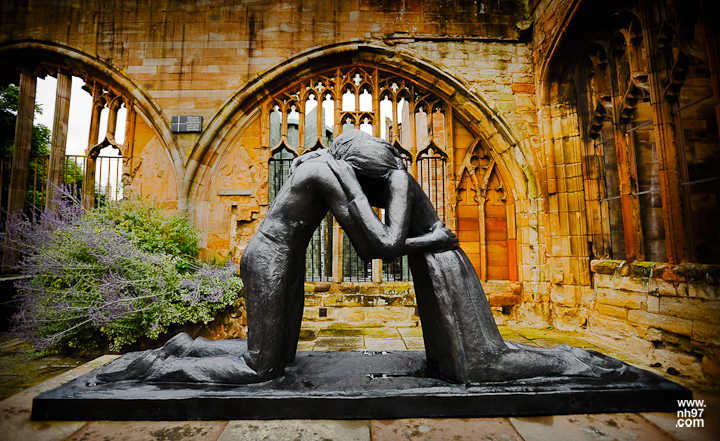
Reconciliation Statue
Reconciliation Statue, placed in the ruins of Coventry Cathedral, England, bombed by the Nazis in World War II.

Being emotionally and/or spiritually wounded by another downright hurts. So, what do we do when it happens? Gratefully, Jesus provided some clear teaching on how to handle a victimizing person. (Matthew 18:15-20)

In part one, we considered the initial step to be taken when a person has been offensive and brought damage to another and/or the community. In their straying from the law of love, we are to respond by speaking to the person privately, to attempt a one-on-one reconciliation and restoration. This effort may be repeated several times over.

These next two steps are only to be undertaken when it has become evident that the person’s intransigence about hurting others will not budge.

The Second Step – Take One or Two Others (Matthew 18:16).

Reconciliation Statue Berlin
Statue outside of the Church of Reconciliation in Berlin, Germany.

“If they will not listen, take one or two others along, so that ‘every matter may be established by the testimony of two or three witnesses.'” –Jesus

The idea here is not to get a few buddies together who agree with our assessment. Rather, we seek others who know the person and can provide loving and objective help. This upholds the ethics of the Old Testament:

A solitary witness against someone in any crime, wrongdoing, or in any sort of misdeed that might be done is not sufficient. The decision must stand by two or three witnesses. (Deuteronomy 19:15, CEB)

When a person fails to respond to reproof privately, then others need to get involved so that there is not a situation of “he said, she said.”  The witnesses are to help establish the nature of the problem. This is purposely meant to be a rather drawn out process because the goal is restoration. We are to give the person every chance to respond to correction.  People need to be given the grace of time to be effectively wooed back to the flock.

The Third Step – Tell It to the Church (Matthew 18:17-18).

Reconciliation Statue Hiroshima
Reconciliation Statue in Hiroshima, Japan

“If they still refuse to listen, tell it to the church; and if they refuse to listen even to the church, treat them as you would a pagan or a tax collector.” –Jesus

If the person ignores the group of witnesses, the group is to report the problem to the church. If the person still refuses to listen, then the person is to be treated like “a pagan or tax collector,” that is, the person is to be excommunicated and treated as though they are an unbeliever who has different needs. Jesus did not mean that we never talk to the person again. It is just the opposite: We communicate to them the need for grace just as we would to anyone.

The sixteenth-century Reformed Confession, the Heidelberg Catechism, took up this this matter (Question and Answer 85):

Q: How is the kingdom of heaven closed and opened by Christian discipline?

            A: According to the command of Christ:

Those who, though called Christians, profess unchristian teachings or live unchristian lives, and after repeated and loving counsel refuse to abandon their errors and wickedness, and after being reported to the church, that is, to its officers, fail to respond also to their admonition – such persons the officers exclude from the Christian fellowship by withholding the sacraments from them, and God himself excludes them from the kingdom of Christ.  Such persons, when promising and demonstrating genuine reform, are received again as members of Christ and of his church.

This approach is also germane with groups of people, churches, or Christian organizations. In the last century, churches around the world ostracized the South African Dutch Reformed Church for their refusal to bend concerning their racism and stance on apartheid.  Restoration did occur.  Not only that, but the Belhar Confession was eventually crafted from this church, a document which stands as a thorough biblical stand against structural racism and racist actions.

The Power of the Small Group (Matthew 18:19-20).

“Again, truly I tell you that if two of you on earth agree about anything they ask for, it will be done for them by my Father in heaven. For where two or three gather in my name, there am I with them.” –Jesus

Jesus reiterated his point about binding and loosing; opening and closing; banning and forgiving. One of the great Reformation teachings is the priesthood of all believers.  The beauty of this is that we may confess our sins to one another in a close, intimate setting so that the steps do not need be done. Small gatherings of believers coming together to confess sin and pray together is the most powerful setting there is.  If we neglect this, we are missing out on the power of God.

Conclusion

Once upon a time, there were two brothers. Their father had a large farm and when he became too old to work, he called his sons to him. “I am too old to work anymore,” he said. “I will divide my farm in half and give each of you one half. I know that you will always work together and will be good friends.”

When the brothers first started farming on their adjoining farms, they were the best of friends and would share everything together. Then, one day there was an argument between the two brothers, and they stopped speaking to one another. For many years, not a word was spoken between them.

One day, one of the brothers was at his house when a carpenter came to his door and said, “I would like to do some work. Do you have any work that I can do?” The brother thought for a moment and then replied, “I would like for you to build a fence on my property. Build it down near the stream that separates my farm from my brother’s. I do not want to see my brother and I would like for you to build a high fence there. I am going into town and I will return this evening.

Bridge over stream

When he came back that evening, he was shocked to see that the carpenter had not followed his instructions. Instead of building a high fence he built a bridge over the stream. The man walked down to look at the bridge, and as he did, his brother walked toward him from the other side. His brother said, “After all the terrible things I’ve done to you over the years, I can’t believe that you would build a bridge and welcome me back.” He reached out to his brother and gave him a big hug.

The brother then walked back up to his farmhouse to talk to the carpenter. “Can you stay?” he asked. “I have more work for you to do.” The carpenter answered, “I’m sorry but I can’t stay. I have to go, for I have many other bridges to build.”

Sometimes you and I have hurts and wounds from our brothers and sisters in Christ. When that happens, we often build a fence between ourselves and them. We stop talking to them. We do not want to see them. We do not want to be around them. However, Jesus wants something different. Instead of fences, he wants us to build a bridge of love.  He wants us to connect and work it out.

How to Handle a Sinner, Part 1

Christ teaching the disciples
A medieval portrait of Christ teaching his disciples.

We live in a fundamentally broken world.  It is filled with broken people. And broken people tend to hurt each other. None of us are immune.  What do you do when you are hurt?

Jesus had something to say on the subject (Matthew 18:15-20). It would be good to hear him out on it because all of us get hurt at some time or another and we need to know how to handle the offending person. We need to get this right. If we do not, the cycle of pain, hurt, damage, and brokenness gets perpetuated.

Just before Jesus offered some teaching on how to handle a sinner, he a parable about a lost sheep – communicating that he is not willing that any sheep should be lost to the sheepfold (Matthew 18:10-14). The teaching on dealing with a person who wounds us is simply the logical extension of the parable. That is, Jesus told us in clear terms what must be done to bring the straying sheep back into the fold.

When attempting to retrieve a wandering person, the tools of guilt, gossip, nagging, and punishment are not consistent with the gospel of grace. Standing at a distance and lobbing verbal grenades toward an erring person is not mentioned by Jesus as an acceptable means of proceeding with those who have caused us suffering.

Jesus offered a three-step process of gracious intervention and a compassionate confrontation with the aim to rescue and restore. Radical independence has no place in the Church.  Strays must be lovingly pursued, carefully rescued, and gently restored.  Anytime someone wanders from the Lord, they hurt another or a group of people, and that wayfaring sheep’s life gets worse. We are not to add to their misery by going to the extremes of either being obnoxiously passive-aggressive to get them to change, or simply ignoring the person altogether, doing nothing, and just hanging back and licking our own wounds.

What others call an “intervention” Christians call “church discipline.”  It seems to be rarely practiced today, which is one reason why we have growing legions of de-churched people. In this post, I focus on step one of this process, because nine out of ten times this first step takes care of the situation. A subsequent post shall deal with the second and third steps.

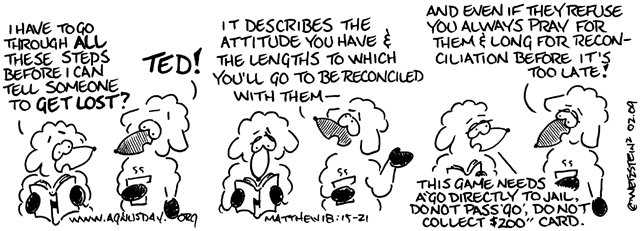
Cartoon Matthew 18

The First Step – One on One (Matthew 18:15). 

Here are several observations about this step:

  • Approach the person privately. We are never to confront an individual in a group, having not first talked to the offending person one on one. We do not start with step two because these are progressive steps.  Furthermore, we are to avoid what I call the “Middle School adolescent way” of confrontation by having someone else do it for you and report back.
  • Focus on the sin event. We are to show the person their fault, and not make a list of all the things the person has done wrong in the last ten years; or, talk about how terrible they are. We must stick to the offense.  What is more, confrontation is not to be done simply with something we do not like. A person’s individual idiosyncrasies or personality is just that, and we need to have the maturity to allow people to be who they are.
  • Be vigilant to avoid overreactions. Steer clear of accusing others of wrongdoing based in some disputable matter. Let us be sure to face the person about a clear sin which has been committed. On the contrary, if we tend to dodge conflict at all costs, we must watch for our own denial and rationalization by saying “it wasn’t so bad.” The health of the church, not to mention our own personal well-being, may very well require that we do the risky thing and talk directly to the one who has affronted us.
  • Pay attention to the approach. The manner in which we oppose another person is critical. The bull-in-the-china-shop approach is nothing more than responding to a sin with another sin. For example, rather than saying, “You need to stop and get right with God or you’ll go to hell,” you could say instead, “When you did that I felt sad and upset because I need to be in a place that values love. Will you please stop this unloving action?” In other words, knee-jerk reactions rarely go over well. But well-placed words said in love and wisdom go a long way toward restoration.
  • Confront our brother or sister. No one is to be the self-appointed ethics Nazi for people outside the church.
  • Confrontation is commanded. If we are to take the words of Jesus seriously, this is not a matter which is open for debate on whether we do it or not. We are to take the attitude that I am my brother’s keeper.  I am not to let a person run rampant with their sin over myself or others. When we are abused and offended, we do not wait for the person to come to us. Even as the victim, we are to initiate the reconciliation and restoration. “Go” to the person, Jesus said. Face-to-face is the way, without reliance on email or voice mail.  It is to be a conversation, not a drive-by comment or accusation.
  • Confrontation is not negotiation. This is a matter of restoring a person who has sinned.  Having differing positions on certain issues in a church or Christian community is a matter for negotiating, not confronting.
  • Do it more than once. This first can (and should) be repeated many times over. The goal is restoration, not get-this-step-out-of-the-way-so-I-can-see-you-get-in-trouble attitude.

Jesus did not invent something new with his teaching but upheld and restated Old Testament ethics about our attitudes in reproving others:

Do not secretly hate your neighbor. If you have something against him, get it out into the open; otherwise you are an accomplice in his guilt. Do not seek revenge or carry a grudge against any of your people. Love your neighbor as yourself. I am God.” (Leviticus 19:17-18, MSG).

In most situations, this first step takes care of the issue and mends the problem with a genuinely restored relationship. If, however, this does not occur, yet other steps ought to be taken. These will be handled in the next post.

May the grace of the Lord Jesus, the love of God our heavenly Father, and the encouragement of the Holy Spirit be with you, today and always. Amen.