Psalm 19 – The God We Can Know

The heavens keep telling
    the wonders of God,
    and the skies declare
    what he has done.
Each day informs
    the following day;
    each night announces
    to the next.
They don’t speak a word,
    and there is never
    the sound of a voice.
Yet their message reaches
    all the earth,
    and it travels
    around the world.

In the heavens a tent
    is set up for the sun.
It rises like a bridegroom
    and gets ready like a hero
    eager to run a race.
It travels all the way
across the sky.
    Nothing hides from its heat.

The Law of the Lord is perfect;
    it gives us new life.
His teachings last forever,
    and they give wisdom
    to ordinary people.
The Lord’s instruction is right;
    it makes our hearts glad.
His commands shine brightly,
    and they give us light.

Worshiping the Lord is sacred;
    he will always be worshiped.
All his decisions
    are correct and fair.
They are worth more
    than the finest gold
    and are sweeter than honey
    from a honeycomb.

By your teachings, Lord,
    I am warned;
    by obeying them,
    I am greatly rewarded.
None of us know our faults.
    Forgive me when I sin
    without knowing it.
Don’t let me do wrong
    on purpose, Lord,
    or let sin have control
    over my life.
Then I will be innocent,
    and not guilty
    of some terrible fault.

Let my words and my thoughts
    be pleasing to you, Lord,
    because you are my mighty rock
    and my protector. (CEV)

Today’s psalm is a celebration of God’s self-revelation. Through both nature and law, the Lord has graciously made the divine life known to humanity. What’s more, God’s moral and ethical teachings provide insight for living a good life. This is for the common good of all persons.

The vision of the psalm is of a personal God, not an abstract deity who is aloof from creation. Through both land and law, there is the Lord of life, desiring humanity to know the divinity which infuses it all and has people’s best interests continually at the forefront of providence and goodwill.

The created world witnesses to God. Creation manifests the glory of its Creator. Each creature and every created thing have the capacity to acknowledge and declare their Originator. That which has no mouth can speak. Those with no vocal cords have a voice. We can hear them, that is, if our ears are open to listen. The creation is not God. Yet the created world and order knows the Lord so intimately that it sometimes seems as if the sun, the trees, the mountains, and the meadows are divine. The divine stamp is there, testifying with mysterious words to a glorious God who desires to be known.

So, the Lord graciously gave us law. God’s righteous and good law flows seamlessly from God’s good character. Law is the divine medium for humanity, a guide for human life toward thriving and flourishing on God’s good earth. We were put on this planet with instructions on how to get along on it. It is when we throw out the rulebook and improvise that we tend to get into all kinds of trouble.

“Knowing God is more important than knowing about God.”

karl rahner

Even when we as people dig our own graves and fall into them, God is there. Grace is available for the asking, redeeming the wayward life. Deliverance is a real possibility, to set us aright again, and restore us to our full luster as people created in the image of God. Law and land converge to guide into grateful living, into the wisdom of dealing rightly in all things.

Wisdom in the Old Testament is the combination of knowledge and practice. It is the application of God’s self-revelation to concrete situations in life. We live wisely when we get to know the sovereign God of creation and use the Lord’s revealed mores and ethos as our guide in daily experiences.

We need God’s gracious revealed law. It’s not just for theology nerds or spiritual eggheads; God’s law is for everyone – the learned and the unlearned. Every one of us needs the guidance and direction of God’s Holy Word, and the careful application of it to all our circumstances. That’s wisdom.

You and I are shaped and formed as godly people as we allow God’s Word to awash us and seep into our souls.  Reading this psalm out loud slowly and contemplatively more than once is an opportunity to let our common ordinary experiences transform into divine appointments.

Clean the slate, God, so we can start the day fresh! Keep me from stupid and idiotic sins, from thinking I can take over your work. Then I can start each day sun-washed, scrubbed clean of sin’s awful grime. Let me not be found in the dominion of darkness but bask in the glorious light of your glory. Accept both my words and my life when I place them on the morning altar, O God, my Rock, my Deliverer, my Redeemer, my All. Amen.

John 12:36-43 – The Shadow Self

“Believe in the light while you have the light, so that you may become children of light.” When he had finished speaking, Jesus left and hid himself from them.

Even after Jesus had performed so many signs in their presence, they still would not believe in him. This was to fulfill the word of Isaiah the prophet:

“Lord, who has believed our message
    and to whom has the arm of the Lord been revealed?”

For this reason, they could not believe, because, as Isaiah says elsewhere:

“He has blinded their eyes
    and hardened their hearts,
so they can neither see with their eyes,
    nor understand with their hearts,
    nor turn—and I would heal them.”

Isaiah said this because he saw Jesus’ glory and spoke about him.

Yet at the same time many even among the leaders believed in him. But because of the Pharisees they would not openly acknowledge their faith for fear they would be put out of the synagogue; for they loved human praise more than praise from God. (NIV)

The season of Lent is a time of preparation for Easter, and of repentance from sin. It is a time to consider our ways and the state of our hearts. In doing so, we find that the grace of God in Christ can heal all wounds. 

Today’s Gospel lesson gives perhaps the most succinct and convicting statement about the shadow places of our lives. Many of the religious authorities believed in Jesus, but they did not speak of it because they were afraid of being put out of the synagogue by the Pharisees. When push came to shove, they cared more for human approval than for God’s glory.

The word “glory” has its roots in the Old Testament and has the meaning of being heavy or having weight. In other words, we might picture God descending to earth among humankind with divine gravity and heft. If we were back in the ‘70s we could say, “heavy, man, heavy!” Glory is really a reference to God’s presence among us. So, if we plug this thought into the religious authority’s attitude, we see that they preferred the presence and accolades of their peers to God. To put the matter even more succinctly, the leaders wanted the limelight and would push their weight around to get it.

Carl Jung (1875-1961) described this hidden shadow self as an unconscious aspect of the human personality. In other words, the shadow results from the conscious self being unaware or unconscious concerning areas of its own personality. Without the light of conscious awareness, the shadow self runs amok within the psyche of a person and far too often calls the shots in speaking and behavior.

“Everyone carries a shadow,” Jung wrote, “and the less it is embodied in the individual’s conscious life, the blacker and denser it is.” (Psychology and Religion, 1938). According to Jung, the shadow side of a person is prone to psychological projection, in which a perceived personal inferiority is recognized as a perceived moral deficiency in someone else. If those projections remain hidden, they eventually come out sideways by harming others because there is a dark illusion, even delusion, that others are stealing what is rightfully mine. Hence, the sinless Jesus is tortured and killed by those who think they are doing a good thing.

It is easy to be hard on the religious rulers in the New Testament, but this is Lent, and, so, we must shine the light of Scripture upon ourselves. This is the time to deliberately gain awareness of our own shadow selves. Perhaps the burning question for all believers at this time of year is: Do I seek the presence of God more than the presence of anything or anyone else?  

Over the decades, I have preached in many churches. Many of them have empty pews or seats in the first several rows during worship. I admit that has always bugged me. I don’t like it. There are times when I am more concerned about the presence of people than the presence of God in a worship service. Maybe you live in fear at work and are more concerned about the presence of people around you than the presence of God, so you keep quiet when you ought to speak up or turn a blind eye to the shadows of an organization.

Lent is not just about identifying sin; it is also about receiving grace. So, let us find that the cleansing work of the Spirit through the work of Jesus is active through our confession of sin. And let us pursue the glory and praise of God in all we do and say as grace permeates deep in our souls. Let the shadows dispel, and the light shine, for the benefit of self and others.

Glorious God lighten our darkness—be our true light. Keep us from the powers of darknessthe perils and dangers of the night. Shine as a kindly light in our spiritual darkness—in our mental turmoil and anxious confusion. We pray this for the love of your Son, our Savior, Jesus Christ who with you and the Holy Spirit lives and reigns as one God, now and forever. Amen.

Romans 3:21-31 – 8 Words That Can Change Your Life

Statue of Martin Luther in Dresden, Germany

But now, apart from law, the righteousness of God has been disclosed, and is attested by the law and the prophets, the righteousness of God through faith in Jesus Christ for all who believe. For there is no distinction, since all have sinned and fall short of the glory of God; they are now justified by his grace as a gift, through the redemption that is in Christ Jesus, whom God put forward as a sacrifice of atonement by his blood, effective through faith. He did this to show his righteousness, because in his divine forbearance he had passed over the sins previously committed; it was to prove at the present time that he himself is righteous and that he justifies the one who has faith in Jesus.

Then what becomes of boasting? It is excluded. By what law? By that of works? No, but by the law of faith. For we hold that a person is justified by faith apart from works prescribed by the law. Or is God the God of Jews only? Is he not the God of Gentiles also? Yes, of Gentiles also since God is one; and he will justify the circumcised on the ground of faith and the uncircumcised through that same faith. Do we then overthrow the law by this faith? By no means! On the contrary, we uphold the law. (NRSV)

Five-hundred years is a long time. It was that long ago when Martin Luther posted his 95 Theses on the Wittenberg Church door in Germany. It sparked the flame of Reformation, a legacy we still live with today.  Protestant Christians have a rich spiritual heritage in acknowledging and affirming the veracity of Holy Scripture and its central message of Christ’s good news of salvation.

Eight words changed Martin Luther’s life, changed the course of history and Christianity, and can change our lives, too.

Law

The role of the law is neither to save nor sanctify but to reveal the true state of our hearts. The law can only condemn; it cannot save. Obedience is important yet cannot be done by sheer willpower. Deliverance does not come by turning over a new leaf; that approach only gets one caught in cycle of regret, promising not to do it again, and then returning to it. Law makes us feel the great weight of our darkness. We need to feel and know what that darkness really is….

Sin

Sin means missing the mark, falling short. We must face what sin really is, without sugar-coating it.  We tend to think of sin as some terrible action like assault or murder, yet sin is primarily thought of in Scripture as attempting to de-throne God with a replacement. You and I need to be realistic about the bad news of sin before we can ever receive the good news of forgiveness. Forgiveness will be elusive until we admit what we have done, or not done, something that warrants needing to be forgiven. Moving forward in hope can only happen when we possess…

Righteousness

Righteousness means right relationships; unrighteousness means broken relationships. Blessed are those who hunger and thirst for right relationships. Like illegal aliens who cannot make themselves citizens, God grants us spiritual amnesty because we cannot make ourselves legal or righteous. Through righteousness God has made it possible for us to live in harmony. Holding onto bad relationships is like a dog returning to its vomit; there is no need for it because God has given us…

Justification

This term is a picture of the court of law. It is a metaphor communicating that righteousness comes because God justified us, that is, did for us what the law could not do – God sent his Son to be a substitute for us. We cannot justify ourselves by obeying the law or simply by being sorry. Without the next word, we will wallow in our guilt because we need this for our justification to really live…

Faith

Faith is a gift given by God. We are unable to generate faith within ourselves because sin estranges us from God. We need divine action. God’s righteousness can only become operative through faith. We must hold out our hands and receive a gift to possess it. We must come to the end of ourselves to exercise faith. We need to see that sin is bad enough to have made life unmanageable and that we have dug a hole too deep to get out of by ourselves. If one thinks they can handle it, then they are going back to the law, living in denial and not by faith.  We also need…

Grace

Faith must have an object, and that object is the cross of Christ. It is grace which gives faith and saves us. Our denial is so great about our sin that we cannot reach out to God unless God acts. Even while we were sinners, Christ died for us. Opening the gift given to us, we find that we are given…

Redemption

Redemption is a word referring to a slave market. We are slaves to sin. We need someone to purchase our freedom. The blood of Christ paid for my sin. Jesus bought me through his death. Jesus has taken care of the sin issue through…

Propitiation

“Sacrifice of atonement” is the meaning of propitiation. It is the satisfaction of God’s wrath against sin.  Because God loves, God has wrath – God is not okay with sin running amok in this world. We are forgiven through the blood of Christ. We are free to live into the gracious joyous life of God in Christ. Yet not all of us do so. For example:

If the institution that gave me my car loan came along and forgave or satisfied the debt I have on my car, it would be weird if I kept making loan payments. But that is what many people keep doing with their lives because they do not really believe they are forgiven and loved by God. We think God is constantly upset or, at least, agitated with us since we screw-up so often. So, we live by law hoping that God will applaud our sincerity and our effort, wishing that everything will be okay. But everything will not be okay with that approach because God wants our faith, not our promises to be better. The Lord asks us:

Do you trust me?  Do you trust me to deliver you from your sin?  Do you trust me to work out the situation that you have made a mess of on your own?  Do you trust me to provide for you everything you need? 

Live into your spiritual heritage. Do not return to the law. Bask in the gracious gift of your freedom in Christ.  Live and enjoy Jesus because you have been made righteous, justified, and redeemed through the precious blood of Jesus Christ.

Almighty God, to whom all hearts are open, all desires known, and from whom no secrets are hid: Cleanse the thoughts of our hearts by the inspiration of your Holy Spirit so that we may perfectly love you, and magnify your holy Name in a worthy manner, through Jesus Christ our Lord. Amen.

Matthew 4:1-11 – Facing Temptation

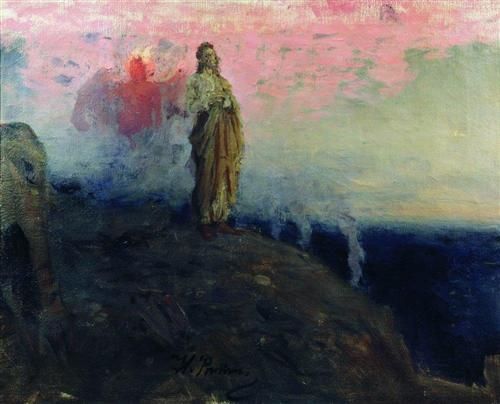
Jesus Tempted by Russian painter Ilya Repin (1844-1930)

Jesus was led by the Spirit into the wilderness to be tempted by the devil. After fasting forty days and forty nights, he was hungry. The tempter came to him and said, “If you are the Son of God, tell these stones to become bread.”

Jesus answered, “It is written: ‘Man shall not live on bread alone, but on every word that comes from the mouth of God.’”

Then the devil took him to the holy city and had him stand on the highest point of the temple. “If you are the Son of God,” he said, “throw yourself down. For it is written:

“‘He will command his angels concerning you,
    and they will lift you up in their hands,
    so that you will not strike your foot against a stone.’”

Jesus answered him, “It is also written: ‘Do not put the Lord your God to the test.’”

Again, the devil took him to a remarkably high mountain and showed him all the kingdoms of the world and their splendor. “All this I will give you,” he said, “if you will bow down and worship me.”

Jesus said to him, “Away from me, Satan! For it is written: ‘Worship the Lord your God and serve him only.’”

Then the devil left him, and angels came and attended him. (NIV)

In our most vulnerable moments, the devil attempts to swoop in and offer his demonic delights for us to consider. We call it “temptation.” Indeed, it can be quite alluring to entertain ways of getting what we need and want through avenues other than God.

In the desert, the place of preparation for ministry, Jesus fasted and prayed forty days. If ever there was a time when Jesus would be vulnerable to alternative religion, the devil mused, wringing his demonic hands together with wicked delight, it would be out in the desert by himself. So, Satan tempted Jesus with three whoppers he thought would get to Jesus, for sure. Having tempted Jesus with food and a way to fame, and having failed both times, Satan gave his final temptation.

To us this temptation to bow down and worship Satan seems like a no-brainer. Well, of course, no one would do such a thing as this, especially Jesus. And he did not. But it was still tempting. It really was. Jesus knew very well what was ahead of him. He had just spent forty days in an intense orientation for an upcoming three years of hard ministry with an end of tortuous death to look forward to. 

Satan presented to Jesus an alternative way, a different path to achieve his purpose for being on this earth. Jesus could have it all without the three years, without the hard slugging to communicate the kingdom of God has come. Most of all, Jesus could circumvent the cross and establish his rule over all the earth – all pain free! The temptation, yes, was very tempting. Become King Jesus now with no suffering.

This has always been one of our great temptations, as well: Take the easy path. Get what you want, what you deserve, now, with no hardship. 

The values of God’s kingdom include trust, patience, and perseverance. Temptation insists we need none of those hard things to be successful. Satan is the original slickster, marketing his quick and easy wares for people to buy into the notion that life can lived without pain and hardship, and with wild success, right now. The scary thing about it is that Satan can deliver… but it will cost us our very lives. Slavery to sin is the price we pay for hitching our hopes to the quick and easy.

The Christian season of Lent is a time for the slow, patient, deliberate development of the soul in attachment with the Lord Jesus. Engaging in spiritual disciplines is hard. It is difficult to fast and pray. Growing in Christ is slow and takes a great deal of learned perseverance. Far too many of us are tempted to circumvent the hard work of discipleship and simply have a spiritual professional distill everything we need into one hour on Sunday morning. Or we fabricate our own religious practice and beliefs, picking and choosing what fits our lifestyle, as if convenience and comfort are the summum bonum of life, instead of worship.

Christ was able to face down temptation because the desert strengthened him. Yes, he was vulnerable. But he was not weak. If we want to handle temptation, it will take Lent to help us. It will take the desert to spiritually form us and prepare us for godly ministry that puts the devil in his place.

Lord Jesus, you are the king of all creation. Just as you chose the hard path of God’s kingdom, so help me to persevere with faith and patience. May my life reflect your words and ways, in the power of the Holy Spirit.  Amen.