Implementing Reform (2 Kings 23:1-14)

Then the king [Josiah] called together all the elders of Judah and Jerusalem. He went up to the temple of the Lord with the people of Judah, the inhabitants of Jerusalem, the priests and the prophets—all the people from the least to the greatest. He read in their hearing all the words of the Book of the Covenant, which had been found in the temple of the Lord. 

The king stood by the pillar and renewed the covenant in the presence of the Lord—to follow the Lord and keep his commands, statutes and decrees with all his heart and all his soul, thus confirming the words of the covenant written in this book. Then all the people pledged themselves to the covenant.

The king ordered Hilkiah the high priest, the priests next in rank and the doorkeepers to remove from the temple of the Lord all the articles made for Baal and Asherah and all the starry hosts. He burned them outside Jerusalem in the fields of the Kidron Valley and took the ashes to Bethel. He did away with the idolatrous priests appointed by the kings of Judah to burn incense on the high places of the towns of Judah and on those around Jerusalem—those who burned incense to Baal, to the sun and moon, to the constellations and to all the starry hosts. 

He took the Asherah pole from the temple of the Lord to the Kidron Valley outside Jerusalem and burned it there. He ground it to powder and scattered the dust over the graves of the common people. He also tore down the quarters of the male shrine prostitutes that were in the temple of the Lord, the quarters where women did weaving for Asherah.

Josiah brought all the priests from the towns of Judah and desecrated the high places, from Geba to Beersheba, where the priests had burned incense. He broke down the gateway at the entrance of the Gate of Joshua, the city governor, which was on the left of the city gate. Although the priests of the high places did not serve at the altar of the Lord in Jerusalem, they ate unleavened bread with their fellow priests.

He desecrated Topheth, which was in the Valley of Ben Hinnom, so no one could use it to sacrifice their son or daughter in the fire to Molek. He removed from the entrance to the temple of the Lord the horses that the kings of Judah had dedicated to the sun. They were in the court near the room of an official named Nathan-Melek. Josiah then burned the chariots dedicated to the sun.

He pulled down the altars the kings of Judah had erected on the roof near the upper room of Ahaz, and the altars Manasseh had built in the two courts of the temple of the Lord. He removed them from there, smashed them to pieces and threw the rubble into the Kidron Valley. 

The king also desecrated the high places that were east of Jerusalem on the south of the Hill of Corruption—the ones Solomon king of Israel had built for Ashtoreth the vile goddess of the Sidonians, for Chemosh the vile god of Moab, and for Molek the detestable god of the people of Ammon. Josiah smashed the sacred stones and cut down the Asherah poles and covered the sites with human bones. (New International Version)

An engraving of King Josiah tearing down the idols, by Philip Galle (1537-1612)

The actions and reforms of King Josiah were bold, pervasive, and challenging.

The Book of Law was found in the Temple. Incredibly, over time, it had been lost. No one had read the words from that large scroll for a very long time. Yet, when Josiah decided to repair the dilapidated Temple, the Torah scroll was found.

Having heard the Torah’s words read to him, Josiah was cut to the heart. He quickly realized that he and the people had strayed far from the laws and commands of their God. So, Josiah was determined to do something about it.

The king decided to reinstate the provisions of the Torah. He assembled people from all levels of Jewish leadership and made a formal covenant to reinstitute the laws found in the scroll.

Over the centuries, other Jewish kings had introduced foreign deities, and built altars to those gods, even within the house of the Lord. There were sacrificial worship practices happening in Judea, from an array of nations with gods at odds with Yahweh, the one true God of Israel.

King Josiah’s purpose was to completely restore the worship of Yahweh, centered in Jerusalem. This meant that all the other gods and their worship practices had to be eliminated. They were defiling the worship of Yahweh.

Beginning in Jerusalem, and going throughout the entire land, Josiah enacted his reforms by removing the altars of foreign gods, high places of worship, and the priests who officiated at them.

Josiah’s reforms had their foundation in a clear set of values. The king knew exactly what he wanted the nation of Judah to be like, which warranted a thorough riddance of everything that was an obstacle to the values espoused in the Torah scroll.

Since Josiah had an objective standard, he was able to aggressively change anything which did not align with those values of worship and practice. And a lot of things had to go in order for the scriptural standard to be enacted and remain.

Most of us are never going to be in a position as Josiah. Yet, we can still bring about the sort of values change that is needed. Change always begins with us personally.

There may be a lot of things in your life, presently, which are obstacles to what you really want. We tend to accumulate a lot of extraneous things in our lives that are not adding to what is most important to us. This is why we often feel so loaded down with all sorts of busyness and activity.

Josiah’s reforms were a national large-scale pruning, so that the true worship of Yahweh could happen. A good place to begin for many of us is to do a regular pruning of our lives, so that we can keep ourselves free of the stuff that doesn’t really matter.

We must rid ourselves of guilt and shame, of the sin which weighs down the soul.

Let us throw off everything that hinders and the sin that so easily entangles. And let us run with perseverance the race marked out for us. (Hebrews 12:1b, NIV)

We need to carefully prune our religious activities, so that we can spiritually grow and mature.

“I am the true vine, and my Father is the gardener. He cuts off every branch in me that bears no fruit, while every branch that does bear fruit he prunes so that it will be even more fruitful… Remain in me, as I also remain in you. No branch can bear fruit by itself; it must remain in the vine. Neither can you bear fruit unless you remain in me.” (John 15:1-4, NIV)

It is good to identify and toss out plans that don’t achieve what we really need and want in life; and are not in sync with what God wants to do in our lives.

In him we were also chosen, having been predestined according to the plan of him who works out everything in conformity with the purpose of his will. (Ephesians 1:11, NIV)

Like a good gardener, it is imperative we keep the garden of our soul free of weeds, insects, and critters that would either choke out or eat away at what is most important in life.

Blessed God, I will try this day to live a simple, sincere and serene life, repelling promptly every thought of discontent, anxiety, discouragement, impurity, and selfishness; cultivating cheerfulness, encouragement, love, and the habit of holy silence; exercising restraint in purchasing, generosity in giving, carefulness in conversation, diligence in work, faithfulness in every task, and faith in all things.

And as I cannot in my own strength do this, nor even with a hope of success attempt it, I look to you, O Lord God my Father, in Jesus my Savior, through the enablement of the Holy Spirit. Amen.

The Real Thing (Hebrews 9:24-28)

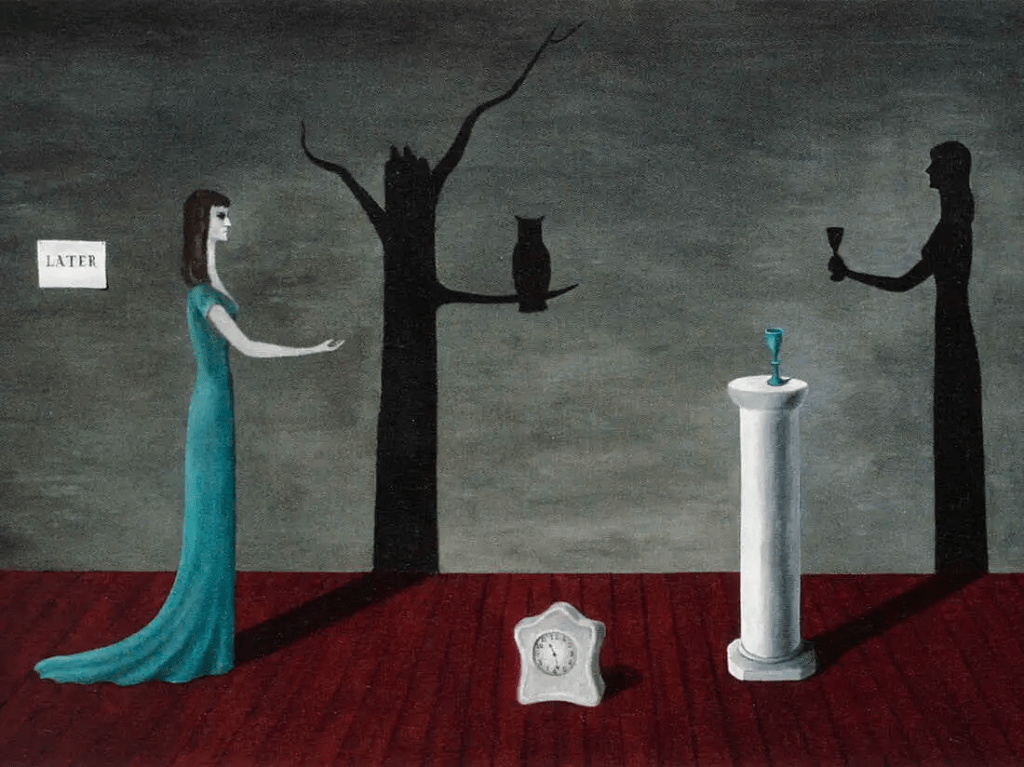
Strange Shadows (Shadows and Substance), by Gertrude Abercrombie, 1950

For Christ did not enter a sanctuary made by human hands, a mere copy of the true one, but he entered into heaven itself, now to appear in the presence of God on our behalf. 

Nor was it to offer himself again and again, as the high priest enters the holy place year after year with blood that is not his own, for then he would have had to suffer again and again since the foundation of the world.

But as it is, he has appeared once for all at the end of the ages to remove sin by the sacrifice of himself. And just as it is appointed for mortals to die once and after that the judgment, so Christ, having been offered once to bear the sins of many, will appear a second time, not to deal with sin but to save those who are eagerly waiting for him. (New Revised Standard Version)

I admit that the Book of Hebrews in the New Testament is one of my favorite books of the Bible. I also recognize that Hebrews is one of the most difficult books to deal with. And specifically, chapter 9 can be quite mind-boggling.

The author of Hebrews, whoever he was actually was, did the intellectually and theologically staggering job of establishing continuity between the two testaments of the Bible.

He compared and contrasted the old (or first) covenant with the new (or second) covenant, examining the Levitical priesthood and its sacrificial system, with Christ as the high priest whose singular sacrifice ended all sacrifices.

The old sacrificial system began on Mount Sinai. Moses sprinkled the sacrificial blood of bulls and goats on both the people and the tabernacle. He was consecrating them, and the sacrificial implements, so that everyone could participate in the worship of Yahweh.

In the new covenantal system, blood is also used to purify. Yet, the heavenly tabernacle could not be cleansed with the blood of animals. It required a better and superior sacrifice. (Hebrews 9:23)

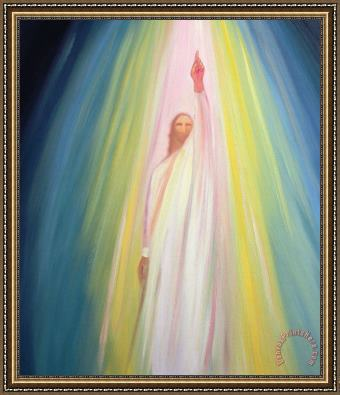
The Sacrifice of Christ, by Elizabeth Wang, 2002

That sacrifice is Jesus. He was both the high priest officiating the ritual, and the actual sacrificial offering. It is the life of Jesus, given in self-sacrificial death, which enables worshipers to come to God without any obstruction whatsoever.

Jesus does not have to keep offering himself. It was a one and done affair. One sacrifice on behalf of everyone. Once for all.

This is, of course, a distinctively Christian view and approach to the problem of guilt, shame, disobedience, and death. It has been a very compelling view for millions of people over the past two millennia.

In whatever way one seeks to understand and make sense of the author’s line of reasoning concerning a Christian approach to sacrifice and dealing with sin, what is apparent to me is that the author talked of a reality that we do not presently see.

The author of Hebrews was lifting up something important that he wanted us to notice. He was pointing out the reality of spiritual forces that have the power to both destroy and give life.

The earthly objects that we can see, touch, feel, hear, and smell are mere representations or shadows of heavenly things.

Many people, if not most people, today would say that invisible things such as our ideas and philosophies of religion are mere mental ways of understanding the objective reality in front of us that we can use our five senses to detect.

But the author of Hebrews insists – and I believe rightly so – that it’s the other way around. Everything we are presently experiencing with our objective senses is a projection of the ultimate invisible reality.

In other words, this entire world will pass away, because it is but a shadow in the history of eternity. The invisible God is the real deal. The heavenly sanctuary is reality. Love is the permanent operating system of eternity, and not your 401(k) or the next political election.

Jesus the Christ has offered himself once for all time, and for all sins. And he did it because the triune God – Father, Son, and Spirit – is a community of unitive love. That is, God is Love. So therefore, God can only do that which is love.

The end of time is not yet here. This present world with all of its inconsistent ways of doing both good and bad is still with us. But Jesus will come again.

The sin issue has been dealt with, once and for all. Christ did that. Jesus will return in order to bring salvation to those who are waiting for him.

If we must wait, let us do it patiently, with all of the faith and endurance it requires. Yet, this is not a passive waiting. We are to be busy proclaiming the good news of God’s invisible realm with both words and sacraments – with the signs and shadows and representations we have that point to the reality of God.

Everything visible and tangible on this earth is mirroring a greater, better, and superior reality which we cannot see with our eyes or touch with our hands.

Christianity is unabashed that all things point to Christ, who is the first and the last, the alpha and omega, the be all and end all of everything.

Come, Lord Jesus, Son of God, Son of Humanity. We long for you to return in glory and set us and this entire sinful world aright with your divine justice.

Be our guest, Lord Jesus, our Savior and Friend. We receive in faith your salvation. We trust that both the physical food and spiritual food you give will sustain us for our work and worship in this world.

May it be so, to the glory of God, and through the enablement of the Holy Spirit. You are one God – Father, Son, and Spirit – in one holy community of Love, now and forevermore. Amen.

Visible Signs of Invisible Realities (Hebrews 9:15-24)

For this reason Christ is the mediator of a new covenant, that those who are called may receive the promised eternal inheritance—now that he has died as a ransom to set them free from the sins committed under the first covenant.

In the case of a will, it is necessary to prove the death of the one who made it, because a will is in force only when somebody has died; it never takes effect while the one who made it is living. This is why even the first covenant was not put into effect without blood. When Moses had proclaimed every command of the law to all the people, he took the blood of calves, together with water, scarlet wool and branches of hyssop, and sprinkled the scroll and all the people. He said, “This is the blood of the covenant, which God has commanded you to keep.” In the same way, he sprinkled with the blood both the tabernacle and everything used in its ceremonies. In fact, the law requires that nearly everything be cleansed with blood, and without the shedding of blood there is no forgiveness.

It was necessary, then, for the copies of the heavenly things to be purified with these sacrifices, but the heavenly things themselves with better sacrifices than these. For Christ did not enter a sanctuary made with human hands that was only a copy of the true one; he entered heaven itself, now to appear for us in God’s presence. (Hebrews 9:15-24)

The Hebrew Christians were tired. They had faced adverse circumstances, unjust imprisonments, persecution, prejudice, confiscation of their property, and public ridicule.

Most of all, they encountered rejection from their Jewish families of origin. There was precious little support for them, outside of their group.

The suffering went on long enough that the Christians began to experience a weakening of faith. In their distress, they started considering whether to return to Judaism, and renege on their commitment to Christ.

The author of Hebrews saw the struggle and spoke up, encouraging and exhorting the believers to keep going, to exercise faith and perseverance in the face of their ongoing troubles.

The author’s overall message to the discouraged believers was that Jesus Christ is superior over everything and everyone. Christ is better than the angels, Moses, and Aaron. Jesus is the ultimate high priest who offered himself as a sacrifice, once for all.

By means of the cross, Jesus became the mediator of a new and better covenant. There is, therefore, no more need of another high priest. Christ now occupies that office permanently.

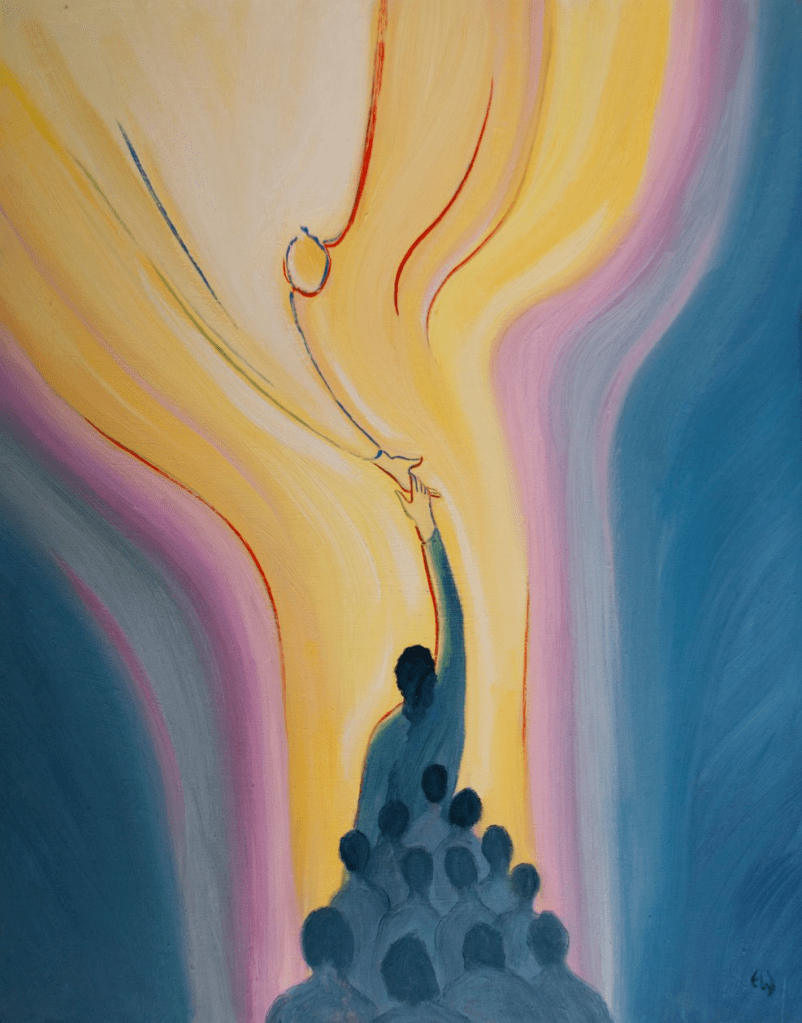
Jesus Christ Points us to God, by Elizabeth Wang

Christ’s death was efficacious for all. The sacrificial system with all of the officiating Levitical priests was the old order of things, meant to point us to Christ.

Offering sacrifices day after day, and engaging in prescribed liturgical rituals in order to access God, are no longer necessary. Perpetual anxiety exists wherever people keep wondering if they have done enough to satisfy their guilt and/or responsibility.

The answer of Christianity is yes, the work is finished; Jesus completed it, once and for all.

There is no longer anything that can distress us. Sin, death, and hell have been conquered through the death of Christ. His singular sacrifice has achieved victory over the sinful powers, and reconciliation and peace with God.

Blessed is the one
    whose sin the Lord does not count against them
    and in whose spirit is no deceit. (Psalm 32:2, NIV)

The covenant code’s sacrificial system was never designed to be a permanent way of doing things. All of the implements used in that system were symbols pointing to the real deal. They were a temporary means of leading people to Christ, who is the once for all sacrifice to end all sacrifices, the one who truly takes away our guilt and shame forever.

The picture is of Christ, as our high priest, who sprinkled us with his own blood and made us clean – not only today or for some temporary period of time – but for all time. We are not only made clean; we are made clean forever by the blood of Christ.

Cleanse me with hyssop, and I will be clean;
    wash me, and I will be whiter than snow. (Psalm 51:7, NIV)

The historical person of Jesus – his life, ministry, crucifixion, death, resurrection, ascension and glorification – was a visible image showing us the great importance of invisible realities.

The Ark of the Covenant was a visible sign of God’s invisible presence, and the need for a restoration of the divine/human connection.

The temple, the worship implements, and the whole sacrificial system was a visible sign of God’s invisible holiness, and the need for purity of heart amongst the people.

Jesus was a real person with a real body and real human needs, a visible reality which showed us the invisible God, and what God truly deems as right and good.

It is Jesus Christ, the Son of God and Son of Humanity, in whom we have redemption the forgiveness of sins. He is the image of the invisible God. (Colossians 1:14-15)

Christ is our Mediator, bridging the gap between heaven and earth.

Christ is our Savior, delivering us from our guilt and shame, our worry and anxiety, and our old enemy, death itself.

Christ is our Advocate, stepping in and acting on our behalf, and sending the Holy Spirit to be his continuing presence on this earth.

Christ is our champion, the pioneer of our salvation, securing redemption for us through his singular death.

Christ is our Intercessor, who even now lives to intercede for us, as we strive and struggle to live in humility, justice, and righteousness, as peacemakers in this world.

What this all means, from the vantage of Christianity, is that we need Jesus.

Without Christ, there is no hope. With Christ, all things are possible.

Jesus is the answer to every question, because Jesus is the center of all things. He is the fertile soil from which all of life sprouts; the first-fruit which provides life; and the continuing sustenance which saves us from a disconnected, fragmented, discouraging existence.

Along with the ancient Hebrew Christians, let us be encouraged with Christ, who is truly our everything.

Accept, O Lord, our thanks and praise for all that you have done for us. We thank you for the disappointments and failures that lead us to acknowledge our dependence on you alone.

Above all, we thank you for your Son Jesus Christ; for the truth of his Word, and the example of his life; for his steadfast obedience, by which he overcame temptation; for his dying, through which he overcame death; and for his rising to life again, in which we are raised to the life of your kingdom.

Grant us the gift of your Spirit; that we may know you and make you known; and through your Spirit, at all times and in all places, may give thanks to you in all things. Amen.

Feeling the Pain (Job 23:1-9, 16-17)

Then Job answered:

“Today also my complaint is bitter;
    his hand is heavy despite my groaning.
Oh, that I knew where I might find him,
    that I might come even to his dwelling!
I would lay my case before him
    and fill my mouth with arguments.
I would learn what he would answer me
    and understand what he would say to me.
Would he contend with me in the greatness of his power?
    No, but he would give heed to me.
There the upright could reason with him,
    and I should be acquitted forever by my judge.

“If I go forward, he is not there;
    or backward, I cannot perceive him;
on the left he hides, and I cannot behold him;
    I turn to the right, but I cannot see him….

God has made my heart faint;
    the Almighty has terrified me.
If only I could vanish in darkness,
    and thick darkness would cover my face. (New Revised Standard Version)

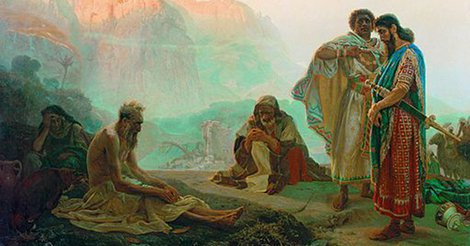
Here is Job, sitting on an ash heap, of all things, and feeling like an ash. His children are gone, all killed by tragic circumstances. His wealth is no more. And now he is lamenting, because he can do nothing else; he has painful nasty sores covering his body that won’t let him do anything.

Job and his friends, by Ilya Repin (1844-1930)

And if that isn’t enough, Job’s “friends” come and end up giving him unhelpful speeches about how all this suffering is really his fault. They reasoned (wrongly) that there must be loads of sin in Job’s life for him to be going through such horror. God is punishing him, they insist.

Job’s companions had initially started out well. For seven days they sat with him in silence (Job 2:13). But then, after a week had passed, they just couldn’t take it anymore. They had the compulsion to speak. And when they opened their mouths, it was merely a bunch of ignorant gobbledygook.  

The friends, the companions, were themselves having an existential theological crisis. Their worldview was being challenged and threatened. So, rather than be open-minded and consider that their views may need to be altered, the friends acted like enemies, accusing Job of sin.

At issue was their clear and clean theology of believing that good guys are blessed with wealth, health, and happiness; and bad guys are cursed with poverty, illness, and misery – like Job.

They could not imagine or entertain the thought that God would let a good person suffer like Job was suffering. Therefore, Job must be bad, and they tried to find that hidden sin within him  to which he must repent of.

Yet, in truth, not all suffering – even terrible grinding suffering – is the result of personal sin or bad decision-making. Sometimes, good people suffer horribly, too.

Times may change, but people throughout the ages don’t. Today, we still think along the same lines as the companions of Job. There is far too much blaming of victims for their victimization; and way too many flippant beliefs which say to others in a terrible situation things like, “You reap what you sow.”

Job, through all of the loss, tragedy, and then suffering from his friends, held onto his integrity. Even though Job knew his situation was undeserved, he did not curse God, nor his friends.

Job made the incredible claim that suffering is not always the result of one’s personal sin – something he himself might not have said before his tragic experiences.

But just because Job did not curse, does not mean he was nice and okay with what unfolded in his life. He wished he was never born. He felt like death would be preferable to living. He contended with God, and longed for justice. His ultimate wish was that God would just speak and say something, anything.

Job was hurting so terribly, that he had bitter words of despair for God. He could make absolutely no sense of what was happening. He could not understand why he was the brunt of so much suffering. It felt like God was attacking him, and he said so.

The silence and absence of God were palpable for Job. He longed to speak with God. And his greatest lament – out of all the reasons to lament – was the horrible feeling of being alone without God’s presence and consolation.

It is interesting that we have no mention in the story about Job’s friends speaking directly to God, or praying to God, or addressing God in any way.

They certainly felt free to tell Job who God is, and how God operates in the world. But there was never any intercession for their friend, and no words of crying out to God on behalf of Job. There was only words of rebuke and chastisement, words of hurt that were as painful as the physical sores on his body

The phrase I hear most often from people speaking to the person in grief and pain is, “You just need to be strong.” And a close second is, “Everything happens for a reason.” The latter phrase is simply unhelpful, and the former phrase is actually hurtful.

It is not a sin to be weak. Just in case you read that sentence too quickly, I will say it again: It. Is. Not. A. Sin. To. Be. Weak!

We understand that when someone breaks a bone, they’ll be limited with weakness for a while. And we make helpful accommodations to that effect. But when someone’s heart is broken, and their life emotionally shredded, we expect them to be strong for everyone else around them.

It may be true that everything happens for a reason, yet most of the time, none of us knows the reason why we’re going through what we’re going through. And we probably won’t, this side of heaven.

If we try to have explanations for everything, then we join the company of Job’s companions who had to try and understand what was happening. And their conclusions were very wrong.

However, there is nothing wrong with weeping with those who weep; and expressing pain, grief, and even anger – both for the one who laments, and those who lament with them.

Pain cannot be relieved unless it is acknowledged, affirmed, and addressed by both the one who suffers and the community who surrounds them.

Where there is lament, there are loud words and expressions of grief. When lament is said to God, then God can hold that person, and rock them in the arms of mercy.

But silence is agonizing. We need friends who will listen and grieve with us. It is vital to have companions who voice to God what we cannot voice in our weakness. All of us, together, must hold onto God, and trust that the Lord hears, and will answer.

As Jesus cried out on the cross, I cry out to you in pain, O God my Creator. Do not forsake me. Grant me relief from this suffering and preserve me in peace; through Jesus Christ my Savior, in the power of the Holy Spirit. Amen.