A Big Glorious Vision of Worship

In the year that King Uzziah died, I saw the Lord, high and exalted, seated on a throne; and the train of his robe filled the temple. Above him were seraphim, each with six wings: With two wings they covered their faces, with two they covered their feet, and with two they were flying. And they were calling to one another:

“Holy, holy, holy is the Lord Almighty;
    the whole earth is full of his glory.”

At the sound of their voices the doorposts and thresholds shook, and the temple was filled with smoke.

“Woe to me!” I cried. “I am ruined! For I am a man of unclean lips, and I live among a people of unclean lips, and my eyes have seen the King, the Lord Almighty.”

Then one of the seraphim flew to me with a live coal in his hand, which he had taken with tongs from the altar. With it he touched my mouth and said, “See, this has touched your lips; your guilt is taken away and your sin atoned for.”

Then I heard the voice of the Lord saying, “Whom shall I send? And who will go for us?”

And I said, “Here am I. Send me!” (Isaiah 6:1-8, NIV)

Uzziah was a king of Judah who reigned for fifty-two years. For most of his rule, he followed God faithfully. Under Uzziah the Jews had enjoyed the best political stability, economic security, and consistent worship of God since the days of King Solomon, hundreds of years before. 

Yet, if one were to look below the surface of Judah, it was also a time of spiritual complacency, apathy in worship, taking prosperity for granted, and self-centered – often oppressing others. The nation needed a fresh experience of God, and it came through the prophet Isaiah.

The essence of worship is a recognition and celebration of the triune God. Worship is a relational rhythm between God and humanity in which God self-reveals and people respond.

Worship is an experience of seeing and hearing divine revelation; repenting from wayward actions; and renewing missional service.

Worshiping the triune God ideally happens every day. It’s a lifestyle – not the result of one cleverly planned hour on Sunday. The people of Isaiah’s day were going through the ritual motions of worship without having their hearts in it. Worship was a kind of rabbit’s foot for them in which, if they had regular attendance within the temple, they believed they could do whatever they wanted with their lives outside the temple. 

As a result, the people did not see or hear God in their worship. Authentic worship of God does not have to do with the environment, the fellowship, or the music. True worship of the triune God is a heart desire to see and hear God. 

If worship does not happen in the sanctuary, that is because worship fails to occur daily life. Real worship is a life-changing encounter with Father, Son, and Holy Spirit. It experiences God’s revelation and changes our view of him. Bona fide worship leads to repentance and changes our view of self. True worship brings spiritual renewal and changes our view of mission and service.

Revelation: Worship Changes Our View of God

Isaiah saw a vision of God in the majestic divine throne room. It was a grand and transcendent vision of a God who dominates the entire setting. The train of God’s robe filled the temple. This is Isaiah’s way of saying the vision was incredibly large. If the train of his robe fills up the temple, then God is an immense Being. Gaining a vision of God’s hugeness is what causes our human problems to be seen as small. 

One time the Assyrian King Sennacherib invaded the land and approached Jerusalem during the reign of Uzziah’s great grandson, Hezekiah. The Assyrians were the dreaded horde of the ancient world, and it seemed no one could withstand them. So, the people prayed:

King Hezekiah and the prophet Isaiah son of Amoz cried out in prayer to heaven about this. And the Lord sent an angel, who annihilated all the fighting men and the commanders and officers in the camp of the Assyrian king… So, the Lord saved Hezekiah and the people of Jerusalem from the hand of Sennacherib king of Assyria and from the hand of all others. God took care of them on every side. (2 Chronicles 32:20-22, NIV)

Isaiah’s vision included seraphs – angels with the job description to glorify God with ceaseless praise. Their physical description symbolizes their function: covering their face symbolizes humility in God’s presence; covering their feet identifies it as holy ground; and flying symbolizes their work to do God’s will.

The seraphs have two-thirds wing power for worship, and one-third wing power for work. If this is any indication how God’s creatures are to conduct their lives, we as humans have a great deal of adjusting to do to accommodate the worship of God.

The sound of worship that came from the seraphs was proclaiming God’s holiness. Isaiah’s view of God changed as a result. As he saw God’s glory, Isaiah saw God as much bigger than he had before. For example, European visitors who come to the United States sometimes have no frame of reference as to how spacious the geography of our country is.

Some have a notion they can make day trips to places like San Francisco, Houston, or New York City because where they live is much more geographically compact. But once they get here, they experience the land in all its glory, and they gain an appreciation for the bigness of America. We all need to experience God’s glory and see God’s holiness because it will cause us to repent of old ways of seeing.

Repentance: Worship Changes Our View of Self

Isaiah was reduced to nothing after seeing a vision of the holy God. Humans cannot see God’s glory without also seeing their sinful selves. Isaiah’s response to God was not praise, but confession. Show me a proud, self-centered, and arrogant person and I will show you a person who has not seen God. Isaiah was unable to cleanse his own sin. Isaiah needed God to purge and purify his uncleanness. The New Testament says:

If we live in the light in the same way as he is in the light, we have fellowship with each other, and the blood of Jesus, his Son, cleanses us from every sin… If we confess our sins, he is faithful and just to forgive us our sins and cleanse us from everything we’ve done wrong. (1 John 1:7, 9, CEB)

Seeing God completely unravels us, for we see our depravity for what it truly is:

  • When the Apostle Peter saw the Lord’s immensity and power through a miraculous catch of fish he fell at Jesus’ knees and said, “Go away from me, Lord; I am a sinful man.” (Luke 5:8) 
  • When the Apostle John had a vision of Christ’s glory, and heard his voice, he fell at the Lord’s feet as though dead. (Revelation 1:12-17)
  • When the prophet Ezekiel had a vision of God and saw the appearance of God’s glory, he fell facedown. (Ezekiel 1:25-28)
  • Even Daniel, perhaps the most righteous prophet of all time, when seeing a vision of God’s glory, fell prostrate with his face to the ground, totally overwhelmed with God’s holiness and his own human sinfulness. (Daniel 8:15-18)

There is wickedness and indifference in the world. People do not see God’s glory and holiness. Because, if they did, they would be totally undone and see the foulness and degradation of hate and injustice. They would turn from apathetic and complacent ways of living. The world and the church need a vision of a holy God that comes from meeting with God. Isaiah saw the Lord. And because he repented, he was then able to hear the voice of God.

Renewal: Worship Changes Our View of Service

God is calling us. God’s voice has gone out. If we do not hear it, it’s because we have not experienced God’s self-revealing and have not responded with repentance. Apart from worship, we are unable to hear God. While Isaiah was worshiping God, he saw, responded, and heard the Lord. The early church heard the voice of God to service and mission:

The church at Antioch had several prophets and teachers…. While they were worshiping the Lord and fasting, the Holy Spirit told them, “Appoint Barnabas and Saul to do the work for which I have chosen them.” Everyone prayed and fasted for a while longer. Next, they placed their hands on Barnabas and Saul to show that they had been appointed to do this work. Then everyone sent them on their way. (Acts 13:1-3, CEV)

Isaiah was willing. He didn’t ask any clarifying questions. He neither inquired what the mission would be nor questioned God as to the plan. Isaiah plainly said, “Here I am, send me.”  It was an unconditional response to hearing God. Isaiah made no deals with God, did not try and negotiate terms of service. Isaiah simply told God he was willing to be sent. 

Many people fill their lives with stuff and activity. And they are unable to hear the voice of God. There’s just too much noise drowning out God. We have uncritically, without any discernment through prayer and worship, filled our lives to overflowing with never-ending things to do. And we have even sanctified it and called it holy, as if God’s will for us is to be constantly on the go.

Someday, we must give an account of our lives. God will ask why we did not take a risk, get involved, and go out into the world with a deep sense of mission. Too many people will say, “I never heard the call!” Yet, God was calling. “Whom shall I send? And who will go for us?” says the triune God.

Conclusion

God’s glory was revealed to Isaiah. Isaiah responded to that vision with confession and repentance. This brought a renewed sense of mission to his life. Isaiah was then able to hear God’s voice calling him to service. It is not our ability God cares about. Because God can equip anybody for any type of work. Instead, it is our availability God cares about.

We need to put ourselves in a position to see and hear God. The obstacles to visioning God’s glory and hearing God’s voice are legion: inattention to God’s Word and God’s creation; no mindfulness to the Holy Spirit; intense, constant, and prolonged preoccupations; lack of availability to the ways of Jesus; little sleep; unhealthy habits; a dull spiritual sense; lack of personal and divine awareness; a paucity of spiritual practices and disciplines; and a failure to be able to experience a vision of God.

God has graciously revealed himself to us as Father, Son, and Spirit. The Trinity is not so much a doctrine to believe as it is a powerful reality to live into. If we see and hear God today it will cause us to repent and be renewed in mission and service.

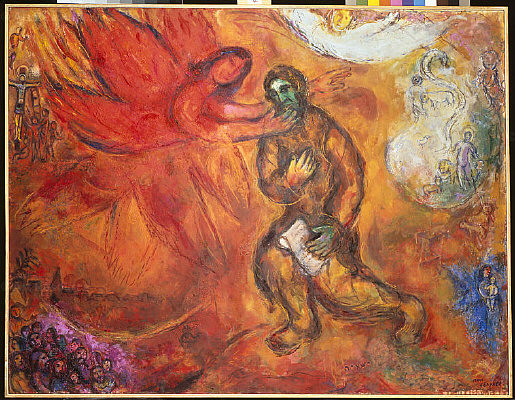
*Above painting of the prophet Isaiah by Marc Chagall, 1968

Romans 8:1-8 – The Privilege of Life in the Spirit

Therefore, there is now no condemnation for those who are in Christ Jesus, because through Christ Jesus the law of the Spirit who gives life has set you free from the law of sin and death. For what the law was powerless to do because it was weakened by the flesh, God did by sending his own Son in the likeness of sinful flesh to be a sin offering. And so, he condemned sin in the flesh, in order that the righteous requirement of the law might be fully met in us, who do not live according to the flesh but according to the Spirit.

Those who live according to the flesh have their minds set on what the flesh desires; but those who live in accordance with the Spirit have their minds set on what the Spirit desires. The mind governed by the flesh is death, but the mind governed by the Spirit is life and peace. The mind governed by the flesh is hostile to God; it does not submit to God’s law, nor can it do so. Those who are in the realm of the flesh cannot please God. (New International Version)

It is a great privilege to be a Christian and possess God’s own Spirit in our lives. There are four privileges of the Christian to take note of so that believers can truly live in the Spirit and not in the flesh (sinful nature).

First Privilege: There is now no condemnation.   

No condemnation means “without judgment.” God pronounced a verdict, and the decision is final. We are united to Christ by means of God’s Spirit. Since God does not condemn us, there is no need whatsoever to condemn ourselves or other people.

Since we do not sit under judgment, believe the sin issue has been taken care of once for all through the life and death of Christ. If you do not feel forgiven, then put yourself in a position to believe. Allow the Holy Spirit of God to take the redemption of Christ and apply it to your life in a real and practical way.

It would be silly to go into the bathroom, turn on the shower, then just stand in the middle of the bathroom without getting under the showerhead. Because you did not put yourself in a position to become clean! You may passionately believe a shower, soap, and shampoo will make you clean. Yet, if you do not actually avail yourself of the privilege of taking the shower but just stand there and look at it, you will not become clean. 

We must put ourselves in a position to experience the privilege of God’s grace, our wonderful state of cleanliness, and the lack of condemnation through reading the Word of God on a regular basis; praying in the Spirit on all occasions; and practicing the silence and solitude necessary to receive the cleansing work of the Holy Spirit.

An illustration of marriage might help us understand both our reality and our responsibility. Two people are declared “married” in a formal wedding ceremony. The couple then works out their shared union together over a lifetime. The Minister does not pronounce condemnation at the ceremony but declares a blessing.

From that point forward the two persons must work on their marriage. They must believe their relationship is important enough to warrant putting themselves in a position to grow together by intentionally doing things like creating date nights and conversations on the couch; learning, appreciating, and participating in the other’s interests and life. 

God is not opposed to effort – but to the notion that we save ourselves. Just as we do not marry ourselves and pronounce ourselves a married couple, so we do not save ourselves. Having a marriage license in hand does not mean there is no effort to be done in the relationship. A marriage is both a legal reality, and a kind of mystical union between the spouses.

Second Privilege: Freedom from sin and death.

In Holy Scripture, sin is not only personal struggle but an ever-present reality in the world. Unfortunately, the power and presence of sin is everywhere within people, institutions, and systems. Because sin is everywhere, death is everywhere. Biblically, death refers not only to the body, yet also to the spirit. Death is a relational term. It’s to be separated from God, apart from a relationship. Conversely, life is connection, to be in union with God. 

God sent the Son. God’s Son became incarnate, a sin-offering, an atoning sacrifice for our sins. God condemned sin in sinful humanity. God met the righteous requirements of the law. God effects holiness in us by means of the Spirit. 

Rather than saving us from sin then simply telling us to live a holy upright life, God the Father and Son sent God the Holy Spirit to indwell us so that we can live like Jesus. Therefore, we must put ourselves in a position to experience this saving work through dwelling in the Scriptures and letting the Spirit and the Word effect practical change in our lives. 

I often quote Scripture from memory. I don’t really set out to memorize Scripture so much as I set out to dwell in it to the degree that it ends-up becoming a part of me. The goal is to become awash by the Spirit and the Word so that in every decision, in everything said, and in each action, we are moved by the Holy Spirit.

Third Privilege: We possess the mind of Christ.

The rub of the problem all Christians face, living in a sinful world, has to do with our mindset. What occupies our minds is what determines whether we will have life and peace, or not. 

If the object of our thoughts is continually away from Christ and the Spirit, we will have loose thinking.  If we put ourselves in a position to indulge the sinful nature, it will affect our mindset. Our mental choices can lead to life or death.

For example, alcoholics know they have two choices: the way of life or the way of death. The first step of the twelve steps is to admit powerlessness over alcohol and that my life has become unmanageable. The second step is to believe a Power greater than myself can restore me to sanity. The third step is to turn life and will to that Power. 

We are powerless over sin, which will, if left unchecked, lead to death. Yet, in the Spirit, we have the possibility of life. Sin, like alcohol, is a daily possibility, even after giving my life and will to God. However, there is also the possibility of life. And that hope of life is what we possess when we have the mind of Christ and the Spirit. We hope through the power of the Spirit to overcome death, embracing choices which lead to life.

The Spirit is not some vitamin supplement to the Christian life, or a protein shake that helps us become healthy.  The Spirit is life and peace, a person, not simply a force. The Spirit brings us the practical benefits of new life in Christ. So, what we put into our minds is vitally important. It’s not about willpower but about putting oneself in a position to receive spiritual power to mold, make, and change us.

Relying solely on willpower is setting yourself up for a crash. Evidence-based studies repeatedly demonstrate that we as people tend to overestimate how much self-control we will have against temptation when we are not in the “heat of the moment.” We too easily believe we can handle more temptation than we can.

Those who are most confident about their self-control are the most likely to succumb to temptation. The key avoiding situations where vices thrive and, most importantly, for individuals to maintain a humble view of their willpower.

Fourth Privilege: The Holy Spirit indwells us.

The Spirit is the distinguishing mark of the Christian life. The Spirit opposes the sinful nature and expects us to do the same. We need not live the Christian life on our own power because of the Holy Spirit. 

There is an internal struggle within us that desires to do right but has a compulsion to do otherwise. It’s the indwelling Spirit that gives us victory. Christ’s life, as much as his death, achieved salvation from sin for us. The very same Spirit that helped Jesus in life and raised him from death belongs to us!

When I was a kid, I remember my grandmother canning grape preserves. I sat on a stool in the kitchen and watched her, looking forward to yummy grape goodness on my next piece of toast. I once asked Grandma, “Why are you always melting that wax over the fruit?” I didn’t understand how wax could make my toast taste any better. She answered, “The wax seals the jar tightly so the fruit can’t be contaminated. If I didn’t seal it, the fruit would eventually rot.” 

You and I are God’s preserves. God not only chooses, redeems, and calls us; the Lord also has a plan for preserving us – to give us the indwelling Spirit so that we can live free from sin and do the will of God.

So, may Christians everywhere appreciate the privileges of no condemnation, freedom from sin, possessing the mind of Christ, and the power of the indwelling Spirit. May you avail yourselves of the Spirit and experience life and peace so that you will love God, love one another, and love the world through the power of the Holy Spirit.

Almighty God, fill us with the knowledge of your will through all spiritual wisdom and understanding. Help us to live worthy of the Lord Jesus and to please him in every way; bearing fruit in every good work, growing in the knowledge of God; being strengthened with all power according to your glorious might so that we may have great endurance and patience, joyfully giving thanks to you. For you, Lord, have rescued us from the dominion of darkness and have brought us into the kingdom of the Son you love, in whom we have redemption, the forgiveness of sins. Amen.

1 John 1:1-2:2 – Walking in the Light without Fumbling in the Darkness

Welcome, friends! Today we consider three important words to help us relieve our emotional and spiritual pain, as well as enabling us to experience joy and new life. Click the videos below and let us worship our risen Lord….

1 John 1:1-2:2, Pastor Tim Ehrhardt

O God, who in Jesus Christ called us out of darkness into your marvelous light; enable us always to declare your wonderful deeds, thank you for your steadfast love, and praise you with heart, soul, mind, and strength, now and forever. Amen, and amen.

Walking in the Light without Fumbling in the Darkness

Photo by Julia Volk on Pexels.com

All the hopes and expectations of Christians are realized in Christ’s resurrection. The good news of Easter cannot be contained or limited to a single day (Easter Sunday). That is why, according to the Church Calendar, Easter is only the first of fifty days of celebration called “Eastertide” which leads to the day of Pentecost.  Eastertide is designed for exploring the new life we have in Jesus and the joyful Christian life we can all experience.

Yet, what if a new life has not been our experience? What do we do when, year after year, Easter comes and goes and all the old sins, failures, compulsions, and addictions remain unchanged?  It is not sufficient to simply know the gospel of grace; there must be a careful and truthful application of the gospel to our lives. For the gospel is not just a message to believe; it is a powerful truth to be acted upon in our daily lives.

Too many folks are spiritually damaged from regrets or remorse over bad decisions. They have shame and guilt about the inability to overcome bad habits. There is a lack of courage in facing temptations and sins within. It all lies beneath the surface festering, irritating, and causing pain. In some cases, it is so deeply embedded in the soul that the cause of the discomfort is unknown.

Spiritual renewal is needed. To take a trip into our inner worlds, there are three words that bring to light three important theological themes.  We need to know and apply these words so we will have the pain relieved and experience the joy of new life in Jesus Christ. (1 John 1:1-2:2)

Fellowship: Christians have a sharing bond of partnership in Christ with God and with one another.

We proclaim to you what we have seen and heard, so that you also may have fellowship with us. And our fellowship is with the Father and with his Son, Jesus Christ. (1 John 1:3, NIV)

Koinonia is a familiar word to many Christians. The image of “fellowship” might be of sitting around a table at a church potluck. Or maybe it evokes the picture of standing around after church and talking with each other over a cup of coffee. The biblical word is much more than this. Fellowship means we have deeply shared beliefs and behaviors with God and one another. 

Fellowship means Christians have a vital union with Jesus which paves the way to cooperate with God’s purposes in the church and the world. Fellowship also means Christians share in Christ together through a common relationship with God and a common purpose of glorifying God. In Christ we partner together to live out the Great Commandment and the Great Commission. Biblical fellowship is an action based in the union we have with God in Christ.  To live in fellowship is to live in the light and not in the darkness.

The way we view Jesus determines how we live the Christian life. Jesus was a real flesh-and-blood man. If Christians do not uphold the physical reality of Jesus, then the Christian life will be unconcerned for the material world and the ethics of bodily existence. The Christian life is very much about both body and soul.

Walk: The power of sin is very deceptive.

If we claim to be without sin, we deceive ourselves and the truth is not in us…. If we claim we have not sinned, we make him out to be a liar and his word is not in us. (1 John 1:8, 10, NIV)

The New Testament often pictures the Christian life as a walk down a road. Which road we are on and how we walk it is especially important. God is light and in him is no darkness at all. We are to walk with the light of Jesus illuminating our way.

Talk is cheap. The real muster is whether we live in the light of revealed truth.  If a person claims a relationship with Jesus but lives how they want, that person is not an authentic believer.  If a person claims to be without sin, that person is self-deceived by the power of sin.  If a person claims they are okay and do not sin, such a person makes a mockery of Christ’s bodily existence, including his human suffering and death.

Photo by Paulo Mu00e1rcio Dos Santos on Pexels.com

If a person’s daily life is characterized by darkness, then no matter how sincerely or publicly they make a profession of Jesus, that proclamation is a sham. This is not about sinners in general making occasional lapses in judgment or behavior. This is about people who claim to be Christian but have daily on-going patterns of deliberately walking down a dark path and doing what they want. Their mantra is, “It’s my life, I do what I want, and nobody is going to tell me what to do.” Such a person is a poser. They only pretend to have a walk with Jesus.

To counter the bogus claims and pretensions, we are to walk in the light, and not hide in the darkness. This requires honesty, integrity, and the courage to allow God’s light to shine on the shadowy places of our lives. There cannot be new life without the light.

We counter the darkness by openly confessing our sins. There is a promise attached we need to take to heart: God is faithful to forgive and purify us. God’s light shining upon us might hurt, but it brings life and healing. Holding onto secrets only festers in the soul, while the snakes of sin slither around our feet.  The result is spiritual blindness, darkness, and death. Confession is more than private and personal; it is also public and corporate.  New life, renewal, revival, and revitalization come from real honest tell-it-like-it-is confession. 

This really ought to scare the hell out of us. Jesus, in his Sermon on the Mount, said we should pluck our eyes out if they offend. Cut our hands off if they cause us to sin. It is better to be in God’s kingdom with no eyes and hands then to burn in hell with all our parts intact. (Matthew 5:29-30)

Repentance is more than mouthing words about being a sinner like everybody else. Repentance is a complete change of how we live our lives. If there is a besetting sin that dogs us every day and we do all the same things this year we did last year to deal with it, and it did not work, then we will be right back here at Eastertide next year – frustrated with the very same dark walk, carrying the very same burden of guilt, shame, and regret. 

Remaining in the dark with no one knowing about our inner life is opposite of biblical fellowship because it forsakes the light. Walking away from the church will not deal with it. Walking away from God will not deal with it. Trying a new teaching or a new practice will not make it go away. Only agonizing, soul-rending, yet freeing, confession will allow God’s surgical knife to take out the offending sin and bring healing of both body and soul.

Patricia Raybon, in her book I Told the Mountain to Move confesses the regret and grief she carried after aborting two children. She writes, “I had told myself that an abortion would end my problems, not complicate them by bringing an innocent life into my own upheaval.” She shares the following letter, written to her two aborted children:

Dear Babies:

“This is Mama. You will know my voice, I think, even though we were together for such a short time. I did a bad thing. I did not trust God. I did not understand God would have made everything okay. I was like Peter, who looked at the waves, not at Jesus. And when he looked at the waves, he started to sink—down, down, down.

That’s how I felt, like I was sinking down. When the doctors said you were growing inside of me, that’s how I felt, so I didn’t know how to love you. I was afraid. I let fear convince me that more babies would just make things worse.

Instead, look what I did. I robbed us. First, I robbed you—taking your own lives. I didn’t think I was strong enough. So, I robbed myself of all the joy you would have brought me, too. Brought all of us, your sisters, your family, and for each of you, your daddy. I thought we would have more problems. That we did not have enough money. That we did not have enough time. That we did not have enough love. But I just did not know then that God is bigger. And God would make everything all right. I didn’t know.”

We are not left to unending remorse and sorrow.

Advocate: The atoning sacrifice of Jesus Christ purifies us from all unrighteousness.

My dear children, I write this to you so that you will not sin. But if anybody does sin, we have an advocate with the Father—Jesus Christ, the Righteous One. (1 John 2:1, NIV)

To advocate means to come alongside another in need, speaking and acting on their behalf. Jesus is our Advocate. Christ’s death atoned for all our sin, guilt, and shame. Christ’s propitiation satisfied all of God’s righteous wrath against every sin, including yours and mine. The Lord’s gracious intervention has saved us from ourselves. Jesus made it possible for us to experience forgiveness, restoration, and new life. 

When we are so broken and full of tears that we cannot even speak, Jesus steps in and speaks on our behalf with meaningful words that have been backed up with the action of the cross and resurrection.

We have a few choices: We could pretend everything is okay and proceed with business as usual. Or we can come to Jesus, confess our sin and receive the grace of forgiveness and cleansing. We can allow the church to be a hospital for sinners through praying for one another. Throughout the New Testament we are called to be little advocates practicing the ministry of coming alongside and speaking on one another’s behalf before God and others.

Choose wisely, my friend.