Hebrews 9:1-12 – Remembering Christ Together

Photo by Krivec Ales on Pexels.com

Now the first covenant had regulations for worship and also an earthly sanctuary. A tabernacle was set up. In its first room were the lampstand and the table with its consecrated bread; this was called the Holy Place. Behind the second curtain was a room called the Most Holy Place, which had the golden altar of incense and the gold-covered ark of the covenant. This ark contained the gold jar of manna, Aaron’s staff that had budded, and the stone tablets of the covenant. Above the ark were the cherubim of the Glory, overshadowing the atonement cover. But we cannot discuss these things in detail now.

When everything had been arranged like this, the priests entered regularly into the outer room to carry on their ministry. But only the high priest entered the inner room, and that only once a year, and never without blood, which he offered for himself and for the sins the people had committed in ignorance. The Holy Spirit was showing by this that the way into the Most Holy Place had not yet been disclosed as long as the first tabernacle was still functioning. This is an illustration for the present time, indicating that the gifts and sacrifices being offered were not able to clear the conscience of the worshiper. They are only a matter of food and drink and various ceremonial washings—external regulations applying until the time of the new order.

But when Christ came as high priest of the good things that are now already here, he went through the greater and more perfect tabernacle that is not made with human hands, that is to say, is not a part of this creation. He did not enter by means of the blood of goats and calves; but he entered the Most Holy Place once for all by his own blood, thus obtaining eternal redemption. (New International Version)

A healthy approach to looking at the whole of the Bible is to see it as an unfolding drama of redemption in six acts: 

  1. Creation of the world.
  2. Fall of humanity.
  3. Israel and the law.
  4. The earthly ministry of Jesus.
  5. The Church. 
  6. Return of Christ.

We are presently in act five, the church age. The previous four acts were all important in leading up to this act, just as the scenes in a play all build upon one another.

So, then, Israel and the law had their place in this drama of redemption. But we are no longer in that act. This is one reason why we do not hold to all the ceremonial and sacrificial stipulations of the old covenant because it has been superseded by the new covenant.

The previous act of the law had its limitations. It was never designed to completely clear the conscience of the worshiper. Its purpose was to be a reminder of sins that points forward to a better time when the sin issue would be settled once and for all. That time has come. 

The person and work of Jesus has completely cleared the conscience of the worshiper because his sacrifice is the sacrifice to end all sacrifices. Christ’s finished work is both thoroughly pervasive and completely permanent.

Therefore, there is no longer any need to languish in guilt as though we were stuck in act three of God’s redemption drama. 

We do not need to be reminded of our sins anymore. Instead, we are to be reminded of Christ’s finished work on the cross, and that his blood has washed away our sins. We are to remember rightly and have Jesus before us continually. Our redemption is not temporal, but permanent. 

Taking some time each day to remind ourselves of this new reality and enjoy act five of the drama is both sage and necessary in order to live a successful Christian life. Here are some wonderful privileges to remember together of being united with Christ contained within the book of Hebrews:

  • Church connects to other like-minded people who help us live for God.

Encourage each other every day while you have the opportunity. If you do this, none of you will be deceived by sin and become stubborn. (Hebrews 3:13, GW)

  • Church creates a sacred space for us to relate to the divine.

So, whenever we are in need, we should come bravely before the throne of our merciful God. There we will be treated with undeserved kindness, and we will find help. (Hebrews 4:16, CEV)

  • Church enables us to reflect on gratitude.

Since we are receiving a kingdom that cannot be shaken, let us be thankful, and so worship God acceptably with reverence and awe. (Hebrews 12:28, NIV)

  • Church provides opportunities to serve and give to others.

Keep on loving one another as brothers and sisters. Do not forget to show hospitality to strangers, for by so doing some people have shown hospitality to angels without knowing it. Continue to remember those in prison as if you were together with them in prison, and those who are mistreated as if you yourselves were suffering. (Hebrews 13:1-3, NIV)

  • Church teaches us forgiveness.

“I will forgive their sins and will no longer remember their wrongs.” (Hebrews 8:12, GNT)

  • Church gives us purpose and meaning.

Because Jesus lives forever, his priesthood lasts forever. Therefore, he is able, once and forever, to savethose who come to God through him. He lives forever to intercede with God on their behalf. (Hebrews 7:24, NLT)

Saving God, you sent your Son, the Lord Jesus, to take care of the sin issue once for all through his blood. I give you unending thanks for your grace. May your Holy Spirit press this reality of forgiveness and clarity of conscience firmly into my mind and heart so that I will always live for you in all things. Amen.

Nehemiah 1:1-11 – A Prayer of Solidarity and Confession

These are the memoirs of Nehemiah son of Hacaliah.

In late autumn, in the month of Kislev, in the twentieth year of King Artaxerxes’ reign, I was at the fortress of Susa. Hanani, one of my brothers, came to visit me with some other men who had just arrived from Judah. I asked them about the Jews who had returned there from captivity and about how things were going in Jerusalem.

They said to me, “Things are not going well for those who returned to the province of Judah. They are in great trouble and disgrace. The wall of Jerusalem has been torn down, and the gates have been destroyed by fire.”

When I heard this, I sat down and wept. In fact, for days I mourned, fasted, and prayed to the God of heaven. Then I said,

“O Lord, God of heaven, the great and awesome God who keeps his covenant of unfailing love with those who love him and obey his commands, listen to my prayer! Look down and see me praying night and day for your people Israel. I confess that we have sinned against you. Yes, even my own family and I have sinned! We have sinned terribly by not obeying the commands, decrees, and regulations that you gave us through your servant Moses.

“Please remember what you told your servant Moses: ‘If you are unfaithful to me, I will scatter you among the nations. But if you return to me and obey my commands and live by them, then even if you are exiled to the ends of the earth, I will bring you back to the place I have chosen for my name to be honored.’

“The people you rescued by your great power and strong hand are your servants.O Lord, please hear my prayer! Listen to the prayers of those of us who delight in honoring you. Please grant me success today by making the king favorable to me. Put it into his heart to be kind to me.”

In those days I was the king’s cup-bearer. (New Living Translation)

I believe that nothing of eternal significance happens apart from God. Jesus said it clearly: “Apart from me you can do nothing.” (John 15:5, NIV) 

There is simply no substitute for a close relationship with God. The will of God can only be accomplished through the spiritual practice of prayer. Prayer is not a passive activity. If done well, prayer takes time, a great deal of effort, and a sense of priority. It is quite possible that biblical praying can be the most challenging, exhausting, laborious, and rewarding thing we do.

Through prayer we can become filled with the Holy Spirit, gain wisdom to make godly decisions, and access spiritual power that can melt the hardest of hearts and change the minds of the most stubborn of people. 

In prayer we have the privilege of expressing our concerns and needs, as well as having God’s agenda revealed to us for what to do. Our personal and communal holiness is in direct proportion to the great task of prayer.

When faced with the reality that his hometown, Jerusalem, was in trouble, Nehemiah, the king’s wine steward, prayed. In prayer he owned the problems Jerusalem faced. He owned it through a prayer that emphasized and reminded God of the covenant with God’s people; he confessed the sins by which Israel violated that covenant; and he held onto the promise that God would lift the curse on the city if the people would only repent.

Nehemiah had a compassionate heart that was attentive to what was going on in his native land. Hearing the tragic news of the city’s condition, he immediately wept, mourned, fasted, and prayed.

Nehemiah was profoundly disturbed by the news that Jerusalem was in trouble. Rather than being preoccupied with himself and his own situation as an exile in Babylon, Nehemiah sought to do something about the security and spiritual health of his people.

In his prayer to God, Nehemiah was genuine, persistent, confident, humble, and submissive to God. He did not distance himself from the sins of the people, but clearly identified with them through a prayer of confession.  That confession was intense, honest, real, and urgent.

Sin always needs to be identified, acknowledged, and pardoned. If it isn’t, there is no hope for things to be different.

There is a season for everything. Hunting seasons may come and go, but it is always open season for prayer.  And Nehemiah’s prayer is a solid biblical model for us to emulate. We have our challenges. Like Nehemiah, let’s own those challenges through prayers which are biblically focused, compassionately offered, and spiritually curious to know and do God’s agenda for the church and the world.

Let us continually have a spirit of prayer to God in everything we say and do – prayerful spirits that above all seeks God’s will and implementing that will through God’s love.

Almighty and gracious God, we lower our heads before you and confess we too often forget that we are yours. Sometimes we carry on our lives as if there was no God and we fall short of being a credible witness to you and your incredible mercy. For these things we ask your forgiveness and strength. Give us clear minds and open hearts so we may witness to the love of Christ in our world. Remind us to be who you would have us to be regardless of what we are doing or who we are with. Hold us to closely and tightly in your good strong hands. Build our relationship with you and with those you have given us on earth, through Jesus Christ our Lord, in the power of your Holy Spirit. Amen.

Revelation 17:1-18 – A Vision of the End

“The Whore of Babylon” by Hans Burgkmair, 1523

One of the seven angels who had the seven bowls came and said to me, “Come, I will show you the punishment of the great prostitute, who sits by many waters.With her the kings of the earth committed adultery, and the inhabitants of the earth were intoxicated with the wine of her adulteries.”

Then the angel carried me away in the Spirit into a wilderness. There I saw a woman sitting on a scarlet beast that was covered with blasphemous names and had seven heads and ten horns. The woman was dressed in purple and scarlet, and was glittering with gold, precious stones and pearls. She held a golden cup in her hand, filled with abominable things and the filth of her adulteries. The name written on her forehead was a mystery:

BABYLON THE GREAT

THE MOTHER OF PROSTITUTES

AND OF THE ABOMINATIONS OF THE EARTH

I saw that the woman was drunk with the blood of God’s holy people, the blood of those who bore testimony to Jesus.

When I saw her, I was greatly astonished. Then the angel said to me: “Why are you astonished? I will explain to you the mystery of the woman and of the beast she rides, which has the seven heads and ten horns. The beast, which you saw, once was, now is not, and yet will come up out of the Abyss and go to its destruction. The inhabitants of the earth whose names have not been written in the book of life from the creation of the world will be astonished when they see the beast, because it once was, now is not, and yet will come.

“This calls for a mind with wisdom. The seven heads are seven hills on which the woman sits. They are also seven kings. Five have fallen, one is, the other has not yet come; but when he does come, he must remain for only a little while. The beast who once was, and now is not, is an eighth king. He belongs to the seven and is going to his destruction.

“The ten horns you saw are ten kings who have not yet received a kingdom, but who for one hour will receive authority as kings along with the beast. They have one purpose and will give their power and authority to the beast. They will wage war against the Lamb, but the Lamb will triumph over them because he is Lord of lords and King of kings—and with him will be his called, chosen and faithful followers.”

Then the angel said to me, “The waters you saw, where the prostitute sits, are peoples, multitudes, nations and languages. The beast and the ten horns you saw will hate the prostitute. They will bring her to ruin and leave her naked; they will eat her flesh and burn her with fire. For God has put it into their hearts to accomplish his purpose by agreeing to hand over to the beast their royal authority, until God’s words are fulfilled. The woman you saw is the great city that rules over the kings of the earth.” (New International Version)

Today’s New Testament lesson is the beginning of a long and elaborate vision of the Apostle John. The vision includes a woman and a scarlet beast, and the angel’s interpretation of what John saw.

An Incredible Vision

“The Whore of Babylon” from Martin Luther’s 1534 translation of the Bible.

Consistent with Old Testament’s imagery depicting the relationship between God and people, John’s vision is of a prostitute whom the kings of the earth committed adultery. This great offense will not be overlooked. It is provoking divine wrath.

The prostitute sits on a scarlet beast, an imposing and rather incredible looking creature with seven heads and ten horns. The woman and the beast signify and portray the pinnacle of opulence, extravagance, and luxury. Yet, she is also the ultimate depiction of corruption, indecency, and irreverence.

The great prostitute influences all the world. She is the evil genius behind the blood of the Christian martyrs. The woman deceives and connives so that she can wreak her violence against the saints of God.

John appears to be slack jawed with all this. The prostitute’s seductive influence has been so great that nations fall to her erotic power. She is so diabolically smooth, her presentation so marvelous, that even John is mesmerized by her.

Why Are You Astonished?

The angel’s question to John is akin to saying, “Well, what did you expect? The Wicked Witch of the West? Evil is much more sinister than an ugly old woman. Unrighteousness cloaks itself in nice garb. Snap out of it, man!”

Astonishment and awe belong to God, not some alluring vision of beauty. The enticement only traps humanity into a sticky web which the Black Widow can feed upon. The woman and the beast are doomed to destruction. Their time is imminently near.

John (and us) must see beyond the surface presentation to the darkness within. Antichrist is not only a person but the evil systems which feed upon helpless humans caught in the web of seduction.

The End Times

The leaders of the earth, deceived and smitten by the temptress, ally together to wage war on all that is right, just, and good – all the while believing they are fighting for beauty. It will eventually climax at Armageddon, the place of final victory over all the malevolence.

The Lamb shall overcome the nefarious forces of corruption. The faithful followers of God need only to persevere and see the punishment of the wicked. Please keep in mind that none of this has a timetable for us to chart. Biblical time revolves primarily around events, not precision clockwork.

It is not our task to walk around predicting dates, nor is it to point fingers at anyone we don’t like as being the antichrist. There’s plenty of shock-and-awe in the Apocalypse of John without us adding to it with our half-baked ideas of the end times.

The world, as it presently exists, is distorted by sin. And we humans tend to be ill-equipped in discerning the difference between The Great Prostitute and Lady Wisdom. What the book of Revelation does for us is show, with alarming symbolism, just how difficult it can be to navigate this old fallen world.

So, let us run to God; trust in the Lamb; and be filled with the Spirit.

Sovereign God, you are slow to anger and abound in steadfast love. Grant to national leaders the wisdom, courage and insight needed for this time of change and uncertainty. Give to all who exercise authority determination to defend the principles of freedom, love and tolerance, strength to protect and safeguard the innocent and clarity of vision to guide the world into the paths of justice and peace. This we ask through Jesus Christ our Lord. Amen.

Job 8:1-22 – Face the Pain

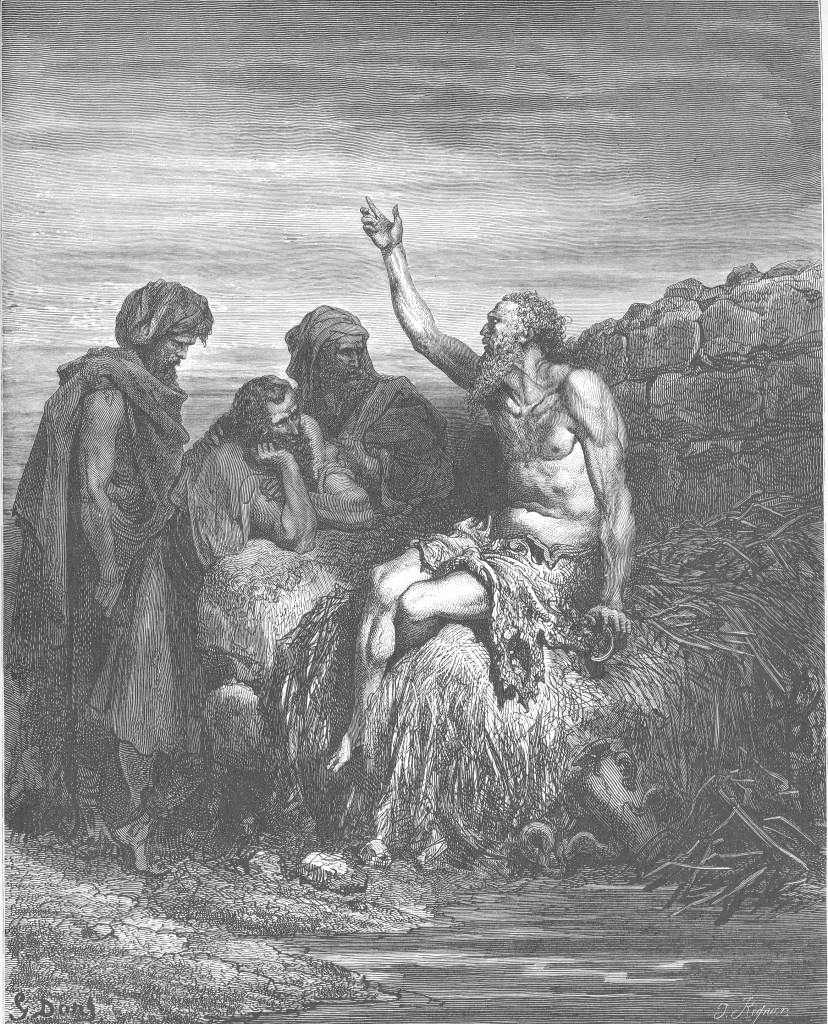
Job Speaks with His Friends by Gustave Doré (1832-1883)

Are you finally through with your windy speech?
God never twists justice;
    he never fails to do what is right.
Your children must have sinned against God,
    and so he punished them as they deserved.
But turn now and plead with Almighty God;
    if you are so honest and pure,
    then God will come and help you
    and restore your household as your reward.
All the wealth you lost will be nothing
    compared with what God will give you then.

Look for a moment at ancient wisdom;
    consider the truths our ancestors learned.
Our life is short; we know nothing at all;
    we pass like shadows across the earth.
But let the ancient wise people teach you;
    listen to what they had to say:

“Reeds can’t grow where there is no water;
    they are never found outside a swamp.
If the water dries up, they are the first to wither,
    while still too small to be cut and used.
Godless people are like those reeds;
    their hope is gone, once God is forgotten.
They trust a thread—a spider’s web.
    If they lean on a web, will it hold them up?
    If they grab for a thread, will it help them stand?”

Evil people sprout like weeds in the sun,
    like weeds that spread all through the garden.
Their roots wrap around the stones
    and hold fast to every rock.
But then pull them up—
    no one will ever know they were there.
Yes, that’s all the joy evil people have;
    others now come and take their places.

But God will never abandon the faithful
    or ever give help to evil people.
He will let you laugh and shout again,
    but he will bring disgrace on those who hate you,
    and the homes of the wicked will vanish. (Good News Translation)

These are the words of Bildad, a “friend” of Job. The guy just couldn’t take it anymore. As Job expressed his deep grief, Bildad grew perturbed. Whereas Job needed to be heard, to tell his story with others who would offer listening ears of empathy, Bildad was uncomfortable with all this grief junk and felt he needed to rebuke Job…. Oy vey.

There are various kinds of suffering, and the biblical character of Job experienced them all. One of the most severe kinds of hurt, and the one that gets far more attention than any other in the book of Job, are the short-sighted rebukes from Job’s “friends.” 

God had a severe mercy for Job. The friends, however, lived in a black and white world of either/or – either you confess your sin, or you don’t – as if all suffering is connected to personal sin. Bildad’s left-brained linear explanation was expressed this way: God will not reject a blameless man.

For Bildad, personal suffering equals personal sin and God’s disfavor. Bildad could only see a sequential connection, a direct line from sin to calamity. It was simply out of his equation to think otherwise. Since Bildad saw suffering as the direct result of sin, his remedy was to exhort toward confession of sin. 

The problem with this view is that we, as the readers, already know this to be a patently false understanding of Job’s suffering. Although Bildad saw the suffering, he did not discern the unseen dimension of good and evil contending behind-the-scenes between God and Satan.

It is only normal to wonder if we have sinned against God whenever finding ourselves in the crucible of suffering. But if we have done patient work to determine there is no personal reason for the pain, perhaps there is something going on that is much bigger than us. 

Our task, like Job’s, is to entrust ourselves to God. We might chafe at such counsel because we like to fix things that hurt. Suffering, however, will not last forever; it will eventually pass. And God’s way will always prevail, in the end. So, we must continually keep in mind that permanent faith transcends temporary pain.

There are four types of pain we experience in this life:

  1. Spiritual pain that arises from within us in our connection, or lack thereof, with the divine.
  2. Emotional pain that arises from our relationship with others.
  3. Physical pain that arises from our bodies and from natural forces on this earth.
  4. Mental pain that arises from cognitive disorders, childhood trauma, and all forms of abuse or neglect.

In all pain, the story we tell ourselves about the reason for the hurt is significant. We have a relationship with our pain. If the story we are telling ourselves is that the pain is all in my head, or that others have it worse than me, we are ignoring or stuffing our pain. If the story is that pain is bad and I must rid myself of it, then we will completely miss what our pain is trying to tell us.

Job was trying to come to grips with his pain. He was facing it, talking about it, expressing his wonderings concerning it, and allowing himself to completely feel all of it.

Conversely, Bildad so tightly held onto his own story about what pain and suffering is that he was unable to be the friend Job needed. And, I might add, at the end of the story, God didn’t look with favor on Bildad’s approach.

So, what will you do with your pain?

What is the story you are telling yourself about your pain?

Who do you trust so that you can talk about your pain?

Where is God in your pain?

How is your current relationship to the pain helping or hindering you?

Where will you turn, in the future, when pain comes upon you?

Loving God, take pity on my life as I seek to embrace you in both good times and bad. I belong to you; therefore, I will not forsake you, no matter how much I do not understand the suffering. Amen.