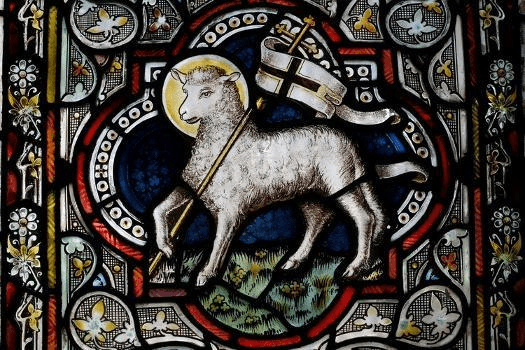
The Lamb of God (John 1:29-34)

Stained glass of the Agnus Dei (Lamb of God), Chamonix, France

The next day John saw Jesus coming toward him and said, “Look, the Lamb of God, who takes away the sin of the world! This is the one I meant when I said, ‘A man who comes after me has surpassed me because he was before me.’ I myself did not know him, but the reason I came baptizing with water was that he might be revealed to Israel.”

Then John gave this testimony: “I saw the Spirit come down from heaven as a dove and remain on him. And I myself did not know him, but the one who sent me to baptize with water told me, ‘The man on whom you see the Spirit come down and remain is the one who will baptize with the Holy Spirit.’ I have seen and I testify that this is God’s Chosen One.” (New International Version)

The Gospel of John is all about finding and seeing Jesus – and then believing. Jesus is seen from various angles, namely because, as the embodiment of God, he requires a multi-perspectival look. In today’s lesson, we see John the Baptist exhorting everyone to take a look at Jesus as the Lamb of God.

Throughout the Apostle John’s Gospel, we see the gradual unfolding of belief amongst people, including the faith of John the Baptist. The Baptist’s initial understanding was that he was in the presence of someone of much greater worth than himself. Only by means of God’s Spirit is John able to gain increased insight concerning Jesus.

It’s important to point out that faith is never a static sort of thing. Rather, faith is always moving in a direction; it’s dynamic. Faith is more than a gift that’s put in a box and given and received. There is continual discovery to faith. It’s as if we’ve been given the gift of a Russian doll, and there are ever-increasing gifts within the gift. There are multiple levels of belief to explore and discover.

Spiritual insight is an initial gift of faith. There is, however, more. With insight there follows the ability to distinguish between material and immaterial realities. This is one reason why the Gospel of John can be difficult to understand – because within one verse, statement, or story, there are double, even triple, meanings to it.

John often invites us to see the spiritual reality that is there underneath the physical. It will take eyes of faith to see, because sheer physical sight will not see the entire reality. And at the end of faith is Jesus, to confess and believe that he is indeed the very Son of God.

The Holy Spirit in today’s lesson actually serves as the divine witness to John the Baptist’s burgeoning development of faith in Christ; John sees Jesus not only as coming from God, but as God.

The confirming voice of the Spirit at the baptism of Jesus lets everyone know that this Lamb of God, Jesus, the Son of God, will take away the sin of the world in his eventual Passover death.
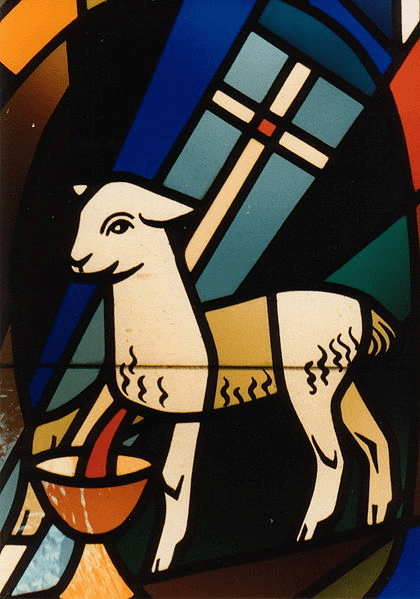
Stained glass of the Agnus Dei, El Cajon, California

To take away sin means to remove it and purify the person from it. John’s increased understanding discerns that his words and his baptism with water don’t bring this removal and purification; but they do point to Jesus. Christ as the one who is able to immerse people in the cleansing bath of grace.

Jesus Christ is qualified and able to call, gather, and cleanse not only Israel, but also the world and all the scattered children of God. Thus, John the Baptist’s ministry is to reveal Jesus to Israel; it’s directed to the entire world and to the taking away of the world’s great sin, once and for all.

The reference to Jesus as the “Lamb of God” is a familiar one to Christians. Lambs are common throughout the Bible. A lamb, however, that takes away sin is somewhat novel (although a scapegoat symbolically takes aways Israel’s sin into the desert, Leviticus 16:8-10). Passover lambs, lambs offered twice daily and in several offerings and acts of worship, were a part of many guilt and purification rituals in the Old Testament. (Leviticus 9:1-13; 14:1-13)

It seems to me that the Apostle John understood Jesus as the Lamb which removes sin by being the representative and once for all sacrifice to end all sacrifices. There is no longer any need to keep offering these various lambs day after day, festival after festival, year after year; Jesus is the efficacious one who ends it all and finally purifies and atones with potent deliverance from sin.

Day after day every priest stands and performs his religious duties; again and again he offers the same sacrifices, which can never take away sins. But when this priest [Jesus] had offered for all time one sacrifice for sins, he sat down at the right hand of God, and since that time he waits for his enemies to be made his footstool. For by one sacrifice he has made perfect forever those who are being made holy. (Hebrews 10:11-14, NIV)

And what is more, it’s this same Lamb of God who will again show up – even though slain, and yet lives – to gather together all the nations of the earth, lead them as the singular Good Shepherd, vanquish all the enemies who oppose goodness, and establish divine light in a sort of eternally lit menorah that blesses the world. (Revelation 5:6-12; 6:1; 7:17; 14:1: 1714; 21:22-23)

The baptism with water of Jesus by John the Baptist, therefore, confirmed and anticipated the baptizing (purifying) work of the Holy Spirit that only Jesus would accomplish. For John baptized with water, but Jesus baptizes with both water and Spirit – demonstrating his singular ability as Savior and Lord.

In this Christian season of Epiphany, Jesus – the Lamb of God who takes away sin and purifies with the Spirit – is Christianity’s eternal light and life.

The bright star still compels people to come and see, as well as leads the little Christs called “Christians” to take their light and let it shine wherever they go. It is a light of mercy and mystery, grace and goodness, wonder and wisdom. It is, I believe wholeheartedly, the light the world needs in order to bring an end to division and connect one another in peace and goodwill.

May it be so, to the glory of God. Amen.

Peace Be Upon Us (Psalm 125)

Those who trust in the Lord are like Mount Zion,
    which cannot be moved but abides forever.
As the mountains surround Jerusalem,
    so the Lord surrounds his people
    from this time on and forevermore.
For the scepter of wickedness shall not rest
    on the land allotted to the righteous,
so that the righteous might not stretch out
    their hands to do wrong.
Do good, O Lord, to those who are good
    and to those who are upright in their hearts.
But those who turn aside to their own crooked ways,
    the Lord will lead away with evildoers.
    Peace be upon Israel! (New Revised Standard Version)

I am profoundly grateful that God is a rock solid mountain who is strong. The Lord is never altered in the basic divine character of merciful grace, steadfast love, and abiding security. The main reason I so deeply appreciate this about God is that this old fallen world is awfully fickle, terribly unreliable, and forever changing.

So, to trust in God is to tether oneself to the ultimate anchor for life. Relationships come and go. People have their own agendas and listen to other people who, in turn, have their own agendas. But God’s plan is purely good, always right, and consistently just. The divine agenda has our best interests at mind.

Being linked to the Lord in faith establishes divine protection, provision, and presence. It’s as if the righteous believer has an invisible security blanket wrapped around them at all times. We are kept in the gracious arms of a loving God.

None of this, however, means that we shall never face grueling circumstances that might even feel like a hellish existence. If the Christian’s Lord Jesus had to undergo suffering before experiencing glory, then how much more do his followers need to expect the same?

Having injustice and wrongdoing in this world is one thing; but having it come from those close to you is quite another thing altogether. Again, the Lord Jesus endured wicked betrayal from Judas Iscariot, one who was within the inner circle of disciples. Yet, the heavenly Father was continually there, surrounding Jesus like the mountain chain, even though it may not have felt like it at many points, especially in the final week of Christ’s life on this earth.

God is good, all the time. Therefore, God knows who is truly good, and who is not. The Lord sees the heart, and clearly discerns the intents and motivations of each person and every group of people on this planet. And since God understands the real nature of a person’s life, the Lord is not fooled by pious sounding and slick talking persons with darkness in their hearts.

The wicked will not endure. God shall eventually lead them away. Like a shepherd separating the sheep from the goats, the Divine Judge will divide the righteous from the wicked. Those who think they can have a secret agenda of crookedness will find out that it’s not so secret after all.

This world, with all it’s inhabitants and systems and societies, needs peace. Sometimes, it seems to me that everyone right now in our contemporary world is upset about something; and they have the rudeness to back it up.

Nations fight nations. People groups attack other people groups. One ethnicity accuses another, and vice versa. Family members are estranged. Lawsuits abound. The judicial courts are beyond full. Unethical practices masquerade within ethical systems and thrive in the shadows. And persons are harmed – lots of them. Lives are destroyed.

I once came home from a day of interacting with patients at the hospital and said to my wife, “You could never dream up the atrocities that one person can do to another.” The short of it is that there is no harmony, no mutual understanding, and thus, no peace, no fulfillment or wholesome way of life for so many.

In the New Testament, the Apostle Paul once cried out concerning the muck of sin, “Who will rescue me from this body of death?” He then went on to answer his own question by saying a simple phrase, “Thanks be to God through Jesus Christ our Lord.” (Romans 7:24)

Yes, for me it’s Jesus. And, for me, that is what this very season of the year is all about. I anticipate the birth of the Christ Child, who came willingly to save us from this manure pile of a situation that is without peace. He became the Prince of Peace, so that we might have the light of life. It was the Apostle John who let us know:

The Word became flesh and blood,
    and moved into the neighborhood.
We saw the glory with our own eyes,
    the one-of-a-kind glory,
    like Father, like Son,
Generous inside and out,
    true from start to finish. (John 1:14, MSG)

Humility, meekness, righteousness, purity, mercy, love, and peace-making – yes, peacemaking – were the hallmarks of Christ’s ministry. These characteristics surrounded him like the divine mountains and shaped every word and each action of Jesus.

It is the time for peace. In fact, it’s high time for it! We have gone long enough provoking others and being provoked. There is a way – the way of peace. And for me, peace is achieved through the ultimate Peacemaker, Jesus Christ, my Lord.

He came and preached peace to you who were far away and peace to those who were near. For through him we both have access to the Father by one Spirit. (Ephesians 2:17-18, NIV)

May you find peace this season because you have discovered the Peacemaker. Peace be upon Israel, and peace to all.

Soli Deo Gloria

Struggling to Accept (Habakkuk 2:1-5)

The prophet Habakkuk cries out to God, by Unknown 19th century artist

I will stand at my guard post.
I will station myself on the wall.
I will watch to see what he will say to me
and what answer I will get to my complaint.

Then the Lord answered me,
“Write the vision.
Make it clear on tablets
so that anyone can read it quickly.
The vision will still happen at the appointed time.
It hurries toward its goal.
It won’t be a lie.
If it’s delayed, wait for it.
It will certainly happen.
It won’t be late.

“Look at the proud person. He is not right in himself.
But the righteous person will live because of his faithfulness.
Also because wine is treacherous
he is arrogant and never rests.
He has a large appetite like the grave.
He is like death—never satisfied.
He gathers all the nations to himself.
He collects all the people to himself. (God’s Word Translation)

The prophet Habakkuk is unique among the prophetic books of the Old Testament. It is more an account of the prophet’s own wonderings and questions before God, than it is bringing a specific word from God to the people.

The book of Habakkuk revolves around the prophet’s queries to the Lord; the Lord’s responses; and the prophet’s struggles to wrap both his head and his heart around those answers.

Habakkuk struggled with the rampant sins of injustice and unrighteousness amongst his own people. He contended with God about how long all this was going to go on. Today’s Old Testament lesson is something of a lament – grieving the loss of justice and righteousness, and longing for God’s salvation from the nation’s troubles. Habakkuk was determination to name the evil, bring it before God, and wait with a determined spirit for a divine response.

The prophet asked a question, and waited for an answer. His complaint is an age old one. He was weary of seeing injustice day after day, of observing the arrogant and the wicked exploit the poor and the needy. He wanted to hear from God; and when the awaited response finally came, it wasn’t what Habakkuk was expecting.

Habakkuk’s first question is one that many today can relate to:

How long, O Lord, am I to cry for help,
but you will not listen?
I cry out to you, “There’s violence!”
yet you will not come to the rescue.
Why do you make me see wrongdoing?
And why do you watch wickedness? (Habakkuk 1:2-3, GW)

God answered the prophet’s question. And Habakkuk didn’t like the answer, at all:

I am going to send the Babylonians,
that fierce and reckless nation.
They will march throughout the earth
to take possession of lands that don’t belong to them. (Habakkuk 1:6, GW)

The problem with this answer, is that, even though the prophet’s own people were unjust and violent, the Babylonians were an even worse lot of people. It was nonsense to Habakkuk that God would use an evil nation to judge God’s own people. So, the prophet asked yet another question of God:

Why do you keep watching treacherous people?
Why are you silent when wicked people swallow those
who are more righteous than they are? (Habakkuk 1:13, GW)

There are many persons who freely admit they are sinful. There is a problem, however, when a person points to others whom they believe are more sinful than they are. Habakkuk, like many contemporary believers, essentially says, “Well, I’m a sinner. I’m not perfect. But I’m not like the Babylonians! They don’t even worship God! And they do a lot worse things than I do!”

If one wants divine judgment, then one must be content with whom it comes from, and how it is done. Otherwise, the person seeks to be the judge, instead of letting the Lord handle the trouble.

We all struggle with navigating the injustice of this world. People of faith will discern that they must trust the Lord by viewing God’s deliverance and actions with a big picture perspective. They remember that God has acted with faithfulness and justice in the past; and the Lord can do it again.

Believers may have to endure some dark valleys, hard circumstances, and plenty of suffering; yet they trust that God will show up. They only need to wait patiently for divine deliverance. Eventually, we all need to conclude with the prophet, after waiting and wrestling over God’s divine plan for the situation we don’t like:

Though the fig tree does not bud
    and there are no grapes on the vines,
though the olive crop fails
    and the fields produce no food,
though there are no sheep in the pen
    and no cattle in the stalls,
yet I will rejoice in the Lord,
    I will be joyful in God my Savior.

The Sovereign Lord is my strength;
    he makes my feet like the feet of a deer,
    he enables me to tread on the heights. (Habakkuk 3:17-19, NIV)

The prophet finally accepted the words of God; and, despite the circumstances, this willingness to receive those words opened to him the possibility to take joy and confidence yet again in the Lord.

God grant me the serenity to accept the things I cannot change; courage to change the things I can; and wisdom to know the difference. Living one day at a time; enjoying one moment at a time; accepting hardships as the pathway to peace; taking, as He did, this sinful world as it is, not as I would have it; trusting that He will make all things right If I surrender to His will; so that I may be reasonably happy in this life, and supremely happy with Him forever in the next. Amen.

Wait for the Lord (Isaiah 64:1-9)

O that you would tear open the heavens and come down,
    so that the mountains would quake at your presence—

as when fire kindles brushwood
    and the fire causes water to boil—
to make your name known to your adversaries,
    so that the nations might tremble at your presence!
When you did awesome deeds that we did not expect,
    you came down; the mountains quaked at your presence.
From ages past no one has heard,
    no ear has perceived,
no eye has seen any God besides you,
    who works for those who wait for him.
You meet those who gladly do right,
    those who remember you in your ways.
But you were angry, and we sinned;
    because you hid yourself we transgressed.
We have all become like one who is unclean,
    and all our righteous deeds are like a filthy cloth.
We all fade like a leaf,
    and our iniquities, like the wind, take us away.
There is no one who calls on your name
    or attempts to take hold of you,
for you have hidden your face from us
    and have delivered us into the hand of our iniquity.
Yet, O Lord, you are our Father;
    we are the clay, and you are our potter;
    we are all the work of your hand.
Do not be exceedingly angry, O Lord,
    and do not remember iniquity forever.
    Now consider, we are all your people. (New Revised Standard Version)

Sometimes it feels like the whole world is messed up, with no resolution in sight. Everything is sideways.

In those moments, when I wonder if there will ever be glory after all the hardship and suffering, I come back to what I firmly believe and bank my life upon: God sees. God cares. God is still actively working behind the scenes in ways I don’t presently see. Truly, the invisible hand of God is looking after my life.

The ancient Israelites, in Isaiah 64, cried out for help because, although they could not see God, they trusted that somehow, someway, they were being seen. The prophet wanted God’s presence manifested in such a way that it would be recognized by both God’s people and God’s enemies.

The people cried out for mountains to quake, brushwood to burn, and water to boil. In other words, the people wanted the Lord to show up in a dramatic way. That’s neither a weird desire nor an offbeat prayer from God’s people. After all, the Lord has showed up and showed off with wondrous and awesome deeds for a long time in their history:

  • Divine plagues on Egypt forced Pharaoh to release Israel from bondage and go their own way
  • Divine deliverance brought them miraculously through the Red Sea
  • Divine judgment caused the waters to overwhelm the Egyptian army
  • Divine provision gave manna out in the desert
  • Divine presence was with the people as they entered the Promised Land
  • The Divine Warrior flattened the walls of Jericho and went before the people in fighting their battles

Indeed, God intervened with consistency. In today’s Old Testament lesson, there’s a qualification, a sort of prerequisite, which is given in order to realize God’s involvement: If the people want to see God move on their behalf, they will have to be patient and wait on the Lord.

Waiting. It seems to be the bane of many a person’s existence. Many people would rather do just about anything but wait. And yet, throughout the Bible’s Old Testament, people are exhorted to do just that: wait…

Wait for the Lord;
    be strong, and let your heart take courage;
    wait for the Lord!

Psalm 27:14, NRSV

Commit your way to the Lord;
    trust in him, and he will act.
He will make your vindication shine like the light
    and the justice of your cause like the noonday.

Be still before the Lord, and wait patiently for him;
    do not fret over those who prosper in their way,
    over those who carry out evil devices.

Refrain from anger and forsake wrath.
    Do not fret—it leads only to evil.
For the wicked shall be cut off,
    but those who wait for the Lord shall inherit the land. (Psalm 37:5-9, NRSV)

I waited patiently for the Lord to help me,
    and he turned to me and heard my cry.
He lifted me out of the pit of despair,
    out of the mud and the mire.
He set my feet on solid ground
    and steadied me as I walked along. (Psalm 40:1-2, NLT)

The psalmist, along with the faithful throughout the ages, can testify that patience with God is worth the wait. There is no answer to our dilemmas quite like that of God’s. And it’s really no use trying to cajole or manipulate God into acting sooner or quicker.

Although we are subject to time, God is above time, and is not subject to anyone’s clock. God will act when God will act, even if it seems painstakingly slow to us. Let’s not try to figure out God’s timetable. If Jesus wasn’t privy to the entire divine schedule, then what makes us think we’ll get a look at it?

“One of the greatest strains in life is the strain of waiting for God.” Oswald Chambers

Perhaps we ought to look more at ourselves and consider our own thoughts and actions. Are we really ready to receive what God wants to give us? Why do we want what we want? Is it for God’s glory, and the common good of all persons, or simply for our own narrow purposes?

It would be better if we consider that God’s word and promises are more powerful than any struggle we go through along the way. If we know the promise is truly coming, and it’s based in divine words, we can wait for it patiently.

For the ancient people, God promised to be the God of Israel; the people needed to be reminded that God’s apparent “slowness” doesn’t translate to a “no” in prayer. God created the elephant who never forgets, as well as the goldfish who never remembers. Take a guess which one is God and which one is us.

Even though God can be disappointed with our sinful behavior, and may allow us to die like a withered leaf in autumn, the Lord’s purpose isn’t for our destruction nor our destitution. God’s anger only lasts a moment, but the Lord’s favor endures for a lifetime.

Almighty and gracious God, help me to become patient, as Christ was patient. Through your guidance, may I become more accepting of my circumstances, and others around me. Assist me to welcome difficult times with a patient heart, through Jesus my Lord, in the strength of the Holy Spirit. Amen.