Accept the Situation (Jeremiah 30:12-22)

“This is what the Lord says:

“‘Your wound is incurable,
    your injury beyond healing.
There is no one to plead your cause,
    no remedy for your sore,
    no healing for you.
All your allies have forgotten you;
    they care nothing for you.
I have struck you as an enemy would
    and punished you as would the cruel,
because your guilt is so great
    and your sins so many.
Why do you cry out over your wound,
    your pain that has no cure?
Because of your great guilt and many sins
    I have done these things to you.

“‘But all who devour you will be devoured;
    all your enemies will go into exile.
Those who plunder you will be plundered;
    all who make spoil of you I will despoil.
But I will restore you to health
    and heal your wounds,’
declares the Lord,
‘because you are called an outcast,
    Zion for whom no one cares.’

“This is what the Lord says:

“‘I will restore the fortunes of Jacob’s tents
    and have compassion on his dwellings;
the city will be rebuilt on her ruins,
    and the palace will stand in its proper place.
From them will come songs of thanksgiving
    and the sound of rejoicing.
I will add to their numbers,
    and they will not be decreased;
I will bring them honor,
    and they will not be disdained.
Their children will be as in days of old,
    and their community will be established before me;
    I will punish all who oppress them.
Their leader will be one of their own;
    their ruler will arise from among them.
I will bring him near and he will come close to me—
    for who is he who will devote himself
    to be close to me?’
declares the Lord.
“‘So you will be my people,
    and I will be your God.’” (New International Version)

Jeremiah, by Marc Chagall, 1956

Once in a while, I get a response from a patient in the hospital who was given a poor diagnosis, or a very challenging prognosis, that goes something like this: “These doctors are always focusing on the negative. I’m only going to listen to the positive. I don’t need all that negative talk and energy.”

I believe in things like hope, optimism, and confidence. Yet, those qualities can only be acquired through the purgative force of hard circumstances and suffering. That means, in order to truly embrace the positive and encouraging, we need to first sit with the negative and discouraging realities in front of us.

Bottom line: It hurts to heal. Cuts need peroxide. Serious wounds need to be vacuumed. Severe internal issues require a surgery – being opened up – with a surgical knife, in order to get the body in a position to heal itself.

I find it curious that so many folks who believe in the Bible have never read the Old Testament prophets.

And very few preachers have never even given a sermon from the prophets. “It’s too gloom and doom, too negative. I focus on the positive and build up the church with New Testament truth!”

So, how’s that working for you? If there is a spiritual cancer that needs removal, it’s going to take some pain and hard treatment. And that is a lot of “negative” stuff.

There wouldn’t be a New Testament without an Old. I am suggesting that perhaps one reason why there is so much spiritual immaturity amongst many churches and Christians is that there is a lot of biblical illiteracy, due to the neglect of the prophets.

Without the prophets, we do not get a true feel for the pathos of God; that is, the Lord’s spiritual and emotional energy against injustice and oppression. And, practically speaking, it leaves us with neither resources nor skills to cope with adversity and trouble when it comes.

What do you do when you – or someone you love – hears that they have an incurable disease or condition?

Those without a solid grounding in the biblical prophets will likely want to rush to the places in Scripture that talk of answers to prayer and miracles and resurrections. But little do they realize that one cannot experience life apart from death, that there is no resurrection without a crucifixion, no positive glory without negative suffering.

No healing can take place if there is no pain of a cross.

Conversely, those who have become familiar with the message of the prophets are sure to respond to the incurable situation with expressions of personal grief and public lament, with humility and submission to the will of God.

Prayers will arise from deep within them that are grounded in the justice of God, and rely upon the promises of God. They will look to their inner spirit, without outwardly blaming God and medical staff for being uncaring and negative.

And, most of all, the spiritually and prophetically aware person will lean into their prodigious support system of a loving and gracious God, as well as the many persons who want to help.

The mature believer engages in a combination of submission and subversion – submitting completely to the will and ways of God, while simultaneously praying against the unfairness of disease, disaster, and death.

Healing and restoration will happen. The kicker is that we just don’t know the timing of any of it. We may not realize healing until the next life. Then again, we might experience a dramatic restoration of health and happiness, far beyond what we could ever ask or imagine.

The wise person learns to be patient, and wait for the proper time. They are comfortable with whatever timetable the Lord has for them. For what is most important to them is that they are close to the God who is near to the brokenhearted.

If we are guilty, we admit it, and seek to repair whatever damage may have been done. And if we are innocent, well then, we admit that we are not our own, but belong, both body and soul, to our faithful Creator.

Even in pain, we rest; even though suffering, we are at peace.

Accept the situation as it is, and not as you want it to be.

O God of love, you are the true sun of the world, evermore risen and never going down: We pray you to shine in our hearts and drive away the darkness of sin and the mist of error. We pray that we may, this day and all our lives long, walk without stumbling in the way you have prepared for us, which is Jesus Christ our Lord; who lives and reigns with you and the Holy Spirit, one God in glory everlasting. Amen. – A prayer of Erasmus of Rotterdam (1466-1536)


Saved for a Reason (Ephesians 2:1-10)

At one time you were like a dead person because of the things you did wrong and your offenses against God. You used to live like people of this world. You followed the rule of a destructive spiritual power. This is the spirit of disobedience to God’s will that is now at work in persons whose lives are characterized by disobedience. At one time you were like those persons. All of you used to do whatever felt good and whatever you thought you wanted so that you were children headed for punishment just like everyone else.

However, God is rich in mercy. He brought us to life with Christ while we were dead as a result of those things that we did wrong. He did this because of the great love that he has for us. You are saved by God’s grace! And God raised us up and seated us in the heavens with Christ Jesus. God did this to show future generations the greatness of his grace by the goodness that God has shown us in Christ Jesus.

You are saved by God’s grace because of your faith. This salvation is God’s gift. It’s not something you possessed. It’s not something you did that you can be proud of. Instead, we are God’s accomplishment, created in Christ Jesus to do good things. God planned for these good things to be the way that we live our lives. (Common English Bible)

Humanity is spiritually hard-wired to do good in this world. 

From a Christian perspective, we live in a fallen world and experience the evils of disasters, diseases, and decision-making that is off, as well as personal and corporate corruption. However, this is not our original design. 

In the Christian tradition, believers in Jesus are not delivered from sin, death, and hell so that they can idly sit in a worldly holding tank until Christ returns. Deliverance is the initial dimension of God’s plan – and not the end game. We are saved for good works to be done in the here-and-now.

Christians know that they are saved from individual and systemic sin through the forgiving work of Jesus Christ. It’s an act of sheer grace on God’s part. A believer in Jesus is not spiritually reborn through her effort any more than a baby’s birthed because of her own doing. It is thoroughly the work of God. Even the faith needed to believe is a gift graciously provided by God.

This, however, is far from the whole story. God has plans and purposes in mind for people. Christians are birthed into a new spiritual community with new commitments to do all kinds of good deeds. It’s as if sin is a weight or an obstacle that has been removed, so that living a life full of goodness can now move forward and do its work. 

To be saved is to be freed for a vigorous moral life that is deeply concerned with altruistic actions in a world full of need.

There is a profound spiritual wound which underlies the great problems of our world. Behind so many of our world issues are matters of the spirit. The unseen world is just as real as the world which is seen. Just as we know germs are present, are real, and we must account for them – so there is spiritual world very much real, and we ignore it at our great peril. 

And so, it seems to me that spiritual people, including Christians delivered for the purpose of good deeds, are to agitate for earthly change graciously, wisely, and lovingly. Expecting human governments or corporate systems to take the lead in moral transformation is like asking the fox to guard the hen house.

I will admit to you that I don’t much have the stomach for what seems to me to be useless emotional debates amongst some Christian communities about all sorts of political issues and religious dogmatic opinions. As redeemed people, delivered for a purpose, I believe it is sage to put our focus on discovering how we can support and bless the essential services laboring to keep humans surviving, and hopefully, thriving. God has raised us up for this, that is, if we have the spiritual eyes to see.

Christians, churches, and spiritual communities must labor at the gates of hell for the lives of women caught in sex trafficking; provide uplift and the tools to a better life for those in grinding poverty and hunger; challenge the idolatry of a materialist culture; and, hundreds of other realities of living in a fallen broken world.

As Christians, God has delivered us from sin, death, and hell so that we will do good in this world. God has sovereignly placed you and I in places and positions for just this time so that we will do good works, both big and small, tackling immense issues as well as little acts of kindness. 

Doing good comes in all sizes, and all of us are to share our lives for the betterment of humanity. After all, we really are our brother’s and our sister’s keeper.

God Almighty, I pray that your people may not lose heart in this world. May you strengthen your church with spiritual power so that the words and ways of Jesus will ground them for faithful service to this planet you have created. May Christians everywhere be rooted and established in the divine love which supports good works done in the humility of a gentle spirit; through Jesus Christ our Lord, who lives and reigns with you and the Holy Spirit, one God, now and forever.  Amen.

Why Are We Here? (Matthew 9:2-13)

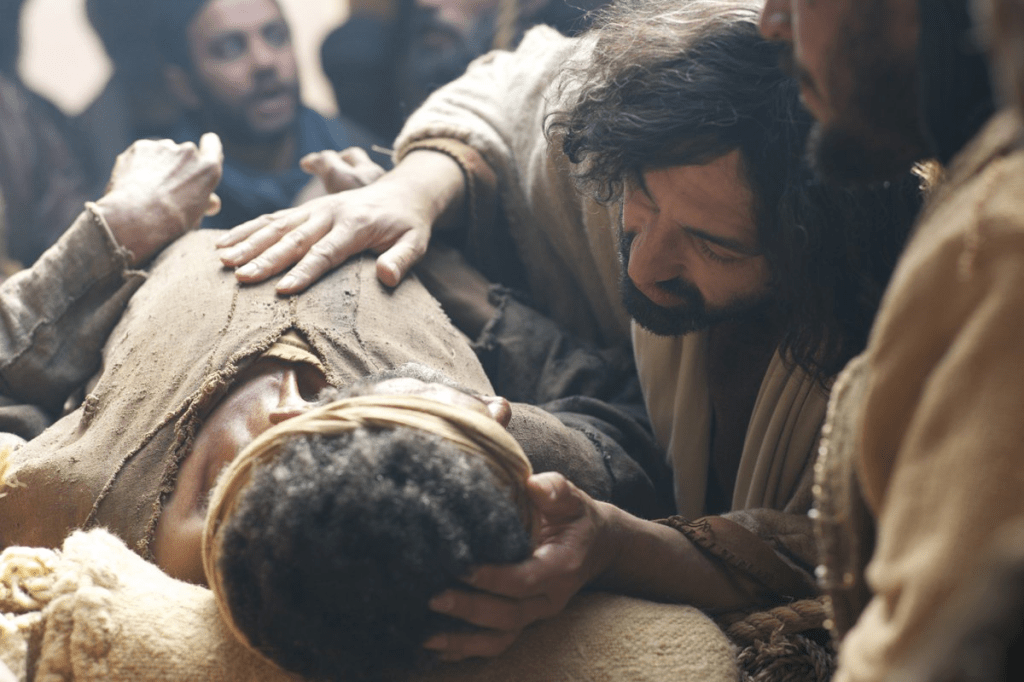
Jesus heals and forgives a paralyzed man

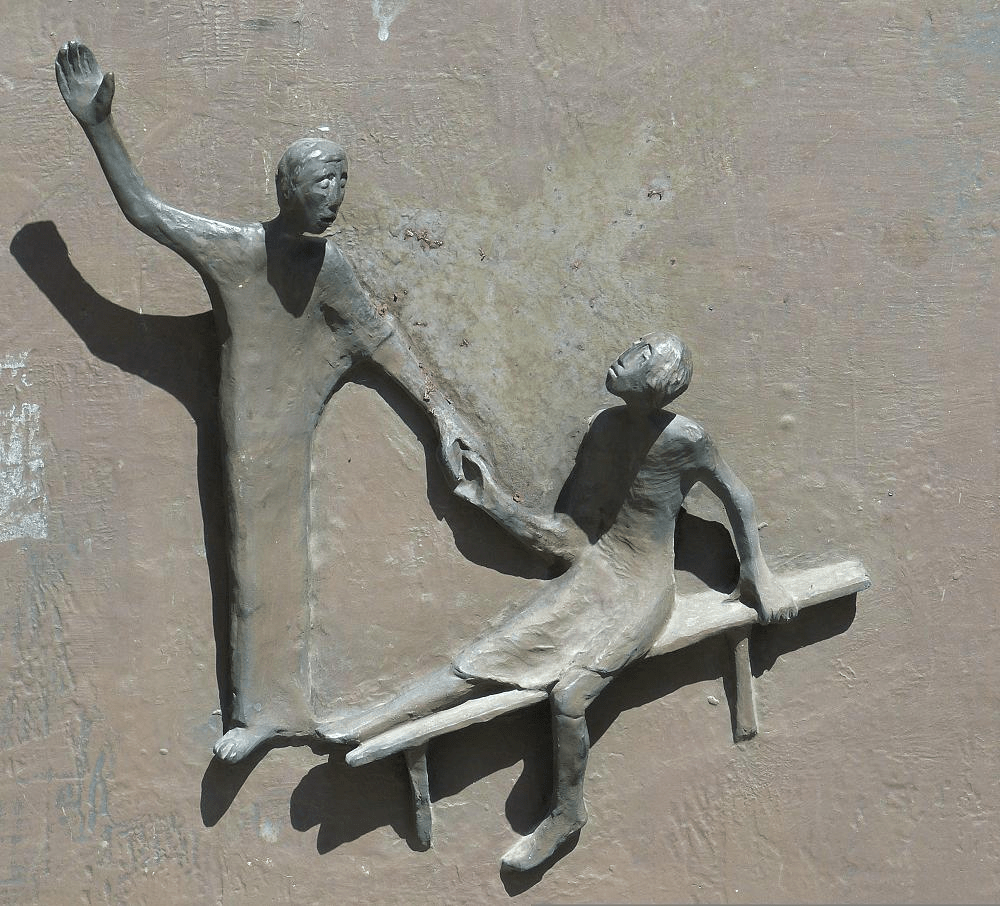
Some men brought to him a paralyzed man, lying on a mat. When Jesus saw their faith, he said to the man, “Take heart, son; your sins are forgiven.”

At this, some of the teachers of the law said to themselves, “This fellow is blaspheming!”

Knowing their thoughts, Jesus said, “Why do you entertain evil thoughts in your hearts? Which is easier: to say, ‘Your sins are forgiven,’ or to say, ‘Get up and walk’? But I want you to know that the Son of Man has authority on earth to forgive sins.” So he said to the paralyzed man, “Get up, take your mat and go home.” Then the man got up and went home. When the crowd saw this, they were filled with awe; and they praised God, who had given such authority to man.

As Jesus went on from there, he saw a man named Matthew sitting at the tax collector’s booth. “Follow me,” he told him, and Matthew got up and followed him.

While Jesus was having dinner at Matthew’s house, many tax collectors and sinners came and ate with him and his disciples. When the Pharisees saw this, they asked his disciples, “Why does your teacher eat with tax collectors and sinners?”

On hearing this, Jesus said, “It is not the healthy who need a doctor, but the sick. But go and learn what this means: ‘I desire mercy, not sacrifice.’ For I have not come to call the righteous, but sinners.” (New International Version)

“The church is a hospital for sinners, not a museum of saints.”

Abigail Van Buren (“Dear Abby”)

Why does the Church exist? Why did Jesus come to this earth? What are we supposed to be doing? Does Christianity make any difference in this world? Why are we here?

The Church is not on this earth solely for the benefit of Christians, any more than a hospital exists for the benefit of the doctors or insurance companies.

Rather, the Church is designed to extend the mission of Jesus through proclamation of good news with the restorative touch of grace. The Church is the community of the redeemed, gathered together for worship and encouragement, and then sent into the world to be the continuing presence of Jesus on this earth.

This mean that the Church’s calling is not to find others who can help them with their tithing and budget, or to keep the pews warm with fresh bottoms.

Some folks are not healthy. Some are sick physically, and others spiritually. Even more are emotionally brokenhearted. And then there are those who are sick-and-tired of being sick-and-tired.

Please know that Jesus came neither to condemn nor heap a pile of unrealistic expectations on us. Christ points us to the source of healing and transformation, and invites us to come to him. 

Conversely, there are many other people today who are healthy, spiritually alive, and have a good well-being. And they possess the opportunity to participate in ways that bring holistic healing to the world as Christians. The mission of Jesus is our mission, as well.

Jesus came to bring forgiveness and transformation. In today’s Gospel healing, it was a case where the person’s paralysis was both physical and spiritual. The paralytic found in Jesus healing of both body and soul.

The religious insiders observed the healing of the paralytic. Yet, they didn’t rejoice over it. Instead, they were hung up on Jesus claiming to be God. Although this may have been a hard truth to accept, Jesus labeled their response as evil – because of an inability to perceive the situation as a divine intervention. Since the religious insiders wrongly discerned who Jesus is, they wrongly interpreted the situation. 

It’s important to see Jesus as the Human One who extends compassion and forgiveness. If we fail to see this about Christ, we will get caught up in all kinds of silly matters concerning personal preferences and power plays, based in how we think things should go, rather than how God is shaking out things.

Jesus came to forgive our guilt and shame. Healing the body is good, but it’s not enough. Christ came to heal both the body and the spirit. At the heart of the human condition is spiritual brokenness, and Jesus wants to remove the obstacle of sin and create a new healthy society. This is a radical vision which seeks to encompass all persons – which means Jesus touched many people overlooked by others.

Jesus came to call the despised people of society, the “sinners.” He called Matthew, a tax collector. Tax collectors were hated. They were corrupt characters who extorted money from innocent people. And furthermore, Jesus had dinner with Matthew, along with all of his unsavory buddies. This kind of behavior by Jesus was deeply offensive to upstanding citizens.

However, Jesus did not back down, saying that it’s not the healthy who need a doctor, but the sick. And he backed up his social actions with Scripture by encouraging offended folks to meditate on what the biblical phrase, “I desire mercy, not sacrifice.” (Hosea 6:6)

It is possible to engage in outward rituals of worship, do all the right things, fulfill duty, yet still miss the heart of what God wants for humanity. Mercy is what God wants. Jesus knew this. So, Christ entangled himself with sinners to bring spiritual healing and restoration.

If we want to see God deliver people from their unhealthy situations, we must entangle ourselves with them, into complicated lives that are not pretty, with persons who have been tainted by sin. 

Lots of people are in awful predicaments. Christians, like their Lord, will need to get their hands dirty and their feet wet to extend Christ’s ministry of mercy and forgiveness.

The gospel was never intended to be proclaimed from afar, but up close and personal. The merciful mission of Jesus requires the following three activities:

  1. Intimacy with Jesus. Engaging in the spiritual disciplines of prayer, giving, fasting, reading, and meditating on Scripture. These practices help us to know Christ better and how to respond with mercy.
  2. Intimacy with fellow believers. We are hard-wired by God for community. Superficial relationships only provide superficial community. Christians need to help one another with spiritual growth, and to hold one another accountable for the mission of Christ.
  3. Intimacy with “sinners.” This world is filled with sick, needy, hurting, and lonely people who are locked in unhealthy patterns of living. They need a merciful change of life that comes from the merciful Jesus acting through merciful Christians. 

Mercy, not judgment, is at the heart of all change. For things to be different, we must be acquainted with mercy.

Most merciful God, we confess we have sinned against you in thought, word, deed, and neglect. We have not held fast to your commandments and have strayed from your teachings. We turn away from self-centered actions and pride. For the sake of your Son, Jesus, have mercy on us and forgive us so that we are released from all sinful obstacles. Empower us with your wisdom, revelation, and discernment so that we might be your merciful hands, feet, and words to one another and those who do not yet know you. Amen.

From Good to Bad (1 Kings 11:26-40)

Also, Jeroboam son of Nebat rebelled against the king. He was one of Solomon’s officials, an Ephraimite from Zeredah, and his mother was a widow named Zeruah.

Here is the account of how he rebelled against the king: Solomon had built the terraces and had filled in the gap in the wall of the city of David his father. Now Jeroboam was a man of standing, and when Solomon saw how well the young man did his work, he put him in charge of the whole labor force of the tribes of Joseph.

About that time Jeroboam was going out of Jerusalem, and Ahijah the prophet of Shiloh met him on the way, wearing a new cloak. The two of them were alone out in the country, and Ahijah took hold of the new cloak he was wearing and tore it into twelve pieces. Then he said to Jeroboam, “Take ten pieces for yourself, for this is what the Lord, the God of Israel, says:

“‘See, I am going to tear the kingdom out of Solomon’s hand and give you ten tribes. But for the sake of my servant David and the city of Jerusalem, which I have chosen out of all the tribes of Israel, he will have one tribe. I will do this because they have forsaken me and worshiped Ashtoreth the goddess of the Sidonians, Chemosh the god of the Moabites, and Molek the god of the Ammonites, and have not walked in obedience to me, nor done what is right in my eyes, nor kept my decrees and laws as David, Solomon’s father, did.

“‘But I will not take the whole kingdom out of Solomon’s hand; I have made him ruler all the days of his life for the sake of David my servant, whom I chose and who obeyed my commands and decrees. I will take the kingdom from his son’s hands and give you ten tribes. I will give one tribe to his son so that David my servant may always have a lamp before me in Jerusalem, the city where I chose to put my Name. 

“However, as for you, I will take you, and you will rule over all that your heart desires; you will be king over Israel. If you do whatever I command you and walk in obedience to me and do what is right in my eyes by obeying my decrees and commands, as David my servant did, I will be with you. I will build you a dynasty as enduring as the one I built for David and will give Israel to you. I will humble David’s descendants because of this, but not forever.’”

Solomon tried to kill Jeroboam, but Jeroboam fled to Egypt, to Shishak the king, and stayed there until Solomon’s death. (New International Version)

The prophet Ahijah speaking to the future king, Jeroboam, by Gerard Hoet, 1728

The Good and the Bad

People were originally created by a good God for the purpose of goodness. After forming the first people, Adam and Eve, God looked at humanity and said that it was “very good.” (Genesis 1:26-28, 31)

Yet, even though we all have been created good, that which is bad entered the world by means of the devil. And ever since that time, people in every era have struggled between their inherent design and their innate desires for something different. (Genesis 3:1-20)

Even King Solomon, with all of his great and God-given wisdom, eventually drifted into the bad. He succumbed to allowing other gods to come alongside the worship of the One true God. And there were consequences to those choices.

Recovering the Word “Sin”

“Sin” is a word that isn’t much used anymore. On the one hand, this is okay since the term has been much abused by many a misguided preacher. Yet, on the other hand, it’s a word which needs to be recovered, so that we will learn to avoid the bad and live into our good as image-bearers of God.

As the head of all Israel and Judah, Solomon had a grand kingdom. His father, David, was a man after God’s own heart. So, God established a covenant with David that there would always be one of his descendants on the throne. Solomon followed in his father’s footsteps and expanded the borders of Israel, bringing a level of prosperity and wealth never seen before or since.

And yet, either despite or because of Solomon’s wild success, bits of disobedience began to occur. Perhaps Solomon simply rested on his own laurels; or maybe he could not envision anything other than ongoing abundance. But for whatever reason, King Solomon started gravitating toward having more than he needed and ignored the instructions given to the people by God:

The king, moreover, must not acquire great numbers of horses for himself or make the people return to Egypt to get more of them, for the Lord has told you, “You are not to go back that way again.” He must not take many wives, or his heart will be led astray. He must not accumulate large amounts of silver and gold. (Deuteronomy 17:16-17, NIV)

And that is precisely what happened. Solomon had 700 wives (women of royal birth) and 300 concubines (women of common origin). And all those women served a variety of gods in a cornucopia of religious practices – some of which were downright inhumane and unjust. (1 Kings 11:1-13)

None of us are immune from falling into the guilt and shame of disobedient sin. For Solomon, this had the consequence of having the kingship almost completely ripped from his descendants to another man’s, Jeroboam.

Individuals, institutions, and nations have the potential for both great good, as well as heinous evil. When anyone begins to be concerned only for themselves and rests on their success, instead of the Lord, they have set up themselves for a collapse through the displeasure of God.

Stories of people who topple into sin are all close to the same – having some power, they use it to assert control over another person or group to obtain whatever they want. King Solomon violated God’s law. Not only that, but when he saw his control threatened, he sought to kill Jeroboam. Perhaps Solomon thought he was above all this, and believed he could do whatever he wanted. But he couldn’t.

Sin causes us to sell-out our principles 

Sin only begets more sin until we deal with it. Sin will always distort the truth so that we minimize the impact of our words, choices, and actions. Truth celebrates openness and honesty; sin seeks the shadows and prizes secrecy. 

The first step to dealing with sin is not to minimize it, ignore it, or pretend it isn’t a big deal. If we do not go down this path of truth, then we will be forever encrusting our lives with ways of ensuring that no one ever knows the sinful secrets. 

In fact, much of religious legalism is nothing more than a person piling on the rules in order for others to not see the sin that hides deep within. In Christianity, turning from the sin and receiving the grace of forgiveness in Jesus Christ is the true and real path to spiritual wholeness, happiness, and success in life.

Results that satisfy us do not necessarily satisfy God

Solomon accomplished what he wanted – some of it very good, and some of it very bad. The good was celebrated, and the bad was covered up. Yet, God sees all of it, celebrating with us the good, but not going with us down the path of self-indulgent sin.

We cannot simply assume that because we do something, and there was no immediate lightning strike, that it was okay. It does not matter if it happened yesterday, last month, or twenty years ago. If we did not deal with the sin, God is not satisfied because he wants to dispense grace; love and a flourishing soul cannot happen if we keep putting things out-of-sight out-of-mind. To only satisfy ourselves is being a spiritual cannibal who eats other people alive.

Outward success and abundance means little to God if the inward state leadership is a vacuous soul, bereft of authentic spiritual connection, with no determination toward God’s intentions for a particular course of action. 

Sin is not something to simply be managed; it is to be put to death through the cross of Christ, and applied to life through intentional spiritual practices meant to genuinely connect with God. 

For the Christian, to do less is to wander into a morass of consequences that damage others, not to mention harming ourselves. So, let us do the work of soul care so that the common good of all will thrive in the grace of God in Christ.

God, you have given all peoples one common origin.
It is your will that they be gathered together
as one family in yourself.
Fill the hearts of mankind with the fire of your love
and with the desire to ensure justice for all.
By sharing the good things you give us,
may we secure an equality for all
our brothers and sisters throughout the world.
May there be an end to division, strife and war.
May there be a dawning of a truly human society
built on love and peace.
We ask this in the name of Jesus, our Lord. Amen.