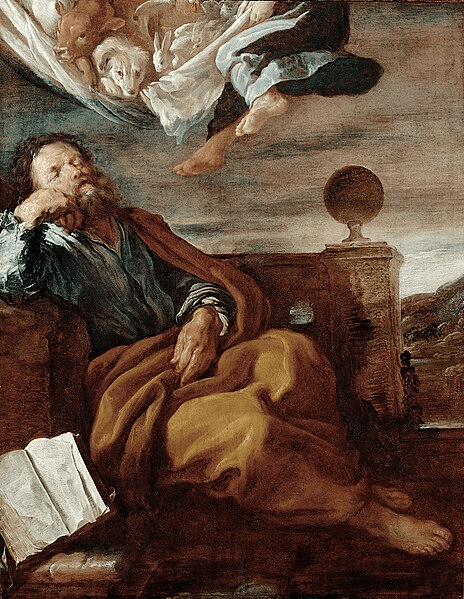
God Has No Favorites (Acts 10:1-34)

Peter’s Vision, by Domenico Fetti, c.1619

At Caesarea there was a man named Cornelius, a centurion in what was known as the Italian Regiment. He and all his family were devout and God-fearing; he gave generously to those in need and prayed to God regularly. One day at about three in the afternoon he had a vision. He distinctly saw an angel of God, who came to him and said, “Cornelius!”

Cornelius stared at him in fear. “What is it, Lord?” he asked.

The angel answered, “Your prayers and gifts to the poor have come up as a memorial offering before God. Now send men to Joppa to bring back a man named Simon who is called Peter. He is staying with Simon the tanner, whose house is by the sea.”

When the angel who spoke to him had gone, Cornelius called two of his servants and a devout soldier who was one of his attendants. He told them everything that had happened and sent them to Joppa.

About noon the following day as they were on their journey and approaching the city, Peter went up on the roof to pray. He became hungry and wanted something to eat, and while the meal was being prepared, he fell into a trance. He saw heaven opened and something like a large sheet being let down to earth by its four corners. It contained all kinds of four-footed animals, as well as reptiles and birds. Then a voice told him, “Get up, Peter. Kill and eat.”

“Surely not, Lord!” Peter replied. “I have never eaten anything impure or unclean.”

The voice spoke to him a second time, “Do not call anything impure that God has made clean.”

This happened three times, and immediately the sheet was taken back to heaven.

While Peter was wondering about the meaning of the vision, the men sent by Cornelius found out where Simon’s house was and stopped at the gate. They called out, asking if Simon, who was known as Peter, was staying there.

While Peter was still thinking about the vision, the Spirit said to him, “Simon, three men are looking for you. So get up and go downstairs. Do not hesitate to go with them, for I have sent them.”

Peter went down and said to the men, “I’m the one you’re looking for. Why have you come?”

The men replied, “We have come from Cornelius the centurion. He is a righteous and God-fearing man, who is respected by all the Jewish people. A holy angel told him to ask you to come to his house so that he could hear what you have to say.” Then Peter invited the men into the house to be his guests.

The next day Peter started out with them, and some of the believers from Joppa went along. The following day he arrived in Caesarea. Cornelius was expecting them and had called together his relatives and close friends. As Peter entered the house, Cornelius met him and fell at his feet in reverence. But Peter made him get up. “Stand up,” he said, “I am only a man myself.”

While talking with him, Peter went inside and found a large gathering of people. He said to them: “You are well aware that it is against our law for a Jew to associate with or visit a Gentile. But God has shown me that I should not call anyone impure or unclean. So when I was sent for, I came without raising any objection. May I ask why you sent for me?”

Cornelius answered: “Three days ago I was in my house praying at this hour, at three in the afternoon. Suddenly a man in shining clothes stood before me and said, ‘Cornelius, God has heard your prayer and remembered your gifts to the poor. Send to Joppa for Simon who is called Peter. He is a guest in the home of Simon the tanner, who lives by the sea.’ So I sent for you immediately, and it was good of you to come. Now we are all here in the presence of God to listen to everything the Lord has commanded you to tell us.”

Then Peter began to speak: “I now realize how true it is that God does not show favoritism…”

Peter’s Vision, by Doug Jaques

In this binary world of either/or, there are either good guys or bad guys, protagonists or antagonists, nice folk or jerks, Christians or non-Christians, etc.

Because this story is tied to its own cultural context, its punchline may not have the intended effect. Perhaps the story needs to be heard in a contemporary setting…

There was a man named “Dem.” He lived in New York, and was head of a labor union there. Dem did right by the people he represented. He always found ways to help those in need; led his family to worship God; and prayed faithfully every day.

One day, at about 3:00pm, during his time of prayer, he had a vision. An angelic messenger of God, as real as his next-door neighbor, came in and said, “Dem.”

Dem stared hard, wondering if he was seeing things. Then he said, “What do you want?” The angelic messenger said, “Your prayers and good works at your workplace and in your neighborhood have gotten God’s attention. So, here’s what you are to do: Send some people to Washington to get the one everyone calls ‘Pastor Pub.’ He’s staying with Perry the Politician whose house is down by the ocean.”

As soon as the angelic messenger was gone, Dem called two employees and one devout worker from the union. He went over with them in great detail everything he just experienced, and sent them off to Washington.

The next day, as the three travelers were approaching the city, Pastor Pub went out on the patio to pray. It was about noon. He got hungry and started thinking about lunch. While his food was being prepared, Pastor Pub fell into a trance.

He saw the skies open up. Something that looked like a huge blanket lowered by ropes at its four corners settled on the ground. Every kind of person – ethnicity, race, and gender – was on it. Then a voice came: “Go, Pastor Pub – baptize, marry, and bury.”

Pastor Pub exclaimed, “Oh, no, Lord. I’ve never so much as gotten close to non-Christians, let alone baptize, marry, or bury just anyone! It’s not holy!”

The voice came a second time: “If God says it’s okay, it’s okay.”

This happened three times, and then the blanket was pulled back up into the skies.

Peter’s Vision, by Edward Knippers

As Pastor Pub sat there puzzled, trying to figure out what it all meant, the people sent by Dem showed up at Perry’s front door. When the butler answered the door bell, they asked if there was a person known as Pastor Pub there.

Pastor Pub, on the back patio, didn’t hear them. So, the Spirit whispered to him, “Three people are at the door looking for you. Get up and go with them. Don’t ask any questions. I sent them to get you.”

Pastor Pub went to the front door and said, “I think I’m the guy you’re looking for. What in the world is going on?”

They said, “Dem is a God-fearing person, well-known for his just and right ways. Ask any politician in this city! He was commanded by an angelic messenger to get you and bring you to his house, so he could hear what you have to say.” Pastor Pub invited them in and was hospitable.

The next morning he got up and went with them. Some of his friends from Washington went along. Arriving in New York, Dem was expecting them; his close friends and relatives, and some workers, were waiting with him.

The minute Pastor Pub came through the door, Dem was up on his feet greeting him – and then down on his knees thanking him profusely. But Pastor Pub pulled him up saying, “There’s no need for that. I’m just a person no different than you.”

Talking things over, they went into the house, where Dem introduced Pastor Pub to everyone. Pastor Pub addressed them, “I’m sure that this is a highly irregular meeting. After all, Republicans, straight people, and anti-abortionists don’t do this sort of thing – visit and relax with Democrats, LGBTQ+ folk, and abortionists.

But God has shown me that no political party, gender, or issue is better than any other. So, the minute I was sent for, I came, no questions asked. But now I’d like to know why you sent for me.”

Dem said, “A few days ago at about this time, midafternoon, I was home praying. Suddenly there was a man right in front of me, flooding the room with light. He said, ‘Dem, your daily prayers and benevolent work have brought you to God’s attention. I want you to send to Washington to get the one they call Pastor Pub. He’s staying with Perry the Politician down by the ocean.’ So, I did it – I sent for you. And you have been good enough to come. Now we are all here in God’s presence, ready to listen to whatever the Lord put in your heart to tell us.”

At that point, the good news came exploding out of Pastor Pub: “It’s God’s own truth, and nothing could be plainer than this: God has no favorites!”

My friends, it is high time we set aside our sinful prejudice toward others. Far too many of us believe and claim that our positions on issues and ideas about how things ought to go are gospel truth – not to mention our ungodly discrimination against another race, ethnicity, and gender.

If it is judgment you want, then that judgment must begin with your own house, and specifically with you yourself…

Don’t Get Too Comfortable (Amos 9:7-15)

“Are not you Israelites
    the same to me as the Cushites?”
declares the Lord.
“Did I not bring Israel up from Egypt,
    the Philistines from Caphtor
    and the Arameans from Kir?

“Surely the eyes of the Sovereign Lord
    are on the sinful kingdom.
I will destroy it
    from the face of the earth.
Yet I will not totally destroy
    the descendants of Jacob,”
declares the Lord.
“For I will give the command,
    and I will shake the people of Israel
    among all the nations
as grain is shaken in a sieve,
    and not a pebble will reach the ground.
All the sinners among my people
    will die by the sword,
all those who say,
    ‘Disaster will not overtake or meet us.’

“In that day

“I will restore David’s fallen shelter—
    I will repair its broken walls
    and restore its ruins—
    and will rebuild it as it used to be,
so that they may possess the remnant of Edom
    and all the nations that bear my name,”
declares the Lord, who will do these things.

“The days are coming,” declares the Lord,

“when the reaper will be overtaken by the plowman
    and the planter by the one treading grapes.
New wine will drip from the mountains
    and flow from all the hills,
    and I will bring my people Israel back from exile.

“They will rebuild the ruined cities and live in them.
    They will plant vineyards and drink their wine;
    they will make gardens and eat their fruit.
I will plant Israel in their own land,
    never again to be uprooted
    from the land I have given them,”

says the Lord your God. (New International Version)

No one is immune from judgment, nor from the watchful eye of the God who knows both the actions of humanity and what is truly within their hearts.

Every one of us has the capacity and the potential for evil – even, and perhaps especially, those who claim to believe and follow God. To be arrogant and cocky is to set up oneself for a fall. To think that you could never fall or do evil is to operate in the realm of pride and hubris – which are the very traits of the Evil One.

Don’t get too comfortable with your life. Don’t simply believe you’re okay and anyone who disagrees with you is not okay.

Evil is not always (and usually isn’t) an in-your-face sort of thing. The sinister and unjust amongst us is much more like someone putting the text of the United States Constitution, the Bill of Rights, the Declaration of Independence, and the Pledge of Allegiance inside of a Bible, making it a convenient collection for those who are tired of having to separate their church from their state.

The Lord, however, will do some separating – the wheat from the chaff, and the sheep from the goats. (Matthew 3:12; 25:31-33)

God does not punish simply for the sake of punishment; rather, judgment is a means to restore and renew. Curses will give way to blessings. What has been lost shall be found.

“They will rebuild the ruined cities and live in them...”

Doom and hope, judgment and grace, suffering and glory. These are the movements and rhythms of the Old Testament prophets. The great sin of Israel which warranted divine wrath was not only that they trampled on the poor and needy. On top of it all, they saw nothing wrong with their way of life. 

This profound lack of awareness, rooted in the spiritual blindness of greed, is what led to judgment. It would take the form of having the Assyrian Empire come, seize the land, and take the people away to a place where they would have no chance to oppress others. Sadly, death would come to many.

The sin of oppressing others and believing there’s nothing wrong with it comes with severe consequences. The people relied too much on their ethnicity and spiritual pedigree. The ancient Israelites wrongly assumed that because they were the people of the covenant, this somehow inoculated them from disaster. Their belief in Jewish exceptionalism was their downfall.

Yet, all would not be endless gloom. The Lord will not destroy completely. God’s anger lasts for a moment. However, God’s grace lasts forever. Restoration, renewal, and fruitful times will come because of God’s mercy. 

Yes, God pronounces judgment when it is warranted. But God also makes and keeps promises to people. In our lesson for today, the Lord promises to restore the fortunes of the people through rebuilding ruined cities and letting them inhabit them once again.

God steps in and graciously acts on behalf of all people because that is what God does. We might get the notion in our heads that God executes judgment to teach people a lesson or to make a point. In my line of work, it is common to hear people express the idea they are under divine punishment because of personal illness or hard circumstances. 

God, however, acts independently out of a vast storehouse of righteousness and mercy. The Lord maintains holy decrees while showing grace to the undeserving. The nation of Israel, in the days of the prophet Amos, deserved only judgment, not grace. 

It seems to me God would have been completely justified to never restore or renew a recalcitrant people. Yet, God’s grace overwhelms and swallows human sin. Try as you might to understand grace, you will end up befuddled. That’s because grace is wildly illogical, nonsensical, and unconditionally free. Grace shows radical acceptance where there ought to be only the punishing fire of hell.

The height of grace and the pinnacle of restoring the fortunes of Israel (from a Christian perspective) came through a baby and a humble birth in the small village of Bethlehem. Jesus came to save the people from their sins. God acted by entering humanity with divine love so that there could be new life and fresh hope. 

So, let grace wash you clean. Allow mercy to renew your life. Receive the gift of gracious forgiveness, merciful love, and divine peace. Look ahead and see there is hope on the horizon.

For the afflicted, there is comfort. But for the comfortable, affliction is coming.

Merciful God, although you are careful to uphold your great holiness, your mercy extends from everlasting to everlasting. May the gospel of grace form all my words and actions so that true righteousness reigns in my life through Jesus, my Lord, in the power of the Holy Spirit. Amen.

Magic vs. Miracle (Acts 8:9-25)

Peter’s Conflict with Simon the Sorcerer, by Avanzino Nucci, 1620. Simon is on the right, wearing black.

Now for some time a man named Simon had practiced sorcery in the city and amazed all the people of Samaria. He boasted that he was someone great, and all the people, both high and low, gave him their attention and exclaimed, “This man is rightly called the Great Power of God.” They followed him because he had amazed them for a long time with his sorcery. 

But when they believed Philip as he proclaimed the good news of the kingdom of God and the name of Jesus Christ, they were baptized, both men and women. Simon himself believed and was baptized. And he followed Philip everywhere, astonished by the great signs and miracles he saw.

When the apostles in Jerusalem heard that Samaria had accepted the word of God, they sent Peter and John to Samaria. When they arrived, they prayed for the new believers there that they might receive the Holy Spirit, because the Holy Spirit had not yet come on any of them; they had simply been baptized in the name of the Lord Jesus. Then Peter and John placed their hands on them, and they received the Holy Spirit.

When Simon saw that the Spirit was given at the laying on of the apostles’ hands, he offered them money and said, “Give me also this ability so that everyone on whom I lay my hands may receive the Holy Spirit.”

Peter answered: “May your money perish with you, because you thought you could buy the gift of God with money! You have no part or share in this ministry, because your heart is not right before God. Repent of this wickedness and pray to the Lord in the hope that he may forgive you for having such a thought in your heart. For I see that you are full of bitterness and captive to sin.”

Then Simon answered, “Pray to the Lord for me so that nothing you have said may happen to me.”

After they had further proclaimed the word of the Lord and testified about Jesus, Peter and John returned to Jerusalem, preaching the gospel in many Samaritan villages. (New International Version)

Simon the Sorcerer was quite a character. For that matter, so was Simon Peter. The contrast between them, however, shows that there were really no similarities between the two – even though the Sorcerer tried to make it so.

The Sorcerer reminds me of the church elder who is a continual suck-up to the pastor. Those sorts of parishioners always drive me nuts in the ministry. I have known plenty of them over the years, who put on a façade of politeness and speak with flattery; but their real agenda is to have power, by any means possible.

People like Simon the Sorcerer have always existed, ever since the fall of humanity into sin. They aren’t committed to anything but themselves. Their actions are motivated by the accumulation of information so that they can use that knowledge to leverage for more power and control.

What is so sad about the Simon the Sorcerer sort of people is that they actually believe that everyone else is motivated by the very same things they are; and that the world operates on acquiring more and more control and power over it.

They need money because they believe everyone has a price. They compulsively follow influential individuals because they believe anyone can be manipulated. They continually boast (and even lie) about their importance and all the great things they have done in the past.

Perhaps most of all, the Simon the Sorcerer type person obsessively seeks attention because they believe their sense of security and self-worth are determined by how many other people like them.

The Apostles of Christ, Philip and John and Peter, saw right through the false discipleship of the Sorcerer. They didn’t need to know all the events of Simon’s past to clearly see that he was a bitter man who was a prisoner to the guilt and shame he carried around in his heart.

simony: The buying or selling of advantages for positions in the Church, or for religious pardons

The difference between Simon the Sorcerer and Simon Peter the Apostle is the difference between manipulative magic and divine miracles. Like the Egyptian magicians of Pharaoh, and the divinely inspired Moses, the ability to perform a great wonder of power, or spiritual sign of power, seem rather similar – that is, at first.

But the similarities of the supernatural powers are merely superficial. There are always limits to what the Sorcerer can do versus the unlimited abilities of the true believer possessing spiritual power – or even between supposed Christian faith healers and the godly believer who is gifted with being a healer.

The bottom line of it all is that the deeds of Simon the Sorcerer pointed to himself in selfish acts of self-glorification. The signs and wonders of Simon Peter – and all the other Christian Apostles – consistently pointed to the kingdom of God and validated the message of repentance and new life, faith and forgiveness, in Jesus Christ.

In other words, the Apostles did not really do any of the miracles of bringing a changed life to people; Christ himself did that, through the ministry and power of the Holy Spirit. It was a message about release and freedom from the dark forces of Satan, and the ability to live a good, just, and right life without having to pay for it in any way.

Today, although few people practice an overt form of magic as the ancients once did, we still must be wary of those who promise magical results for whatever we need or what ails us.

One could argue that much of contemporary marketing and consumerism are a modern form of buying into the magical thinking that my life can be mystically and unexplainedly improved through using a particular product (or a certain church consultant!).

The easy way is most typically the approach of the Sorcerer and charlatan; it doesn’t really change anything, or require anything of us, especially when it comes to the human heart. It never truly brings about a better world.

The way of the cross, however, is a hard road – the narrow way – and few end up finding it. The old life must go in order to make way for the new life. There must be a crucifixion before there can ever be a resurrection.

God, you sent your Son into the world that we might live through him. May we abide in his risen life so that we may bear the fruit of love for one another and know the fullness of joy. Amen.

Mercy Is Coming (Micah 7:8-20)

“Justice Tempered with Mercy,” an oil painting by Emil Bisttram, 1936

Do not rejoice over me, my enemy,
        because when I fall, I will rise;
            if I sit in darkness, the Lord is my light.
I must bear the raging of the Lord,
    for I have sinned against him,
        until he decides my case and provides justice for me.
    He will bring me out into the light;
        I will see by means of his righteousness.
    Then my enemy will see;
        shame will cover her who said to me:
            “Where is the Lord your God?”
    My eyes will see her ruin;
        now she will become something to be trampled,
            like mud in the streets.

A day for the building of your walls!
        On that day, the boundary will be distant.
        On that day, they will come to you from Assyria and the cities of Egypt,
            from Egypt to the River,
            from sea to sea,
            and from mountain to mountain.
And the earth will become desolate because of her inhabitants,
        because of the fruit of their actions.

Shepherd your people with your staff,
        the sheep of your inheritance,
        those dwelling alone in a forest in the midst of Carmel.
    Let them graze in Bashan and Gilead, as a long time ago.

As in the days when you came out of the land of Egypt,
        I will show Israel wonderful things.

Nations will see and be ashamed of all their strength;
        they will cover their mouths;
        their ears will be deaf.

They will lick dust like the snake,
        like things that crawl on the ground.
They will come trembling from their strongholds to the Lord our God;
        they will dread and fear you!
Who is a God like you, pardoning iniquity,
        overlooking the sin of the few remaining for his inheritance?
    He doesn’t hold on to his anger forever;
        he delights in faithful love.
He will once again have compassion on us;
        he will tread down our iniquities.
You will hurl all our sins into the depths of the sea.
You will provide faithfulness to Jacob, faithful love to Abraham,
        as you swore to our ancestors a long time ago. (Common English Bible)

The prophecy of Micah was directed to the people because of the nation’s messed up social and political relations. Unrighteousness had thoroughly drenched the land. In this situation, the nation groaned; Micah responded to them and interceded for the people; God agreed with it all; and Micah concluded with a theological reminder of who God is and what God is like.

The nation of Israel was in a bad way during the eighth century B.C.E. because of their injustice toward one another. The leaders only thought of themselves, and not the people as a whole. Unfaithfulness ran so deep that not even one’s closest friends or relatives could be trusted.

To be a faithful and righteous person during that time required a resolve to wait for God’s deliverance – because there was no way any one person or group of people could fix any of it.

And this is the nature of hope – it can only be understood and realized by knowing, sensing, and feeling hopelessness in all of its despair. We do not hope for something we already possess.

The prophet Micah recognized the situation of the nation for what it was, as well as the consequences to having injustice throughout the land. Yet, he also looked forward to a time when God’s wrath will move from God’s people to the people’s enemies.

It may seem as if the Lord is either slow, not paying attention, or doesn’t care; but God’s timing is not the same as ours. Divine deliverance will come when divine deliverance will come.

The circumstances of Israel’s national sins were ripe not only for God’s judgment, but also for Micah’s prayers on behalf of the people. He called on the Lord to shepherd Israel, while at the same time, to put Israel’s enemies in their place.

And God, out of the storehouse of divine mercy, granted an assurance of pardon.

But if we confess our sins, he is faithful and just to forgive us our sins and cleanse us from everything we’ve done wrong. (1 John 1:9, CEB)

Micah affirmed the grace and mercy of God. He had the confident expectation that the Lord would cast all of Israel’s sins into the depths of the sea. Guilt, shame, and despair will not have the last word; the final word belongs to mercy.

Into a world full of cynicism and sarcasm, hopelessness and despair, it is vitally important that we have faithful and godly individuals who have a settled hope. This is what it means to be a remnant, a small minority of people who hold onto that which is just, right, and good.

We are to quietly go about our business of bringing justice, mercy, and love to this world with a quiet and confident expectation that God’s grace will overcome and overwhelm everything in its path.

Most merciful God, we confess that we have sinned against you in thought, word, and deed, by what we have done, and by what we have left undone. We have not loved you with our whole heart; we have not loved our neighbors as ourselves. We are truly sorry and we humbly repent. For the sake of your Son Jesus Christ, have mercy on us and forgive us; that we may delight in your will, and walk in your ways, to the glory of your Name. Amen.