Mercy and Judgment (Revelation 8:1-5)

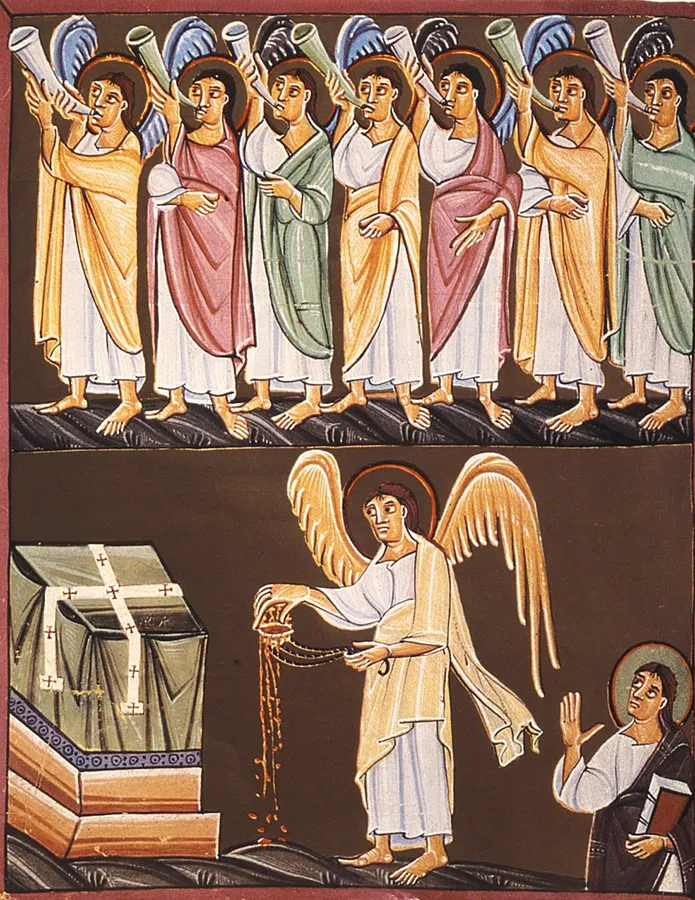
Seven angels with seven trumpets, and the angel with a censer, from the Bamberg Apocalypse, c.1020 C.E.

Then, when the Lamb opened the seventh seal, there was silence in heaven for about half an hour.

Then I saw the seven angels who stand before God, and seven trumpets were given to them. Another angel came and stood at the altar, and he held a gold bowl for burning incense. He was given a large amount of incense, in order to offer it on behalf of the prayers of all the saints on the gold altar in front of the throne. 

The smoke of the incense offered for the prayers of the saints rose up before God from the angel’s hand. Then the angel took the incense container and filled it with fire from the altar. He threw it down to the earth, and there were thunder, voices, lightning, and an earthquake. (Common English Bible)

When I was kid, growing up on a Midwest American farm, I remember times when severe weather was coming. I knew it was going to be bad whenever everything became still and there was complete silence: No wind, no birds singing, no insects chirping, nothing moving whatsoever. It was the eerie silence which precedes something big coming.

That is the way it will be in heaven when the seventh seal is opened. The silence is so quiet that you know a lot of noise and movement are about to happen. It’s not serene silence; it’s scary silent.

With the opening of the seventh seal, a climactic moment is reached. The silence is not only an anticipation of the coming drama, but is also a sign of reverence and awe.

The seventh seal initiates a series of woes: The seven trumpets. But before the trumpets begin, an angel appears. Standing before a heavenly altar, the angel mixes incense along with prayers from the people, then offers them on the altar.

These prayers of the people are for justice, and a longing for the kingdom to come, and God’s will to be done, on earth, as it is always done in heaven.

The imagery relates to us that God hears the prayers, and will act, according to the divine character and will.

The angel takes fire from the altar and hurls it down to earth, causing thunder and lightning, and an earthquake. In other words, the prayers are being answered; they are having an effect. Judgment on the earth begins with the blowing of the seven trumpets.

As we may expect, the incredible silence gives way to an equally incredible noise of weather and the earth moving. And the angel, serving as a quiet and contemplative high priest, now moves to becoming a judge upon the earth.

It turns out that mercy and judgment are not two contrasting concepts and actions; they are two sides of the very same coin. The altar of mercy becomes the source of judgment.

Whenever there is an injustice, we want (and expect) to have that act acknowledged and taken care of by a proper authority. To have a judge simply say that he/she is merciful and will acquit the guilty, does not work in every situation. Mercy only exists because of the presence of guilt and judgment.

God takes care of sin because God loves. An unloving deity would be unconcerned, random, and capricious in handling injustice. But not the God of the Bible. God shows mercy to the righteous, and will judge the wicked.

God’s mercy extends to the point of acquitting the guilty, if God so desires to do so. And everyone needs mercy, because we all have committed injustices in our lives.

Yet, by means of humble contrition and faith, we can mercifully discover gracious amnesty. This is why Jesus came, to take care of the sin issue once for all through the Cross.

We have been made holy by God’s will through the offering of Jesus Christ’s body once for all. (Hebrews 10:10, CEB)

In the time of the Apostle John’s vision, which is the Book of Revelation, Christians were facing persecution and martyrdom. The prayers of the suffering believers rose to heaven:

They cried out with a loud voice, “Holy and true Master, how long will you wait before you pass judgment? How long before you require justice for our blood, which was shed by those who live on earth?” (Revelation 6:10, CEB)

God’s response to the prayers of the saints is to send judgmental fire against the earth by the hand of the angel. In John’s apocalyptic vision, not only are the believers in Christ facing trials and tribulations for their faith, but the unbelieving persecutors who victimize the saints will be punished, as well.

If the persecutors use fiery elements against the believers, God can (and will) turn that fire back on the them. This is similar to the Book of Exodus, in which the plagues that struck and judged the Egyptians were, at the same time, a means of protecting and preserving the Israelites.

The Book of Revelation included in the Christian canon of scripture, not for the purpose of predicting the time or the season in which Jesus Christ will come back to judge the living and the dead. Rather, John’s Apocalypse is meant to encourage the followers of Christ that their suffering will not last forever; and neither will the arrogance of the wicked.

We don’t know when all of this end-of-the-age stuff is going to shake out. Which is why it is so important we learn to persevere through suffering. Because we might have to wait awhile.

Prayer for us then becomes not simply something we do if we have a bit of discretionary time; it becomes vital for us. We discern that we must speak with God. We are compelled to offer our prayers. We feel the great need to cry out and petition God for justice and righteousness.

It seems, if I don’t pray, I won’t make it. Therefore, I must pray. I will pray with all of my heart and soul, till I cannot pray anymore. And then I will pray some more, because I need God.

There is nothing easy about moving through suffering. It’s hard to persevere. It hurts to be the brunt of another’s violent tongue and/or hand. Yet, we do not experience this alone. The divine presence is with us. And that makes all the difference.

Oh God:
Give me strength to live another day;
Let me not turn coward before its difficulties, or fail in its duties;
Let me not lose faith in other people;
Keep me sweet and sound of heart, in spite of ingratitude, treachery, or meanness;
Preserve me from minding little stings, or giving them;
Help me to keep my heart clean, and to live so honestly and fearlessly that no outward failure can dishearten me, or take away the joy of conscious integrity;
Open wide the eyes of my soul that I may see good in all things;
Grant me this day some new vision of your truth;
Inspire me with the spirit of joy and gladness and make me the cup of strength to suffering souls; in the name of the strong Deliverer, our only Lord and Savior, Jesus Christ. Amen.

Feeling the Pain (Job 23:1-9, 16-17)

Then Job answered:

“Today also my complaint is bitter;
    his hand is heavy despite my groaning.
Oh, that I knew where I might find him,
    that I might come even to his dwelling!
I would lay my case before him
    and fill my mouth with arguments.
I would learn what he would answer me
    and understand what he would say to me.
Would he contend with me in the greatness of his power?
    No, but he would give heed to me.
There the upright could reason with him,
    and I should be acquitted forever by my judge.

“If I go forward, he is not there;
    or backward, I cannot perceive him;
on the left he hides, and I cannot behold him;
    I turn to the right, but I cannot see him….

God has made my heart faint;
    the Almighty has terrified me.
If only I could vanish in darkness,
    and thick darkness would cover my face. (New Revised Standard Version)

Here is Job, sitting on an ash heap, of all things, and feeling like an ash. His children are gone, all killed by tragic circumstances. His wealth is no more. And now he is lamenting, because he can do nothing else; he has painful nasty sores covering his body that won’t let him do anything.

Job and his friends, by Ilya Repin (1844-1930)

And if that isn’t enough, Job’s “friends” come and end up giving him unhelpful speeches about how all this suffering is really his fault. They reasoned (wrongly) that there must be loads of sin in Job’s life for him to be going through such horror. God is punishing him, they insist.

Job’s companions had initially started out well. For seven days they sat with him in silence (Job 2:13). But then, after a week had passed, they just couldn’t take it anymore. They had the compulsion to speak. And when they opened their mouths, it was merely a bunch of ignorant gobbledygook.  

The friends, the companions, were themselves having an existential theological crisis. Their worldview was being challenged and threatened. So, rather than be open-minded and consider that their views may need to be altered, the friends acted like enemies, accusing Job of sin.

At issue was their clear and clean theology of believing that good guys are blessed with wealth, health, and happiness; and bad guys are cursed with poverty, illness, and misery – like Job.

They could not imagine or entertain the thought that God would let a good person suffer like Job was suffering. Therefore, Job must be bad, and they tried to find that hidden sin within him  to which he must repent of.

Yet, in truth, not all suffering – even terrible grinding suffering – is the result of personal sin or bad decision-making. Sometimes, good people suffer horribly, too.

Times may change, but people throughout the ages don’t. Today, we still think along the same lines as the companions of Job. There is far too much blaming of victims for their victimization; and way too many flippant beliefs which say to others in a terrible situation things like, “You reap what you sow.”

Job, through all of the loss, tragedy, and then suffering from his friends, held onto his integrity. Even though Job knew his situation was undeserved, he did not curse God, nor his friends.

Job made the incredible claim that suffering is not always the result of one’s personal sin – something he himself might not have said before his tragic experiences.

But just because Job did not curse, does not mean he was nice and okay with what unfolded in his life. He wished he was never born. He felt like death would be preferable to living. He contended with God, and longed for justice. His ultimate wish was that God would just speak and say something, anything.

Job was hurting so terribly, that he had bitter words of despair for God. He could make absolutely no sense of what was happening. He could not understand why he was the brunt of so much suffering. It felt like God was attacking him, and he said so.

The silence and absence of God were palpable for Job. He longed to speak with God. And his greatest lament – out of all the reasons to lament – was the horrible feeling of being alone without God’s presence and consolation.

It is interesting that we have no mention in the story about Job’s friends speaking directly to God, or praying to God, or addressing God in any way.

They certainly felt free to tell Job who God is, and how God operates in the world. But there was never any intercession for their friend, and no words of crying out to God on behalf of Job. There was only words of rebuke and chastisement, words of hurt that were as painful as the physical sores on his body

The phrase I hear most often from people speaking to the person in grief and pain is, “You just need to be strong.” And a close second is, “Everything happens for a reason.” The latter phrase is simply unhelpful, and the former phrase is actually hurtful.

It is not a sin to be weak. Just in case you read that sentence too quickly, I will say it again: It. Is. Not. A. Sin. To. Be. Weak!

We understand that when someone breaks a bone, they’ll be limited with weakness for a while. And we make helpful accommodations to that effect. But when someone’s heart is broken, and their life emotionally shredded, we expect them to be strong for everyone else around them.

It may be true that everything happens for a reason, yet most of the time, none of us knows the reason why we’re going through what we’re going through. And we probably won’t, this side of heaven.

If we try to have explanations for everything, then we join the company of Job’s companions who had to try and understand what was happening. And their conclusions were very wrong.

However, there is nothing wrong with weeping with those who weep; and expressing pain, grief, and even anger – both for the one who laments, and those who lament with them.

Pain cannot be relieved unless it is acknowledged, affirmed, and addressed by both the one who suffers and the community who surrounds them.

Where there is lament, there are loud words and expressions of grief. When lament is said to God, then God can hold that person, and rock them in the arms of mercy.

But silence is agonizing. We need friends who will listen and grieve with us. It is vital to have companions who voice to God what we cannot voice in our weakness. All of us, together, must hold onto God, and trust that the Lord hears, and will answer.

As Jesus cried out on the cross, I cry out to you in pain, O God my Creator. Do not forsake me. Grant me relief from this suffering and preserve me in peace; through Jesus Christ my Savior, in the power of the Holy Spirit. Amen.

How To Handle the One Who Grieves (Job 37:1-13)

The Wrath of Elihu, by William Blake, 1805

“At this my heart pounds
    and leaps from its place.
Listen! Listen to the roar of his voice,
    to the rumbling that comes from his mouth.
He unleashes his lightning beneath the whole heaven
    and sends it to the ends of the earth.
After that comes the sound of his roar;
    he thunders with his majestic voice.
When his voice resounds,
    he holds nothing back.
God’s voice thunders in marvelous ways;
    he does great things beyond our understanding.
He says to the snow, ‘Fall on the earth,’
    and to the rain shower, ‘Be a mighty downpour.’
So that everyone he has made may know his work,
    he stops all people from their labor.
The animals take cover;
    they remain in their dens.
The tempest comes out from its chamber,
    the cold from the driving winds.
The breath of God produces ice,
    and the broad waters become frozen.
He loads the clouds with moisture;
    he scatters his lightning through them.
At his direction they swirl around
    over the face of the whole earth
    to do whatever he commands them.
He brings the clouds to punish people,
    or to water his earth and show his love.” (New International Version)

Job’s Despair, by William Blake, 1821

On the one hand, the biblical book of Job needs little introduction. Many people know it has to do with a man’s innocent suffering and tenacious faith. Most folks are familiar with how it feels to suffer for no apparent reason. And everyone understands the struggle when life is broken by pain and loss.

Yet, on the other hand, the book of Job defies simple anecdotes about suffering. And the relationship between Job and God has a lot of complexity to it. Add in Job’s friends with their wordy offerings into his situation, and there becomes a fuller picture of the true wrestling of faith and patience that occurs.

Elihu was a young person who was with the three friends of Job. After listening to everyone speak, he himself went on a long speech, stretching six chapters from Job 32-37. He was angry with Job, and with Job’s three friends.

The young Elihu had picked up that Job thought of himself more righteous than God. And he was also upset that the “friends” offered nothing helpful, and could provide no convincing answers to Job – thus making it appear that God was guilty of Job’s intense suffering and grief.

Job, by French painter Léon Bonnat, 1880

In today’s Old Testament lesson, we are getting an end part of Elihu’s speech in which he sought to defend God’s justice through observing the majesty and order of creation.

The testimony of God’s sovereign governance of the world is found in the rain, the thunder, and the lightning; through the winter storms and the frost. The Lord uses the created order to both judge and sustain people. And through the ecological systems we can see that God is at work, regulating it all, and using it for divine purposes, Elihu points out.

What strikes me about Elihu’s words is that he is not wrong, he’s just not very helpful. As a believer, I look at his speech as more of a Captain Obvious moment; yes, he is stating theological reality, but no, he’s not really breaking any new ground or giving any great insight here.

Both Job and Job’s friends had already expressed a theological perspective in kind. Which makes me curious as to why Elihu felt so compelled to even talk at all. I think he would have been better remembered, and maybe even hailed as spiritual beyond his years, if he would have just kept silent.

I realize not everyone is going to go with me on that observation, and that’s fine. Yet it seems to me that a good many people lob too many words toward the suffering among us, when what is actually needed is a compassionate presence that has learned to be comfortable with the uncomfortable.

There are times when words are not needed, when the situation is so incredibly unique and/or difficult that to offer a speech is like yelling in the woods with no one around; it might make the one yelling feel better but that’s about it.

If anyone needed to feel better it wasn’t Elihu. What’s more, a perceived need of defending God’s reputation or honor perhaps betrays a shortsighted theology to begin with. The Lord is quite big enough to handle any rebuffs or misunderstandings from mouthy humans. God isn’t in Junior High School, requiring a mouthpiece to help him out in a scuffle.

I would personally rather give comfort to a hurting person, instead of theological exhortations and speeches about how we ought to talk to, and about, God. That’s because I observe Jesus bringing genuine comfort and help. And I would much rather take my cues for dealing with grieving people from Christ than from Elihu, or anybody else for that matter.

“God blesses those people who grieve. They will find comfort!” (Matthew 5:4, CEV) Jesus said this in his Sermon on the Mount, as a beatitude of all who desire God’s kingdom. Christ understood well the psalmist’s understanding of God’s role and stance concerning people’s grief: “The Lord is close to the brokenhearted; he saves those whose spirits are crushed.” (Psalm 34:18, CEB)

The Apostle Paul, taking a lesson from both his Jewish learning and his encounter with Christ said, “mourn with those who mourn.” (Romans 12:15, NIV) Comfort because of grief and suffering will be built into the end of time. Methinks, then, that this is important…

“Look! God’s dwelling place is now among the people, and he will dwell with them. They will be his people, and God himself will be with them and be their God. ‘He will wipe every tear from their eyes. There will be no more death’ or mourning or crying or pain, for the old order of things has passed away.” (Revelation 21:3-4, NIV)

In whatever way you choose to look at the book of Job, please don’t miss what is to be our response to another’s pain. There is a time for theological education, and there is a time to put a robust theology into practice through a very real comforting presence of another who is in terrible suffering.

God, the strength of the weak and the comfort of those who suffer: Hear my prayers and grant those who suffer in body, mind, or spirit the power of your grace, that affliction may be turned into health, and sorrow into joy. Amen.

It’s In the Details (Exodus 28:29-38)

Aaron the High Priest

“Whenever Aaron enters the Holy Place, he will bear the names of the sons of Israel over his heart on the breast-piece of decision as a continuing memorial before the Lord. Also put the Urim and the Thummim in the breast-piece, so they may be over Aaron’s heart whenever he enters the presence of the Lord. Thus Aaron will always bear the means of making decisions for the Israelites over his heart before the Lord.

“Make the robe of the ephod entirely of blue cloth, with an opening for the head in its center. There shall be a woven edge like a collar around this opening, so that it will not tear. Make pomegranates of blue, purple and scarlet yarn around the hem of the robe, with gold bells between them. The gold bells and the pomegranates are to alternate around the hem of the robe. Aaron must wear it when he ministers. The sound of the bells will be heard when he enters the Holy Place before the Lord and when he comes out, so that he will not die.

“Make a plate of pure gold and engrave on it as on a seal: holy to the Lord. Fasten a blue cord to it to attach it to the turban; it is to be on the front of the turban. It will be on Aaron’s forehead, and he will bear the guilt involved in the sacred gifts the Israelites consecrate, whatever their gifts may be. It will be on Aaron’s forehead continually so that they will be acceptable to the Lord. (New International Version)

This area of Holy Scripture is likely not one of the more popular places to read. Frankly, it’s boring and pedantic. Yet, contained within the Bible it is, for us to examine.

After giving Moses the Ten Commandments in Exodus 20, the next several chapters, from Exodus 20-31 contain detailed instructions from God concerning the covenant code stipulations with the Israelites. Plans for liturgical and sacrificial worship are covered with a fine tooth comb. Instructions for building implements for worship are precise.

And the special garments of the priests’ clothing are described in detail, both as to their design and the material to be used. It’s as if we’re all sitting in a virtual meeting just trying to stay awake, let alone pay attention. Yet, the fact of the details lets us know that the plan is important.

Aaron the High Priest, by Jan Luyken (1669-1712)

Today’s Old Testament lesson deals specifically with the vestments of Aaron, the first high priest of the covenant. An ephod was made – which is a richly embroidered, apron-like vestment having two shoulder straps and ornamental attachments for securing the breastplate, worn with a waistband. (Exodus 28:1-30)

The garment which Aaron was to wear, when he entered the sacred space, symbolically kept the nation of Israel in front of Yahweh, and also over the high priest’s heart.

There was a robe which covered the ephod, equipped with bells. As Aaron moved, the bells rang, signaling that he was coming into and out of the presence of God. Only the high priest was consecrated to enter the most holy place; and the high priest alone wore the special clothing for the unique service which was done.

The entire ritual of the high priest’s service was a visual display of God’s glory and of the reality that no one may enter God’s presence flippantly or carelessly. God is gracious and merciful; and God also has no tolerance for impurity, unrighteousness, and pride.

God expects divine laws, stipulations, and commands to be obeyed without prejudice. The Israelites could not pick and choose what directives from God they would do, or not do. And that is the core of what holiness before the Lord really is.

An interesting observation about this text of Scripture is that Aaron the high priest is given no instructions or commands about what to say when he entered and then left God’s presence. No mantras. No incantations or formulaic words. The inference is that Aaron was silent.

Instead, the garments spoke. “Holy to the Lord” on the plate affixed to the turban said a lot – along with the ephod and the robe, affirming that holiness is needed in order to make any sort of decisions before God.

We never get an explanation in Scripture about what the Urim and Thummim are – which is why, when translating the words from Hebrew, we merely have English transliterations of them. We only know that they were used when making decisions. Evidently, the high priest was an earthly source of God’s wisdom and direction.

Whatever we think about these verses in the book of Exodus, it seems that we are meant to understand that details matter; and how we go about our obedience, down to the last jot and tittle, matters.

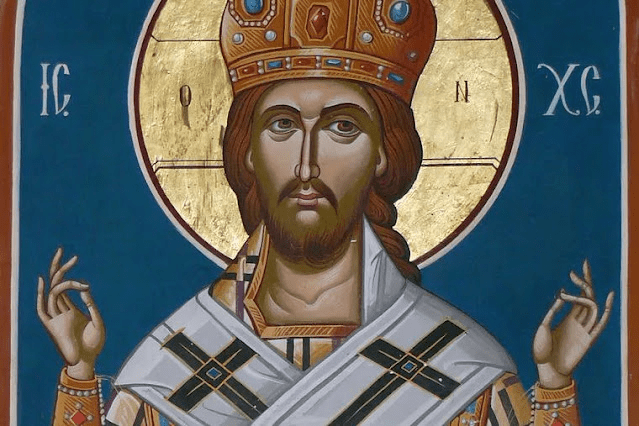
Orthodox icon of Jesus Christ, the High Priest of a New Covenant

In the ministry of Christ, there were people wondering if all of his talk was upending or replacing those detailed imperatives of God. Jesus responded:

“Do not think that I have come to abolish the Law or the Prophets; I have not come to abolish them but to fulfill them. For truly I tell you, until heaven and earth disappear, not the smallest letter, not the least stroke of a pen, will by any means disappear from the Law until everything is accomplished.” (Matthew 5:17-18, NIV)

Jesus furthermore upheld God’s expectation that divine commands be obeyed:

“Therefore anyone who sets aside one of the least of these commands and teaches others accordingly will be called least in the kingdom of heaven, but whoever practices and teaches these commands will be called great in the kingdom of heaven.” (Matthew 5:19, NIV)

At issue was the nature of righteousness – right relations with both God and others. Justice is imperative. Being humble, pure, merciful, and a peacemaker matters. The laws and directives of God are never to be used for walking around like a peacock to display what a wonderfully important and religious person you are.

In other words, the ornate garments of the high priest are not the person; they are special clothing used for a special purpose. Clothes may be important, yet it’s the heart that truly matters. And a heart devoted to God will seek to humbly obey God’s words down to the most minute detail.

O God, by whom the humble are guided, and light rises up in darkness for the godly: Grant us, in all our doubts and uncertainties about obedience, the grace to ask what you would have us to do, that the Spirit of wisdom may save us from all false choices, and that in your light we may see light, and in your straight path may not stumble; through Jesus Christ our Lord. Amen.