Matthew 5:6 – Blessed are Those Who Hunger and Thirst for Righteousness

Blessed are those who hunger and thirst for righteousness,
    for they will be filled. (New International Version)

Happy are people who are hungry and thirsty for righteousness because they will be fed until they are full. (Common English Bible)

Happy are those whose greatest desire is to do what God requires;
    God will satisfy them fully! (Good News Translation)

They are blessed who hunger and thirst after justice,
    for they will be satisfied. (New Century Version)

God blesses those who hunger and thirst for justice,
    for they will be satisfied. (New Living Translation)

The words “justice” and “righteousness” come from the same word (δικαιοσύνη). The English words are much like two sides to the same coin – one side primarily emphasizing an action, and the other side a relationship.

The word “justice” in Holy Scripture refers to much more than a punitive corrective action toward wrongdoing. That is only a secondary concern for justice. The primary idea is to provide necessities to people without prejudice or favoritism. This is why the Old Testament is filled with references to providing justice to groups of needy or oppressed people such as orphans, widows, foreigners, and the poor:

Do not deprive the foreigner or the fatherless of justice or take the cloak of the widow as a pledge. Remember that you were slaves in Egypt and the Lord your God redeemed you from there. That is why I command you to do this. (Deuteronomy 24:17-18, NIV)

Cursed is anyone who withholds justice from the foreigner, the fatherless or the widow. (Deuteronomy 27:19, NIV)

Good will come to those who are generous and lend freely, who conduct their affairs with justice. (Psalm 112:5, NIV)

I know that the Lord secures justice for the poor and upholds the cause of the needy. (Psalm 140:12, NIV)

Learn to do right; seek justice. Defend the oppressed. Take up the cause of the fatherless; plead the case of the widow. (Isaiah 1:17, NIV)

Woe to those who make unjust laws, to those who issue oppressive decrees, to deprive the poor of their rights and withhold justice from the oppressed of my people, making widows their prey and robbing the fatherless. (Isaiah 10:1-2, NIV)

God is greatly concerned for justice because the Lord is always just in all affairs.

The word “righteousness” primarily has to do with obtaining and maintaining right relationships with God and other people, with the result of doing right actions in the world. Holy Scripture is loaded with references to righteousness. In the Old Testament, justice and righteousness are often coupled together. That’s because justice is to be dispensed with personal relationship – and not detached in an impersonal way.

People do not merely need access to resources – they also require the gift of human connection in obtaining them.

The Lord loves righteousness and justice; the earth is full of his unfailing love. (Psalm 33:5, NIV)

The Lord works righteousness and justice for all the oppressed. (Psalm 103:6, NIV)

Let the one who boasts boast about this: that they have the understanding to know me, that I am the Lord, who exercises kindness, justice and righteousness on earth, for in these I delight,” declares the Lord. (Jeremiah 9:24, NIV)

I will betroth you to me forever; I will betroth you in righteousness and justice, in love and compassion. (Hosea 2:19, NIV)

God hungers and thirsts for righteousness, which is why believers share this same appetite. Being attentive to the entire spectrum of needs that people have – physical, mental, emotional, and spiritual – are what Jesus has in mind when characterizing true disciples.

God specializes in filling broken people and meeting their needs. The picture here is one of a starving person who needs food and drink, or he will die. The person who hungers does not merely view justice and righteousness as options, or something nice to have. Rather, they know that without God’s just action and right relationship, they will die!

People who strongly desire Jesus and his righteousness are easy to spot:

  • Those who are just and right crave and devour God’s Word, so they read and learn Holy Scripture.

Like newborn babies, crave pure spiritual milk, so that by it you may grow up in your salvation, now that you have tasted that the Lord is good. (1 Peter 2:2-3, NIV)

  • Those who are just and right are incessantly chattering about Jesus, so they pursue fellowship with believers and connections with unbelievers.

We are therefore Christ’s ambassadors, as though God were making his appeal through us. We implore you on Christ’s behalf: Be reconciled to God. God made him who had no sin to be sin for us, so that in him we might become the righteousness of God. (2 Corinthians 5:20-21, NIV)

  • Those who are just and right want to know Christ better, so they pray a lot.

The prayer of a righteous person is powerful and effective. (James 5:16b, NIV)

  • Those who are just and right desire right relations with others, so they make things right with others.

Godly sorrow brings repentance that leads to salvation and leaves no regret, but worldly sorrow brings death. See what this godly sorrow has produced in you: what earnestness, what eagerness to clear yourselves, what indignation, what alarm, what longing, what concern, what readiness to see justice done. (2 Corinthians 7:10-11, NIV)

Only those who know their poverty of spirit, personally grieve over sin, and are truly humble end up hungering and thirsting for righteousness. This is the recognition that without God, I will not make it. I can neither be justified nor righteous without Jesus.

Grant us, Lord God, a vision of your world as your love would have it: a world where the weak are protected, and none go hungry or poor; a world where the riches of creation are shared, and everyone can enjoy them; a world where different races and cultures live in harmony and mutual respect; a world where peace is built with justice, and justice is guided by love. Give us the inspiration and courage to build it, through Jesus Christ our Lord. Amen.

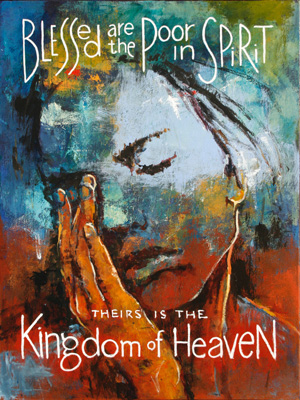
*Above painting by Hyatt Moore

Matthew 5:5 – Blessed Are the Meek

Blessed are the meek,
    for they will inherit the earth. (NIV)

To give us a flavor of Christ’s counter-cultural Beatitudes, when was the last time, or has anyone ever, described themselves to you as meek?

Whenever I have interviewed people for positions, both paid and voluntary, and asked them to tell me their strengths, I have never had anyone say to me, “I’m a meek person.”

Why would I want to be meek?

Far too often, we equate meek with weak. If someone is meek, we may wrongly reason they must be a washrag, or overly introverted, and maybe not taking proper initiative in life. Of all the character qualities we might aspire to, I doubt that meekness is on anyone’s top ten list of desired qualities.

Yet, of the few words in the Gospels which Jesus uses to describe himself, one of those words is meek. And even then, many English translations steer clear of the word. For example, the New International Version of the Bible says in translating the words of Jesus, “Come to me all you who are weary and burdened, and I will give you rest. Take my yoke upon you and learn from me, for I am gentle and humble in heart, and you will find rest for your souls. For my yoke is easy and my burden is light.” (Only the King James Version translates the word as “meek,” instead of “gentle.”)

What does it mean to be meek?

Meek and gentle are the same words. The original Greek word is πραεῖς (pronounced “prah-ace”). “Meek” is the word used in other ancient Greek literature for breaking a horse. It is to be changed from being a wild stallion who wants to go his own way, to a broken horse who is gentle before the Master and allows others on his back without bucking.

Consider, for example, the scene around Christ’s crucifixion. Jesus was naked, exposed, and vulnerable to the idle curiosity of the crowd and the vulgar frivolity of the soldiers who were having a party around his suffering. “If you are the king of the Jews,” they taunted, “save yourself.”

And yet the extraordinary thing is there was no spirit of revenge with our Lord. Jesus did not curse his tormentors. Instead, he prayed, “Father forgive them, for they don’t know what they’re doing.” (Luke 23:24)

It is important to notice the meekness that Jesus is speaking about in this Beatitude is not being a pushover. Meekness is not to be confused with being nice and easy-going. Meek and lowly as he was, Jesus could also take a whip to greedy money-changers in the Temple. We must not confuse meekness with weakness.

What characterizes a meek person?

Whereas poverty of spirit is more a humility before God, meekness is a humility toward other people. It is to be flat on our backs with only one way to look: up to God; and because we are in that position, there is no opportunity to look down on others. 

Meekness is a foundational Beatitude. Jesus considers it a necessary part of righteousness. I believe the word “meek” needs a renaissance. Even if we use the word “gentle” this will be a great advancement in how people interact with one another. So, what characterizes a meek person?

  • The meek have a desire to put other’s interests ahead of their own, because they know it is not all about them. They practice healthy rhythms of giving and receiving with others, without prejudice or favoritism.
  • The meek are more concerned with edifying and building up their brothers and sisters than justifying themselves. They don’t care who gets the credit. And they receive criticism well.
  • The meek are truly egalitarian and do all things with equity and inclusion. They make no distinctions between rich and poor, beautiful and ugly, intelligent and cognitive deficits, black and white, gay and straight, Democrat and Republican, or insider and outsider. In the meek person’s mind, every person is created in the image of God and therefore deserves respect, attention, and justice.

It is the meek who will inherit the earth – not aggressive people who believe in survival of the fittest, stepping on people to get where they want to go, or badgering others in order to get their way. 

Someone might protest, “But if I live this way, I’ll be pushed around.”  Meekness is not living without boundaries but is power under control. Maybe you will get stepped on – but you will inherit the earth.

How do I live as a meek person?

The three Beatitudes of being poor in spirit, mourning over sin, and meekness toward others are foundational to all that Jesus says and does. They are central to being Christ’s follower. Without them, there is only a contrived legalistic righteousness of our own without any real need of God. That is the way of pride, which is the straight and broad road to hell. 

Perhaps repentance is in order. It could be that too many people have made much more of themselves than what they truly are. Maybe we have adopted a soft attitude toward shame and shaming others, believing that some people need a bit of guilt from us to change their obnoxious ways. Perhaps we have paid scant attention to those who are in physical or spiritual poverty. And just maybe we have ignored and gossiped about others simply because we believe we are better than them.

A genuine follower of Christ lives a repentant lifestyle. The Apostle James said, “Confess your sins to one another, and pray for one another so that you may be healed” (James 5:16).  The way of Christ is the way of community. We are not to live ingenuine lives, hiding behind a mask of outward conformity. Now is the time for authenticity, living life as God intended it to be lived, as a disciple of Jesus in the way of spiritual poverty, mourning, and meekness – the narrow path that leads to salvation.

Non-retaliation happens when we realize our poverty of spirit and practice grief and lament. When we are flat on our backs before God, there is no place to look but up. And it means there is no ability to look down on others. It is to be broken and moldable before God. 

If you and I were part of the original crowd that listened to Jesus, there is hope. I have no ability to practice retaliation, even if I wanted to, because I have no earthly power. But that’s okay because, in this spirit of meekness, I take personal responsibility for my attitudes and my actions. I am neither worse nor better than any other person. I do not need to retaliate, even when egregiously wronged, because I can fully entrust myself to God alone who judges the living and the dead. 

Conclusion

It turns out that brokenness is the path to genuine righteousness. Jesus promised that the meek will inherit the earth. Christ didn’t just make that up. He was quoting Holy Scripture:

Do not fret because of those who are evil
    or be envious of those who do wrong;
for like the grass they will soon wither,
    like green plants they will soon die away.

Trust in the Lord and do good;
    dwell in the land and enjoy safe pasture.
Take delight in the Lord,
    and he will give you the desires of your heart.

Commit your way to the Lord;
    trust in him and he will do this:
He will make your righteous reward shine like the dawn,
    your vindication like the noonday sun.

Be still before the Lord
    and wait patiently for him;
do not fret when people succeed in their ways,
    when they carry out their wicked schemes.

Refrain from anger and turn from wrath;
    do not fret—it leads only to evil.
For those who are evil will be destroyed,
    but those who hope in the Lord will inherit the land.

A little while, and the wicked will be no more;
    though you look for them, they will not be found.
But the meek will inherit the land
    and enjoy peace and prosperity. (Psalm 37:1-11, NIV)

Jesus was saying that only the truly meek will learn contentment, joy, and satisfaction. Their ego is not so inflated that they insist they deserve more. Indeed, because as God’s people they are learning from him, the meek understand they are co-heirs with Christ in an inheritance of God’s kingdom.

May your meekness and gentleness be known to all.

*Above painting by Hyatt Moore

Matthew 5:4 – Blessed are Those Who Mourn

“Blessed are those who mourn,
    for they will be comforted.” (NIV)

Throughout most of human history, there have been groups of people, typically women, who occupy a special role within their respective societies. Sometimes paid professionally, and many times not, these folks had an important function – so important was this vocation that a unique skill set was needed to support an entire community of people.

What is that role, that function? To be a mourner.

In Scotland and Ireland, they were referred to as “keeners.” Keening is mourning, and keeners were employed to help others grieve and lament the death of a loved one. Through their emotional wailing, family members could feel as though someone was putting a voice to their grief. It was also considered a way to honor the dead and share their accomplishments. 

The keen is a bygone practice, along with many of the funeral practices of other cultures. With the advent of modern institutional funeral homes, beginning in the nineteenth century, there has been more and more distance to the raw feeling and emotion of death. Keening was a tradition which included songs of lament, at least one of them being composed specifically for the occasion.

For millennia, cultures have recognized and affirmed the need for and importance of wailing and crying and deep grief to have its say.

Jesus believed mourning to be significant enough to include it, right off the bat, in his Sermon on the Mount. Authentic disciples of Jesus Christ mourn.

Mourning, in the Beatitudes, is the emotional response to spiritual bankruptcy. To be a spiritual mourner is to weep and wail over sin… loudly! It is to see that sin in all its foulness and degradation is terrible and destroys relationships. Because of this, we experience personal grief over both the world’s sin and ours.

The Christian disciple, the true follower of Jesus, knows death is coming, and must be faced. God is coming and will be known by all as either Savior or Judge. Sin is present all around us, even in us, and it is unspeakably ugly and black in the light of God’s holiness. Eternity is real, and every living human being is rushing toward it.

The alternatives of eternity are inexorably coming – life or death, forgiveness or condemnation, heaven or hell. These are all realities which will not go away. The person who lives in the light of them, and rightly assesses self and the world, cannot help but mourn.

They mourn for the sins of their nation and neighborhood. They mourn over the erosion of the very concept of truth. The keener mourns over the greed, the cynicism, and the lack of integrity all around. Indeed, the Christian mourner mourns that there are so few keeners expressing the biblical mandate to mourn.

I wonder if sin causes us to weep, even to wail. I am curious if the presence of sin in the world and within ourselves keeps us awake at night, or not.

If individuals can only locate sin out there somewhere and are never close enough to see lost souls entrenched in sin, needing a Savior, then they must come back to the first Beatitude of knowing their spiritual poverty and wrestle with putting pride in its place and fully embracing a humble spirit.

Those who do not mourn have a hard heart because mourners are sensitive to sin.

“But I’m not really a person who cries.” Perhaps you ought to explore why that is so. It could be that a thick callous has developed over the heart. The telltale signs of this are being comfortable with watching violence and having no problem with uttering violent speech.

Many Christians pray for revival; it will not occur apart from the way of the spiritual beggar who mourns over the violence, oppression, bigotry, arrogance, and injustice of the world. 

If there is to be any transformation of heart, it will come through seeing myself for who I am and seeing the sins of this world for what they are.  Without this, there is no hungering and thirsting for righteousness, no mercy, no purity, and no peace in the world or the church. 

Jesus told a parable to illustrate true righteousness versus self-righteousness, saying:

“Two men went up to the temple to pray, one a Pharisee and the other a tax collector. The Pharisee stood by himself and prayed: ‘God, I thank you that I am not like other people—robbers, evildoers, adulterers—or even like this tax collector. I fast twice a week and give a tenth of all I get.’

“But the tax collector stood at a distance. He would not even look up to heaven, but beat his breast and said, ‘God, have mercy on me, a sinner.’

“I tell you that this man, rather than the other, went home justified before God. For all those who exalt themselves will be humbled, and those who humble themselves will be exalted.” (Luke 18:10-14, NIV)

Jesus says the mourner, the keener, will be comforted; she will find the remedy to alleviate guilt and shame in her own life through Jesus, as well as the answer to the ills of the world, in Christ.

We do not need lots of money, a high position, a particular gender, or even be a faithful practicing religious person to be a mourner. Anyone can be one. And this is the door by which we enter the kingdom of God.

Almighty and most merciful Father, we have sinned and strayed from your ways like lost sheep…. We have left undone those things which we ought to have done; and we have done those things which we ought not to have done…. We acknowledge with great sorrow our great and many sins which we, from time to time, have committed by thought, word and deed, against your divine majesty…. O Lord, have mercy upon us.

Spare all who confess their faults and truly repent; according to your promises declared in Christ Jesus our Lord. We are cut to the heart and are sorry for our wrongs; remembering them now grieves us…. Forgive all our past wrongdoing; be merciful to us now in the present; and extend your kindness to us in the future, through Jesus Christ, your Son, our Lord, who with you and the Holy Spirit are one God, now and forever. Amen.

*Above painting by Hyatt Moore

Matthew 5:3 – Blessed are the Poor in Spirit

The Beatitudes of Christ (Matthew 5:1-12) are not a knee-jerk, random collection of pithy phrases from Jesus on what constitutes approval from God.  They intentionally build upon each other.  If the Sermon is the cornerstone of Christ’s teaching, and the Beatitudes are the cornerstone of the Sermon, then poverty of spirit is the cornerstone of the Beatitudes.  This Beatitude is foundational to the Christian life. So, what does it mean to be “poor in spirit”? 

“Poor” comes from the word “beggar.” And why does any beggar beg? Because they are in need. Beggars are desperate and destitute, knowing they need help just to survive another day. A beggar begs because he cannot rely on reciprocity; he has absolutely nothing to give in return.

Jesus was saying to the crowd following him, that true followers have a realization of their spiritual bankruptcy and have no shame in begging God to act on their behalf. The truth is that we are all spiritually destitute before God and stand in stark need of divine resources to help us. 

In reality, we have nothing of worth to give or offer to God. And we can gain nothing apart from God. Therefore, we must realize who we are and take the position of humility, not pride, and look to God.

To understand our poverty of spirit is to see that we are stripped of all self-righteousness, and absolutely need God. Knowing and understanding our spiritual bankruptcy is to see sin for what it really is. So, how do you know when you are poor in spirit?

  • The spiritual beggar makes no deals with God because they have nothing to bargain with. There is no ground from which to leverage anything.
  • The spiritual beggar doesn’t complain because they realize they don’t deserve anything. Instead, there is praise to God for such incredible grace in providing their needs.
  • Spiritual beggars are always begging, that is, praying all the time. Beggars don’t pray because it is an effective strategy to further their agenda. They pray because, if they don’t, they won’t make it!
  • Spiritual beggars take Christ on his terms, not theirs. The beggar will do anything Jesus says because he knows his situation is desperate. He has an inner attitude of total dependence upon God. Without humility before God, the spiritual beggar discerns he is hopeless. There is no room for the pride that tries to posture and position to get what I want, because the spiritual beggar knows he has none of this.
  • Spiritual beggars realize the more you learn, the more you don’t know – that you are dependent on a holy God and Holy Scripture, and not your own ideas, thoughts, convictions, and opinions. So, you willingly take the posture of listening instead of always talking.
  • The spiritual beggar knows no enemies. The late Henri Nouwen said, “Poverty is the inner disposition that allows us to take away our defenses and convert our enemies into friends. We can only perceive the stranger as an enemy as long as we have something to defend.” Those who are poor in spirit are not anxiously clinging to their stuff, their money, or their good name. They have nothing of their own; it all belongs to God for divine purposes.

Only the poor in spirit will enter the kingdom of heaven. The way is narrow and only a few are willing to truly humble themselves before God and take the posture of a beggar. If we think we are above this, then we have gone the broad way of destruction that many will find.

Humility knows that God is God, and I am not. Therefore, we orient our lives around this reality. Just as we need to respect the law of gravity and submit to its presence and reality, so it is most necessary and important to accept God’s rule and reign in this world and submit to its constant force. This is simply the way of wisdom.

We do not presume to come to you, O merciful Lord, trusting in our own righteousness, but in your abundant and great mercies. We are not worthy so much as to gather up the crumbs under your table; but you are the same Lord whose character is always to have mercy. Grant us, therefore, gracious Lord, to be intimately close to your dear Son Jesus Christ, and to identify with him in his death so that our sinful bodies may be made clean by his body, and our souls washed through his most precious blood. May we forever dwell in Christ, and he in us.  Amen.

*Above painting by Hyatt Moore