The Fruit of the Spirit

The fruit of the Spirit is love, joy, peace, patience, kindness, goodness, faithfulness, gentleness, and self-control. (Galatians 5:22-23, CEB)

It takes little effort to have a bad attitude; to slip a bit of gossip into the day; or to go along with the crowd in a divisive conversation. However, it takes a good deal of humility, energy, and commitment in order to live into the fruit of the Spirit.

On the one hand, the believer in Jesus Christ has been graciously given such fruit; we possess it by means of the Spirit. On the other hand, it feels as if we still need this fruit to be given to us, because our daily experience of it is such a struggle.

For me, experiencing the fruit of the Spirit is a bit like buying something from Ikea; I have it, but it needs to be put together. And I’m not so good at making sense of the directions and actually getting the thing in working condition.

Yes, there will be some frustration tapping into our spiritual reservoir and accessing the fruit provided for us. Yet, it’s totally worth it. In fact, the nine elements of spiritual fruit mentioned in the New Testament book of Galatians are experiences people really want to have – whether they are Christian, or not.

One of the reasons folks may become overwhelmed with the Spirit’s fruit is that they look at those nine words as nine different “fruits.” However, the grammar of the text is clearly not plural but singular. In other words, the “fruit” of the Spirit is one packaged piece.

It may be tempting to relieve ourselves of any responsibility or accountability with this fruit by saying, “I’m good at being kind and good, but I really have problems with patience and self-control.”

But the text doesn’t allow for such thinking. To not possess any one of the nine words is to not have the entire nine. The Holy Spirit of God is not divided; when the Spirit gives, it’s the whole kit-and-caboodle.

After all, the believer in Jesus seeks to be a person of integrity and wholeness, being aligned fully in all aspects of life around the person and work of Christ. Any fragmentation belies the reality that one, no matter how apparently peaceful or gentle, is attempting to manifest spiritual fruit on one’s own power.

There is a big difference  between trying to control the process of Christian sanctification (becoming holy) and exercising self-control. And there is an even wider chasm between accessing and using the accepted spiritual fruit, and trying to go on a self-improvement project that is disconnected from God’s given grace.

In truth, believers already have everything they need for life and godliness in this present evil age (2 Peter 1:3). The seed has been firmly planted within the soul. We possess the fruit. Yet, that fruit must grow and mature before it is ripe enough to eat. There is still the work of cultivating and nurturing to do, so that we might flower and flourish.

We only need the essential conditions to grow. Any seed – no matter what kind – will grow and produce a harvest if it has the proper amounts of sun, rain, and good soil. Then, we never need to wonder what will happen; the seed will grow.

As spiritual farmers, we need to be daily working in the field our soul, keeping the weeds and the critters out, so that there is no obstacle or impediment to the growth and maturity of our precious fruit.

If we need to build a fence, we build it. If we must buy or borrow a hoe, we do it. Whatever needs to happen to guard what we possess, we are committed to doing it.

None of us ever produces a seed. Not even in this modern age of genetically modified seeds can we do this. The scientist only manipulates what is already there; he cannot create a seed ex nihilo.

So, we have this tremendous spiritual fruit, graciously given to us by means of God’s Spirit. Perhaps the million dollar question is:

How do I access this grace? How can I realize the fruit of love, joy, peace, patience, kindness, goodness, faithfulness, gentleness, and self-control in my life?

We have no further to look than to the very words of the Lord Jesus himself:

Very truly I tell you, unless a kernel of wheat falls to the ground and dies, it remains only a single seed. But if it dies, it produces many seeds. Anyone who loves their life will lose it, while anyone who hates their life in this world will keep it for eternal life. Whoever serves me must follow me; and where I am, my servant also will be. (John 12:24-26, NIV)

We must die to ourselves. There is no other way. Christ demonstrated the way by dying and being placed in the earth. Only then could he rise from death. And only then could his disciples have their faith come to fruition, spreading gospel seed throughout the world.

For one cannot have a resurrection unless there is first a crucifixion. There must be suffering before glory.

That, my friend, is the cost of discipleship. It’s the cost of realizing the spiritual fruit that you and I long for in our lives. This is the struggle we must go through to experience the life that is truly life.

Heavenly Father, in you I live and move and have my being. I humbly pray You so to guide and govern me by your Holy Spirit, that in all cares and occupations of my life I may not forget You, but remember I am ever walking in Your sight, exhibiting Your fruit; through Jesus Christ my Lord. Amen.

Some Relational Wisdom (Proverbs 25:1-28)

Here are some more
    of Solomon’s proverbs.
They were copied by the officials
    of King Hezekiah of Judah.
God is praised
    for being mysterious;
rulers are praised
    for explaining mysteries.
Who can fully understand
    the thoughts of a ruler?
They reach beyond the sky
    and go deep in the earth.

Silver must be purified
before it can be used
    to make something of value.
Evil people must be removed
before anyone can rule
    with justice.

Don’t try to seem important
    in the court of a ruler.
It’s better for the ruler
    to give you a high position
than for you to be embarrassed
    in front of royal officials.
Be sure you are right
    before you sue someone,
or you might lose your case
    and be embarrassed.

When you and someone else
can’t get along,
    don’t gossip about it.
Others will find out,
and your reputation
    will then be ruined.

The right word
    at the right time
is like precious gold
    set in silver.
Listening to good advice
is worth much more
    than jewelry made of gold.
A messenger you can trust
is just as refreshing
    as cool water in summer.
Broken promises
are worse than rain clouds
    that don’t bring rain.
Patience and gentle talk
can convince a ruler
    and overcome any problem.

Eating too much honey
    can make you sick.
Don’t visit friends too often,
or they will get tired of it
    and start hating you.
Telling lies about friends
    is like attacking them
with clubs and swords
    and sharp arrows.
A friend you can’t trust
    in times of trouble
is like having a toothache
    or a sore foot.
Singing to someone
    in deep sorrow
is like pouring vinegar
    in an open cut.

If your enemies are hungry,
    give them something to eat.
And if they are thirsty,
give them something
    to drink.
This will be the same
as piling burning coals
    on their heads.
And the Lord
    will reward you.
As surely as rain blows in
    from the north,
anger is caused
    by cruel words.
It’s better to stay outside
    on the roof of your house
than to live inside
    with a nagging wife.

Good news from far away
refreshes like cold water
    when you are thirsty.
When a good person gives in
    to the wicked,
it’s like dumping garbage
    in a stream of clear water.
Don’t eat too much honey
    or always want praise.
Losing self-control
leaves you as helpless
    as a city without a wall. (Contemporary English Version)

The wise sayings in this chapter of the Book of Proverbs have to do with relational topics such as: relating to a leader; relating to others; and relating to oneself (self-control).

Relating To a Leader

When it comes to relating to any sort of leader above us, it is best to avoid arrogance and embrace humility.

Whether we realize it, or not, or like it, or not, leaders have a perspective that others don’t. They see the big picture of what is happening, and ideally, make wise decisions based upon all the factors and people involved.

This means that we are not always, maybe not even usually, going to understand what a leader or ruler is doing. This is why it is so important for leaders themselves to consult and collaborate with others, and choose wisely.

Humility isn’t only for followers, it is just as much, perhaps even more, necessary for the leader. Making decisions in a vacuum, or just trusting in one’s own counsel, usually doesn’t work out well. Everyone has character flaws, yet a leader’s flaws, weaknesses, and sins can stick out rather easily to others.

That doesn’t mean, however, that anyone has a right to believe they themselves can do a better job, or know more about how to lead, or have all the information. Because they don’t.

The ways of God are mysterious because it is a very big picture that only the Lord sees. And there are a lot of moving parts and people to all of God’s choices and movements in this world.

The important part, for us, is to recognize the goodness and wisdom of God, and to trust that the Lord – as the God of Love – always does what is right, just, and good, even though it may not always seem that way.

Relating To Others

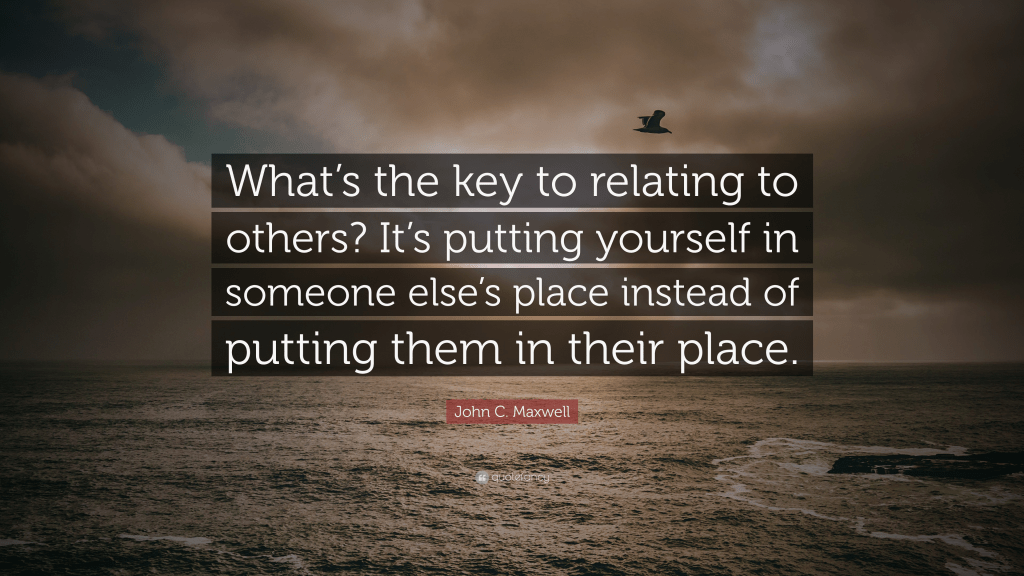
When it comes to how we generally relate to our fellow humanity, we are to show some empathy and deference. The ability to put yourself in another’s shoes is quite important and necessary, in order to relate well to others.

In failing to do this, and only thinking of oneself, we end up overstaying a welcome from someone who was thinking of us; or not paying attention that my morning blessing feels more like a curse to the night owl; or sharing some juicy tidbit of information that isn’t ours to share, so that others listen and pay attention to me.

Today, in this day and age, many persons fail to think of others when they are driving. Far too many people drive as if they own the road, and as if the traffic laws don’t apply to them. If they think of another driver at all, it’s only to curse them for hindering their ability to get to where they want to go.

Relating to Self

In contrast to all of that, we ourselves are to practice self-control and choose to live differently. Instead of cursing, we bless; and rather than selfishness, we practice selflessness.

If we would but all learn to exercise kindness over revenge, our world would be a very different place than it is today. And if we would but choose to speak the truth in love, rather than tell lies in hate or indifference, then there would be a lot less harm and hurt in this old fallen world.

By practicing self-control, we stop the cycle of hate, injustice, and unkindness. But if we choose the path of escalating verbal and/or physical violence, then this only leaves us vulnerable to harm. And it may open a way of having those you care about be harmed, as well.

I myself am the only person I’m in control of. And so I choose to:

  • be honest, trustworthy, and let God provide the judgment and justice needed for others
  • consider others, and think before talking
  • listen to wise counsel, and not entertain the manipulative words of the foolish
  • walk the patient path of wisdom

O God, grant me the wisdom I need in all my relationships. Help me recognize when things may be unsafe. I pray your protection over me and my family when we feel vulnerable. Thank you for having the power to heal broken relationships. Amen.

Who Is In Control? (Psalm 47)

Ascension, by Angela Taylor Perry

Clap your hands, all you peoples;
    shout to God with loud songs of joy.
For the Lord, the Most High, is awesome,
    a great king over all the earth.
He subdued peoples under us
    and nations under our feet.
He chose our heritage for us,
    the pride of Jacob whom he loves.

God has gone up with a shout,
    the Lord with the sound of a trumpet.
Sing praises to God, sing praises;
    sing praises to our King, sing praises.
For God is the king of all the earth;
    sing praises with a psalm.

God is king over the nations;
    God sits on his holy throne.
The princes of the peoples gather
    as the people of the God of Abraham.
For the shields of the earth belong to God;
    he is highly exalted. (New Revised Standard Version)

Who is in control? This is really a big question. We humans seem almost obsessed with the issue of control.

Some people want to be in charge of regulating everything. Others want to exert force over nothing at all. And there are those who continually want to know the clear lines of authority and who is in control, at all times.

Control, in and of itself, is not a bad thing. In fact, it’s a good thing. Taking charge of a situation – and especially of oneself – is often needed. Leadership that is informed, decisive, humble, true, and right, is a must.

The problem comes whenever we try to exert domination over another person, or attempt to command an organization when it isn’t our responsibility to do so.

Ultimate control of all things belongs to God, and not to you or me. The psalmist is insistent that God is the Ruler of the universe; and that all things belong to the Lord. God’s commands are good.

The Lord’s dominion is known as the kingdom of God. Whenever people are in sync with this reality, then they are able to be joyful and celebrate the good, right, and just Being who is in control.

Yet, if people have problems trusting another; desire to always call the shots on everything; and command everyone; there you will find a host of miserable people – with the one trying to exert control as the most miserable of all.

People, instead, are called to self-control. We are to have charge over our own thoughts and actions. It’s important to have sobriety in our lives in which we can use proper restraint, as well as needed initiative.

Be alert and be of sober mind. Your enemy the devil prowls around like a roaring lion looking for someone to devour. (1 Peter 5:8, NIV)

In order to get our lines of authority in the proper places, and to participate in the established rhythms of control in the universe, we are commanded to clap, shout, and sing. Because God has ultimate control, divine initiatives are grounded in goodness, justice, righteousness, and deliverance from evil. The Lord has mercifully acted on behalf of people.

The Lord only asks of us to do things that he himself has done. The psalm states that “God has gone up with a shout.” We shout because God shouts. God rules over the nations, and was not simply some local deity that the ancient Israelites served and worshiped. The divine presence is with those who acknowledge God; they will hear the Lord’s shout.

“No misfortune is seen in Jacob,
    no misery observed in Israel.
The Lord their God is with them;
    the shout of the King is among them.
God brought them out of Egypt;
    they have the strength of a wild ox.” (Numbers 23:20-22, NIV)

We are also told to sing. The reason we do so is because the Lord is high above all people, and is king over the nations. This is something we need to say out loud and to sing, and to not only read silently in our heads. Our ears need to listen to the psalm, to hear the praises of God reverberating on our ear drums.

My people, hear my teaching;
    listen to the words of my mouth. (Psalm 78:1, NIV)

It is perfectly appropriate for Christians to use today’s psalm in reflection upon Ascension Day. Jesus has been lifted up into the sky; God has gone up with a shout. The Lord has equipped us for citizenship in the kingdom of God. We have solid grounds for celebration, shouting, and singing. Jesus is our King.

God put this power to work in Christ when he raised him from the dead and seated him at his right hand in the heavenly places, far above all rule and authority and power and dominion and above every name that is named, not only in this age but also in the age to come. And he has put all things under his feet and has made him the head over all things for the church. (Ephesians 1:20-22, NRSV)

Because of Christ’s ascension, believers in Jesus have the memory of the past, the experience of the present, and a hope for the future. With Jesus in control, there is no need for fear, or for trying to gain control for oneself.

Grant, we pray, Almighty God, that as we believe your only-begotten Son our Lord Jesus Christ to have ascended into heaven, so we may also in heart and mind there ascend, and with him continually dwell; who lives and reigns with you and the Holy Spirit, one God, for ever and ever. Amen.

Wednesday of Holy Week (John 13:21-32)

The Lord’s Supper, by Rubem Zevallos Técnica

After saying this Jesus was troubled in spirit and declared, “Very truly, I tell you, one of you will betray me.” The disciples looked at one another, uncertain of whom he was speaking. One of his disciples—the one whom Jesus loved—was reclining close to his heart; Simon Peter therefore motioned to him to ask Jesus of whom he was speaking. So while reclining next to Jesus, he asked him, “Lord, who is it?” 

Jesus answered, “It is the one to whom I give this piece of bread when I have dipped it in the dish.” So when he had dipped the piece of bread, he gave it to Judas son of Simon Iscariot. After he received the piece of bread, Satan entered into him. Jesus said to him, “Do quickly what you are going to do.” 

Now no one knew why he said this to him. Some thought that, because Judas had the common purse, Jesus was telling him, “Buy what we need for the festival,” or that he should give something to the poor. So, after receiving the piece of bread, he immediately went out. And it was night.

When he had gone out, Jesus said, “Now the Son of Man has been glorified, and God has been glorified in him. If God has been glorified in him, God will also glorify him in himself and will glorify him at once. (New Revised Standard Version)

In some Christian traditions, Wednesday of Holy Week is known as “Spy Wednesday.” It’s a reference to Judas Iscariot, and recalls his betrayal of Jesus to the religious authorities. Historically, the association of Wednesday with this betrayal of Jesus led to Wednesdays being observed as fast days in the church, a tradition still observed by some. 

Jesus was gathered with his disciples for the meal we know as the “Last Supper.” Jesus had just taken a towel and a bowl of water and washed the feet of those gathered with him. Peter, predictably, protested to Christ doing such a thing. Yet, Jesus told Peter that if there’s no foot washing, there’s no Christ. 

The Lord Jesus then went on to say that not all the disciples are clean. Christ knew he was about to be betrayed. Since Judas was there with the other disciples, that meant Jesus knelt to wash his feet, as well. Hence, the heightened reason why Jesus was so troubled in the moment.

The clueless men didn’t know what or who in the world Jesus was talking about. Nobody around the table suspected Judas as a betrayer. That’s how much Judas was a part of the group. He was trusted enough to be the purse holder who handled the common money account.

It appears that only Jesus and Judas know what’s going on when Judas is handed the piece of bread; then Jesus told him to do quickly what he must do. Sadly and unfortunately, Judas made his own free and deliberate choice, without any coercion – except perhaps with some satanic nudging.

The Last Supper, by Unknown artist, c.1400 C.E.

To betray the Son of God seems unthinkable. What could ever motivate a person to sell out Jesus? What reasoning is there behind such a foul decision? Why would anyone choose to be a turncoat toward an innocent man?

Although we may be interested in answers to such questions, and even though I myself have my own thoughts about the matter, the Apostle John gives us no motive for the decision of Judas. He simply did what he did, with no other comment than that.

With Judas out of the room, Jesus began speaking of glory – of the glorious relationship between the Father and the Son, and the divine love which comes tumbling out on Christ’s followers. And the divine choice is for love.

We also have a choice. We can choose to be self-aware, to be attentive to our emotions, to recognize the consequences of behaviors and choices, to avoid unhealthy and harmful patterns of living. These choices help us to have love tumble out of us when it’s needed.

Faith can, and ought, to play a leading role in life. It is when folks refuse to listen to their conscience and ignore their gut feelings, that questionable decision-making of the head and heart can take over.

There’s a lot that’s out of our control. Yet, we always have the choice of self-control concerning our words and actions. Things like kindness, empathy, and love are within our ability to choose. And we are always free to live into our spiritual identity as loved by Jesus and belonging to God.

It’s hard, though. Making such choices in the face of such betrayal. Christ was troubled in his spirit, not because of his upcoming humiliation and torture, but because he knew that one in his inner circle would betray him.

A mosaic of The Last Supper, in Monreale Cathedral, Palermo, Sicily, Italy

If you have ever had someone very close turn on you, then you well understand why this troubled Jesus and wounded him more than a physical cross. It is terribly disheartening to know that someone is not who they seem.

Remember, Jesus chose Judas as a disciple. And Judas chose to follow Jesus. As such, Judas was privy to all of Christ’s private explanations of parables and events. Judas was entrusted with the money; he knew everything on the event itinerary.

In other words, Judas was trusted to be a faithful follower. But instead, he sold out Jesus. It really must have been weird for Judas when Jesus brought up the matter before everyone – that he was going to be betrayed by one of them.

An outright naming of the scoundrel, however, was not the purpose of Christ’s raising the issue. This was no mystery game to be played around the table. A simple sharing of bread and wine was the only tip Jesus gave as to who it was. John caught on to what was happening, at least later, if not at the time.

The symbolism happening was packed with meaning. Bread, wine, and sharing them together symbolized the blood about to be spilled; a body about to be broken. And, ironically, Judas is the one who set it in motion. He did his part in making the blood flow and breaking the body.

There is, however, for the Christian, even more going on than that. These very symbols have become for us reminders of radical grace and forgiveness. The elements become the means of gathering together to remember and partake of that original event.

So, when Judas left to enact his betrayal, Jesus spoke not of the bad apple in the bushel, but of God’s glory. For it is soon to be revealed. And none of it will really be about Judas. It is now about demonstrating the purpose of God, the heart of Jesus, and the power of the Spirit.

Creator of the universe, you made the world in beauty, and restore all things in glory through the victory of Jesus Christ. We pray that, wherever your image is still disfigured by selfishness, greed, and betrayal, the new creation in Jesus Christ may appear in justice, love, and peace, to the glory of your name. Amen.