What Are You Searching For? (1 Samuel 9:15-27)

Now the day before Saul came, the Lord had revealed to Samuel: “Tomorrow about this time I will send to you a man from the land of Benjamin, and you shall anoint him to be ruler over my people Israel. He shall save my people from the hand of the Philistines, for I have seen the suffering of my people, because their outcry has come to me.” 

When Samuel saw Saul, the Lord told him, “Here is the man of whom I spoke to you. He it is who shall rule over my people.” Then Saul approached Samuel inside the gate and said, “Tell me, please, where is the house of the seer?” 

Samuel answered Saul, “I am the seer; go up before me to the shrine, for today you shall eat with me, and in the morning I will let you go and will tell you all that is on your mind. As for your donkeys that were lost three days ago, give no further thought to them, for they have been found. And on whom is all Israel’s desire fixed, if not on you and on all your ancestral house?” 

Saul answered, “I am only a Benjaminite, from the least of the tribes of Israel, and my family is the humblest of all the families of the tribe of Benjamin. Why then have you spoken to me in this way?”

Then Samuel took Saul and the young man and brought them into the hall and gave them a place at the head of those who had been invited, of whom there were about thirty. And Samuel said to the cook, “Bring the portion I gave you, the one I asked you to put aside.” The cook took up the upper thigh and set it before Saul. Samuel said, “See, what was reserved is set before you. Eat, for it was kept for you for this appointed time, so that you might eat with the guests.”

So Saul ate with Samuel that day. When they came down from the shrine into the town, a bed was spread for Saul on the roof, and he lay down to sleep. Then at the break of dawn Samuel called to Saul upon the roof, “Get up, so that I may send you on your way.” Saul got up, and both he and Samuel went out into the street.

As they were going down to the outskirts of the town, Samuel said to Saul, “Tell the young man to go on before us, and when he has passed on, stop here yourself for a while, that I may make known to you the word of God.” (New Revised Standard Version)

There are many times in our lives when we are on a quest for something that is lost. Saul was on a mission to find some lost donkeys. But, all along, there was a much larger quest taking place; God was on a quest to find a leader for Israel. Saul was wandering and looking for donkeys; he tried to find the “seer” (Samuel) in order to find the animals. He found, however, that he himself was the object of a bigger search.

I wonder how often we look and seek and turn over every rock in order to find something, only to discover that we had the thing all along. And if we were to look a bit deeper into ourselves, I believe we would find that we already have what we need.

We search for an answer, seek for a person who can lead us where we want to be, or go on a quest to find the something, or that someone, which will satisfy our longing for peace, normalcy, or at least, a smidge of relief. Yet, we just might be on the wrong search.

If spiritual guidance is what we want, then what, precisely, do we need? What exactly is it which requires help? We may end up looking like a jack ass, simply because we are searching for one.

In contrast to Saul’s blind searching, Samuel sits patiently and waits, knowing exactly who he’s watching for.

Even though Samuel, as the mouthpiece of God, had warned the people against asking for king, the people still demanded one. Yet, God was flexible and moved with the will of the people. And Samuel trusted the Lord and moved with God. None of this, however, negated the situation of the people’s misguided stubbornness.

The Lord takes our human decision-making, responsibility, and accountability seriously. So, we too, are to weigh our decisions carefully so that they are consistent with good purposes. And when things go sideways, we are to own up to our decisions and actions (or inactions).

Throughout the story, even though Saul looks impressive, he is continually clueless to everything going on. He isn’t aware that the donkeys have been found. He doesn’t know where to look for the seer, and that the seer is Samuel. He isn’t aware of why he is being invited to a feast. Saul was clueless that he was being chosen for a task.

To be unaware is to be driven by the forces within us which we do not recognize. Yet, conversely, to be aware is to have the conscious power of choices; we can choose one path over another because we have awareness of where those paths lead, as well as what is going on inside of us. In other words, we can make decisions wisely with awareness of self, others, and the world.

Saul had none of this awareness. And as his story unfolds throughout the rest of the book of 1 Samuel, we can observe how much he seems out of control and disconnected from himself, others, and the situations around him.

One of things which inevitably results from a lack of self-awareness, is impatience. The life of Saul, as we shall see, is marked by having ants-in-his-pants; he had a hard time waiting. The introduction we have of Saul in today’s story begins to clue us in on the fact that he actively searches for dumb animals, intimating that he himself may not be the brightest bulb in Israel.

Samuel, however, is self-aware, and thus, patient. He is able to wait, and does not give into any anxiety to do differently. Samuel’s quest for humility, wisdom, and knowledge of God helped him become aware and confident.

Which character do you most relate to, Samuel, or Saul? Why? In what ways might you gain a greater awareness of yourself, others in your life, and your circumstances? How might you develop a better awareness of the divine?

Most of all, what is it that you are truly searching for?

Blessed God, help me to see myself and my life through your unconditional love and acceptance of me so that your love and power can flow in and through me. Help me to remember that nothing can separate me from your love. Amen.

Wednesday of Holy Week (John 13:21-32)

The Lord’s Supper, by Rubem Zevallos Técnica

After saying this Jesus was troubled in spirit and declared, “Very truly, I tell you, one of you will betray me.” The disciples looked at one another, uncertain of whom he was speaking. One of his disciples—the one whom Jesus loved—was reclining close to his heart; Simon Peter therefore motioned to him to ask Jesus of whom he was speaking. So while reclining next to Jesus, he asked him, “Lord, who is it?” 

Jesus answered, “It is the one to whom I give this piece of bread when I have dipped it in the dish.” So when he had dipped the piece of bread, he gave it to Judas son of Simon Iscariot. After he received the piece of bread, Satan entered into him. Jesus said to him, “Do quickly what you are going to do.” 

Now no one knew why he said this to him. Some thought that, because Judas had the common purse, Jesus was telling him, “Buy what we need for the festival,” or that he should give something to the poor. So, after receiving the piece of bread, he immediately went out. And it was night.

When he had gone out, Jesus said, “Now the Son of Man has been glorified, and God has been glorified in him. If God has been glorified in him, God will also glorify him in himself and will glorify him at once. (New Revised Standard Version)

In some Christian traditions, Wednesday of Holy Week is known as “Spy Wednesday.” It’s a reference to Judas Iscariot, and recalls his betrayal of Jesus to the religious authorities. Historically, the association of Wednesday with this betrayal of Jesus led to Wednesdays being observed as fast days in the church, a tradition still observed by some. 

Jesus was gathered with his disciples for the meal we know as the “Last Supper.” Jesus had just taken a towel and a bowl of water and washed the feet of those gathered with him. Peter, predictably, protested to Christ doing such a thing. Yet, Jesus told Peter that if there’s no foot washing, there’s no Christ. 

The Lord Jesus then went on to say that not all the disciples are clean. Christ knew he was about to be betrayed. Since Judas was there with the other disciples, that meant Jesus knelt to wash his feet, as well. Hence, the heightened reason why Jesus was so troubled in the moment.

The clueless men didn’t know what or who in the world Jesus was talking about. Nobody around the table suspected Judas as a betrayer. That’s how much Judas was a part of the group. He was trusted enough to be the purse holder who handled the common money account.

It appears that only Jesus and Judas know what’s going on when Judas is handed the piece of bread; then Jesus told him to do quickly what he must do. Sadly and unfortunately, Judas made his own free and deliberate choice, without any coercion – except perhaps with some satanic nudging.

The Last Supper, by Unknown artist, c.1400 C.E.

To betray the Son of God seems unthinkable. What could ever motivate a person to sell out Jesus? What reasoning is there behind such a foul decision? Why would anyone choose to be a turncoat toward an innocent man?

Although we may be interested in answers to such questions, and even though I myself have my own thoughts about the matter, the Apostle John gives us no motive for the decision of Judas. He simply did what he did, with no other comment than that.

With Judas out of the room, Jesus began speaking of glory – of the glorious relationship between the Father and the Son, and the divine love which comes tumbling out on Christ’s followers. And the divine choice is for love.

We also have a choice. We can choose to be self-aware, to be attentive to our emotions, to recognize the consequences of behaviors and choices, to avoid unhealthy and harmful patterns of living. These choices help us to have love tumble out of us when it’s needed.

Faith can, and ought, to play a leading role in life. It is when folks refuse to listen to their conscience and ignore their gut feelings, that questionable decision-making of the head and heart can take over.

There’s a lot that’s out of our control. Yet, we always have the choice of self-control concerning our words and actions. Things like kindness, empathy, and love are within our ability to choose. And we are always free to live into our spiritual identity as loved by Jesus and belonging to God.

It’s hard, though. Making such choices in the face of such betrayal. Christ was troubled in his spirit, not because of his upcoming humiliation and torture, but because he knew that one in his inner circle would betray him.

A mosaic of The Last Supper, in Monreale Cathedral, Palermo, Sicily, Italy

If you have ever had someone very close turn on you, then you well understand why this troubled Jesus and wounded him more than a physical cross. It is terribly disheartening to know that someone is not who they seem.

Remember, Jesus chose Judas as a disciple. And Judas chose to follow Jesus. As such, Judas was privy to all of Christ’s private explanations of parables and events. Judas was entrusted with the money; he knew everything on the event itinerary.

In other words, Judas was trusted to be a faithful follower. But instead, he sold out Jesus. It really must have been weird for Judas when Jesus brought up the matter before everyone – that he was going to be betrayed by one of them.

An outright naming of the scoundrel, however, was not the purpose of Christ’s raising the issue. This was no mystery game to be played around the table. A simple sharing of bread and wine was the only tip Jesus gave as to who it was. John caught on to what was happening, at least later, if not at the time.

The symbolism happening was packed with meaning. Bread, wine, and sharing them together symbolized the blood about to be spilled; a body about to be broken. And, ironically, Judas is the one who set it in motion. He did his part in making the blood flow and breaking the body.

There is, however, for the Christian, even more going on than that. These very symbols have become for us reminders of radical grace and forgiveness. The elements become the means of gathering together to remember and partake of that original event.

So, when Judas left to enact his betrayal, Jesus spoke not of the bad apple in the bushel, but of God’s glory. For it is soon to be revealed. And none of it will really be about Judas. It is now about demonstrating the purpose of God, the heart of Jesus, and the power of the Spirit.

Creator of the universe, you made the world in beauty, and restore all things in glory through the victory of Jesus Christ. We pray that, wherever your image is still disfigured by selfishness, greed, and betrayal, the new creation in Jesus Christ may appear in justice, love, and peace, to the glory of your name. Amen.

Accept Your Shadow Side (Acts 7:30-40)

“Forty years later, in the desert near Mount Sinai, an angel appeared to Moses in the flame of a burning bush. When Moses saw it, he was amazed at the sight. As he went to take a closer look, the voice of the Lord called out to him, ‘I am the God of your ancestors—the God of Abraham, Isaac, and Jacob.’ Moses shook with terror and did not dare to look.

“Then the Lord said to him, ‘Take off your sandals, for you are standing on holy ground. I have certainly seen the oppression of my people in Egypt. I have heard their groans and have come down to rescue them. Now go, for I am sending you back to Egypt.’

“So God sent back the same man his people had previously rejected when they demanded, ‘Who made you a ruler and judge over us?’ Through the angel who appeared to him in the burning bush, God sent Moses to be their ruler and savior. And by means of many wonders and miraculous signs, he led them out of Egypt, through the Red Sea, and through the wilderness for forty years.

“Moses himself told the people of Israel, ‘God will raise up for you a Prophet like me from among your own people.’Moses was with our ancestors, the assembly of God’s people in the wilderness, when the angel spoke to him at Mount Sinai. And there Moses received life-giving words to pass on to us.

“But our ancestors refused to listen to Moses. They rejected him and wanted to return to Egypt. They told Aaron, ‘Make us some gods who can lead us, for we don’t know what has become of this Moses, who brought us out of Egypt.’ (New Living Translation)

We humans are a confusing paradox of sinner and saint. We are majestic people, created in the image and likeness of a good God. We are also profoundly fallen, touched by sin in every area of our lives. Our hearts exist with both light and darkness, having the capacity for both incredible altruism as well as inexplicable evil.

So then, it will do no good to retreat into binary definitions of people as being either good or bad. No, we shine and shadow at the same time. What really gets us into a terrible mess is when we ignore or deny our shadow selves. We then demonize the other while claiming purity for ourselves.

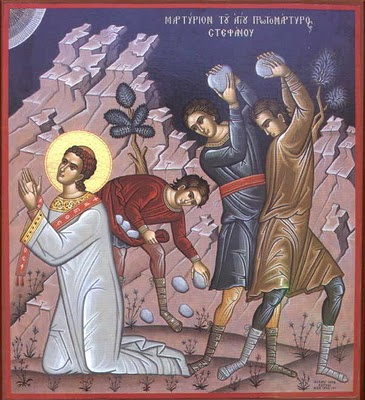
This is precisely what occurred when Stephen stood and spoke to a group of his fellow Jews. They stubbornly refused to acknowledge their shadow side. And it resulted in Stephen’s stoning and death. Whereas Stephen lifted and brought to light the unseemly aspects of their collective heritage, the people wanted nothing to do with it.

The Martyrdom of Stephen

In our present day, responses that do not want to acknowledge the shadow side include statements such as, “Quit being so negative. We focus on the positive. Expel this recalcitrant troublemaker once and for all!”

Oy. Acceptance cuts two ways. We must accept both our blessings and our curses. The acceptance of reality will not occur apart from a solid self-acceptance of who we are and how we are feeling in any given situation. On the practical level, it works something like the following story…

Several years ago, I went on a leadership retreat in the Canadian wilderness. We were so far out in the sticks that we needed special first aid training before leaving because if someone got severely injured it would be hours before any medical attention could be received. There was no cell phone service, no towns, no anything except mile after square mile of wilderness. 

One day, I was canoeing with a group of leaders, far out into the Canadian wilderness where there were no towns or people anywhere near us. It was very windy on this day in late May – which meant the water was still ice cold in Canada. One of the canoes capsized. We had to act quickly and deliberately – which was no small feat in a stiff wind. More than fifteen minutes would result in hypothermia for the two people in the water.

I did not like being in that situation. In fact, I didn’t much like the Canadian wilderness. Too many black flies and giant mosquitoes for me. My shadow side was coming out. But here I was, and I had to accept the reality I was in. One of the lessons I learned in that moment was that acceptance can sit alongside other reactions and emotions.

For example, a person can be outraged by an injustice, as Stephen was, and accept that it is a reality. Acceptance does not mean complacency or giving up. We can accept something while at the same time trying to make it better.

I also needed to accept what was happening inside of me. I was cold and worried. Trying to push those feelings away would have only added to the stress of the situation. If I failed to accept what was true about myself, I would be less able to deal with the situation, and so, would compromise my ability to help two people at risk.

I needed to accept the entire circumstance, including myself. Accepting what is inside gave me more influence over the situation, not less. Self-acceptance became the key to acceptance of unwanted conditions, and more importantly, acceptance of one another as human beings.

In that moment of rescuing two people (which ultimately proved successful) I became aware of a part of myself – the part that gets afraid and irritated – and chose not to stuff it or deny its existence.

I became the guy who talked to the panicked people in the water and kept them as calm as possible so that the others could get them out. I was able to do my part to help fearful people because I acknowledged and accepted my own fear.

Unlike my situation, however, Stephen’s experience ended in martyrdom. Just because we respond rightly, is no guarantee that everything will work out for our benefit. Rather, we say and do the things we must say and do, while leaving the results to a sovereign Lord.

It is our responsibility to work on ourselves, not others. And acceptance is the path to get there, all of it – including the shadow side – and not just part of it.

Jesus, let your mighty calmness lift me above my fears and frustrations. By your deep patience, give me tranquility and stillness of soul in you. Make me in this, and in all things, more and more like you. Amen.

Dealing with a Clash of Belief (Acts 3:17-4:4)

“And now, friends, I know you had no idea what you were doing when you killed Jesus, and neither did your leaders. But God, who through the preaching of all the prophets had said all along that his Messiah would be killed, knew exactly what you were doing and used it to fulfill his plans.

“Now it’s time to change your ways! Turn to face God so he can wipe away your sins, pour out showers of blessing to refresh you, and send you the Messiah he prepared for you, namely, Jesus. For the time being he must remain out of sight in heaven until everything is restored to order again just the way God, through the preaching of his holy prophets of old, said it would be. Moses, for instance, said, ‘Your God will raise up for you a prophet just like me from your family. Listen to every word he speaks to you. Every last living soul who refuses to listen to that prophet will be wiped out from the people.’

“All the prophets from Samuel on down said the same thing, said most emphatically that these days would come. These prophets, along with the covenant God made with your ancestors, are your family tree. God’s covenant-word to Abraham provides the text: ‘By your offspring all the families of the earth will be blessed.’ But you are first in line: God, having raised up his Son, sent him to bless you as you turn, one by one, from your evil ways.”

While Peter and John were addressing the people, the priests, the chief of the Temple police, and some Sadducees came up, indignant that these upstart apostles were instructing the people and proclaiming that the resurrection from the dead had taken place in Jesus. They arrested them and threw them in jail until morning, for by now it was late in the evening. But many of those who listened had already believed the Message—in round numbers about five thousand! (The Message)

I believe a lack of self-awareness is at the middle of a great many sins in this world. A lot of folks just simply do not realize how they come across to others; what impact their words and actions have upon others; and their illogical and nonsensical forms of thinking.

It’s frustrating and maddening for those who can see the blind spots in another’s life. And, keep in mind, it’s the same for others concerning some area of thought or dogmatic belief we may hold to, as well.

Recently, I had one of those surreal conversations. I had made a statement, quoting a verse from one of the New Testament Gospels about what Jesus said. Later in the day, a person who heard me say it, approached me and emphatically stated, “Jesus never said that.”

Even though I went directly to the verse and read it, the person then stated, “But that’s not from the King James or New King James Version.” So, I went to the New King James and read it. “You have to go to the King James because that’s the most reliable.” And then, after reading it there, the person dogmatically stated, “Well, that was added by a scribe. Jesus didn’t really say that.”

Even after all this, and pointing the person toward the field of textual criticism and how languages get translated, they still refused to consider the evidence right in front of their face. Yes, indeed, it is maddening! (Note: The person went so far as to begin attacking my biblical hermeneutic and my faith, because well, if you cannot accept the evidence, then you must go the ad hominem route of discrediting the person. *Sigh*)

People generally do not like their beliefs challenged nor upended. And some persons will do just about anything to maintain those beliefs – including verbal attacks against someone’s very personhood.

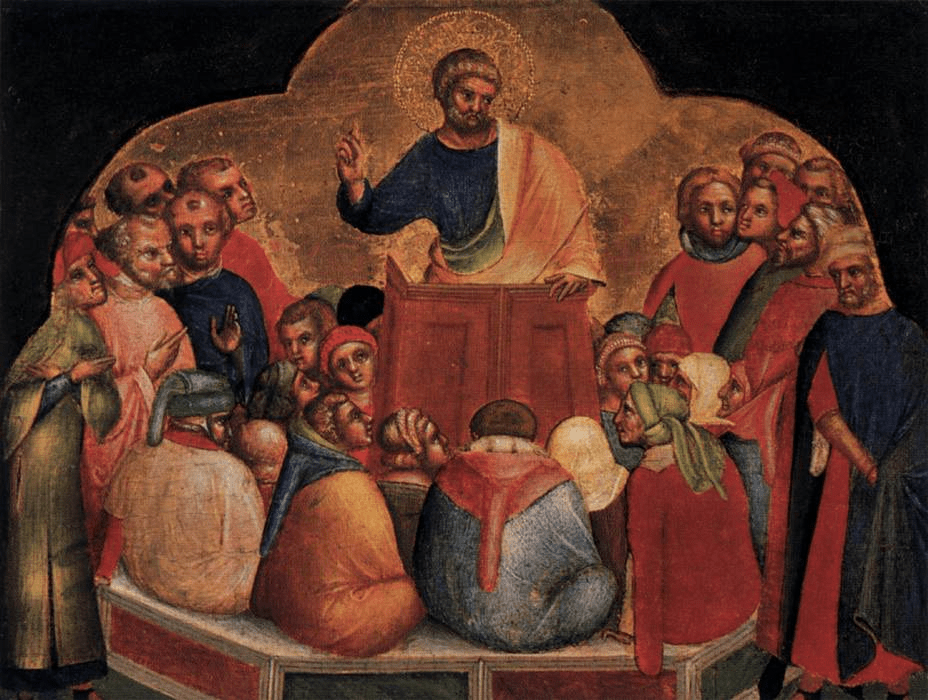
Apostle Peter preaching, by Lorenzo Veneziano, c.1370

And that is exactly what happened with the Apostles Peter and John. Their proclamation of Christ and his resurrection struck a nerve with the Jewish Sadducees who were the keepers of proper worship and liturgy amongst the temple. The Apostles’ teaching was so scandalous and threatening to their own beliefs, that they used their authority to throw Peter and John in jail – just for proclaiming a message the Sadducees didn’t like.

It never feels good getting toasted by those who claim insight and knowledge but are, in reality, a bunch of ignorant simpletons who don’t want to change and will hold onto their sense of power and superiority at all costs.

Yet, the consolation to all of this, is that there are others who are open-minded enough to listen well and adjust their belief systems to match the truthful evidence given to them. And so, despite the efforts of the Sadducees to suppress apostolic preaching, the fledgling group of Christ followers were being added by the thousands.

It turns out that nobody can resist the Holy Spirit of God, no matter how much earthly pull and power they possess.

Today’s New Testament lesson reminds us and teaches us that:

  • Self-awareness of why we hold to our particular beliefs, matters. We ought to hold our dogmatism very loosely.
  • Proclamation of the gospel, that is, the good news of Christ’s crucifixion and resurrection, makes a difference in lot of people’s lives.
  • Opposition is to be expected. There are some who view the good news of grace as the bad news of judgment against themselves; they will oppose it by any means possible.
  • Humility will always serve us well in the spiritual life, whereas condescending arrogance will never help anybody. For God’s sake, please have enough humility to listen and learn, even if (and especially) you don’t like what you’re hearing – no matter which end of the discussion you are on.

If we want the world to be different, then the change begins with you and me. Christians have the opportunity, if they will take up the mantle, of being the most calm, humble, and attentive people in the room. In this time of the year, no other stance and skill can be more important amongst family, friends, and others during the holidays.

O Lord, you have told us what is good, and what you require of us: To do what is right, to love mercy, and to walk humbly. Help us walk together in love and compassion towards the cross, humbly with you and one another. Let your Holy Spirit guide us on the right path to truth and reconciliation with humility; and enable us to hear each other, for we do not want to walk by pride or self-sufficiency, through Jesus Christ our Lord. Amen.