The Beauty of Love (Song of Songs 1:1-17)

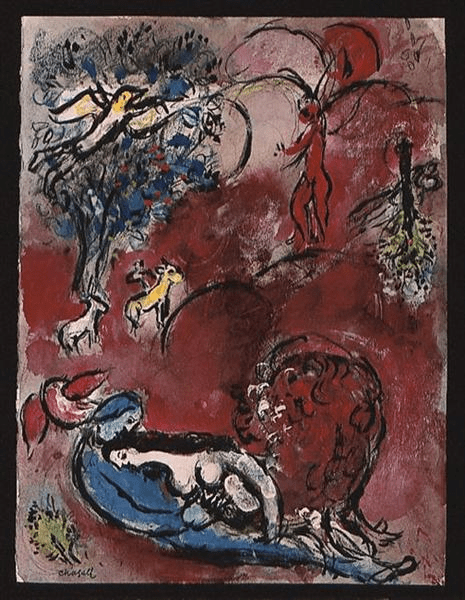
Song of Songs I, by Marc Chagall, 1960

The Song of Songs, which is for Solomon.

[Woman]

If only he would give me some of his kisses . . .

Oh, your loving is sweeter than wine!
Your fragrance is sweet;
        your very name is perfume.
        That’s why the young women love you.
Take me along with you; let’s run!

My king has brought me into his chambers, saying,
“Let’s exult and rejoice in you.
Let’s savor your loving more than wine.
        No wonder they all love you!”

Dark am I, and lovely, daughters of Jerusalem—
        like the black tents of the Kedar nomads,
        like the curtains of Solomon’s palace.
Don’t stare at me because I’m darkened
        by the sun’s gaze.
My own brothers were angry with me.
        They made me a caretaker of the vineyards—
        but I couldn’t care for my own vineyard.

Tell me, you whom I love with all my heart—
        where do you pasture your flock,
        where do you rest them at noon?—
            so I don’t wander around with the flocks of your companions.

[Man]

If you don’t know your way,
    most beautiful of women,
        then follow the tracks of the herds
            and graze your little goats
            by the tents of the shepherds.

I picture you, my dearest,
        as a mare among Pharaoh’s chariots!
Lovely are your cheeks, adorned with ear hoops;
        your neck, with beads.
Let’s make hoops of gold beaded with silver for you!

[Woman]

With my king close by,
        my perfume filled the air.
A sachet of myrrh is my love to me,
        lying all night between my breasts.
A cluster of henna flowers is my love to me
        in the desert gardens of En-gedi.

[Man]

Look at you—so beautiful, my dearest!
        Look at you—so beautiful! Your eyes are doves!

[Woman]

Look at you—so beautiful, my love!
        Yes, delightful! Yes, our bed is lush and green!
The ceilings of our chambers are cedars;
        our rafters, cypresses. (Common English Bible)

The Song of Songs is an unabashedly sensuous biblical book. It is, throughout its contents, an erotic paean to love. In eight chapters, a man and a woman pursue each other through verdant fields and lush valleys. The excitement they have, being together, is palpable.

For most of church history, the Song of Songs has been viewed as an allegory, a love poem between Christ and the Church. And in the case of Hebrew Scripture, the covenant love which exists between God and Israel, has been the predominant interpretive lens.

Seen from this perspective, the Song of Songs reflects that we ought to love the Lord with overpowering commitment, as if we were love-sick for our Beloved. Our thoughts are constantly on the object of our love – how we can please our beloved one.

And yet, there still seems to be room to read the Song in the very down-to-earth realness of physical love between two lovers. Since we are embodied people, such love ought to be celebrated, and is anything but base or to be refused. Sex is a gift from the Creator, and encouraged by God.

I think that the Song of Songs is not an either/or; it is a both/and; it’s both literal and allegorical. That’s not a weird thing. On the allegorical level, the Song is a beautiful poem describing the Divine Eros for God’s people, and the faithful’s heartfelt love for the God whose very name is Love.

Concerning a literal view, the Song celebrates the sanctity of human love, seeing within it the symbol of God’s love for us. Our very real bodies are themselves sacred, just as much as our souls.

Yet, however one chooses to look at the Song of Songs, it remains a statement of mutual admiration, of committed love and affection. It is indeed a poetic lifting of love above all else.

Indeed, if love isn’t the answer, we are not asking the right question.

Believe it or not, the Song of Songs was once viewed as an important key, capable of unlocking the entirety of Holy Scripture.

In fact, C.H. Spurgeon, the Prince of Preachers, in the nineteenth century, preached 59 sermons from this book; in Victorian England, no less. Spurgeon discerned the Song as central to the whole of the Bible. Reflecting on Song of Songs 1:7, he said:

“These words express the desire of the believer after Christ, and his longing for present communion with Him…. Tell me where Thou feeds, for wherever Thou stands as the Shepherd, there will I lie down as a sheep; for none but Thyself can supply my need. I cannot be satisfied to be apart from Thee. My soul hungers and thirsts for the refreshment of Thy presence….

“Satan tells me I am unworthy; but I always was unworthy, and yet Thou hast long loved me; and wherefore my unworthiness cannot be a bar to my having fellowship with Thee now. It is true I am weak in faith, and prone to fall, but my very feebleness is the reason why I should always be where Thou feeds Thy flock, that I may be strengthened, and preserved in safety beside the still waters.

“Why should I turn aside? There is no reason why I should, but there are a thousand reasons why I should not, for Jesus beckons me to come. If He withdraw Himself a little, it is but to make me prize His presence more. Now that I am grieved and distressed at being away from Him, He will lead me yet again to that sheltered nook where the lambs of His fold are sheltered from the burning sun.” Charles Haddon Spurgeon

The Song, in history past, once functioned as a beautiful path to deep intimacy with God. Methinks it behooves us to recover this.

The two lovers in the Song see beauty everywhere. They see it in each other, in the fields where the sheep are pastured, in the orchards where love is consummated, in the seasons, in the animals, trees, and hills. Beauty is all around them, and it is they themselves.

All things which God has created are lovely. Nothing is too small or too insignificant when the eyes of love look upon them. Beauty is designed to be noticed, celebrated, and praised. Love is meant to be expressed out loud, with flavor.

Each time love is stated, every exhalation of adoration, and all of the instances when beauty is acknowledged and affirmed, the ones who speak bind themselves more deeply to God and God’s big world. Together, they call all of it good.

Today’s Old Testament lesson is a wondrous reminder that beauty and love will have its way. Regardless of class, race, family, or societal norms, lovers will continue to seek and find one another and claim their relationship.

While the daughters may stare, and the brothers may be angry, the lovers will yet affirm the beauty of their love. And they will find contentment with each other.

You and I are no accident on this earth; we were created by a loving Creator who has an eye for beauty. And no matter how separated we may get from our divine source, God will seek us out; and if we seek the Lord, he will be found.

O God, you have prepared for those who love you such good things as surpass our understanding: Pour into our hearts such love towards you, so that we, loving you in all things and above all things, may obtain your promises, which exceed all that we can desire. Amen.

The Wounded Healer (Psalm 18:1-6, 43-50)

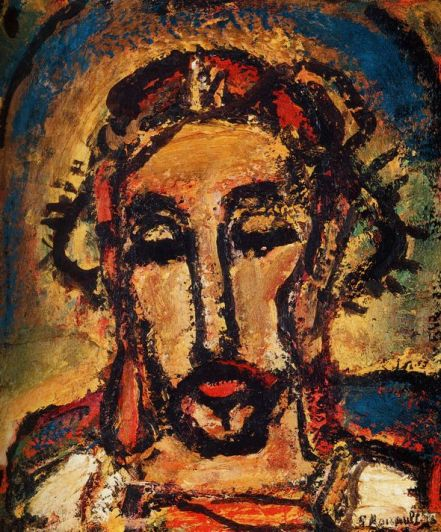
By French painter Georges Rouault (1871-1958)

I love you, Lord;
    you are my strength.
The Lord is my rock, my fortress, and my savior;
    my God is my rock, in whom I find protection.
He is my shield, the power that saves me,
    and my place of safety.
I called on the Lord, who is worthy of praise,
    and he saved me from my enemies.

The ropes of death entangled me;
    floods of destruction swept over me.
The grave wrapped its ropes around me;
    death laid a trap in my path.
But in my distress I cried out to the Lord;
    yes, I prayed to my God for help.
He heard me from his sanctuary;
    my cry to him reached his ears…

You gave me victory over my accusers.
    You appointed me ruler over nations;
    people I don’t even know now serve me.
As soon as they hear of me, they submit;
    foreign nations cringe before me.
They all lose their courage
    and come trembling from their strongholds.

The Lord lives! Praise to my Rock!
    May the God of my salvation be exalted!
He is the God who pays back those who harm me;
    he subdues the nations under me
    and rescues me from my enemies.
You hold me safe beyond the reach of my enemies;
    you save me from violent opponents.
For this, O Lord, I will praise you among the nations;
    I will sing praises to your name.
You give great victories to your king;
    you show unfailing love to your anointed,
    to David and all his descendants forever. (New Living Translation)

King David, the psalmist, had no problem with publicly expressing his great feeling of love for God. His desire was to be thoroughly devoted to the Lord; and he confidently discerned God as the source of his strength.

What’s more, David freely recognized God as the One who brought him deliverance. David cried out in distress. In his despair and desperation, he looked to the Lord, and God responded.

This is in contrast to those who complain about God and consider the Lord as distant and uncaring – if existing at all. David’s experience was that of being heard by God. And he wanted everyone to know, so that the faithful may be encouraged.

David didn’t want people becoming discouraged because of the bitterness of others who accuse God of being unconcerned.

The psalmist was not just talking about some mundane request, like asking for parking spot close to the building. David was in a life-and-death situation, stressful beyond imagination. Things were not looking good for him.

It seemed that the insolent, who think God isn’t watching, believed they could act unjustly and do whatever they wanted. Sadly, their lust for power and control blinds them to the larger reality of an invisible God who sees, and who responds at just the right time.

David wanted people to remember and not to forget about the saving actions of God. Because by keeping in mind who God truly is, then we can have confident trust, and will live in a way that is right, just, and good.

“Our service will not be perceived as authentic unless it comes from a heart wounded by the suffering about which we speak.”

Henri Nouwen

A good, right, and just life is always the appropriate response to divine mercy and deliverance. We are saved from evil, so that we might live in the spiritual freedom of purity and peace. And David gave God some due praise, adoration, and thanksgiving for rescuing him from his enemies.

Since David went through all of the adversity, hardship, stress, and suffering of dealing with unjust people, he was in a position to be a wounded healer for us.

A wounded healer is not someone who endorses a victim mentality. Rather, this is a person who has been profoundly hurt – physically, mentally, emotionally, or spiritually – and comes through the experience with an ability to be present with others and help facilitate healing in those who suffer.

Surely he took up our pain
    and bore our suffering,
yet we considered him punished by God,
    stricken by him, and afflicted.
But he was pierced for our transgressions,
    he was crushed for our iniquities;
the punishment that brought us peace was on him,
    and by his wounds we are healed. (Isaiah 53:4-5, NIV)

We all suffer and face various hard circumstances. And we are all changed by the hurtful encounters. But we don’t all respond the same way to that adversity. The difficult experiences of pain lead us to become either bitter or better.

If we have a wounded healer in our life, there is a good chance that we will be able to move through the hardship and come to a place of gratitude for what the Lord has done for us and how God brought us deliverance.

“As followers of Jesus we can also allow our wounds to bring healing to others.”

Henri Nouwen

Deliverance may not end up looking like anything we anticipate. If we are stuck on particular outcomes and have a singular expectation, then we may very well miss the Rescuer when the ship of salvation shows up.

Yet, if we can remain open to and aware of God – as well as of what’s going on inside us – then we shall likely experience healing for our deep wounds of pain. And we will embrace the scars it leaves as a reminder of the Lord’s deliverance.

It could be that things don’t change, at least like we want. In such times, perhaps the greatest healing that can take place is to be healed from the need for healing.

The Lord shows unfailing commitment and steadfast love to the faithful, to those who seek God. We shall find the divine in all circumstances, that is, if we seek God with all our heart.

“You will seek me and find me when you seek me with all your heart.” (Jeremiah 29:13, NIV)

Pain cannot be taken away unless we enter into it. So, it only makes sense to me, that we have a guide like the psalmist to lead us, and a Savior like Jesus to rescue us.

“Wholeness is not achieved by cutting off a portion of one’s being, but by integration of the contraries.”

Carl Jung

May you be patient in suffering, as Christ was in his earthly pain.

May the Lord be near you in your time of weakness and wondering.

May God sustain you by divine grace, and grant you courage not to have a failure of faith.

May you know healing of both body and soul.

And may you always believe that what happens to you in this present life is of little account if you hold Christ in eternal life. Amen.

Seeking God in Hard Times (Psalm 9:9-20)

By Bible Art

The Lord is a safe place for the oppressed—
    a safe place in difficult times.
Those who know your name trust you
    because you have not abandoned
    any who seek you, Lord.

Sing praises to the Lord, who lives in Zion!
    Proclaim his mighty acts among all people!
Because the one who avenges bloodshed
    remembers those who suffer;
    the Lord hasn’t forgotten their cries for help.

Have mercy on me, Lord!
    Just look how I suffer
    because of those who hate me.
But you are the one who brings me back
    from the very gates of death
        so I can declare all your praises,
        so I can rejoice in your salvation
        in the gates of Daughter Zion.

The nations have fallen
    into the hole they themselves made!
    Their feet are caught
        in the very net they themselves hid!
The Lord is famous for the justice he has done;
    it’s his own doing that the wicked are trapped.

Let the wicked go straight to the grave,
    the same for every nation that forgets God.

Because the poor won’t be forgotten forever,
    the hope of those who suffer won’t be lost for all time.

Get up, Lord! Don’t let people prevail!
    Let the nations be judged before you.
Strike them with fear, Lord.
    Let the nations know they are only human. (Common English Bible)

I firmly believe that there is hopeful comfort in the Lord – that when people go through awful things, God is there to be a safe place for them.

I also believe that, in the end, good triumphs and evil perishes. That’s because I am convinced that the Lord is an equitable judge; God hears the cries of defenseless righteous victims and acts on behalf of the oppressed without prejudice or favoritism.

Yet, that does not mean God’s people will always be inoculated from trouble, hardship, and adversity. What it does mean is that the Lord is with us, and that God loves us.

Everyone goes through difficult times. Some folks endure horrible trauma. And those experiences can dog us and torment us, even long after the event. Even in good times, we might sometimes become anxious or frantic without any real threat in front of us.

We may want to praise God with genuineness and sincerity. However, we might not yet feel vindicated or released. And there still may be some unjust suffering going on. We long to declare the goodness of God, but we also want to do so with a testimony of deliverance and healing.

That is precisely how the psalmist felt. He knows the wicked won’t endure, but he also wants to give praise to the Lord for seeing them sink in the sinister pit they’ve dug for others.

God is a righteous judge. And there are times when the Lord brings judgment upon evil by letting the wicked self-destruct with their own words and behavior. In other words, God at times engages in direct judgment, and other times lets the moral gravity of the earth crush them in their duplicitous crimes.

Whenever circumstances are hard, it’s easy to feel forgotten, as if no one sees or hears our suffering; they don’t realize the depth of our hurt by a wicked person. It’s appropriate, as the psalmist did, to cry out and plead with God to rise up on behalf of the weak and powerless; and to call for an end of the mindless and godless insanity of arrogant people.

It is equally hard to observe others we care about experience oppression. We cry out to the Lord on their behalf, that they will no longer have to endure such injustice. We want our loved ones to thrive and enjoy life and thrive – not to be crushed under an unjust burden from selfish people who only care about themselves.

We boldly ask God to knock them off the evil hill they’ve built for themselves – to blot them out because of their continual oppression of the righteous. The wicked think no one can touch them atop their proud strong perch. They believe they’re above accountability and can get away with anything. That makes us angry!

Whenever we are wronged or treated unfairly – or observe another person or group of people experiencing injustice – it stirs up our anger.

Anger, in and of itself, is neither good nor bad. It just is. It’s what we do with our anger that gets dicey. A lot of human anger gets expressed in unhealthy ways by either passively stuffing it and ignoring it; aggressively lashing out with verbal and/or physical violence; or passive-aggressively doing indirect jabs at the object of our anger.

The psalmist, however, is assertive with his anger. He offered straightforward observations with definite feelings to God. He also affirmed that the Lord is the One who administers justice with fairness and equity.

There are times when only God can bring an evil system, institution, organization, government, nation, group of people, or individual to heel.

When the poor are overlooked or oppressed by the rich, it’s unjust. It creates anger, both human and divine. In their misery and hardship, the needy can flee to God, who is faithful to care for them and treat them with respect and dignity, as people carrying the divine image.

The nations of the earth are not all attentive to the needy. They don’t all serve their citizens and try to do right by them. Unfortunately, many people throughout the world groan under national leadership which is enamored with power and privilege – and forget those who are powerless, unable to lift themselves by their bootstraps.

In the teeth of such a reality, the psalmist petitioned God. He asked, even insisted, that God step in and act as judge and jury. It was an assertive use of anger that went to the source of true help, to the Lord, who possesses both the will and the ability to overturn injustice and establish a right use of power.

Do you know what I want? I want justice—oceans of it. I want fairness—rivers of it. That’s what I want. That’s all I want.

Amos 5:24, MSG

The Lord, thankfully, is a strong fortress for the oppressed and a protective force in times of trouble.

God remembers the prayers of the down-and-out.

Sooner, or later, those who are wicked in their dealings through exploitation of the powerless, will know firsthand that they are puny humans, and that God is immensely big.

God almighty, you have given all peoples one common origin. It is your will they be gathered together as one family in yourself. Fill the hearts of humanity with the fire of your love and with the desire to ensure justice for all.

By sharing the good you give us, may we ensure equity for all our brothers and sisters throughout the world. May there be an end to division, strife and war. May there be a dawning of a truly human society built on love and peace, through Jesus Christ, our Lord. Amen.

The Message of Palm Sunday (John 12:12-16)

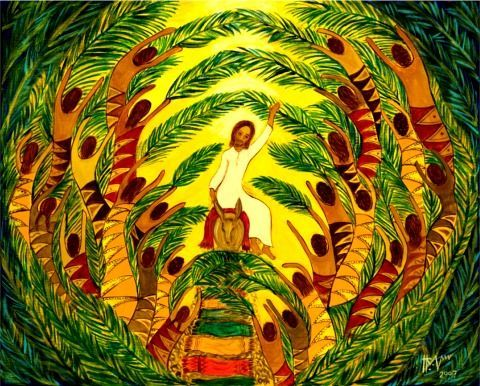
Christ enters Jerusalem, by Hanna-Cheriyan Varghese

The next day the great crowd that had come to the festival heard that Jesus was coming to Jerusalem. So they took branches of palm trees and went out to meet him, shouting,

“Hosanna!
Blessed is the one who comes in the name of the Lord—
    the King of Israel!”

Jesus found a young donkey and sat on it, as it is written:

“Do not be afraid, daughter of Zion.
Look, your king is coming,
    sitting on a donkey’s colt!”

His disciples did not understand these things at first, but when Jesus was glorified, then they remembered that these things had been written of him and had been done to him. (New Revised Standard Version)

Here are two questions to keep in mind as we consider Palm Sunday, the day we remember Jesus coming into Jerusalem during the Feast of Passover (Holy Week): 

  1. Is Jesus really enough for me, just the way he is? 
  2. Or, do I think he ought to be different than he is?

Many of the people who gathered to give Jesus praise at the beginning of the week, shouted to the Roman authorities to have him crucified at the end of the week. So, what changed? Why the big turn around? 

The change in attitude came because Jesus did not fit the crowd’s expectations of who the Messiah is, and what he should do. Jesus, just as he is, was not enough for them. They did not accept him for who he was. 

Let’s be aware and in touch with our own expectations for God, and for what we believe Jesus ought to be and to do. Because missed expectations create either hurt, anger, or both. 

How we view Jesus determines how we view the Christian life and the Christian Church. If we see Jesus like an earthly king or politician, and emphasize his war chest, while downplaying his meekness, we will then have a triumphalist view of Christianity. We’ll be disappointed when there is no practical victory taking place. 

The crowd wanted assurances that in Christ’s first 40 days in office, he would put the big hurt on the Roman authorities. The people had expectations of strong leadership, making things happen now, and accomplishing big hairy audacious goals of upending the establishment. 

But if we view Jesus as the Gentle King and the Humble Sovereign – viewing him as lowly royalty – giving due emphasis to both his authority and his humility, then we will likely worship Jesus as he truly is, and not as we want him to be. 

Most of the crowd was following Jesus with misguided expectations

Jesus did some incredible miracles, especially the one where he raised Lazarus from the dead. Over a million people came to Jerusalem every year during the week of Passover, and word had spread about a man who just might be the hope of Israel. They heard about his power and authority, and wanted to check him out.

And this is a good thing, not a bad thing. It’s important that people investigate Jesus and see for themselves who he is and what he’s all about. 

Just because there are people who do not respond immediately to Jesus, doesn’t mean they won’t in the future. After all, even the disciples who were closest to Jesus did not fully understand who he was or what he was doing. Only later, after the resurrection and ascension, did they put it all together and “get it.” So, cut others (and yourself) some slack.

Let’s give a lot of latitude to people who seek Jesus. They need the good news of forgiveness and new life in Christ. They don’t need immediate pressure to follow Jesus, or given a set of moral rules to follow, right now, as if clean living brings salvation from sin, death, and hell. 

People need room to investigate Jesus, and plenty of helpful guides along the way to point them in the right direction. So, let’s encourage honest questions and real conversations about Jesus.

However, some of the crowd checking out Jesus already had their minds made up about who they thought he should be. They had no room for a suffering servant and a humble savior, seeing only the sins of others, and not their own faults. 

Those with closed minds believed Jesus should be a political liberator from the Gentile Romans. The crowd was understandably weary of being dominated by non-Jews. But what many wanted was some serious payback and a new establishment with Messiah in charge.

This would be like, in our own day, getting completely jazzed-up about a particular presidential candidate who did some incredible things on the campaign trail and is now entering Washington D.C. to a ticker-tape parade and lots of flag-waving. 

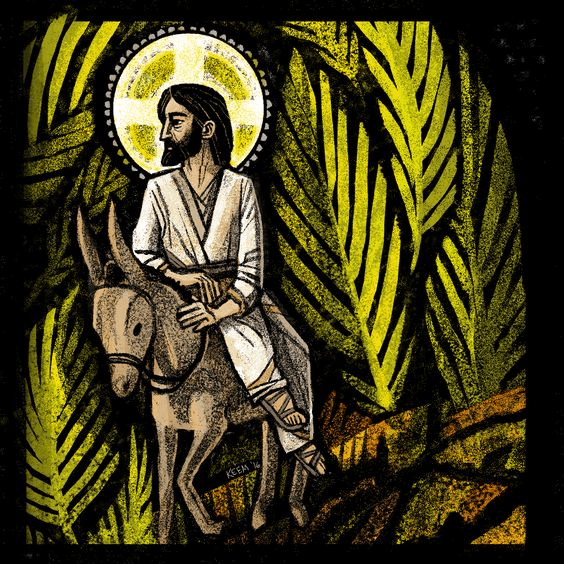
Art by Kris Miller

Palm branches were the national symbol for Israel, like our flag displays. There was no question about what the crowd of people wanted: A strong leader-king who was going to change the establishment and inaugurate a new administration of peace and prosperity that put the Romans in their place and give prominence to the Jews, like King David of old.

But Jesus made it evident he was not going to submit to what the crowd wanted. Christ had a different idea about what needed to take place.

Jesus did not ride into Jerusalem on a war horse, but on a donkey

An enthused crowd. People anticipating Jesus… and then he shows up! “What in the heck is he riding on…?  Is that a donkey!?” It was an anti-climactic moment.

Jesus purposely chose a donkey to ride into Jerusalem – serving notice to everyone that he was not going to capitulate to the crowd’s agenda for him and become the political savior they were looking for. The establishment was not going to be overturned.

Christ was giving balance to the people about who he was. Yes, he actually is a king, and the sovereign Lord of all – but a gentle King, a humble Sovereign, a meek Messiah. Those adjectives were not in most people’s vocabulary for a king. But Jesus is a king on his terms, not anybody else’s.

Because Jesus is a gentle king, we need not be afraid

Sometimes, what we think we need, and what we actually need, are two different things. Jesus uses his royal authority and power to help, not hurt. Although he might not meet all the expectations of the crowd, that doesn’t mean he will avoid giving them what they really need. 

The crowd was too hung up on their hardships and expecting deliverance from a human government. But what they received was something better: salvation from the dark powers of sin, death, and hell. 

Jesus will certainly come and right every wrong, but he will do it in God’s timing, not ours. 

In the meantime, when evil seems to be winning the day, we can be assured that God’s judgment will deal with each and every sin committed against God’s people. Jesus is attentive to his followers; his grace and power combine to give us what we truly need.

Conclusion

Ironically, Jesus ended up not being enough for his own people; they wanted something different than what they got. Here is the timeless point today’s story emphasizes:

We must adjust to who Jesus is, and not the other way around. 

In truth, Jesus came to take on the establishment – just not the Roman one. Jesus came to overturn the ruling establishment of Satan and his wicked spirits; to upend the principalities and powers of this dark world.

Jesus came to take back the people of this earth for God, and he would not do it through a political revolution, but by a spiritual one. Jesus would seize power by becoming a sacrifice for sin, making it possible for people to live a new life without the world, the flesh, and the devil dogging them at every turn.

Jesus is the rightful Ruler of both the church and the world. And he rules in humility, meekness, gentleness, and love. Jesus calls his followers to serve him by living in that same way. Just a few days after the entrance into Jerusalem with palm branches waving, Jesus told his disciples exactly what he wanted from them: 

“Now that I, your Lord and Teacher, have washed your feet, you also should wash one another’s feet. I have set you an example that you should do as I have done for you. I tell you the truth, no servant is greater than the master, nor is a messenger greater than the one who sent him (this is Jesus’ way of saying that they all must adjust to him, and not the other way around). Now that you know these things, you will be blessed if you do them.” (John 13:13-17, NIV)

Jesus went on to give them a clear command:

“Love one another.  As I have loved you, so you must love one another (this is Jesus’ way of emphasizing what is to be the priority of his subjects in the kingdom of God). By this all men will know that you are my disciples if you love one another.” (John 13:34-35, NIV)

Jesus is engaging in a revolution, but not in a worldly sense. Christ sends his followers to spread the message of forgiveness and new life for individuals, families, workplaces, neighborhoods, and nations. It is a revolution that will be ushered in through love, not hate; through the violence of a singular sacrifice, and not through the violence of wars and political coups.

Is Jesus really enough for me, just the way he is? Or, do I believe he ought to be different than he is?  

I daily strive to say, no matter the circumstance, that the grace of Jesus Christ is enough for me. If all were stripped and taken from me, if all the world were against me, if nothing went right and all was upside-down, I would still have the love of God in Jesus Christ. Amen.