Tuesday of Holy Week (John 12:20-36)

Now among those who went up to worship at the festival were some Greeks. They came to Philip, who was from Bethsaida in Galilee, and said to him, “Sir, we wish to see Jesus.” Philip went and told Andrew, then Andrew and Philip went and told Jesus. 

Jesus answered them, “The hour has come for the Son of Man to be glorified. Very truly, I tell you, unless a grain of wheat falls into the earth and dies, it remains just a single grain, but if it dies it bears much fruit. Those who love their life lose it, and those who hate their life in this world will keep it for eternal life. Whoever serves me must follow me, and where I am, there will my servant be also. Whoever serves me, the Father will honor.

“Now my soul is troubled. And what should I say: ‘Father, save me from this hour’? No, it is for this reason that I have come to this hour. Father, glorify your name.” Then a voice came from heaven, “I have glorified it, and I will glorify it again.”The crowd standing there heard it and said that it was thunder. Others said, “An angel has spoken to him.” 

Jesus answered, “This voice has come for your sake, not for mine. Now is the judgment of this world; now the ruler of this world will be driven out. And I, when I am lifted up from the earth, will draw all people to myself.”He said this to indicate the kind of death he was to die. The crowd answered him, “We have heard from the law that the Messiah remains forever. How can you say that the Son of Man must be lifted up? Who is this Son of Man?” 

Jesus said to them, “The light is in you for a little longer. Walk while you have the light, so that the darkness may not overtake you. If you walk in the darkness, you do not know where you are going. While you have the light, believe in the light, so that you may become children of light.”

After Jesus had said this, he departed and hid from them. (New Revised Standard Version)

We continue to journey with Jesus during this Holy Week, on Tuesday. A mix of both Jews and devout Gentiles made their way to Jerusalem for the Passover festival. It was amongst this group of people that Jesus delivered his final public teaching to the crowd.

There were some Greeks who really wanted to see Jesus, and they saw an opportunity to do so when everyone was gathering at Passover time. They asked some of Christ’s disciples if they could do so, and the word was passed to Jesus. This occasion prompted Jesus to let the disciples know that the time has come for death, and therefore, life.

For those with the eyes to see what was happening, many of the people were being drawn to Jesus, rather than the temple. The Lord Jesus was gathering the nations – foreigners and outcasts – to the holy mountain to meet with him. Salvation would be found in him.

Do not let the foreigner joined to the Lord say,
    “The Lord will surely separate me from his people,”
and do not let the eunuch say,
    “I am just a dry tree.”
For thus says the Lord:
To the eunuchs who keep my Sabbaths,
    who choose the things that please me
    and hold fast my covenant,
I will give, in my house and within my walls,
    a monument and a name
    better than sons and daughters;
I will give them an everlasting name
    that shall not be cut off.

And the foreigners who join themselves to the Lord,
    to minister to him, to love the name of the Lord,
    and to be his servants,
all who keep the Sabbath and do not profane it
    and hold fast my covenant—
these I will bring to my holy mountain
    and make them joyful in my house of prayer;
their burnt offerings and their sacrifices
    will be accepted on my altar,
for my house shall be called a house of prayer
    for all peoples.
Thus says the Lord God,
    who gathers the outcasts of Israel:
I will gather others to them
    besides those already gathered. (Isaiah 56:3-8, NRSV)

Jesus does the work of connecting the disconnected, of bringing together disparate humanity into a needed and peaceful wholeness and integrity. Christ is the ultimate gatherer, fostering get-togethers that bring the opportunity for divine/human connection, as well as the chance for unity and reconciliation between people.

Christ was about to die on behalf of the nations. He was sacrificing himself in order to bring Jews everywhere scattered in diaspora together. And he was giving himself for the sake of Greeks and all sorts of ethnicities, so that both Jew and Gentile might be gathered together as the one people of God. In other words, Jesus Christ offers himself for the life of the whole world.

There was certainly a gathering of people on Palm Sunday with Christ’s triumphal entry. Yet, this was not the event that truly brings everyone together. It is the death of Christ that does that.

Up to this point, on Holy Tuesday, Jesus had already communicated several times in various ways about his upcoming death. (i.e. John 2:20; 3:14-15) On this day he refers to it again through the cryptic language of stating that the hour has come for the Son of Man to be glorified.

Using an agricultural metaphor that surely connected with his hearers, Jesus let the gathered ones know that he is the seed who will fall, and die, yet produce an incredible harvest. He is the one who willingly gives up his soul on behalf of the world. Jesus does this in obedience to his Father’s will.

In fact, Jesus is so sure about his mission as Savior of the world, that he confidently proclaims he will face death without asking for divine deliverance from it.

The confused and divided crowd of people were given a direct voice from heaven. This was not to assure or reassure Jesus, but was for the sake of the gathered folks in Jerusalem. They were provided some light, so that there was some guidance in the midst of the darkness which was about to happen in a few days.

Wanting to see Jesus needs to become more than a desire to meet a celebrity, or to fawn over him as a fan or a groupie following him around. Our ears need unclogging. Our eyesight requires some correction. The crucifixion and resurrection of Jesus will unclog us and correct us.

The darkness will always be around the corner, this side of heaven. And death will persist, too, until Christ returns. Therefore, we must trust that God will bring about life through death. In the darkest of times, a light will illumine the path.

Holy and immortal God, from earliest times you have named us and called us into discipleship. Teach us to follow the One whose light scatters the darkness of our world, so that we may walk as children of the light. Amen.

The Mediator and Leader (Psalm 110:1-4)

The Lord said to my lord,
    “Sit here at my right side
    until I put your enemies under your feet.”
From Zion the Lord will extend your royal power.
    “Rule over your enemies,” he says.
On the day you fight your enemies,
    your people will volunteer.
Like the dew of early morning
    your young men will come to you on the sacred hills.

The Lord made a solemn promise and will not take it back:
    “You will be a priest forever
    in the priestly order of Melchizedek.” (Good News Translation)

This is the most quoted psalm in the New Testament (twenty-four times) with the reason being that the apostles discerned Jesus as the messianic ruler of Psalm 110. The author of Hebrews purposed to highlight the superiority of Jesus Christ over everyone and everything. So, he went to this psalm, and used it early in his letter for the beginning of his argument:

In the past God spoke to our ancestors through the prophets at many times and in various ways, but in these last days he has spoken to us by his Son, whom he appointed heir of all things, and through whom also he made the universe. The Son is the radiance of God’s glory and the exact representation of his being, sustaining all things by his powerful word. After he had provided purification for sins, he sat down at the right hand of the Majesty in heaven. So, he became as much superior to the angels as the name he has inherited is superior to theirs….

But about the Son he says,

“Your throne, O God, will last for ever and ever;
    a scepter of justice will be the scepter of your kingdom.
You have loved righteousness and hated wickedness;
    therefore God, your God, has set you above your companions
    by anointing you with the oil of joy.”

He also says,

“In the beginning, Lord, you laid the foundations of the earth,
    and the heavens are the work of your hands.
They will perish, but you remain;
    they will all wear out like a garment.
You will roll them up like a robe;
    like a garment they will be changed.
But you remain the same,
    and your years will never end.”

To which of the angels did God ever say,

“Sit at my right hand
    until I make your enemies
    a footstool for your feet”? (Hebrews 1:1-13, NIV)

In Christianity, Jesus is the ultimate Mediator between God and humanity. Neither angel nor any other human can fill such a role. The author of Hebrews wanted to make it clear that Jesus is the rightful Ruler of all creation.

Christ’s authority is far and above all others. So, Christians are never defenseless in this world. Believers have a caring mediator, and a powerful sovereign, knowing that Jesus has the authority to back up his words of love and assurance toward us.

Jesus has the unique combination of being both a king and a priest; he intercedes for us and provides us with compassionate leadership. Again, in the middle of his argument, the author of Hebrews used Psalm 110 to emphasize this:

Every high priest is selected from among the people and is appointed to represent the people in matters related to God, to offer gifts and sacrifices for sins. He can deal gently with those who are ignorant and are going astray, since he himself is subject to weakness. Therefore, he has to offer sacrifices for his own sins, as well as for the sins of the people. And no one takes this honor on himself, but he receives it when called by God, just as Aaron was.

In the same way, Christ did not take on himself the glory of becoming a high priest. But God said to him,

“You are my Son;
    today I have become your Father.”

And he says in another place,

“You are a priest forever,
    in the order of Melchizedek.”

During the days of Jesus’ life on earth, he offered up prayers and petitions with fervent cries and tears to the one who could save him from death, and he was heard because of his reverent submission. Son though he was, he learned obedience from what he suffered and once made perfect, he became the source of eternal salvation for all who obey him and was designated by God to be high priest in the order of Melchizedek. (Hebrews 5:1-10, NIV)

Christ demonstrated and proved that he is qualified to be the rightful priest and king because of his obedient suffering. Therefore, Jesus is perfectly suited and able to help us. He is neither a detached nor an aloof priestly king.

The Lord Jesus knows exactly what it’s like to be a human in this broken and fallen world. Such divine empathy translates into solid emotional and spiritual support because, as the Christian tradition holds, Jesus has taken care of the sin issue once for all through the Cross.

The Messiah’s enemies – whose eventual and final defeat is certain – are not Gentile kingdoms or human institutions. Christ’s ultimate foes are the hostile and evil principalities and powers of this dark world, including death itself. The universal reign of Jesus, the exalted Son of David, brings deliverance from guilt, shame, and injustice as the unique God-Man.

In this unabashed Christian view of Psalm 110, Jesus is our perfected high priest who is able for all time to save those who approach God, since he always lives to make intercession for us (Hebrews 7:25). The appropriate response to such a great king and priest is submissive loyalty and eternal praise.

O Lord our God: Reign in power over us, through your Son, Jesus Christ – for he is exalted over all governments and authorities, all ideologies and creeds, and all human hearts and souls. King Jesus: Be enthroned in our lives, in all people everywhere, as our mediator and atoning sacrifice. Spirit of God: Reign in power over us through Jesus Christ and give us the victory over all the enemies of our souls, within and without, for the glory of your Name. Amen.

Who Is Jesus? (Luke 2:22-40)

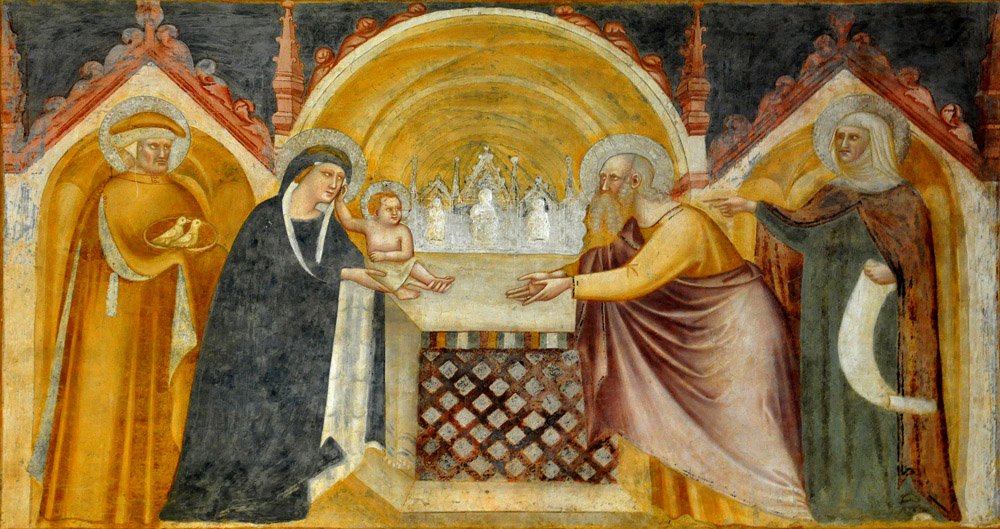
The Presentation in the Temple, 14th century fresco in Pomposa Abbey, Codorigo, Italy

When the time came for the purification rites required by the Law of Moses, Joseph and Mary took him to Jerusalem to present him to the Lord (as it is written in the Law of the Lord, “Every firstborn male is to be consecrated to the Lord”), and to offer a sacrifice in keeping with what is said in the Law of the Lord: “a pair of doves or two young pigeons.”

Now there was a man in Jerusalem called Simeon, who was righteous and devout. He was waiting for the consolation of Israel, and the Holy Spirit was on him. It had been revealed to him by the Holy Spirit that he would not die before he had seen the Lord’s Messiah. Moved by the Spirit, he went into the temple courts. When the parents brought in the child Jesus to do for him what the custom of the Law required, Simeon took him in his arms and praised God, saying:

“Sovereign Lord, as you have promised,
    you may now dismiss your servant in peace.
For my eyes have seen your salvation,
    which you have prepared in the sight of all nations:
a light for revelation to the Gentiles,
    and the glory of your people Israel.”

The child’s father and mother marveled at what was said about him. Then Simeon blessed them and said to Mary, his mother: “This child is destined to cause the falling and rising of many in Israel, and to be a sign that will be spoken against, so that the thoughts of many hearts will be revealed. And a sword will pierce your own soul too.”

There was also a prophet, Anna, the daughter of Penuel, of the tribe of Asher. She was very old; she had lived with her husband seven years after her marriage, and then was a widow until she was eighty-four. She never left the temple but worshiped night and day, fasting and praying. Coming up to them at that very moment, she gave thanks to God and spoke about the child to all who were looking forward to the redemption of Jerusalem.

When Joseph and Mary had done everything required by the Law of the Lord, they returned to Galilee to their own town of Nazareth. And the child grew and became strong; he was filled with wisdom, and the grace of God was on him. (New International Version)

The Gospel accounts of Matthew, Mark, Luke, and John actually contain very little information about the childhood of Jesus. That’s because the Gospels are not biographies – in the sense we think of them – but rather they are narratives that seek to answer a fundamental question about faith and life on this earth: Who is this Jesus?

C.S. Lewis went about exploring that very question. He reasons with us in his classis work, Mere Christianity:

“I am trying here to prevent anyone saying the really foolish thing that people often say about Him: I’m ready to accept Jesus as a great moral teacher, but I don’t accept his claim to be God. That is the one thing we must not say. A man who was merely a man and said the sort of things Jesus said would not be a great moral teacher. He would either be a lunatic — on the level with the man who says he is a poached egg — or else he would be the Devil of Hell. You must make your choice. Either this man was, and is, the Son of God, or else a madman or something worse. You can shut him up for a fool, you can spit at him and kill him as a demon or you can fall at his feet and call him Lord and God, but let us not come with any patronizing nonsense about his being a great human teacher. He has not left that open to us. He did not intend to.”

C.S. Lewis, Mere Christianity

St. Luke’s account of Christ’s childhood stories, seeks to make some important theological points about Jesus:

  • born a Jew amongst devout religious Jews in a thoroughly Jewish society, under Roman authority (Luke 2:1-7)
  • born of a woman, born under the law (Galatians 4:4-5)
  • obedient to his heavenly Father (Luke 2:49; Mark 3:35)
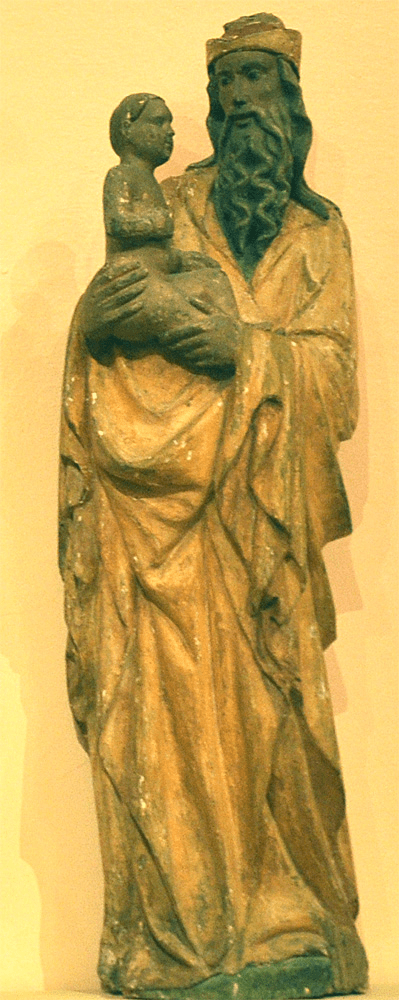
The Presentation in the Temple, 14th century marble statue in the National Museum of the Middle Ages, Paris, France

So, as such, the presentation of Jesus in Jerusalem at the temple is motivated by specific requirements of the law of Moses:

The Lord said to Moses, “Say to the Israelites: ‘A woman who becomes pregnant and gives birth to a son will be ceremonially unclean for seven days…. On the eighth day the boy is to be circumcised. Then the woman must wait thirty-three days to be purified from her bleeding. She must not touch anything sacred or go to the sanctuary until the days of her purification are over….

“‘When the days of her purification for a son… are over, she is to bring to the priest at the entrance to the tent of meeting a year-old lamb for a burnt offering and a young pigeon or a dove for a sin offering….

“‘These are the regulations for the woman who gives birth to a boy… But if she cannot afford a lamb, she is to bring two doves or two young pigeons, one for a burnt offering and the other for a sin offering. In this way the priest will make atonement for her, and she will be clean.’” (Leviticus 12:1-8, NIV)

What’s more, every first-born male (as Jesus was) specifically belongs to the Lord, and is set apart.

The Lord said to Moses, “Consecrate to me every firstborn male. The first offspring of every womb among the Israelites belongs to me… you are to give over to the Lord the first offspring of every womb….”

“In days to come, when your son asks you, ‘What does this mean?’ say to him, ‘With a mighty hand the Lord brought us out of Egypt, out of the land of slavery. When Pharaoh stubbornly refused to let us go, the Lord killed the firstborn of both people and animals in Egypt.

This is why I sacrifice to the Lord the first male offspring of every womb and redeem each of my firstborn sons.’ And it will be like a sign on your hand and a symbol on your forehead that the Lord brought us out of Egypt with his mighty hand.” (Exodus 13:1-2, 12, 14-16, NIV)

Luke was making the connection that when Joseph and Mary presented Jesus to the Lord in Jerusalem, they were essentially dedicating his life to God. Jesus will be the means of redemption for all the people.

Mary would have remembered the words the angel Gabriel told her, that her son will not only be holy, but also be called the Son of God. The life of Jesus – conception, birth, and presentation at the temple – is demonstrably dedicated fully and completely to his heavenly Father. Deliverance for both Jews and Gentiles is focused in the person of Jesus.

Simeon and the Child Jesus, 16th century statue in Zadar, Croatia

Simeon and Anna show up at the presentation of Jesus as devout Jews who are awaiting the fulfillment of God’s promises of consolation and redemption for Israel.

“I, the Lord, have called you in righteousness;
    I will take hold of your hand.
I will keep you and will make you
    to be a covenant for the people
    and a light for the Gentiles.” (Isaiah 42:6, NIV)

Break forth; shout together for joy,
    you ruins of Jerusalem,
for the Lord has comforted his people;
    he has redeemed Jerusalem.
The Lord has bared his holy arm
    before the eyes of all the nations,
and all the ends of the earth shall see
    the salvation of our God. (Isaiah 52:9-10, NRSV)

Simeon and Anna became the spokespersons for the redemption that is to come through Jesus. They both got a glimpse of the salvation that would, one day, reveal itself to the whole world. Forgiveness of sins, deliverance from death and hell, and freedom from guilt and shame all become laser focused on the suffering servant of God.

Who is Jesus? He is the ultimate meaning of Christmas, the incarnation of the Son of God, the Savior of the world. Amen.

Christ Is Born (Luke 2:1-20)

Nativity, by He Qi, 1998

In those days Caesar Augustus declared that everyone throughout the empire should be enrolled in the tax lists. This first enrollment occurred when Quirinius governed Syria. Everyone went to their own cities to be enrolled. Since Joseph belonged to David’s house and family line, he went up from the city of Nazareth in Galilee to David’s city, called Bethlehem, in Judea. He went to be enrolled together with Mary, who was promised to him in marriage and who was pregnant. While they were there, the time came for Mary to have her baby. She gave birth to her firstborn child, a son, wrapped him snugly, and laid him in a manger, because there was no place for them in the guestroom.

Nearby shepherds were living in the fields, guarding their sheep at night. The Lord’s angel stood before them, the Lord’s glory shone around them, and they were terrified.

The angel said, “Don’t be afraid! Look! I bring good news to you—wonderful, joyous news for all people. Your savior is born today in David’s city. He is Christ the Lord. This is a sign for you: you will find a newborn baby wrapped snugly and lying in a manger.” Suddenly a great assembly of the heavenly forces was with the angel praising God. They said, “Glory to God in heaven, and on earth peace among those whom he favors.”

When the angels returned to heaven, the shepherds said to each other, “Let’s go right now to Bethlehem and see what’s happened. Let’s confirm what the Lord has revealed to us.” They went quickly and found Mary and Joseph, and the baby lying in the manger. When they saw this, they reported what they had been told about this child. Everyone who heard it was amazed at what the shepherds told them. Mary committed these things to memory and considered them carefully. The shepherds returned home, glorifying and praising God for all they had heard and seen. Everything happened just as they had been told. (Common English Bible)

Nacimiento (Nativity), by Leoncio Saenz, 1983

It is of significance – and not by accident – that Jesus had a humble birth in a lowly setting. All around was the backdrop of a powerful Roman Empire. Whereas Christ could have been born as the mighty king that he actually is, he instead was born and then laid in a feeding trough for animals.

Caesar Augustus — whose name means revered or exalted one — ended a long period of war in the Roman Empire and was hailed as a prince of peace, the savior of the world. With his reign began the Pax Romana (Roman Peace). Under the rule of Augustus, the economy was booming; culture, religion, and infrastructure were developed and prospered. He was hailed by many with the title “Ceasar is Lord.”

Yet, as with many powerful rulers in history, Augustus ruthlessly suppressed his enemies and limited their human rights. It was peace by totalitarian rule – which is really no peace, at all.

It was in those days that Augustus proclaimed his decree for a census of the entire Roman world, so that taxes could be collected from all the conquered peoples of the empire. And so, despite being very pregnant, Mary and her fiancé Joseph made the arduous 90-mile trek from Nazareth in Galilee to Bethlehem, the city of David. That was the only way they could be properly registered, to return to the ancestral home.

It’s no surprise that Mary ended up giving birth to Jesus, far from their actual home, in less than ideal circumstances, for a delivery of a baby.

It appeared Ceasar Augustus was the absolute ruler, and much too powerful for anyone to challenge him. It also seemed that Jesus, a vulnerable little infant with even smaller resources, could do anything but just try and survive. But appearances can be, and are often, quite deceiving.

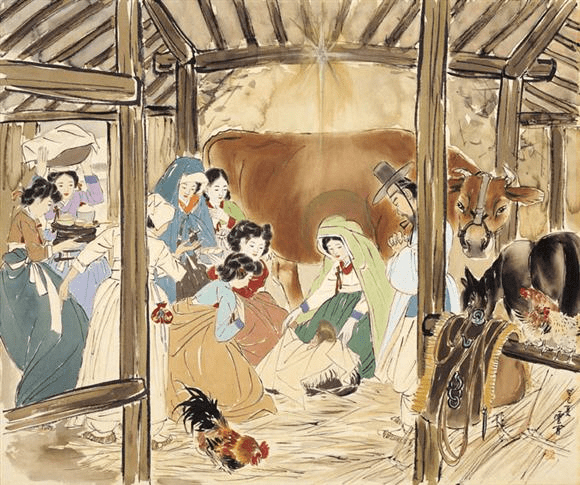
The Birth of Jesus Christ, by Woonbo Kim Ki-chang, 1952

In truth, Jesus is Lord, and Ceasar is not. Christ is the real Prince of Peace who brings God’s benevolent rule and reign to earth, as it is always done in heaven. And it will not be achieved through military power, but by the justice and mercy of God. Because, as it turns out, Love is a much greater force than any human authority or empire.

Considering God’s gracious kingdom – which turns all appearances on its head – it is quite appropriate that news of Christ’s royal birth comes first to a bunch of shepherds. They were among the lowliest of the emperor’s subjects.

Although we may tend to romanticize the shepherds keeping watch over their flocks by night, most people thought of shepherds as low class workers who nobody wanted to be around. They were poor, illiterate, and thought to be dishonorable drunks. Shepherds also had the reputation of being thieves because they grazed their flocks on other people’s property. In short, they were mostly the outcasts of society.

To this group of people the angel announces good news of great joy for all the people everywhere – and not just the powerful and the rich: To you is born this day in the city of David, a Savior, who is the Messiah, the Lord. The shepherds go to Bethlehem to find this baby, and become the first to share the good news of the Savior’s birth.

Today, we still live in a world dominated by people who desire power and privilege over others. We still live in a world enamored with wealth and resources, power and authority, military might and social control. In this world, much like the ancient world, the lowly still get trampled and the least among us get little if any attention.

Masters of both small and large worlds will eventually be toppled, not to mention our own personal petty empires we seek to build. All of our planning and scheming will never bring true peace and security. Jesus has arrived! Christ is born! All other empires are now on borrowed time.

Nativity, by Joseph Mulamba-Mandangi, 2001

The Savior is born for all the world, for us, even though we are separated from Christ’s birth by two millennia. Jesus still comes to bring peace on earth and goodwill to all humanity through the power of Love. He still casts out fear and relieves anxious hearts. And his reign will last forever and ever.

With Jesus Christ as Sovereign, outcasts are welcomed in; the hungry are fed; the poor are lifted up; captives are set free; enemies are reconciled. And wherever the good news is proclaimed, guilt and shame melts away, and lives are changed.

Today Christians all over the world celebrate the birth of Christ. And we also look forward to his coming again, when his reign of justice, mercy, and peace comes in all its fullness.

May God bless you this Christmas and always. May you be comforted by the Lord’s presence in your life, and always follow his guiding light. For Christ has come, the Immanuel, God with us. Amen.