Spiritual Wisdom and Power (1 Corinthians 2:1-5)

By Bible Art

When I came to you, brothers and sisters, I did not come proclaiming the testimony of God to you with superior speech or wisdom. For I decided to know nothing among you except Jesus Christ and him crucified. And I came to you in weakness and in fear and in much trembling. My speech and my proclamation were made not with persuasive words of wisdom but with a demonstration of the Spirit and of power, so that your faith might rest not on human wisdom but on the power of God. (New Revised Standard Version)

When it comes to proclaiming the gospel – the good news of Christ’s person and work – both the message and the messenger are important.

The Apostle Paul was dialed in and focused on the Cross of Jesus Christ. Although he could have used various methods of persuasion, he was determined to set aside all other means of proclamation, and declare Christ’s Cross as the message and method itself.

This means that Paul also deliberately faded himself into the background, in order to have the Cross of Christ in the foreground. He emphasized his own weakness, his fear and trembling, in order to highlight the strength and majesty of God.

Paul wanted the messenger to point to the message – which meant that all of his speaking allowed God’s Spirit and power to show itself through him, rather than in spite of him.

The Corinthians came to believe the message not because of a big showy demonstration of Paul’s strength, intellect, and wisdom. Instead, they embraced Christian belief because of spiritual power and effort.

If it is spiritual wisdom and power centered in the message of Christ’s Cross which saves us, then it is also more than good enough to sanctify us, as well, and be the core from which all of the Christian life emanates from.

The Apostle understood that he is God’s agent, God’s ambassador, but that God alone is the One who saves humanity and delivers them from sin, death, and hell.

Christ Carrying the Cross, by Martin Schongauer, c. 1480 C.E.

Paul’s argument doesn’t have anything to do with making sure that the word “cross” is said in every sermon and conversation, or that Christians have only one thing to talk about.

Instead, the Apostle wanted the Corinthian Church to distance themselves from their typical of use of worldly philosophical wisdom, in favor of a distinctly spiritual wisdom which demands a certain kind of ministry:

The cross of Jesus Christ is to be the central event in which all of Christian life and ministry revolves around. In other words, the shape of Christianity is cruciform.

And since the cruciform nature of Christianity is our reality, our wisdom is to be received and flow from the Cross of Christ. To do less is to rely upon a different power other than the distinctive spiritual power of Christ’s death.

It isn’t any one of us which breaks through to another’s spirit; the power of God compels a person to listen, receive the message, and be given faith to believe, grow, and spiritually mature.

When the good news of Christ’s person and work takes root and develops within us, then what comes out of us is spiritual power, and not our own homespun worldly human wisdom.

“Wisdom” is the ability to take a body of knowledge and apply it to concrete situations in life.

So, when it comes to spiritual wisdom, Christians mature in the grace and knowledge of the Lord Jesus; then, they learn to take this important body of knowledge and apply it to all of the various circumstances and situations they are faced with every day.

This isn’t to say that worldly wisdom has no merit or significance, or that it is misguided. Rather, it means that this sort of wisdom doesn’t have the ability, the strength, or the power to move and change us, or others, toward deliverance and new life. We need the wisdom of the Spirit for that. And Paul insisted that this wisdom comes from the Cross of Christ.

The crucifixion of Christ is the wise guide for all of the Apostle Paul’s theology, message, and ministry. That singular event was like a massive meteor hitting the ocean of humanity, with a powerful tsunami of spiritual power and grace still making waves up to this very day.

Indeed, the Cross of Christ impacts all of creation, the entire universe. The person and work of Jesus Christ has cosmic implications for the salvation and deliverance of everything from the grip of evil.

On the practical daily level of things, none of this is about trying to do or be better, to somehow work harder at being a Christian or doing Christian mission and ministry. The fact of the matter is that we can only give to others what we have received from God. This means that:

  • The Holy Scriptures are to be received with reverence and fear, as a message given for us to learn and know so well that it becomes as familiar to you as the backdoor of your house.
  • The Christian life is about dying to self, taking up one’s cross and following Christ. If we desire the power of the resurrection, then this will first require embracing and allowing the powerful suffering of the cross to do its work.
  • Faithfulness is at the heart of living. Our task is to show up, pay attention, and speak the truth in love, and let God use this to accomplish the Divine holy will. Being married to outcomes and consequences will likely lead to reliance upon worldly wisdom, and eventually disappointment.
  • The Cross of Christ is what everything and everyone hinges upon. The world does not revolve around you nor me. So, let’s get in sync with the Spirit of God and rely upon the cruciform power provided for us by means of Christ’s death.

O God, who for our redemption gave your only-begotten Son to the death of the cross, and by his glorious resurrection delivered us from the power of our enemy: Grant us so to die daily to sin, that we may evermore live with him in the joy of his resurrection; who lives and reigns now and forever. Amen.

Sing a New Song (Psalm 98:1-5)

Oh, sing to the Lord a new song!
For He has done marvelous things;
His right hand and His holy arm have gained Him the victory.
The Lord has made known His salvation;
His righteousness He has revealed in the sight of the nations.
He has remembered His mercy and His faithfulness to the house of Israel;
All the ends of the earth have seen the salvation of our God.

Shout joyfully to the Lord, all the earth;
Break forth in song, rejoice, and sing praises.
Sing to the Lord with the harp,
With the harp and the sound of a psalm, (New King James Version)

I still remember, years ago when I was in college, a guy with a pony tail and wearing flip-flops, walking up with a guitar on his back in front of a gathering of fellow students who were Christians.

Yet, most evident, was his broad smile which seemed to engulf his entire face. He talked about his life before Christ – which was all of his life up until the week before – and what Jesus had done for him.

Then, he took his guitar and announced that he wrote a song to this very text, the first few verses of Psalm 98. I wish I had a recording of it, especially because of how he sang it with such volume and exuberance, as if the words had just been crafted yesterday.

Even though the psalm is ancient, the psalmist himself was inviting people to sing a song infused with a new perception of life on this earth.

There is always plenty of room to reflect on what God has done, and is doing, in this very big world. Not only can we consider the immensity and intricacy of the created order, but we can also declare all the things we cannot detect with our five senses.

And perhaps those are the things which impact us the most, when we sense and feel the reality of God’s work in the world, and in our lives. At least that’s what my pony-tailed smiling friend was so excited about.

The things which exist beyond our normal human experience are no less real than our daily mundane activities. This is the realm where the Lord makes the greatest impact of all. God hasn’t only done great things, but has done great things for me.

We have to use metaphors and personifications in order to even begin understanding the wonder and awe of God’s saving power in our very real here-and-now lives. God’s mighty right hand and holy arm of power speak to the incredible strength and authority which can reach into the thickest and nastiest of garbage dumpsters to pull out the pearl of great price, that is, you and me.

Consider God, the One who puts all things right, and is just and good in all things – paying attention to the least of us, and lifting up with divine deliverance from the most dire and awful of circumstances.

Indeed, the Lord has made God’s salvation known, and revealed God’s righteousness to the nations.

Sometimes it takes someone with a fresh new song to wake us up to the reality that we can discern the activity of God every day, in all the ordinary and myriad ways of our lives. Along with all of creation, and pony-tail guy, we join the chorus of those who are already singing with the unique voice God provided for us.

And those many songs all include, at their center, the reality that before I chose God, God chose me; that when I forget, God remembers; that with my waxing and waning of love, God is consistently steadfast and faithful with love; and that God provides salvation, and judges the people with equity, even when I show favoritism.

With each new testimony of God’s saving work, it becomes harder and harder for others to insist that God is absent, hidden, or negligent. God is there. God is here. God is everywhere.

We can get so wrapped up in our own small worlds, and our own little safe places, where everyone looks like me, acts like me, and thinks like me. But the world is much bigger than our contrived spaces in which we can set ourselves up as master and commander.

The Lord mercifully breaks through all of our puny posturing and petulance, and saves us from ourselves. God pushes and cajoles us to see beyond the end of our noses. We are moved to see a new perspective we haven’t noticed before.

And once we make out what God is doing, and does for me, then bursting into song with shouting and volume is the organic response to our experience. If you think about it, there is really no other way to respond, once you have gotten a glimpse of God’s activity, and discerned something that was previously undiscernible.

Even the rocks will cry out in the face of such love and grace.

It’s okay to open your mouth, once your eyes have been opened, and let a new song come tumbling out. Because joy is the response of being delivered from what once bound us.

Gracious and Loving God, you have filled the world with beauty: Open our eyes to behold your gracious hand in all these works; that, rejoicing in your whole creation, we may learn to serve you with gladness; for the sake of him through whom all things were made, your Son Jesus Christ our Lord.

Deliver Us From Evil (Psalm 144:9-15)

I will sing a new song to you, God.
    I will sing praises to you on a ten-stringed harp,
        to you—the one who gives saving help to rulers,
        and who rescues his servant David from the evil sword.
Rescue me and deliver me from the power of strangers,
        whose mouths speak lies,
        and whose strong hand is a strong hand of deception,
    so that our sons can grow up fully, in their youth, like plants;
    so that our daughters can be like pillars carved to decorate a palace;
    so that our barns can be full, providing all kinds of food;
    so that our flocks can be in the thousands—
        even tens of thousands—in our fields;
    so that our cattle can be loaded with calves;
    so that there won’t be any breach in the walls,
    no exile, no outcries in our streets!

The people who have it like this are truly happy!
    The people whose God is the Lord are truly happy! (Common English Bible)

And lead us not into temptation, but deliver us from evil.”

Jesus (Matthew 6:13, KJV)

Evil lurks everywhere. It resides in the human heart, hidden in the dark shadows, coming out sideways through shameful lies and guilty actions.

The presence of evil is also found throughout the world in every institution, organization, and group, ensconced as systemic injustice – hoarding resources for the powerful at the expense of the powerless; showing prejudice and favoritism to some, while ignoring others.

Since there is wickedness found in all places and with all people, evil needs to be dealt with and expunged from both hearts as well as institutions and organizations. Part of the solution is to do away with all obstacles which stand in the way of human flourishing.

Save us from the Evil One. (Matthew 6:13, ERV)

To be sure, the heart of humanity must be dealt with and be the focus of change. Yet, if we only focus one-dimensionally on evil, it will persist, and even grow into monstrous proportions, unless we equally direct our right and just efforts on structural and systemic evil.

People and their institutions need deliverance from the power of evil in the world. And for that to happen, the hindrances and handicaps to human thriving must be eliminated.

Our entire concept of salvation needs a fuller scope. Not only do individuals need personal deliverance from sin, death, and hell, so do entire societies. Complete systemic rescue from oppressive obstacles is a must. Far too many people in this fallen world are weighed down from institutional sin.

Christ obeyed God our Father and gave himself as a sacrifice for our sins to rescue us from this evil world.

Galatians 1:4, CEV

In looking at the need for deliverance from evil in a different context, the genius of the American experiment was that the founding fathers (and mothers!) of the United States created a political and societal system which sought to eliminate class distinctions and allowed people of lower means to achieve land ownership and business acumen simply through hard work and thrift.

Unfortunately, the experiment only extended mostly to landowning white men. Native American and African American people still had huge systemic obstacles to overcome. And the new republic had different expectations for women.

It took a Civil War and decades of grueling work to address political and social change (not to mention religious). We are still today laboring to truly give liberty and justice for all, and to achieve the ideal of an egalitarian nation.

We, as both individuals and citizens, need divine intervention through deliverance. Like Gilligan and the crew of the Minnow stranded on a deserted island, we seek to be rescued – knowing we need help beyond ourselves for salvation.

Rescue us from the evil one. (Matthew 6:13, NRSV)

The psalmist looked ahead in hope, convinced that a good God will deliver and provide good people with everything they need to thrive and flourish in this life, and in the life to come.

If God doesn’t fight our overwhelming battles for us, we are lost. This present darkness, this both ancient and contemporary evil, is an extremely powerful foe. However, the Lord is greater and will have the last word.

Christianity asserts that Jesus is the pioneer of our salvation, and the once for all answer to the problem of evil, for both the world and the human heart. Christ, in other words, is the fulfillment of the psalmist’s prayers for deliverance, health, and hope.

Protect us from evil. (Matthew 6:13, CEV)

In his earthly ministry, Jesus did not give explanations for our pain and sorrow. Instead, Jesus comes where our pain is most acute, and takes it upon himself – bringing healing and hope.

The Lord tackles evil, not by having a Zoom conference on the subject of wickedness, but by allowing evil to do its worst to him. Christ exhausts evil by draining it of its power, emerging resurrected with new life for all.

The good news: Jesus is Lord and has defeated the powers of evil.

Now, renewal and reform can occur. Hearts can change. Systems can be revamped. God’s new world has begun.

God rescued us from the control of darkness and transferred us into the kingdom of the Son he loves. He set us free through the Son and forgave our sins. (Colossians 1:13-14, CEB)

I, personally, am a Christian because I believe God is the one who satisfies the passion for justice, the longing for spirituality, the hunger for relationship, and the yearning for beauty. I see God in Jesus of Nazareth, the world’s true Lord.

Hope, like the psalmist expressed, is what you get when you realize a different worldview is possible. Hope springs to life when those who feel the brunt of evil in the world become acutely aware that the rich, the powerful, and the unscrupulous are not the ones really in charge.

“Our task as image-bearing, God-loving, Christ-shaped, Spirit-filled Christians, following Christ and shaping our world, is to announce redemption to a world that has discovered its fallenness, to announce healing to a world that has discovered its brokenness, to proclaim love and trust to a world that knows only exploitation, fear and suspicion…” N.T. Wright

May you be delivered from evil, and saved from the Evil One. May you know the Savior, and take solace in his peace. And may you be buoyant in faith, confident in hope, and overflowing with love. Amen.

For the Life of the World (John 6:1-21)

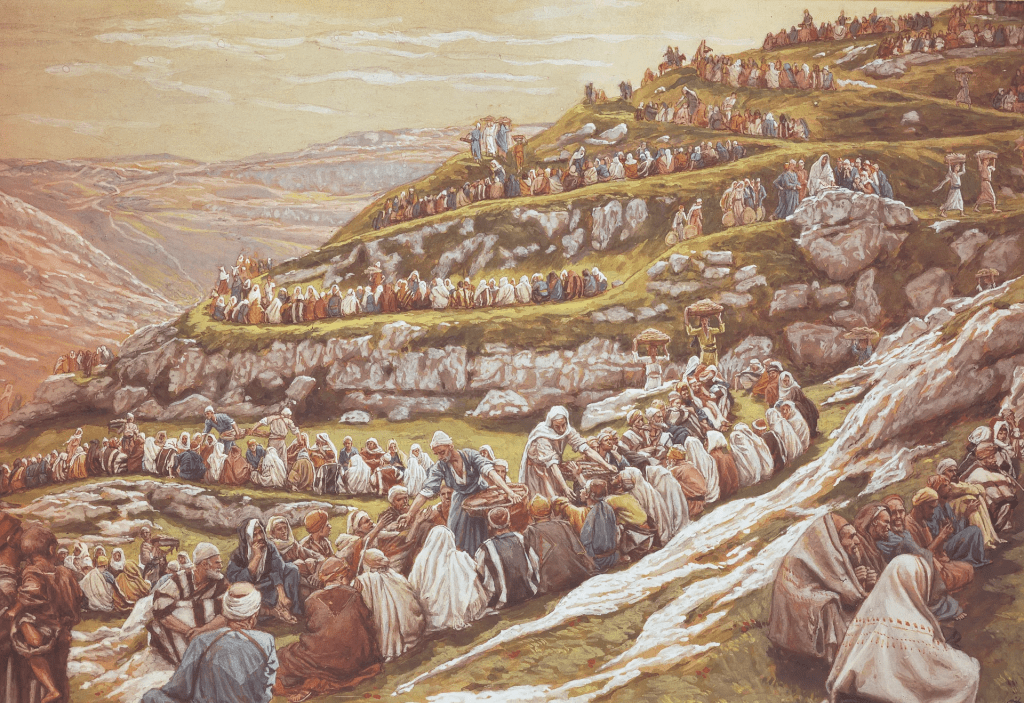
The Miracle of the Loaves and Fishes, by James Tissot, 1886

After this Jesus went to the other side of the Sea of Galilee, also called the Sea of Tiberias. A large crowd kept following him because they saw the signs that he was doing for the sick. Jesus went up the mountain and sat down there with his disciples. 

Now the Passover, the festival of the Jews, was near. When he looked up and saw a large crowd coming toward him, Jesus said to Philip, “Where are we to buy bread for these people to eat?” He said this to test him, for he himself knew what he was going to do. 

Philip answered him, “Two hundred denarii would not buy enough bread for each of them to get a little.” One of his disciples, Andrew, Simon Peter’s brother, said to him, “There is a boy here who has five barley loaves and two fish. But what are they among so many people?” 

Jesus said, “Make the people sit down.” Now there was a great deal of grass in the place, so they sat down, about five thousand in all. Then Jesus took the loaves, and when he had given thanks he distributed them to those who were seated; so also the fish, as much as they wanted. 

When they were satisfied, he told his disciples, “Gather up the fragments left over, so that nothing may be lost.” So they gathered them up, and from the fragments of the five barley loaves, left by those who had eaten, they filled twelve baskets. When the people saw the sign that he had done, they began to say, “This is indeed the prophet who is to come into the world.”

When Jesus realized that they were about to come and take him by force to make him king, he withdrew again to the mountain by himself.

When evening came, his disciples went down to the sea, got into a boat, and started across the sea to Capernaum. It was now dark, and Jesus had not yet come to them. The sea became rough because a strong wind was blowing. When they had rowed about three or four miles, they saw Jesus walking on the sea and coming near the boat, and they were terrified. But he said to them, “It is I; do not be afraid.” Then they wanted to take him into the boat, and immediately the boat reached the land toward which they were going. (New Revised Standard Version)

Christ Walking on the Waters, by Julius Sergius Von Klever, c.1880

The Deliverers Moses and Jesus

The Apostle John intended us to see the link between Moses and Jesus. God used Moses to bring deliverance of the people from slavery through a miracle at the Red Sea. The Lord also used him for a divine provision of manna in the wilderness.

And the Lord Jesus brought about a deliverance of the disciples from anxiety through a miracle on the Sea of Galilee. Christ also brought a divine provision of food in the middle of nowhere for thousands of people.

The miraculous displays by Jesus happened at the time of Passover, the very time that Jews celebrate the deliverance from Egypt. Just as divine power was exerted at the time of Moses in the original Passover, so also divine power likewise showed itself with Jesus in the supply of food and control of the sea.

What’s more, today Christians everywhere around the world remember God’s saving events with the elements of bread and cup, recalling divine deliverance and provision, and finding relief from their fears and anxieties.

A Miraculous Provision and Distribution of Food

It’s no coincidence that Jesus is pictured as sitting on a mountain – reminiscent of Moses on a mountain receiving the divine law and wisdom. The gathering of people around Christ was so great (thousands of them) and the need for food equally as great, that Jesus questioned his disciples concerning resources for such a large crowd.

Christ, of course, could have circumvented his disciples and simply provided the needed foodstuffs without them. Yet, he didn’t, on purpose. Always the rabbi and teacher, Jesus intended to give the disciples a lesson they wouldn’t forget.

After ascertaining that the only food available was a boy’s five barley loaves and two dried fish, Jesus knew that this was plenty, in order to feed up to 5,000 people. It was enough, because Jesus is enough. Only a small amount is needed to fill the bellies of thousands.

Sacramental Living, by Charissa Jaeger-Sanders

And, what is more, for those with the faith to see it, a little communion wafer and a small swallow from a cup is more than enough to satisfy and satiate the hungriest of faithful and penitent people.

Not only did the people eat as much as they needed and wanted, but there was also so much remaining food that the twelve disciples collected twelve baskets of bread. They could keep on ministering, providing, and distributing for people because little is much when God is in it. Long after Christ’s death and resurrection, his followers continued to give with the divine largess from Jesus.

Walking on Water

It had been a full day of teaching and miraculous ministry, in the full light for all to see. Christ’s power, however, is also operative at night. The darkness is not able to subdue continued miracles from Jesus.

For the Apostle John’s writings, darkness is almost always a theological statement, denoting that there are dark forces operative on this earth. And those powers definitely did not like Christ’s effective day of ministry.

The actual physical storm symbolized the chaotic and angry response of the sinister elements in the world. But despite the terrible conditions, Jesus calmly walked on the sea as the new Moses who takes charge of the water.

The disciples abject fear turned on a dime into exuberant joy, as they realized it was indeed Jesus who entered the boat. In addition, they experienced an immediate place of safe harbor.

Christ was standing in the divine tradition of bringing people from stormy circumstances and evil situations to the safe haven of God’s presence.

Jesus saves people from their fears and anxieties, their travails and ills, and their guilt and shame. Christ also provides everything we need, both material and immaterial. And he does it for the life of the world, for everyone who comes by faith.

Gracious Lord, you are the Sustainer of the hungry. Like a mother, you long to feed your children until each is satisfied. Turn our eyes to you alone, so that, aware of our own deepest longings, we will reach out with Christ to feed others with the miracle of your love. Amen.