Isaiah 52:13-53:12 – Good Friday

Golgotha by Norwegian artist Edvard Munch (1863-1944)

The Lord says, “See, my servant will act wisely.
    People will greatly honor and respect him.
Many people were shocked when they saw him.
    His appearance was so damaged he did not look like a man;
    his form was so changed they could barely tell he was human.
But now he will surprise many nations.
    Kings will be amazed and shut their mouths.
They will see things they had not been told about him,

    and they will understand things they had not heard.”

Who would have believed what we heard?
    Who saw the Lord’s power in this?
He grew up like a small plant before the Lord,
    like a root growing in a dry land.
He had no special beauty or form to make us notice him;
    there was nothing in his appearance to make us desire him.
He was hated and rejected by people.
    He had much pain and suffering.
People would not even look at him.
    He was hated, and we didn’t even notice him.

But he took our suffering on him
    and felt our pain for us.
We saw his suffering
    and thought God was punishing him.
But he was wounded for the wrong we did;
    he was crushed for the evil we did.
The punishment, which made us well, was given to him,
    and we are healed because of his wounds.
We all have wandered away like sheep;
    each of us has gone his own way.
But the Lord has put on him the punishment
    for all the evil we have done.

He was beaten down and punished,
    but he didn’t say a word.
He was like a lamb being led to be killed.
    He was quiet, as a sheep is quiet while its wool is being cut;
    he never opened his mouth.
Men took him away roughly and unfairly.
    He died without children to continue his family.
He was put to death;
    he was punished for the sins of my people.
He was buried with wicked men,
    and he died with the rich.
He had done nothing wrong,
    and he had never lied.

But it was the Lord who decided
    to crush him and make him suffer.
    The Lord made his life a penalty offering,
but he will still see his descendants and live a long life.
    He will complete the things the Lord wants him to do.
“After his soul suffers many things,
    he will see life and be satisfied.
My good servant will make many people right with God;
    he will carry away their sins.
For this reason I will make him a great man among people,
    and he will share in all things with those who are strong.
He willingly gave his life
    and was treated like a criminal.
But he carried away the sins of many people
    and asked forgiveness for those who sinned.” (NCV)
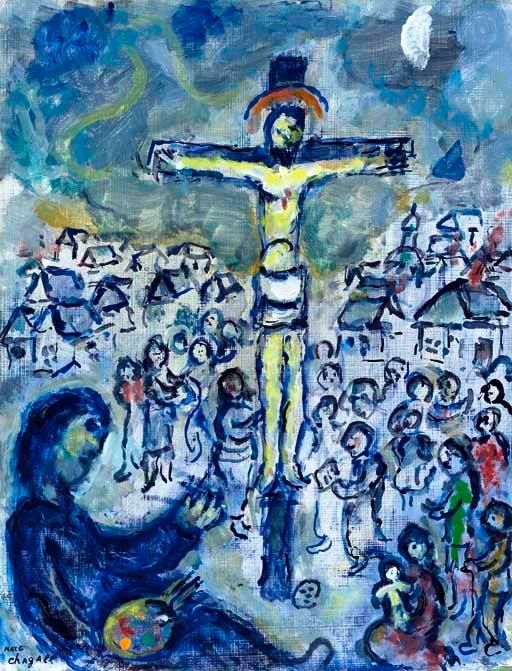
Le peintre et le Christ (The Painter and the Christ) by Marc Chagall (1887-1985)

With all the suffering in this world due to ongoing diseases, natural disasters, moral distress, and so much more, it might seem awkward that Christians everywhere would observe a day called “Good” Friday. 

Considering the hard circumstances of so many people, to call today “good” might appear cruel and out of touch with the world. Even for Christians, at first glance, “Good Friday” can seem a bit oxymoronic for a day observing the torture and death of an innocent man. 

Some would argue that Christ is no longer on the cross and we need to give all our focus on the resurrected Jesus and victory. No need for all this suffering stuff. Yet, the Resurrection only has meaning because of this very day, Good Friday. Without the Suffering Servant of Isaiah, there is no King Jesus. 

For Christians everywhere, this day is an incredibly good day because the crucifixion of Jesus Christ means the redemption of the world. On this day followers of Jesus remember and commemorate the events that led up to the cross; unpack those events and interpret them with profound meaning and significance; and worship Jesus with heartfelt gratitude because of the redeeming work of the cross.

The bulk of the New Testament Gospels of Matthew, Mark, Luke, and John are given over to the final week of Christ’s life, especially leading to the cross. Good Friday observances often take a somber form due to the brevity of Christ’s experience on the cross. 

On this day, Christians remember the last words of Christ, and recognize the significant impact his death had on the immediate persons around him. Believers also contemplate the lasting results of that singular death as an atoning sacrifice; perfect love; reconciliation between God and humanity; victory over evil; and the redemption of all creation.

Sadness, then, is far from the only emotive expression today. It is also appropriate to feel wonder, gratitude, and deep satisfaction for the accomplishment of deliverance from the power of sin. There is the recognition that something profound and meaningful has truly happened in the egregious suffering of Jesus. Thus, we not only remember the anguish of Christ, but what that horrible torment accomplished. In fact, the cross of Jesus is so significant that an eternity of considering its impact could never plumb the depths of its far-reaching effects.

Mount Calvary by William H. Johnson (1901-1970)

With such profound meaning, one would think that Good Friday is a hugely observed day on the Christian Calendar. Yet, for a chunk of churches and Christians, it is not. The cross is not a popular subject. Maybe it’s because neither Christian nor non-Christian wants to ponder something so bloody and sad.

Episcopal priest Fleming Rutledge has adroitly put her finger on the issue: “Religious people want visionary experiences and spiritual uplift; secular people want proofs, arguments, demonstrations, philosophy, and science. The striking fact is that neither one of these groups wants to hear about the cross.”  Indeed, as the Apostle Paul has said, the cross of Christ is “a stumbling block to Jews and folly to Gentiles” (1 Corinthians 1:23).

A personalized religion which leaves the cross out of the picture (too much violence and sacrifice) might seem appealing yet will only leave us bereft of the communion of the saints both past and present. Consider the ancient witness of the Church:

“I believe in Jesus Christ, his only Son, our Lord… he suffered under Pontius Pilate, was crucified, died, and was buried; he descended to hell.”

Apostles’ Creed

“For our sake he [Christ] was crucified under Pontius Pilate; he suffered death and was buried.”

Nicene creed

Christ suffered “in both body and soul – in such a way that when he sensed the horrible punishment required by our sins ‘his sweat became like great drops of blood falling down on the ground.’  He cried, ‘My God, my God, why have you forsaken me?’  And he endured all this for the forgiveness of our sins.  Therefore, we rightly say with the Apostle Paul that we know nothing ‘except Jesus Christ, and him crucified;’ we ‘regard everything as loss because of the surpassing value of knowing Christ Jesus our Lord.’ We find all comforts in his wounds and have no need to seek or invent any other means than this one and only sacrifice, once made, which renders believers perfect forever.” –Belgic Confession, Article 21

And let us consider further the New Testament witness:

“Jesus suffered outside the gate in order to sanctify the people through his own blood.  Therefore, let us go forth to him outside the camp, and bear the abuse he endured.” (Hebrews 13:12-13, NIV)

“May I never boast of anything except the cross of our Lord Jesus Christ, by which the world has been crucified to me, and I to the world.” (Galatians 6:14, NRSV)

The extent of Good Friday goes far beyond a day on the calendar; it is the fulcrum upon which all of Christianity hinges. Because Christ suffered, our suffering has meaning. Each situation of trauma; every case of disease; all suffering and wholesale hard circumstances only make sense, in the Christian tradition, when they are viewed in solidarity with cross of Jesus Christ.

So, today, let Christians everywhere contemplate the cross, observe the salvation accomplished through Christ’s death, and offer prayers and petitions for those who need deliverance from the power of evil. Let us worship God in Jesus Christ because of the suffering on the cross.


Psalm 70 – Wednesday of Holy Week

Christ in the Garden of Olives by French artist Paul Gauguin (1848-1903)

God! Please hurry to my rescue!
    God, come quickly to my side!
Those who are out to get me—
    let them fall all over themselves.
Those who relish my downfall—
    send them down a blind alley.
Give them a taste of their own medicine,
    those gossips off clucking their tongues.

Let those on the hunt for you
    sing and celebrate.
Let all who love your saving way
    say over and over, “God is mighty!”

But I’ve lost it. I’m wasted.
    God—quickly, quickly!
Quick to my side, quick to my rescue!
    God, don’t lose a minute. (MSG)

It doesn’t take a rocket scientist to know that today’s psalm is a plea from a desperate person in a desperate situation of life and death. Help is needed, not in some future time, but immediately!

I don’t know if you have ever been in such a stressful and dangerous situation in which all you could say is “Help! Help me!” The abject feeling of helplessness is palpable and just plain awful. The sense there is nothing you can do to improve your circumstance other than some sort of merciful divine intervention is more than unnerving. Its downright hard to breathe, let alone trying to cry out for rescue.

It seems the psalmist was in a position where there were people getting a twisted sense of joy over the misfortune of others. Its as if they were delighting in the confusion and vulnerability of those unable to stop what is happening.

In the throes of such stress and danger the psalmist wants the evil turned back on the wicked. He wants such persons off his back – to have God hunt them like they are hunting the poor and needy who have no ability to resist.

It makes sense this psalm is short, just a few verses. Long prayers aren’t necessarily better. Prayers can be short, especially when it is a frantic cry for God’s help. There is nothing in Holy Scripture that dictates how long or short prayer ought to be. “Help!” just might be one of the best prayers we can pray. One little word. That’s all it takes.

It also makes sense to me that this is an honest prayer. When in the throes of some horrible situation, all pretension goes out the window. Honest heartfelt prayers are the best kind of prayer. If we are hurting badly enough, boldness comes quickly to the tip of our tongues. I once had a kidney stone (which was extremely painful!). I walked in a bent over position into the Emergency Department of a hospital and yelled at the first staff person I saw, saying, “I want help, NOW!

To confess our great need to a God who listens might just be the best kind of theology we could ever express. In such a terrible place as the psalmist was, there is no thought to keeping up appearances. There is only an unfiltered expression of need. Our prayers can be earnest and urgent.

Prayer can be short, honest, and urgent because emergent situations require it. So, what do you do when you feel desperate? How do you handle your emotions? Where do you go for help?

In this Holy Week we are reminded that Jesus looked to the Father for help. In the worst of circumstances – facing ridicule, torture, and a horrible death – the Lord Jesus let the psalms shape his own prayers of desperation while under severe stress and duress:

“The one who ate my bread has lifted his heel against me.” (John 13:18; Psalm 41:9)

“They hated me without a cause.” (John 15:24; Psalm 69:4)

“I am deeply grieved, even to death; remain here, and stay awake with me.” (Matthew 26:38; Psalm 42:5-6)

“My God, my God, why have you forsaken me?” (Matthew 27:46; Psalm 22:1)

Then Jesus, crying with a loud voice, said, “Father, into your hands I commend my spirit.” Having said this, he breathed his last. (Luke 23:46; Psalm 31:16)

There is a God who understands our plight. Jesus, the pioneer of our salvation, has gone before us in the way of suffering and knows what it is like to experience the agony and anguish of evil’s weight. He is our great high priest, the one who can intercede effectively and compassionately for us in our great times of need:

 Now that we know what we have—Jesus, this great High Priest with ready access to God—let’s not let it slip through our fingers. We don’t have a priest who is out of touch with our reality. He’s been through weakness and testing, experienced it all—all but the sin. So, let’s walk right up to him and get what he is so ready to give. Take the mercy, accept the help. (Hebrews 4:14-16, MSG)

May you find in Jesus the help you so desperately need. Amen.

Philippians 2:12-18 – Think of the Needs of the Group

Photo by Ingo Joseph on Pexels.com

Therefore, my dear friends, as you have always obeyed—not only in my presence, but now much more in my absence—continue to work out your salvation with fear and trembling, for it is God who works in you to will and to act to fulfill his good purpose.

Do everything without grumbling or arguing, so that you may become blameless and pure, “children of God without fault in a warped and crooked generation.” Then you will shine among them like stars in the sky as you hold firmly to the word of life. And then I will be able to boast on the day of Christ that I did not run or labor in vain.But even if I am being poured out like a drink offering on the sacrifice and service coming from your faith, I am glad and rejoice with all of you. So, you too should be glad and rejoice with me. (NIV)

Here is what I would like you to do. Go back and read these verses for today….

Now, I want you to read them again, but with this understanding: Every pronoun in the verses is plural, not singular….

Did that last reading make a difference for you? You see, we all tend to read with certain lenses. Reading with American glasses usually means we read such biblical passages, like our New Testament lesson today, with individualist lenses. But this would be a misreading of the text.

These words from Holy Scripture are directed at the community. They are meant to be read with a collective understanding. So, when the Apostle Paul told the Philippian church to “work out your salvation with fear and trembling,” he wasn’t aiming it toward individual persons. He meant everyone together was to help one another live out their common salvation. In other words, deliverance is more than an individual affair – it is also a communal concern.

This also shapes how we understand the admonition to do everything without being a grump and a complainer. The community works together to encourage each other and weeds out all arguing and bickering. Practically speaking, no one individual is going to get over being a crotchety curmudgeon without the help of the group. Since people are hard-wired by God for community, always trying to be radically independent will almost always end in being a faultfinder and bellyacher.

Group work is human work, and vice versa.

Interdependence with others is the proper road to travel, without veering into either ditch of independence or dependence. Community dynamics are necessary to life. Mutual giving and receiving are a must. Both sharing and accepting need to occur for any sort of relational health.

The reason the Apostle Paul wrote his letter to the Philippian Church was because they weren’t getting along, weren’t playing well with others. Christianity is a team sport. Everyone must work together, even when it comes to salvation. Deliverance from sin, death, and hell – salvation from guilt, shame, disconnection, and relational separation from both God and others – is a matter for the collective community. That’s why no one is baptized alone or observes the Lord’s Table all by themselves.

Today’s New Testament lesson is not a text dealing with individual salvation but is an ethical text dealing with the outworking of salvation in the believing community for the sake of the world. Paul’s present concern was with a group of believers being God’s people. Individuals were to stop their selfish in-fighting and get along with each other.

To do that, the entire group was to set aside selfish ambition and put the concerns of others ahead of their own personal agendas. Everyone is to think of the needs of the group. When we do that, we then discern that murmuring and grumbling are simply not helpful. And, what’s more, such an attitude can damage, even destroy a group through bitterness resulting in gangrene of the church body.

Instead, we are to be blameless and pure in all our dealings with one another. Here are a few basic ways this communal concern works itself out practically:

  • No one cries alone.
  • No one suffers in silence.
  • No one falls through the cracks.
  • There is always someone present to share joy with.
  • There is always someone around to hear your story.
  • There is always somebody there to pick you up.

When such a dynamic dominates any group, then it will be hard to find any grumblers, any sort of in-fighting, and little discontent. Rather, there is a great deal of carrying one another’s burdens, a lack of judgment toward others, and a settled hope that, even though the world might be going to hell in a handbasket, we will be okay because we have each other.

So then, the church is to be an inclusive community, inviting persons into a hospitable space of care and support. Church as factory cannot do this. Church made up of special interest groups is not able to do this. Church as simply a Sunday affair will never get it done.

However, Church poured out as an offering to the world will get it right. Church as oriented toward faithful service for the common good of all has it. Church as the community of the redeemed, living out their faith together as one people of God cannot be stopped or restrained from blessing the entire planet.

Do you want to go it alone? That is what Satan did, and it hasn’t worked out so well for us.

Will you think of the needs of the group? That is what Jesus did, and it resulted in our salvation.

We are to work out that salvation, together, so that our collective faith is strengthened, and the world is delivered from its great loneliness. So, put your best foot forward and think of the needs of the group.

Holy God, we your people come with deep gratitude for our common call as believers for the life of your big world. Draw us into communion with you and all creation. Living with intentional awareness and openness to change, we seek to expand the expression of our collective obedience to the mission of Jesus to love God and neighbor, inviting others to walk with us in sharing our gifts. Free our hearts to recognize and attend to Christ in hidden and unexpected places. We renounce and reject societal barriers created by the misuse of power and authority by selfish individuals. Transform us to listen deeply to one another and to the brokenness of the world. Bless our efforts to be the change we want to see in the world, through the enablement of your Holy Spirit. Amen.

Isaiah 43:8-13 – God Is Sovereign and I Am Not

Photo by Rachel Claire on Pexels.com

Bring my people together.
They have eyes and ears,
    but they can’t see or hear.
Tell everyone of every nation
    to gather around.
None of them can honestly say,
    “We told you so!”
If someone heard them say this,
    then tell us about it now.

My people, you are my witnesses
    and my chosen servant.
I want you to know me,
to trust me,
and understand
    that I alone am God.
I have always been God;
    there can be no others.

I alone am the Lord;
    only I can rescue you.
I promised to save you,
    and I kept my promise.
You are my witnesses
that no other god did this.
    I, the Lord, have spoken.
I am God now and forever.
No one can snatch you from me
    or stand in my way. (CEV)

I confess that I am an unabashed Calvinist – a Protestant theologian, pastor, and chaplain in the Reformed tradition. What that means to me is that I believe in God’s unconditional election of persons to salvation and new life. Maybe that means nothing to you, and to others it means everything. For many folks, it is just some churchy mumbo-jumbo which is rather irrelevant to the real stuff of the Christian life. 

I do not agree. It seems to me to be quite important. The heart of Reformation faith is a focus on God’s sovereignty, majesty, power, and grace. It is God who justifies, and not any human. That means there are no conditions to which God is beholden to act.

God works in the world according to divine free will and is not dependent upon anyone or anything to accomplish good purposes and fulfill good promises.

Today’s Old Testament lesson is a soaring view of God’s grace and powerful control. Yes, indeed, throughout all eternity God is God. There is none who can thwart the Lord’s plans. God acts freely and mercifully and nothing can cancel out those actions. Nothing can separate us from the love of God. 

We might jump from finger to finger in our puny attempts at autonomy, but we are not getting out of God’s hand! 

This really ought to be a comfort to every believer. God’s decrees will be fulfilled, and there is not one thing any wicked person can do to subvert divine initiatives. Furthermore, there is absolutely no way we can screw-up God’s purposes. We simply do not have such power. Our great task as believers is to rest secure in God’s will and place our trust in the One who knows exactly what he is doing in the world.

So, take a few minutes, draw a few deep breaths, and think on the wonderful truth that God is sovereign. To help you, here is the great opening to the Reformed confession, The Heidelberg Catechism, giving us a glimpse into the majesty of God:

Q: What is your only comfort in life and in death?

A: That I am not my own,

but belong with body and soul,

both in life and in death,

to my faithful Savior Jesus Christ.

He has fully paid for all my sins

with his precious blood,

and has set me free

from all the power of the devil.

He also preserves me in such a way

that without the will of my heavenly Father

not a hair can fall from my head;

indeed, all things must work together

for my salvation.

Therefore, by his Holy Spirit

he also assures me

of eternal life

and makes me wholeheartedly willing and ready

from now on to live for him. Amen.