

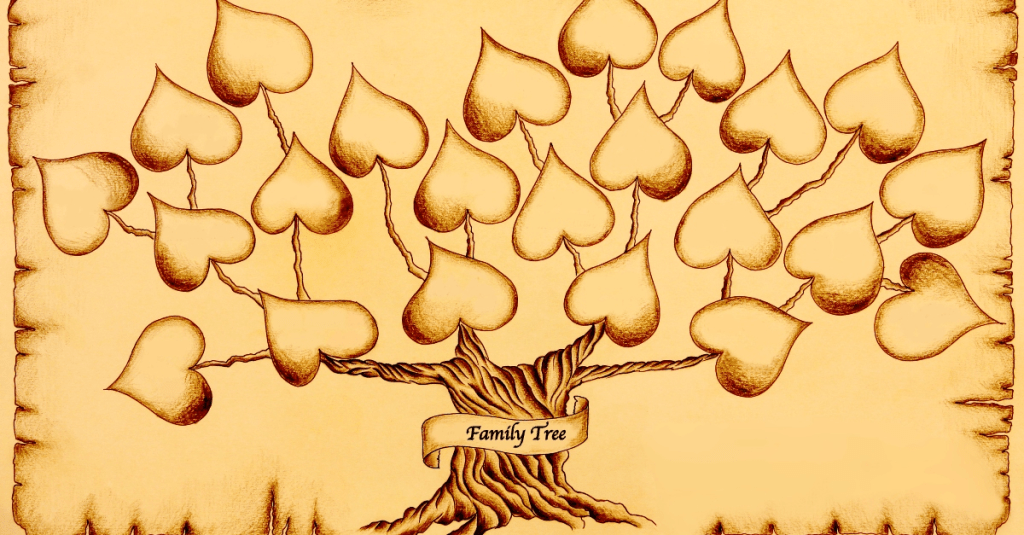
Now these are the descendants of Perez: Perez became the father of Hezron, Hezron of Ram, Ram of Amminadab, Amminadab of Nahshon, Nahshon of Salmon, Salmon of Boaz, Boaz of Obed, Obed of Jesse, and Jesse of David. (New Revised Standard Version)
No, I didn’t make a mistake about what the verses are for today from the Revised Common Lectionary. Yes, the Old Testament lesson is a brief genealogy. And yes, there is something to learn from this.
The Bible contains a lot of genealogies. Although they may be boring, with names we have difficulty pronouncing, every genealogy serves the same purpose that it does for your own family history.
Genealogies remind us of our connection with past generations. And this interconnectedness has influenced us in profound ways. You and I are the result of what history has produced. We are who we are, to a significant degree, because of the people who came before us.
By listing someone’s descendants in writing, it indicates an ongoing developing story which has happened, and continues to develop up to the present time, and even into the future.
One aspect about biblical genealogies that must be noted: Ancient compilers of genealogical lists did not often include every single person in the genealogy. They typically listed the more significant persons, and left out persons who barely dented history.
That’s because the biblical writer’s purpose in giving a genealogy was not necessarily to be exact and precise about each individual past actor. Rather, the writer usually has a moral and/or theological reason for providing the list.
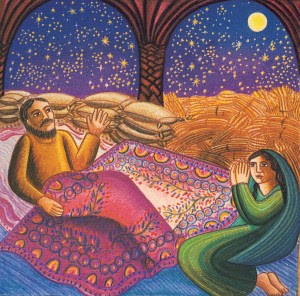
For the writer of the Book of Ruth, the reason for this genealogy was to establish the bloodline and pedigree of King David. Perez was a son of the patriarch Judah (and Tamar). Boaz was a descendant of Judah. Boaz married Ruth, and they had a son, Obed, who was the grandfather of David.
I hope that you see the grace in every biblical genealogy. Including in our genealogy for today, we have two women, Tamar and Ruth. Both of them were unlikely candidates for producing a king. And even more unlikely to be included in greatest Christian genealogy of them all, the lineage of Jesus (Matthew 1:1-17)
The Gospel writer Matthew included in his genealogical list a note about Boaz. He was the son of Rahab. Yes, the same Rahab who was the prostitute in Jericho, and became a faithful woman included in God’s covenant community. (Matthew 1:5-6)
Ruth was a “heathen” woman from Moab, a nation which historically was hostile to Judah. Yet, through her own pious actions, Ruth became a worthy member of Judah, and listed as a great mother of the Jewish people.
The brief genealogy we have here is a part of an historical continuity in God’s covenant community. From Abraham to Judah to David to Jesus, and to the Christian Church, this both literal and spiritual heritage is brought about through a daughter-in-law of Naomi the Jew, Ruth.
None of us are truly alone. We are all connected as people. And Christians are spiritually linked to the covenant as God’s people, by faith.
Just as Abraham “believed God, and it was reckoned to him as righteousness,” so, you see, those who believe are the descendants of Abraham. And the scripture, foreseeing that God would reckon as righteous the gentiles by faith, declared the gospel beforehand to Abraham, saying, “All the gentiles shall be blessed in you.” For this reason, those who believe are blessed with Abraham who believed. (Galatians 3:6-9, NRSV)
This connection to the past, prevents us from having an over-individualistic faith in God and relationship to the Lord. We belong to the historical and worldwide communion of saints. We, both personally and communally, belong to God.
For the writer of the Book of Ruth, history is important. Genealogy is significant. God’s covenant matters. The Church’s life is bound up in the person of Christ, in King Jesus, Son of David, Son of Boaz and Ruth, Son of Abraham.
Not only do we belong to God, but we also belong to one another. We belong to ordinary people who showed extraordinary faith.
And it is through ordinary people that God works out divine purposes on this earth for the common good of all people.
We have many grandparents in the faith. We are linked to them by faith. There is a mystical spiritual connection that we enjoy with them. And that connection is shared with others of the faith, as well.
For by the grace given to me I say to everyone among you not to think of yourself more highly than you ought to think but to think with sober judgment, each according to the measure of faith that God has assigned. For as in one body we have many members and not all the members have the same function, so we, who are many, are one body in Christ, and individually we are members one of another. (Romans 12:3-5, NRSV)
Blessed Christ, you do not call us servants, but friends—companions on this mission to see love, peace, and hope made known. You do not leave us to fend for ourselves, but invite us into community with you and others. Draw us closer to you and one another, and help us to become companions and confidants in our collective journey of faith and perseverance. Amen.





 Rev. Tim Ehrhardt