Learn To Do Right (Isaiah 1:1-4, 16-20)

Statue of Isaiah the Prophet, by Salvatore Revelli (1816-1859), Rome, Italy

The vision concerning Judah and Jerusalem that Isaiah son of Amoz saw during the reigns of Uzziah, Jotham, Ahaz and Hezekiah, kings of Judah.

Hear me, you heavens! Listen, earth!
    For the Lord has spoken:
“I reared children and brought them up,
    but they have rebelled against me.
The ox knows its master,
    the donkey its owner’s manger,
but Israel does not know,
    my people do not understand.”

Woe to the sinful nation,
    a people whose guilt is great,
a brood of evildoers,
    children given to corruption!
They have forsaken the Lord;
    they have spurned the Holy One of Israel
    and turned their backs on him…

Wash and make yourselves clean.
    Take your evil deeds out of my sight;
    stop doing wrong.
Learn to do right; seek justice.
    Defend the oppressed.
Take up the cause of the fatherless;
    plead the case of the widow.

“Come now, let us settle the matter,”
    says the Lord.
“Though your sins are like scarlet,
    they shall be as white as snow;
though they are red as crimson,
    they shall be like wool.
If you are willing and obedient,
    you will eat the good things of the land;
but if you resist and rebel,
    you will be devoured by the sword.”
For the mouth of the Lord has spoken. (New International Version)

Whenever the prophet has a vision, everyone better perk up and take notice.

After the northern Jewish kingdom of Israel fell to the Assyrians in 722 B.C.E., they lost their national identity. The southern Jewish kingdom of Judah, and its capitol Jerusalem, continued to exist for nearly a century and a half – even though they were vassals of either the Assyrians or the Babylonians.

Yet, Judah still functioned as its own nation in a semi-independent state. It was during this time that the prophet Isaiah had his vision, under the kingship of those descended from King David.
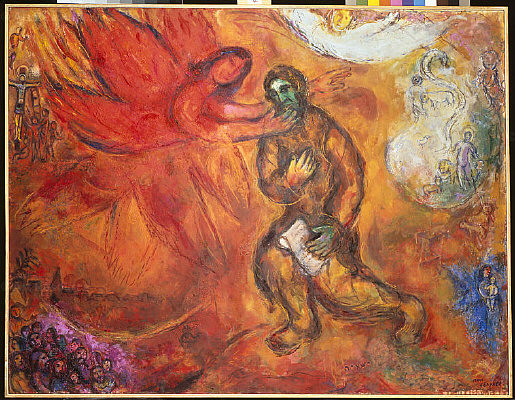
The Prophet Isaiah, by Marc Chagall,1968

The initial section of Isaiah’s prophecy is a series of oracles that establish the relationship between God and the nation of Judah, especially Jerusalem. The gist of God’s message is that the people are guilty of lots of sins.

However, the Lord left a gracious opening for them; their fate was not yet sealed. The nation could repent of their sins and experience a future restoration. God wanted to bring a resolution, and not have the people keep going in their unhealthy ways.

Throughout Isaiah’s vision, God is presented as a Father, with the children being Israel (both northern and southern kingdoms). And Father God has a complaint against them. The people’s principal sins were rebellion and ignorance. They spurned God’s authority, and did not accept their family intimacy with God.

Thus, the Lord is quite disappointed with the people. Heavenly witnesses are called to hear the charges of wrongdoing. The troubles of the nation were to be interpreted as warnings and disciplines, meant to lead them to stop and do right. Yet it seems that the warnings go unheeded by the people. It appears that God’s efforts to woo the people back are in vain.

Although the people’s continued sacrificial worship is merely done as a mere perfunctory act, and without true hearts of devotion for what is just and right, God offered them a chance to make things right, so that they could do justice and embrace righteousness.

God made it clear what it would take to repent: learn to do good; seek justice; recuse the oppressed; defend the orphan; plead for the widow. God even issued an invitation for a divine/human dialogue to happen.

Grace and cleansing from sin are possible, that is, if the people are willing and obedient, instead of remaining rebellious and refusing to do what is right, just, and good.

The nation was at a crossroads and had to make a decision. Would they choose wisely or foolishly?

Decision-making is critical. Some choices are harder than others. Yet the ability to decide is a God-given gift and ability.

Making decisions is fraught with consequences; we may try to anticipate or ignore what might happen with a particular choice. And how we go about decision-making is important. Who do we listen to? What information do we need? How will this choice shake out in the end?

Intentions are not choices, but are simply a mental resolve to do or not do something, at some point. And to not make a decision is to have already made a decision to either procrastinate or not do anything at all.

There are also decisions of duty. This may or may not be admirable. There is also the choice of attitude and energy given to the decision – because a choice of doing one’s duty can be done with joy or grumpiness, excitement or bitterness, with a bright disposition or a flat sullen affect.

It’s not really hard to guess or assess the choices of the people in Judah and Jerusalem in Isaiah’s day. They were doing an outward duty of temple worship, but without any heart to it.

Many of the people looked upon their duty as a sort of magical talisman that would ward off any trouble or army invasion. With that kind of approach, the people looked upon the rest of their time as their own, as discretionary, as the choice to do whatever they wanted to do.

If their business practices were dubious and not quite right, then big deal. After all, they give their money at the temple.

If the leaders played favorites and overlooked the needy person among them, then so what? The poor and oppressed can work harder, right?

And if orphans and widows – who were the most vulnerable persons in society – were not completely cared for, then that’s sad, but too bad for them.

I can picture an ancient city council saying something like, “We have a lot on our plate, dealing with foreign powers, the economy, and political issues. Those needy persons need to get a clue. It’s their own fault for hanging around and not leaving the city for greener pastures. Not our problem.”

Oh, but it very much was their problem. It was everyone’s problem, and each person’s responsibility, to ensure that God’s justice, goodness, and righteousness was infused throughout the entire city and nation.

Hence, the reason for the book of Isaiah. Tackle the moral and ethical problems head on before it’s too late and the gravity of judgment presses everyone out of the land.

What’s needed is a willing heart inclined to walk into divine obedience, without any talkback, and without any negotiations or deals.

God is merciful, and is willing to talk it out. But justice must be done. Needs must be met. People must be cared for. The Lord’s will must be done, here on earth, as it is always done in heaven. Is this what you are about, or not? Will you learn to do right?

Most merciful God, shine the light of your gracious love upon my cold hard heart. Enlighten my mind and dispel the darkness; speak the truth and help me obey; and have pity upon me. Forgive me yet again of my offenses, transgressions, and guilty acts. Grant me the grace to serve you with faithfulness and care for your people with love and purity, today and always. Amen.

Pentecost (John 15:26-27, 16:4b-15)

The Holy Spirit, by He Qi

“When the Advocate comes, whom I will send to you from the Father, the Spirit of truth who comes from the Father, he will testify on my behalf. You also are to testify because you have been with me from the beginning…

“I did not say these things to you from the beginning, because I was with you. But now I am going to him who sent me, yet none of you asks me, ‘Where are you going?’ But because I have said these things to you, sorrow has filled your hearts. Nevertheless, I tell you the truth: it is to your advantage that I go away, for if I do not go away, the Advocate will not come to you, but if I go, I will send him to you. 

“And when he comes, he will prove the world wrong about sin and righteousness and judgment: about sin, because they do not believe in me; about righteousness, because I am going to the Father, and you will see me no longer; about judgment, because the ruler of this world has been condemned.

“I still have many things to say to you, but you cannot bear them now. When the Spirit of truth comes, he will guide you into all the truth, for he will not speak on his own but will speak whatever he hears, and he will declare to you the things that are to come. He will glorify me because he will take what is mine and declare it to you. All that the Father has is mine. For this reason I said that he will take what is mine and declare it to you. (New Revised Standard Version)

Pentecost, by John August Swanson (1938-2021)

This is the Christian Day of Pentecost. It is often referred to as the birthday of the Church. Pentecost marks the time when the Holy Spirit came upon the fledgling believers in power. 

Pentecost is significant for Christians because it marks the age of the Spirit, the era of new spiritual life and power. Ten days after recognizing Christ’s Ascension, and fifty days after Christ’s resurrection from death, the Christian Year observes the Day of Pentecost (which literally means “fifty” in Greek). 

An implication of Pentecost is that it brings both change and stability, of being uprooted as well as deeply grounded. To experience Pentecost, it is necessary to invite change and to allow ourselves to be changed.

To live a truly spiritual life, full of the Holy Spirit, means that things will never be the same again. With the Spirit, there is a new form of consciousness, an emerging awareness of both self and the world, and new interests and commitments which are followed.

Change involves unlearning old thinking and ways of doing things, becoming uprooted and planted in fresh spiritual soil. The spiritual person will discover new, necessary, and expansive ways of living the faith of Jesus Christ in today’s topsy-turvy world.

Today’s Gospel lesson has Jesus talking to his disciples for the last time before his crucifixion and resurrection. He communicated to them that he was going away, and they were sad and confused about it all. So, Jesus assured them that they would not be alone – his presence would be with them in the person of the Holy Spirit.

Jesus made it plain that the One who is coming, the Paraclete, is the One who comes alongside and offers to the disciples a ministry of advocating, testifying, speaking truth, glorifying, and proving the world wrong about sin and righteousness and judgment.

The Spirit advocates for us and all creation. The Spirit hears our pain, moaning, and desperation, bringing it all to God in helpful language (Romans 8:26). The Spirit testifies about Jesus to us and about his ministry. The Spirit speaks truth to us whenever we go astray from the words and ways of Jesus; and so, will challenge us and provoke us to live into our majesty as people created in God’s image and redeemed by Christ’s death and resurrection.

If and when our Christian life and worship becomes a ho-hum hodge-podge of ritualistic or legalistic goo, where no spiritual growth or life transformation is happening – and worse, if it becomes characterized by injustice – then the Spirit will have something to say in regard to sin, righteousness, and judgment.

A lack of faith can take many forms. For many Christians, the separation between belief and practice is a form of apostasy. Signing off on a set of doctrinal beliefs means nothing unless it has feet and hands to it by going after those who are suffering, giving restitution for what we’ve taken, and putting the love of Christ where love is not found.

A confession of faith is hollow and useless without first having a confession of sin. Jesus did not say that people will know Christians by their doctrinal confessions and ancient creeds, but that others will know the Christian by the fruit of a life given to righteousness and justice. (Matthew 7:16)

The worldly ruler is the one who perpetuates systems of evil and oppression; and ignores poverty, hunger, and need. The ruler of this world is condemned by the Spirit because of meanness, brutality, violence, and abject greed and selfishness.

Anyone who turns the life-giving good world which God has made into a death-dealing world of ignorance, sloth, and power politics is under the judgment of the Spirit, on orders by Judge Jesus. Whenever the bent of the will is developed into only being concerned with personal happiness, while ignoring communal needs, the person is existing far from the teachings of Jesus to his disciples.

On this Day of Pentecost, and into this proper Pentecostal season, our call is to have a genuine spiritual life that allows the true self to make a difference in this old fallen world. The spiritual person seeks to tap into the Spirit and insist on caring for others without prejudice or favoritism; and will ground themselves in healthy spiritual dynamics of positive change and transformation as living sacrifices to God. (Romans 12:1-3)

With the reality of Pentecost, believers in Jesus, and the whole Church everywhere, has the full power of the Holy Spirit with them at all times. This means our ultimate trust is not in the power of authoritative positions, economic budgets, polished programs, personal ingenuity, or a consumer self-realization.

Our trust is in the name of the Lord who made heaven and earth, in Jesus Christ, God’s only Son, and in the strength of the Holy Spirit who is the continuing presence of Jesus. Such power is given for a purpose. So let us be responsible and conscientious in living the Christian life.

And may the blessing of the Spirit move you to know Jesus better, love the world more, and be the person you were created to be – to the glory of God. Amen.

It’s In the Details (Exodus 28:29-38)

Aaron the High Priest

“Whenever Aaron enters the Holy Place, he will bear the names of the sons of Israel over his heart on the breast-piece of decision as a continuing memorial before the Lord. Also put the Urim and the Thummim in the breast-piece, so they may be over Aaron’s heart whenever he enters the presence of the Lord. Thus Aaron will always bear the means of making decisions for the Israelites over his heart before the Lord.

“Make the robe of the ephod entirely of blue cloth, with an opening for the head in its center. There shall be a woven edge like a collar around this opening, so that it will not tear. Make pomegranates of blue, purple and scarlet yarn around the hem of the robe, with gold bells between them. The gold bells and the pomegranates are to alternate around the hem of the robe. Aaron must wear it when he ministers. The sound of the bells will be heard when he enters the Holy Place before the Lord and when he comes out, so that he will not die.

“Make a plate of pure gold and engrave on it as on a seal: holy to the Lord. Fasten a blue cord to it to attach it to the turban; it is to be on the front of the turban. It will be on Aaron’s forehead, and he will bear the guilt involved in the sacred gifts the Israelites consecrate, whatever their gifts may be. It will be on Aaron’s forehead continually so that they will be acceptable to the Lord. (New International Version)

This area of Holy Scripture is likely not one of the more popular places to read. Frankly, it’s boring and pedantic. Yet, contained within the Bible it is, for us to examine.

After giving Moses the Ten Commandments in Exodus 20, the next several chapters, from Exodus 20-31 contain detailed instructions from God concerning the covenant code stipulations with the Israelites. Plans for liturgical and sacrificial worship are covered with a fine tooth comb. Instructions for building implements for worship are precise.

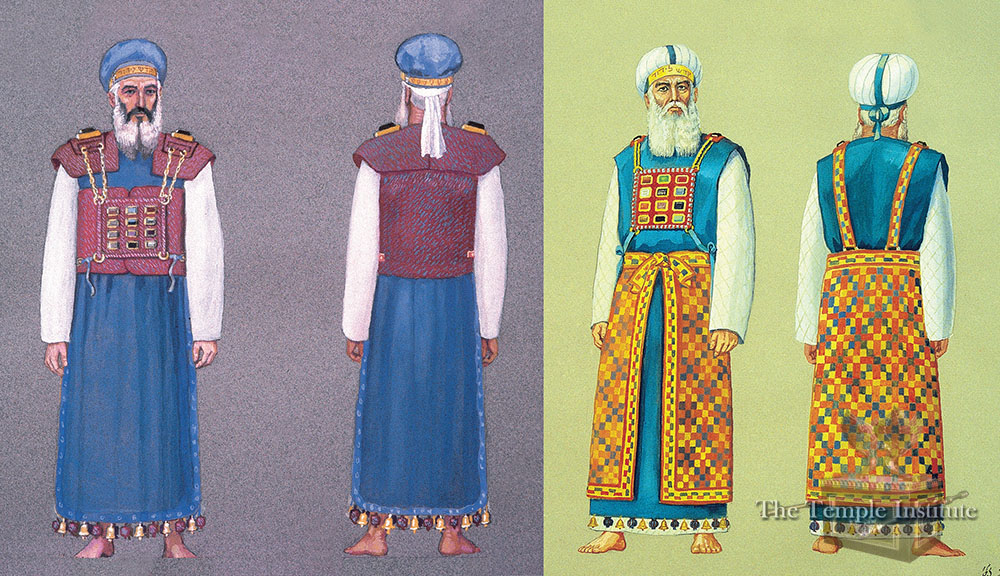
And the special garments of the priests’ clothing are described in detail, both as to their design and the material to be used. It’s as if we’re all sitting in a virtual meeting just trying to stay awake, let alone pay attention. Yet, the fact of the details lets us know that the plan is important.

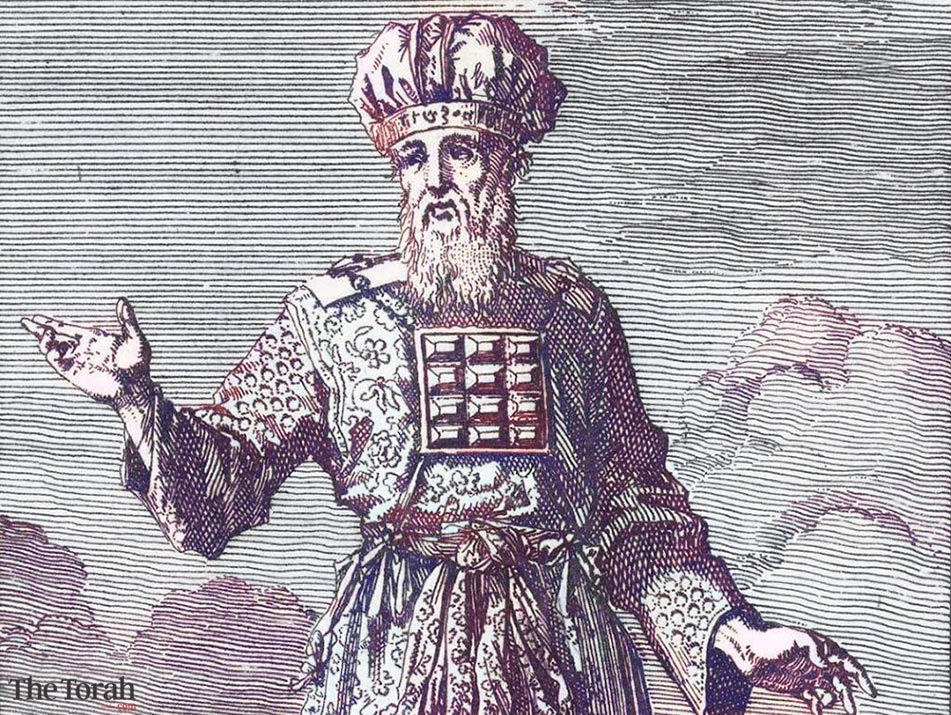
Aaron the High Priest, by Jan Luyken (1669-1712)

Today’s Old Testament lesson deals specifically with the vestments of Aaron, the first high priest of the covenant. An ephod was made – which is a richly embroidered, apron-like vestment having two shoulder straps and ornamental attachments for securing the breastplate, worn with a waistband. (Exodus 28:1-30)

The garment which Aaron was to wear, when he entered the sacred space, symbolically kept the nation of Israel in front of Yahweh, and also over the high priest’s heart.

There was a robe which covered the ephod, equipped with bells. As Aaron moved, the bells rang, signaling that he was coming into and out of the presence of God. Only the high priest was consecrated to enter the most holy place; and the high priest alone wore the special clothing for the unique service which was done.

The entire ritual of the high priest’s service was a visual display of God’s glory and of the reality that no one may enter God’s presence flippantly or carelessly. God is gracious and merciful; and God also has no tolerance for impurity, unrighteousness, and pride.

God expects divine laws, stipulations, and commands to be obeyed without prejudice. The Israelites could not pick and choose what directives from God they would do, or not do. And that is the core of what holiness before the Lord really is.

An interesting observation about this text of Scripture is that Aaron the high priest is given no instructions or commands about what to say when he entered and then left God’s presence. No mantras. No incantations or formulaic words. The inference is that Aaron was silent.

Instead, the garments spoke. “Holy to the Lord” on the plate affixed to the turban said a lot – along with the ephod and the robe, affirming that holiness is needed in order to make any sort of decisions before God.

We never get an explanation in Scripture about what the Urim and Thummim are – which is why, when translating the words from Hebrew, we merely have English transliterations of them. We only know that they were used when making decisions. Evidently, the high priest was an earthly source of God’s wisdom and direction.

Whatever we think about these verses in the book of Exodus, it seems that we are meant to understand that details matter; and how we go about our obedience, down to the last jot and tittle, matters.

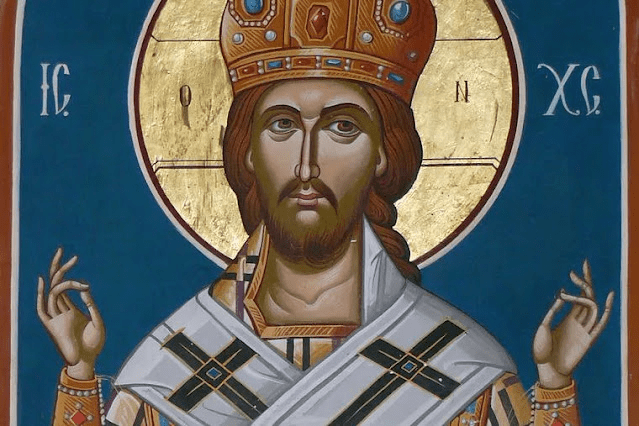
Orthodox icon of Jesus Christ, the High Priest of a New Covenant

In the ministry of Christ, there were people wondering if all of his talk was upending or replacing those detailed imperatives of God. Jesus responded:

“Do not think that I have come to abolish the Law or the Prophets; I have not come to abolish them but to fulfill them. For truly I tell you, until heaven and earth disappear, not the smallest letter, not the least stroke of a pen, will by any means disappear from the Law until everything is accomplished.” (Matthew 5:17-18, NIV)

Jesus furthermore upheld God’s expectation that divine commands be obeyed:

“Therefore anyone who sets aside one of the least of these commands and teaches others accordingly will be called least in the kingdom of heaven, but whoever practices and teaches these commands will be called great in the kingdom of heaven.” (Matthew 5:19, NIV)

At issue was the nature of righteousness – right relations with both God and others. Justice is imperative. Being humble, pure, merciful, and a peacemaker matters. The laws and directives of God are never to be used for walking around like a peacock to display what a wonderfully important and religious person you are.

In other words, the ornate garments of the high priest are not the person; they are special clothing used for a special purpose. Clothes may be important, yet it’s the heart that truly matters. And a heart devoted to God will seek to humbly obey God’s words down to the most minute detail.

O God, by whom the humble are guided, and light rises up in darkness for the godly: Grant us, in all our doubts and uncertainties about obedience, the grace to ask what you would have us to do, that the Spirit of wisdom may save us from all false choices, and that in your light we may see light, and in your straight path may not stumble; through Jesus Christ our Lord. Amen.

Remain In Me (John 15:1-8)

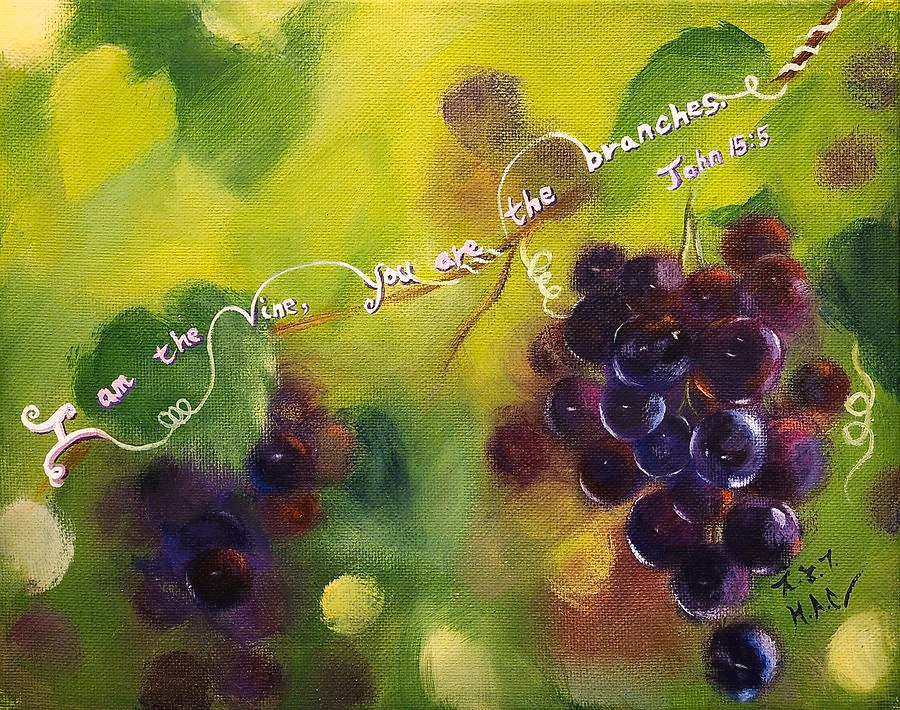
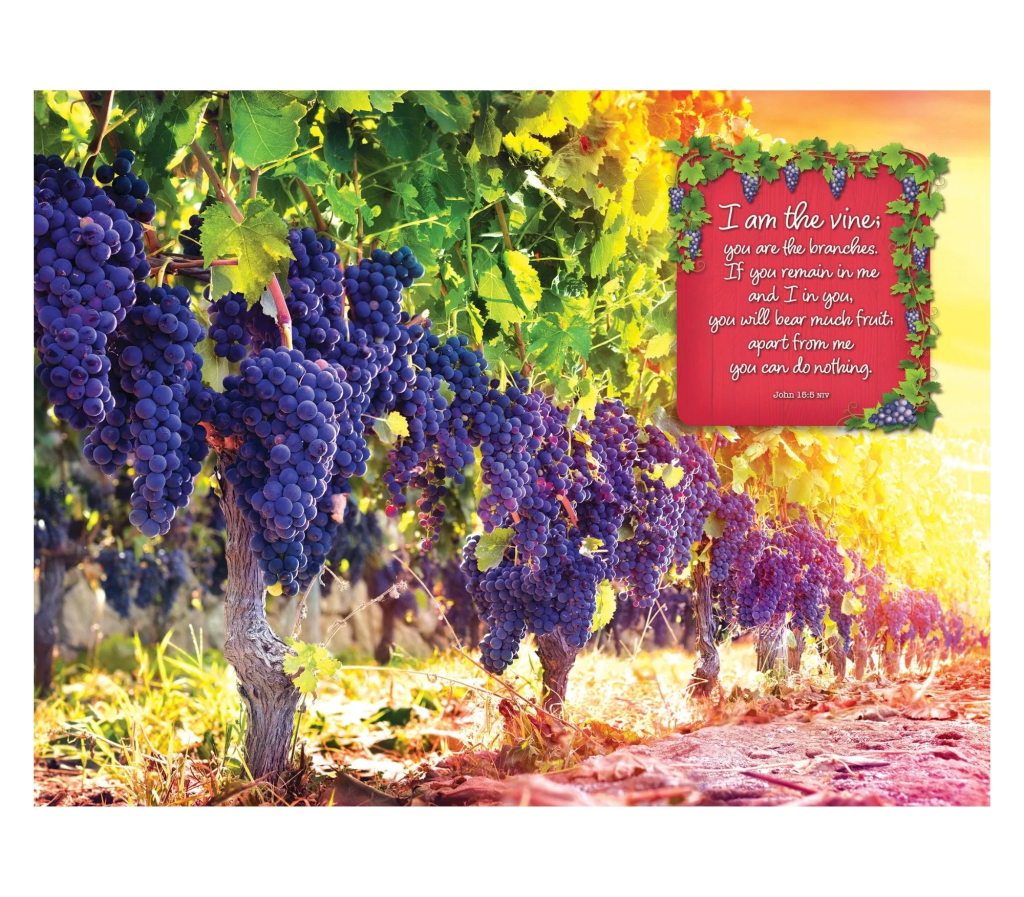
The Vine and the Branches, by Irene Thomas

I am the true vine and my Father is the gardener. He cuts off every branch in me that bears no fruit, while every branch that does bear fruit he prunes so that it will be even more fruitful. You are already clean because of the word I have spoken to you. Remain in me, as I remain in you. No branch can bear fruit by itself; it must remain in the vine. Neither can you bear fruit unless you remain in me.

I am the vine; you are the branches. If you remain in me and I in you, you will bear much fruit; apart from me you can do nothing. If you do not remain in me, you are like a branch that is thrown away and withers; such branches are picked up, thrown into the fire and burned. If you remain in me and my words remain in you, ask whatever you wish, and it will be done for you. This is to my Father’s glory, that you bear much fruit, showing yourselves to be my disciples. (New International Version)

In the New International Version of the Bible, the word “remain” is repeated 8 times in 8 verses. The original Greek word translated as “remain” is μένω (pronounced “men-oh”). It means to linger in the present moment; to be mindful to ourselves and our situations; to stay connected.

Remaining with Jesus means we that have continual unbroken connection of unity and fellowship with him.

In order to have a connection, there must be two ends to connect. The Jesus connection is always there. We are the other connection. And, frankly, we can be flaky – pulling away and coming close – which is why Jesus gave a repeated invitation to keep the connection.

Some other translations of John 15:4 may help to fill out an understanding of this invitation to remain in Christ (emphasis mine):

Stay joined to me, and I will stay joined to you. Just as a branch cannot produce fruit unless it stays joined to the vine, you cannot produce fruit unless you stay joined to me. (CEV)

Live in me, and I will live in you. A branch cannot produce any fruit by itself. It must stay attached to the vine. In the same way, you cannot produce fruit unless you live in me. (GW)

Abide in Me, and I in you. As the branch cannot bear fruit of itself, unless it abides in the vine, neither can you, unless you abide in Me. (NKJV)

Stay connected to me, and I will stay connected to you! A branch cannot produce fruit on its own but only if it has a vital connection to the vine. In the same way, there’s no way you can produce fruit at all, unless you have a meaningful connection with me. (my own translation)

The task of every Christian is to remain connected to Jesus. So, the question is: How do we keep the connection without breaking it? How can we be fruitful?

Focus on the Relationship

Christianity, at its core, is a living relationship with Jesus. Yes, doctrine is important; and it’s necessary to know the basic tenets of Christian faith. Yet, any knowledge we gain about Christianity is to be channeled into developing the relationship.

By Helian Cornwell

Bible trivia is only as good as the understanding we apply to build the relationship. Knowledge makes us proud of ourselves, while love makes us helpful to others. Knowledge makes us feel important, yet love strengthens the Church. Knowledge puffs up but love builds up. (1 Corinthians 8:1)

Christ’s redemption – his incarnation, holy life, death, resurrection, and ascension – are meant to restore the severed relationship with humanity. Only knowing doctrinal truth is not the same as using the doctrines to connect with God in a loving relationship.

It takes planning, dedication, time, and effort to grow and maintain our relationship with Jesus Christ. If we fail to use our time and energy on that relationship, then the leaves on the branch begin to wither.

Scripture, silence, solitude, community, prayer, giving, and fasting have always been at the center of Christian practices designed to put us in a position to hear and receive from God.

Relate Well to the Other Branches

The Church is a living growing community. Christ and the Church have a vital union with each other. I used to live in a place where there was a tree that had grown up next to an old fence post. The tree grew tall and engulfed the post to the degree that now you can only see part of the fence post.

To remove the post, you would have to remove the tree; the two have become one. Not only are we connected to the trunk, but we’re also connected to each other. We are all part of the same vine; we aren’t separate vines. So, we all need to do our part in the vine’s system.

Keep Close to the Vine

My grandmother had a grapevine in her backyard when I was a kid. I have firsthand understanding that the sweetest, juiciest, biggest, and best tasting grapes are found in the middle, securely next to the vine’s stem.

The sour grapes are found at the end of the branches. Show me a sourpuss Christian, and I’ll show you a Christian who is not close to Christ. Show me a sweet Christian and I’ll show you a believer who daily works at their close connection with Jesus.

Pruning is Necessary

Healthy vines need pruning, at least once a year; ideally, twice a year, in the Spring before budding, and in Autumn, after the harvest. Without pruning, the vine’s ability to produce good and abundant grapes is compromised. The grapevine’s branches need to be kept short because the nutrients are concentrated in and near the vine stem.

Pruning hurts. From the perspective of us branches, pruning feels like judgment. But it isn’t. Even though pruning is painful, it makes us healthier and tastier.

It’s better to do a few things well, rather than try and do a lot of things for which there is limited time and energy. So, do some spiritual pruning twice a year!

Know Why You are Connected

Yes, Christians have a connection with Jesus so that we are saved from sin, death, and hell. And, yes, we are connected to experience abundant life. Yet, the goal of that connection is to produce succulent fruit.

If there are no grapes on the vine, the vine is useless. Grapevines exist to produce grapes. Christians and Churches exist for the life of the world, to produce the fruit of righteousness consistent with our Christ-connected union: love, joy, peace, patience, kindness, goodness, faithfulness, gentleness, and self-control. (Galatians 5:22-23)

The Church is not an end in itself, but exists for the life of the world. Using other metaphors, Jesus said:

“You are the salt of the earth. But if the salt loses its saltiness, how can it be made salty again? It is no longer good for anything, except to be thrown out and trampled underfoot.

“You are the light of the world. A town built on a hill cannot be hidden. Neither do people light a lamp and put it under a bowl. Instead, they put it on its stand, and it gives light to everyone in the house. In the same way, let your light shine before others, that they may see your good deeds and glorify your Father in heaven.” (Matthew 5:13-16, NIV)

Pray

If we live in union with Christ – with the words and ways of Jesus powerfully within us—then ask for anything, and it will be done. Prayer is both an event that anyone can do, as well as a spiritual practice that needs growth and development.

The words of Jesus are the nutrients for our spiritual life. When those words find a home within us, there is a divine/human conversation. Christ promises that if we just ask, we’ll receive.

As the relationship with Christ grows, we learn to be thoughtful about our asking. Flippantly or selfishly asking for things disrespects the connection we enjoy with God. Claiming or demanding answers to prayer demeans the relationship. We can also dishonor God by simply not asking, at all.

Prayer is the delivery system for receiving our nutrients; and is also the means of delivering fruitful blessing so that the world might live. Jesus modeled a prayer for us that is grounded in connection and unity with the Father:

I am not praying just for these followers. I am also praying for everyone else who will have faith because of what my followers will say about me. I want all of them to be one with each other, just as I am one with you and you are one with me. I also want them to be one with us. Then the people of this world will believe that you sent me.

I have honored my followers in the same way that you honored me, in order that they may be one with each other, just as we are one. I am one with them, and you are one with me, so that they may become completely one. Then this world’s people will know that you sent me. They will know that you love my followers as much as you love me.

Father, I want everyone you have given me to be with me, wherever I am. Then they will see the glory that you have given me, because you loved me before the world was created. Good Father, the people of this world don’t know you. But I know you, and my followers know that you sent me. I told them what you are like, and I will tell them even more. Then the love that you have for me will become part of them, and I will be one with them. (John 17:20-26, CEV)

We must live and pray consistent with who we are, and what our mission is. The Church is to be one as God is One. Christians are to pray for unity because the triune God is always united. Believers everywhere need to remain in Christ through a vital connection of loving God and loving their neighbors. Amen.